
California law protects you from employer retaliation once you report discrimination, harassment, wage violations, or other unlawful conduct. If you believe you have experienced retaliation, you may have options that include filing a CRD intake, requesting a right-to-sue notice for FEHA-covered claims, or pursuing remedies under statutes such as FEHA or Labor Code § 1102.5, depending on the facts and the type of protected activity involved. Start now by documenting what happened, preserving your records, and considering a consultation with an employment attorney.
TL;DR:
- Most retaliation claims rely on evidence of timing and pattern, with subtle workplace changes becoming more suspicious if occurring after protected activity.
- Documentation, including emails, schedules, and notes, is crucial to establish a clear timeline and support circumstantial evidence of retaliation.
- The three-year deadline to file a CRD intake form emphasizes the importance of early action and ongoing record keeping.
- Employers must have known about your protected activity for retaliation liability to apply; anonymous reports may weaken your case without evidence of employer awareness.
- Consulting an attorney early helps evaluate the strength of your claim, organize evidence, and navigate complex procedural rules without risking missed deadlines.
Table of Contents
- What Are Glendale Employees’ Rights After Workplace Retaliation: Protected Activity Explained
- The Three Elements of a California Retaliation Claim
- Common Signs of Retaliation Glendale Employees Should Watch For
- How to Document and Preserve Evidence After Suspected Retaliation
- What Remedies Are Available After Workplace Retaliation
- Deadlines You Cannot Afford to Miss
- When to Consult an Employment Attorney
- California United Law Group: Practice Focus and Firm Background
- Beyond FEHA: Other California Protections Glendale Workers Should Know
- Retaliation Tactics Common in Glendale Workplaces
- What to Expect From Internal Complaint Processes
- Risks and Consequences to Understand Before Filing a Claim
- Our Take: Document First, File Smart, Then Get Counsel Involved
- Talk to California United Law Group About Your Situation
- Sources
What Are Glendale Employees’ Rights After Workplace Retaliation: Protected Activity Explained
Before you can build a retaliation claim, you need to know whether what you did actually counts as “protected activity” under California law. This is the foundation of every retaliation case, and it’s broader than most Glendale workers realize.
California’s Fair Employment and Housing Act (FEHA) protects employees who oppose or participate in proceedings involving FEHA-prohibited practices, while Labor Code § 1102.5 protects employees who disclose information about, or refuse to participate in, suspected violations of law, rules, or regulations. Labor Code §1102.5 specifically bars employers from adopting internal rules that stop workers from reporting violations, and it makes retaliation for that reporting illegal, with civil penalties reaching up to $10,000 per employee in some cases.
Protected activity generally includes:
- Reporting discrimination or harassment to a supervisor, HR, or a government agency
- Participating in a workplace investigation, whether as a witness or a complainant
- Requesting reasonable accommodation for a disability or religious practice
- Refusing to follow a directive you reasonably believe is unlawful
- Contacting a government agency, regulatory body, or other legally protected reporting channel about suspected violations
- Assisting a coworker who is filing their own complaint
One detail surprises a lot of employees: you don’t need to be right about the underlying violation for your activity to be protected. California courts recognize that an employee may be protected from retaliation even if the opposed conduct is later found not to violate FEHA, as long as the employee reasonably and in good faith believed the conduct was unlawful. In Miller v. Department of Corrections, the California Supreme Court explained that this protection can apply when an employee reasonably and in good faith believes they are opposing unlawful employer conduct. A jury typically decides whether that belief was objectively reasonable.
There’s a catch that trips up many claims before they start: your employer has to have known about your protected activity for retaliation liability to attach. If you reported a safety issue anonymously and no one in management ever connected it to you, it’s difficult to argue they retaliated against you for something they didn’t know you did. This is why keeping a record of who you told, and when, matters as much as documenting what happened afterward.
If you’re a whistleblower specifically, the protections run even deeper. Our overview of Glendale whistleblower rights breaks down how these protections apply when you’re reporting suspected fraud, safety violations, or legal noncompliance at work.
The Three Elements of a California Retaliation Claim
Every retaliation claim in California rests on three legal pillars, and understanding them helps you assess whether what happened to you fits the legal definition, not just the emotional one.
First, you need protected activity, the conduct described above. Second, you need an adverse employment action, something your employer did that negatively affected your job. Third, you need a causal connection between the two. For FEHA retaliation claims, California jury instructions identify three core elements: protected activity, an adverse employment action, and a causal link between the two. The employer’s knowledge of the protected activity is also critical because retaliation requires a connection between what the employee did and the employer’s response.
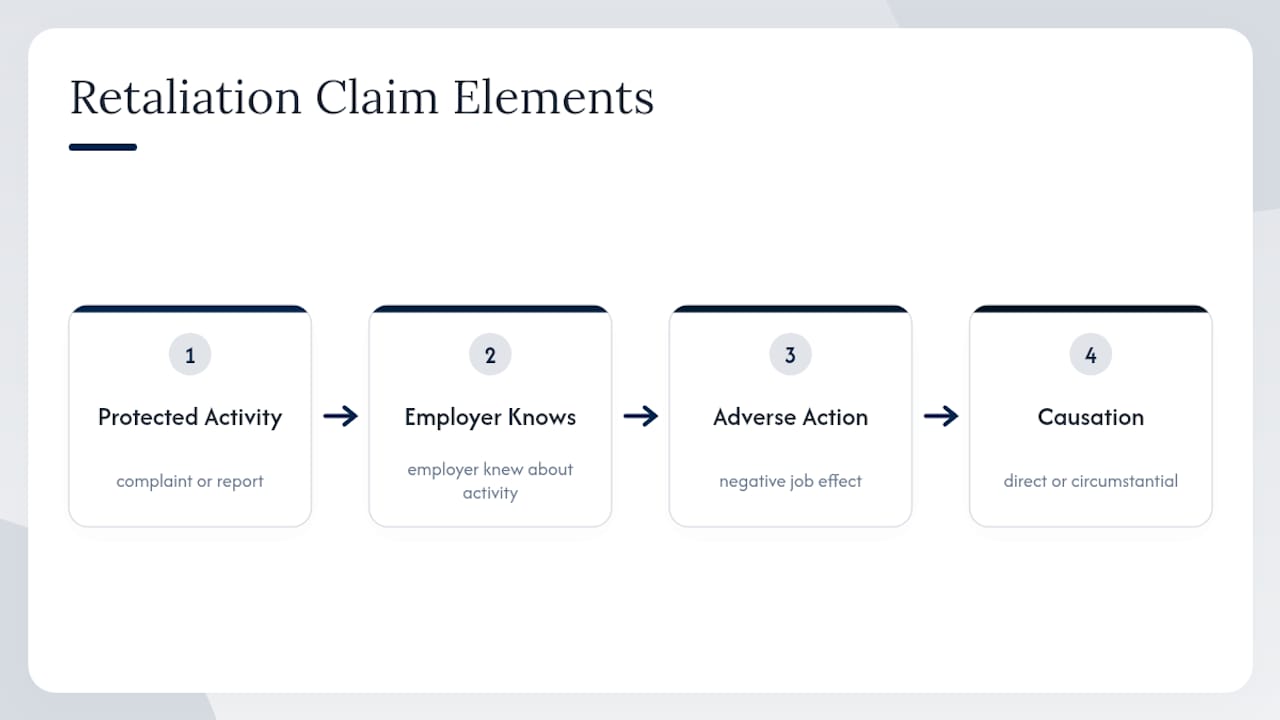
Causation is usually the hardest element to prove, and it’s where evidence quality matters most. Direct evidence includes something explicit, a supervisor saying “you wouldn’t be losing your bonus if you hadn’t filed that complaint,” or an email that spells out the connection. This kind of evidence is rare. Most retaliation cases rely on circumstantial evidence instead.
Circumstantial evidence builds the picture piece by piece. Timing is often an important piece of circumstantial evidence: if you were a strong performer for a substantial period and were terminated shortly after reporting harassment, that timing may support an inference of retaliation, especially when paired with inconsistent explanations, changed treatment, or evidence that the employer’s stated reason is pretextual. Changed treatment matters too. Were you suddenly excluded from meetings you used to attend? Did your manager start documenting minor issues that were never flagged before? Was a coworker who didn’t file a complaint treated more favorably in a comparable situation?
Neither courts nor administrative bodies require a single, dramatic act of retaliation to find liability. The totality of the circumstances often carries more weight than any one incident. A pattern of small slights, missed promotions, exclusion, sudden scrutiny, can combine to show retaliation even when no individual act would be enough on its own. California courts recognize that a series of subtle but damaging retaliatory acts may collectively amount to an adverse employment action. In Yanowitz v. L’Oreal USA, Inc. (2005) 36 Cal.4th 1028, the California Supreme Court explained that courts should consider the workplace context and the cumulative effect of the employer’s conduct.
This is why documentation from the earliest possible moment matters so much. A claim built on a pattern needs dates, details, and context, not just a memory of feeling targeted.
California retaliation law is highly fact-specific. In Yanowitz v. L’Oreal USA, Inc. (2005) 36 Cal.4th 1028, the California Supreme Court recognized that a series of retaliatory acts may be considered together when evaluating whether an employee suffered an adverse employment action. For whistleblower claims under Labor Code § 1102.5, Lawson v. PPG Architectural Finishes, Inc. (2022) 12 Cal.5th 703 explains that the employee must show the protected activity was a contributing factor in the challenged employment action; the burden then shifts to the employer to prove by clear and convincing evidence that it would have taken the same action for legitimate, independent reasons.
Common Signs of Retaliation Glendale Employees Should Watch For
Retaliation doesn’t always look like a termination notice. It often shows up as a series of smaller, quieter changes that build over weeks or months. Recognizing the pattern early gives you a better chance to document it while the details are still fresh.
- Termination or demotion shortly after you reported an issue or participated in an investigation.
- Reduced hours or schedule changes that cut into your income without a stated business reason.
- Exclusion from meetings you previously attended as a regular part of your role.
- Sudden negative performance reviews after a history of positive or neutral evaluations.
- Removal of job duties or responsibilities, sometimes framed as a “restructuring.”
- Increased scrutiny or write-ups for conduct that was previously overlooked or tolerated.
- Constructive discharge, where working conditions become so intolerable that a reasonable employee in the same position would feel compelled to resign.
Individually, some of these might have an innocent explanation. Together, especially when they start shortly after you engage in protected activity, they form a pattern worth documenting. Watch for disparate treatment too: if coworkers who didn’t complain about anything are getting the benefit of the doubt while you’re suddenly under a microscope, that inconsistency is worth noting.
Pro Tip: Keep a simple, dated log every time something changes at work after you report an issue. Even a two-line note (“March 3: excluded from weekly team meeting, first time in 2 years”) builds a timeline that’s far more persuasive than trying to reconstruct events months later from memory.
For a deeper look at how these patterns play out in real workplaces, our guide on signs of employer retaliation walks through additional examples California workers commonly report.
How to Document and Preserve Evidence After Suspected Retaliation
The strength of a retaliation claim often comes down to the quality of the paper trail behind it. This isn’t about building a legal strategy. It’s about preserving what already exists before it disappears.
Start with anything in writing. Emails, text messages, Slack or Teams messages, and any written communication tied to the adverse action are worth saving in a format outside your work devices, since access to those accounts can end abruptly. Personnel actions matter too: written warnings, performance improvement plans, schedule changes, and payroll records that show reduced hours or pay all help establish a timeline.
Useful evidence to gather includes:
- Copies of emails, texts, or messages related to your complaint or the adverse action
- Written warnings, disciplinary notices, or performance improvement plans
- Pay stubs or schedules showing changes in hours or compensation
- Names and contact information of coworkers who witnessed relevant events
- Your own contemporaneous notes describing what happened, when, and who was present
Keep notes as close to real time as possible. A note written the same day you were excluded from a meeting carries more credibility than a reconstruction written six months later during a legal consultation. Include the date, what happened, who was involved, and whether you reported it internally, and to whom.
One caution deserves direct attention: don’t record conversations without confirming it’s legal to do so. California generally requires consent from all parties to a private conversation, and an unlawful recording can create legal exposure of its own. Stick to preserving evidence that already exists in writing, and consult an attorney before taking any step that feels aggressive or intrusive.
Pro Tip: Save copies of documents you are lawfully allowed to keep, such as your own complaint, disciplinary notices, schedules, pay records, or written communications sent to you. Do not take confidential, privileged, trade secret, or proprietary company materials without first getting legal advice. Losing access to your work account the day you’re terminated is common, and it can wipe out evidence you didn’t realize you needed to save.
What Remedies Are Available After Workplace Retaliation
Employees who successfully establish retaliation in California have access to both administrative and civil remedies, and understanding the difference helps set realistic expectations.
The administrative path starts with the California Civil Rights Department (CRD). CRD’s public guidance is direct on this point: firing an employee for filing a CRD complaint is illegal retaliation, and the agency can investigate that conduct. When you submit an intake form, CRD may investigate the allegations, attempt resolution, or issue a right-to-sue notice that allows you to pursue the matter in civil court. Some FEHA claims require this administrative step before you can file a lawsuit, which is why timing your intake matters as much as the underlying facts.
If your case proceeds to civil court, either after a right-to-sue notice or under a statute that doesn’t require administrative exhaustion, the available remedies typically include:
- Reinstatement to your former position, where appropriate
- Back pay for wages and benefits lost due to the retaliatory action
- Compensatory damages, which may include financial losses and emotional distress damages where legally available and supported by the evidence
- Statutory civil penalties, including penalties available under Labor Code §1102.5 in qualifying cases
The Department of Industrial Relations also maintains intake forms and resources for related wage and labor complaints, since retaliation sometimes overlaps with wage and hour violations, particularly when an employee reported unpaid overtime or missed meal breaks before facing adverse treatment.
Every one of these remedies depends heavily on the specific facts of your case, the strength of your evidence, and which legal theory applies. This overview is educational, not a promise of what any individual case will yield. Our broader guide to retaliation rights and legal options in California covers how these remedies interact with different types of claims.
Deadlines You Cannot Afford to Miss
Timing rules in employment retaliation cases are strict, and missing a deadline can permanently close off your ability to pursue a claim, regardless of how strong the underlying facts are.
For FEHA-related retaliation claims, one key deadline is the three-year window to submit a CRD intake form, measured from the date of the last alleged retaliatory act. Other retaliation claims, including some Labor Code claims, may have different deadlines and procedures. That three-year clock is longer than many employees expect, but it’s not a reason to wait. Evidence degrades, witnesses change jobs or lose memory of specifics, and email retention policies can quietly erase records you’ll need later.
Key procedural points to understand:
- CRD intake deadline: three years from the date of the last alleged retaliatory act for FEHA-covered claims.
- Right-to-sue notice: CRD may investigate your intake and, depending on the outcome, issue a right-to-sue letter that allows you to file a civil lawsuit.
- Administrative exhaustion: some claims require you to go through CRD before a court will hear the case, so skipping this step can derail litigation later.
Because the process has multiple moving parts, and because Labor Code § 1102.5 whistleblower claims follow a different legal framework than FEHA retaliation claims, it is worth getting an early read on your situation rather than assuming every deadline or procedure is the same. Early administrative intake or a consultation with counsel doesn’t commit you to litigation. It simply preserves your options while the facts are still fresh and your evidence is still intact.
When to Consult an Employment Attorney
Not every workplace conflict requires a lawyer, but certain patterns are strong signals that it’s time to get a professional opinion before more time passes.
Consider reaching out to an attorney if you were terminated shortly after filing a complaint or participating in an investigation, if you’re seeing a pattern of adverse actions rather than a single isolated incident, if your evidence feels complicated or scattered across multiple sources, or if you’re approaching a filing deadline and aren’t sure which one applies to your situation.
An employment attorney does more than file paperwork. A qualified attorney can evaluate whether your situation meets the legal elements of a retaliation claim, help you organize and preserve evidence before it’s lost, handle the CRD intake process on your behalf, and negotiate with your employer or represent you in litigation if the matter doesn’t resolve informally. That evaluation matters because not every uncomfortable workplace experience meets the legal bar for retaliation, and an honest assessment early on saves you from investing time and stress into an intake that may not fit your facts.
Kenneth A. Seligson and the team at California United Law Group consult with employees facing retaliation, wrongful termination, discrimination, harassment, and related workplace issues. A consultation isn’t a promise of a particular outcome. It’s a chance to get a clear-eyed read on where you stand. If you were fired shortly after reporting a violation, our resource on what to do if you were fired after reporting violations offers additional context on your options.
California United Law Group: Practice Focus and Firm Background
California United Law Group represents California employees in workplace disputes, including FEHA claims, Labor Code violations, wrongful termination, and retaliation. The firm handles cases from the earliest pre-litigation stage, including CRD intake and negotiation, through full litigation when a matter doesn’t resolve informally.
For Glendale employees specifically, this means access to attorneys who understand both the statewide legal framework and the practical realities of how retaliation plays out in local workplaces, from corporate offices to retail and service industries common throughout the area. If you’re trying to figure out whether your situation warrants formal action, a conversation with the firm is a reasonable first step, not a commitment to litigation.
Beyond FEHA: Other California Protections Glendale Workers Should Know
FEHA and Labor Code §1102.5 aren’t the only statutes standing between Glendale employees and retaliatory employers. California’s labor code includes a patchwork of additional protections that often apply depending on the type of complaint you raised.
Labor Code §98.6 protects employees who file wage claims or testify in wage-related proceedings from retaliation. Labor Code §6310 protects workers who raise workplace safety concerns, including complaints made informally to a supervisor about a hazardous condition, not just formal OSHA filings. Retaliation related to protected leave, including leave under California family, medical, or paid sick leave laws, may also trigger separate protections depending on the facts, the employer, and the type of leave involved.
These overlapping statutes matter because a single set of facts can sometimes support multiple legal theories. An employee who was fired after reporting unsafe machinery, for example, might have a claim under both Labor Code §1102.5 and Labor Code §6310, depending on how the complaint was framed and to whom it was made. Sorting through which statutes apply to your specific facts can help identify the strongest available legal theory and avoid overlooking deadlines or procedures that may apply.
Retaliation Tactics Common in Glendale Workplaces
Glendale’s local workforce includes employees in entertainment and media, healthcare, retail, hospitality, and small to mid-sized professional offices, and retaliation concerns can look different depending on the setting.
In corporate and media environments, retaliation often shows up as sudden exclusion from projects or a shift toward remote or less visible assignments after an employee raises a concern. In healthcare and retail settings, retaliation more frequently appears as schedule manipulation, cutting hours, assigning undesirable shifts, or transferring an employee to a less favorable location under the guise of “business needs.”
Smaller professional offices sometimes rely on a subtler tactic: creating a sudden paper trail. An employee with years of positive reviews starts receiving documented criticism almost immediately after filing a complaint, criticism that appears designed to justify a later termination rather than reflect any real change in performance. This pattern deserves its own mention: a sudden shift from positive reviews to progressive discipline after protected activity may become important evidence, especially if the employer later relies on that paper trail to justify termination. That’s precisely why your own contemporaneous notes, showing what your performance record looked like before you complained, carry real weight if the employer’s documentation suddenly shifts afterward.
What to Expect From Internal Complaint Processes
Many Glendale employers, particularly those with formal HR departments, have an internal complaint process that employees may choose to use before or alongside an external filing. Understanding what that process typically looks like helps you know what to expect, and what to document along the way.
A typical internal process starts with a report to a direct supervisor, HR, or through an anonymous hotline if the company has one. From there, expect an acknowledgment of the complaint, followed by some form of investigation, interviews with relevant witnesses, and a review of related records. The timeline varies widely; some companies resolve internal complaints in a couple of weeks, while others take considerably longer, especially if the allegations are complex.
Be realistic about what internal processes can and cannot do. HR’s role is to act on behalf of the company, not as your personal advocate, even when individual HR staff are genuinely trying to be fair. An internal investigation might conclude that no policy violation occurred, even if you continue to experience adverse treatment afterward. That outcome doesn’t mean your rights end there. It often means the next step is an external filing with CRD or a conversation with an attorney about your options.
Document every step of the internal process: who you spoke with, what was said, and any follow-up you received. That record becomes part of your evidence if the matter later moves to a CRD intake or litigation.
Risks and Consequences to Understand Before Filing a Claim
Pursuing a retaliation claim is a legitimate exercise of your legal rights, but it’s worth understanding realistically what the process can involve before you begin.
Retaliation claims are fact-specific, and outcomes vary significantly based on the strength of the evidence, the credibility of witnesses, and how clearly the timeline connects your protected activity to the adverse action. Not every uncomfortable workplace experience meets the legal threshold, and a claim that lacks sufficient evidence may not succeed, regardless of how genuinely unfair the situation felt.
There’s also a practical reality to consider: filing a complaint, whether internally or through CRD, can change workplace dynamics while your employment continues, if you’re still employed at the time. Some employees experience additional friction during an active complaint or investigation, which is itself illegal if it constitutes further retaliation, but it underscores why documentation should continue throughout the process, not just at the start.
Litigation, if a case proceeds that far, can take time. Settlement, trial, and appeal timelines vary considerably, and no attorney can guarantee a particular result or timeline. Weighing these realities against your own circumstances, financial, emotional, and professional, is part of deciding whether and when to move forward. A consultation with an attorney can help you understand the likely path forward for your specific facts, without you having to guess at what a claim will demand of you.
Our Take: Document First, File Smart, Then Get Counsel Involved
The conventional advice on workplace retaliation tends to jump straight to “talk to a lawyer,” and while that’s not wrong, it skips a step that actually determines how strong your case will be by the time you get there. The strongest documented claims are not necessarily the ones where employees react fastest. They’re the ones who document consistently from the moment something feels off, well before they’ve decided whether to file anything at all.
We’d push back gently on the idea that CRD intake and legal representation are competing paths. They’re not. The three-year CRD window should not be treated as extra time to wait. It is better to preserve evidence early, evaluate deadlines promptly, and avoid letting witness memories, emails, or records disappear. What we see go wrong most often isn’t employees waiting too long to file. It’s employees who file or resign in the heat of the moment, without a written timeline, and then struggle to reconstruct the pattern that made their situation retaliatory rather than just unpleasant.
Prioritize the paper trail. Everything else, intake forms, deadlines, legal theories, works better once that record exists.
— California United Law Group
Talk to California United Law Group About Your Situation
If you’re weighing whether to file a CRD intake on your own or bring in legal help, California United Law Group may handle qualifying employment cases on a contingency fee basis, meaning attorney’s fees are owed only if the case results in a settlement or award. Case costs and fee terms depend on the written fee agreement, so prospective clients should review those terms carefully before signing. That changes the calculation for a lot of Glendale employees who are hesitant to spend money on a lawyer while they’re already dealing with reduced income from retaliation.
The firm’s practice centers on FEHA and Labor Code claims, including wrongful termination, retaliation, discrimination, and harassment, and represents employees from the first consultation through litigation if a case doesn’t resolve earlier. If your situation involves a pattern of adverse actions, a termination shortly after a complaint, or a deadline you’re not sure how to calculate, a conversation with Kenneth A. Seligson and the team can clarify where you stand. To learn more about the litigation process itself, our overview of the employment lawsuit process walks through what to expect if your case moves beyond the administrative stage.
Schedule a free consultation to go over your specific facts and deadlines. A consultation does not guarantee representation or any particular result.
This article is general information, not a substitute for advice from a qualified lawyer. Consult a qualified legal professional about your own circumstances before acting on anything here.