
Employer actions that punish an employee for legally protected workplace activity can be unlawful under California law. If you work in Culver City and your employer demoted you, cut your hours, reassigned you to a worse role, or subjected you to conduct that would discourage a reasonable employee from reporting legal violations, those actions may constitute illegal retaliation under FEHA, Labor Code § 1102.5, or other California workplace laws.
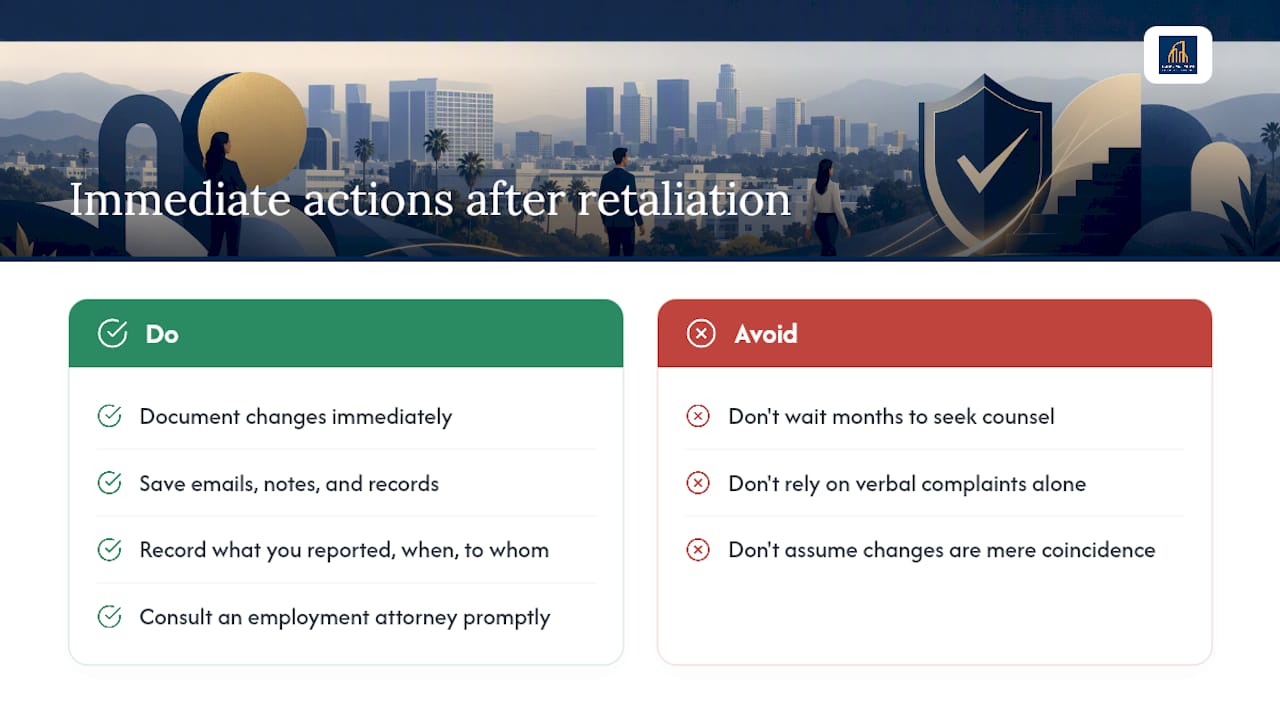
Take these steps right away to protect your rights:
- Preserve all evidence. Save emails, texts, performance reviews, and any written communications related to your complaint and the employer’s response.
- Write down a timeline. Record dates, what you reported, who was present, and what changed afterward.
- Request your personnel file. Request your personnel file in writing. California Labor Code § 1198.5 generally gives employees the right to inspect and receive copies of personnel records, subject to statutory procedures and timing rules.
- Contact an employment attorney. Administrative filing deadlines are real and can be short; consulting counsel early helps you understand your options before time runs out.
This article is general educational information, not legal advice, and reading it does not create an attorney-client relationship. Employment law issues are fact-specific, deadlines vary, and outcomes are never guaranteed. Consult a qualified California employment attorney for guidance on your situation.
Table of Contents
- What legally counts as retaliation in Culver City and California
- Common illegal employer actions after you speak up
- Which California laws and agencies protect you, and when to use each
- Where to file and what deadlines apply to your retaliation claim
- How a Culver City employment attorney can help you
- Key Takeaways
- A practitioner’s perspective from California United Law Group
- California United Law Group is ready to help Culver City employees
- Official agencies and primary sources for further information
What Legally Counts As Retaliation In Culver City And California
As a practical screening framework, retaliation claims usually focus on three core issues: protected activity, adverse employment action, and a causal connection between the two. At trial, a plaintiff must also prove legally recognized harm and that the employer’s conduct caused that harm. In many retaliation claims, you do not have to prove that the underlying violation actually occurred. The key question is often whether you engaged in protected activity, such as opposing conduct you reasonably believed was unlawful or disclosing information you had reasonable cause to believe showed a legal violation.
Protected activity covers a wide range of conduct, depending on the statute involved. Under FEHA, it includes opposing discrimination or harassment, requesting a reasonable accommodation, or participating in an investigation or proceeding. Under Labor Code § 1102.5, it includes disclosing information about suspected legal violations to a supervisor, government agency, or law enforcement, as well as refusing to participate in activity you reasonably believe is unlawful. Verbal complaints and internal reports can both qualify.
Adverse action means a materially negative change in your employment. Termination is the clearest example, but courts also recognize demotions, pay cuts, schedule reductions, materially worse assignments, retaliatory discipline, and patterns of conduct that would discourage a reasonable employee from engaging in protected activity.
Causation is often shown through timing. When an employer takes action shortly after learning of a protected complaint, timing can support an inference of retaliation, especially when combined with other evidence such as shifting explanations, changed documentation, or different treatment from comparable employees. For FEHA discrimination- and harassment-related retaliation claims, the California Civil Rights Department (CRD) generally handles complaints involving covered private and public employers with five or more employees, subject to statutory exceptions.
Common Illegal Employer Actions After You Speak Up
Recognizing retaliation in your own workplace is often the hardest part. Employers rarely say outright that they are punishing you for a complaint. The adverse action usually arrives dressed as a performance issue, a restructuring, or a policy change.
Common adverse actions that California courts treat as potential retaliation include:
- Constructive discharge, where working conditions become so intolerable that a reasonable person would feel forced to resign. If proven, a resignation under those conditions may be treated as a termination.
Here are a few hypothetical Culver City examples that illustrate these patterns: A production coordinator at a local entertainment company reports unpaid overtime, then finds her shifts cut and her name removed from project rosters within two weeks. A warehouse worker at a Culver City distribution center files a safety complaint with HR, and his supervisor begins issuing written warnings for minor infractions that were previously ignored. A tech employee at a Culver City firm raises concerns about discriminatory hiring practices and is abruptly reassigned to a role with no advancement path.
Timing and documentation changes are often important sources of circumstantial evidence. When an employer’s written record of an employee suddenly shifts after a complaint, that shift is worth preserving carefully.
Which California Laws And Agencies Protect You, And When To Use Each
Multiple statutes and agencies can apply to a single retaliation situation. The right filing route depends on the nature of your protected activity and the remedy you are seeking.
| Agency / Law | Typical Claims Handled | Key Filing Note |
|---|---|---|
| CRD / FEHA | Retaliation for opposing discrimination, harassment, or requesting accommodation | File with CRD within the applicable FEHA administrative filing deadline; a right-to-sue notice is generally required before filing a civil FEHA lawsuit. Confirm the current deadline before relying on it. |
| California Labor Commissioner | Retaliation for wage complaints, reporting Labor Code violations | File a Retaliation Complaint (DLSE-1); separate administrative process |
| Labor Code § 1102.5 | Whistleblower disclosures to supervisors, government agencies, or refusals to participate in illegal acts | May be pursued through civil litigation and, in some circumstances, administrative procedures depending on the claim; California law creates a rebuttable presumption for certain adverse actions occurring within 90 days of protected activity. Confirm the proper route and deadline before filing. |
| NLRB | Retaliation for concerted activity, union organizing, or group complaints about working conditions | File an unfair labor practice charge with the NLRB, generally within six months of the retaliatory act. |
| EEOC | Federal discrimination-based retaliation (Title VII, ADA, ADEA, etc.) | File with EEOC; generally 300 days in California; right-to-sue required for federal suit |
FEHA and the CRD are the primary route for most Culver City employees whose retaliation stems from discrimination or harassment complaints. The CRD fact sheet confirms that FEHA covers a broad range of protected activities and applies to employers with five or more employees.
The Labor Commissioner handles retaliation tied to wage claims, meal and rest break complaints, or other Labor Code violations. This is a separate process from CRD and has its own forms and timelines.
The NLRB protects concerted activity under the National Labor Relations Act, even for employees who are not in a union. If two or more employees complained together about working conditions and one was punished for it, the NLRB may have jurisdiction.
The EEOC covers federal anti-discrimination statutes. The EEOC’s retaliation guidance explains that federal law prohibits retaliation against employees who oppose discrimination or participate in EEOC proceedings. In California, FEHA and federal law often overlap, and CRD filings may be cross-filed with the EEOC when the required procedures are followed.
Under Labor Code § 1102.6, once an employee proves by a preponderance of the evidence that protected whistleblowing was a contributing factor in the adverse action, the employer must prove by clear and convincing evidence that it would have taken the same action for legitimate, independent reasons even if the employee had not engaged in protected activity. Federal wage-related statutes that interact with state claims are summarized by the U.S. Department of Labor.
Where To File And What Deadlines Apply To Your Retaliation Claim
The filing path you choose depends on the type of protected activity involved. Here is a practical overview of the main routes and their typical deadlines.
CRD / FEHA retaliation claims — File with the California Civil Rights Department within the applicable administrative filing deadline and obtain a right-to-sue notice before filing a civil FEHA lawsuit. Confirm the current deadline before relying on it.
Labor Commissioner retaliation complaints — Wage, Labor Code, and workplace-rights retaliation claims may be filed with the Labor Commissioner using the applicable retaliation complaint process. Deadlines vary by statute, so confirm the deadline for the specific claim.
NLRB (concerted activity) — File an unfair labor practice charge with the National Labor Relations Board within six months of the retaliatory act. The NLRB investigates and, if it finds merit, can pursue the matter on your behalf.
EEOC (federal overlap) — In California, you generally have 300 days from the retaliatory act to file with the EEOC. Filing with the CRD often cross-files with the EEOC automatically, but confirm this with your attorney.
Administrative deadlines can be strict, and employees should not assume they can be extended. Missing a filing window can bar your claim entirely, regardless of its merits. Consulting an employment attorney early, before deadlines approach, is one of the most practical steps you can take to protect your rights.
How A Culver City Employment Attorney Can Help You
An employment attorney helps you preserve your claim, choose the right filing route, and navigate a process that can be procedurally complex. Waiting too long to consult counsel can weaken a retaliation case because documents may be lost, memories may fade, and filing deadlines may approach.
Here is what legal representation typically involves in a retaliation matter:
- Administrative filings — Counsel can prepare and submit complaints to the CRD, Labor Commissioner, NLRB, or EEOC on your behalf.
California United Law Group represents employees in Culver City on retaliation claims under FEHA, Labor Code § 1102.5, and related statutes. The firm handles appropriate matters at different stages, including pre-litigation, administrative proceedings, litigation, and trial. Fee and cost responsibility depends on the written fee agreement, and clients should review whether they may be responsible for litigation costs regardless of the outcome. Initial consultations are available for employees who want to understand their options.
For Culver City-specific resources, the firm’s Culver City retaliation page covers local guidance on reporting and preservation steps. Employees in the technology sector can also find sector-specific information at the Culver City tech workers resource.
Key Takeaways
Culver City employees who speak up about workplace problems have real legal protections under California law, and acting quickly to document and preserve evidence is the single most important step after a suspected retaliatory act.
| Point | Details |
|---|---|
| Three elements required | You must show protected activity, an adverse action, and a causal link between the two. |
| CRD filing window | FEHA retaliation complaints must be filed within the applicable CRD administrative deadline. Confirm the current deadline before relying on it. |
| 90-day retaliation presumption | For certain California Labor Code retaliation claims, an adverse action within 90 days of protected activity may create a rebuttable presumption of retaliation. |
| Personnel file right | Labor Code § 1198.5 lets you request and copy your employment records; do this in writing. |
| California United Law Group | The firm represents employees in appropriate Culver City retaliation matters. Fee and cost terms depend on the written fee agreement. |
A Practitioner’s Perspective From California United Law Group
One pattern we see repeatedly in retaliation cases is that the employee knew something was wrong within days of the adverse action, but waited months to consult an attorney. By then, emails had been deleted, witnesses had moved on, and the employer’s documentation had been quietly revised. The basic framework of a retaliation claim may sound straightforward, but proving the claim is often evidence-intensive. What makes cases difficult is the evidentiary gap that opens when evidence is not preserved early.
California’s burden-shifting framework under Labor Code § 1102.6 can be significant for employees once they prove that protected whistleblowing was a contributing factor in the adverse action. But reaching that threshold requires a clear record of what you reported, when, and to whom. A verbal complaint with no follow-up email is far harder to establish than one that left a paper trail.
The other thing worth saying plainly: retaliation does not always look dramatic. A sudden performance review after years of positive evaluations, a schedule change that costs you income, a reassignment that removes you from visibility, these are the forms retaliation most often takes in practice. Employees sometimes dismiss these changes as coincidence, but courts evaluate retaliation claims in context, including timing, documentation, and other circumstantial evidence.
California courts have recognized that retaliation claims turn heavily on context. In Yanowitz v. L’Oreal USA, Inc., the California Supreme Court explained that retaliation may involve a course of conduct and that the employer’s action must be evaluated in the workplace context. In Wysinger v. Automobile Club of Southern California, the court recognized that a longer gap between protected activity and an adverse action may still support causation when the employer engages in a pattern of conduct consistent with retaliatory intent. In People ex rel. Garcia-Brower v. Kolla’s Inc., the California Supreme Court confirmed that Labor Code § 1102.5 can protect disclosures even when the employer already knew about the reported violation.
If you work in Culver City and something changed at work after you spoke up, the right first step is to document what happened and speak with an attorney who handles California employment claims. The workplace retaliation rights overview on the California United Law Group site is a useful starting point for understanding your options.
California United Law Group Is Ready To Help Culver City Employees
Facing potential retaliation after speaking up is stressful. California United Law Group offers Culver City employees a free initial consultation to review the facts of their situation and explain what legal options may be available. The firm handles retaliation claims under FEHA, Labor Code § 1102.5, and related statutes. In appropriate cases, the firm may offer contingency-fee representation. Fee and cost responsibility depends on the written fee agreement, including whether the client may be responsible for litigation costs regardless of outcome.
When you reach out, it helps to bring whatever documentation you have: emails, performance reviews, a written timeline, and any records of your complaint. You do not need a complete file to have a conversation.
👉 Contact California United Law Group to schedule a free consultation with a Culver City employment attorney. The firm’s team is available to review your situation and help you understand your rights under California law.
This article is for general educational purposes only, does not constitute legal advice, and does not create an attorney-client relationship. Employment law matters are fact-specific, deadlines vary, and outcomes are never guaranteed. Consult a qualified California employment attorney for guidance on your individual situation.
Official Agencies And Primary Sources For Further Information
The following official resources provide authoritative information on retaliation protections, filing procedures, and employee rights under California and federal law.
| Resource | What it covers |
|---|---|
| California Civil Rights Department (CRD) | FEHA retaliation definitions, protected activities, filing timelines, and CRD complaint procedures |
| EEOC — Retaliation | Federal anti-discrimination retaliation protections, protected activity definitions, and EEOC filing process |
| NLRB — National Labor Relations Act | Concerted activity protections and how to file an unfair labor practice charge |
| U.S. Department of Labor — Major federal labor laws | Overview of federal statutes covering wage, safety, and whistleblower protections |
| California Supreme Court — S266001 | Burden-shifting framework for § 1102.5 whistleblower claims under California law |
| Cornell Law — Constructive discharge | Legal definition and application of constructive discharge as an adverse action |
All information in this article is educational only. For advice specific to your situation, consult a qualified California employment attorney.