
California law protects working fathers in West Hollywood from paternity-related workplace discrimination, and that protection is real, specific, and enforceable. Under the California Family Rights Act (CFRA), the federal Family and Medical Leave Act (FMLA), California Paid Family Leave (PFL) administered by the Employment Development Department (EDD), and the Fair Employment and Housing Act (FEHA) enforced by the California Civil Rights Department (CRD), eligible fathers have both job-protected leave rights and anti-discrimination protections. West Hollywood employees are governed by California law, which provides significant job-protected leave, wage-replacement, and anti-retaliation protections for eligible employees.
Two distinctions matter immediately:
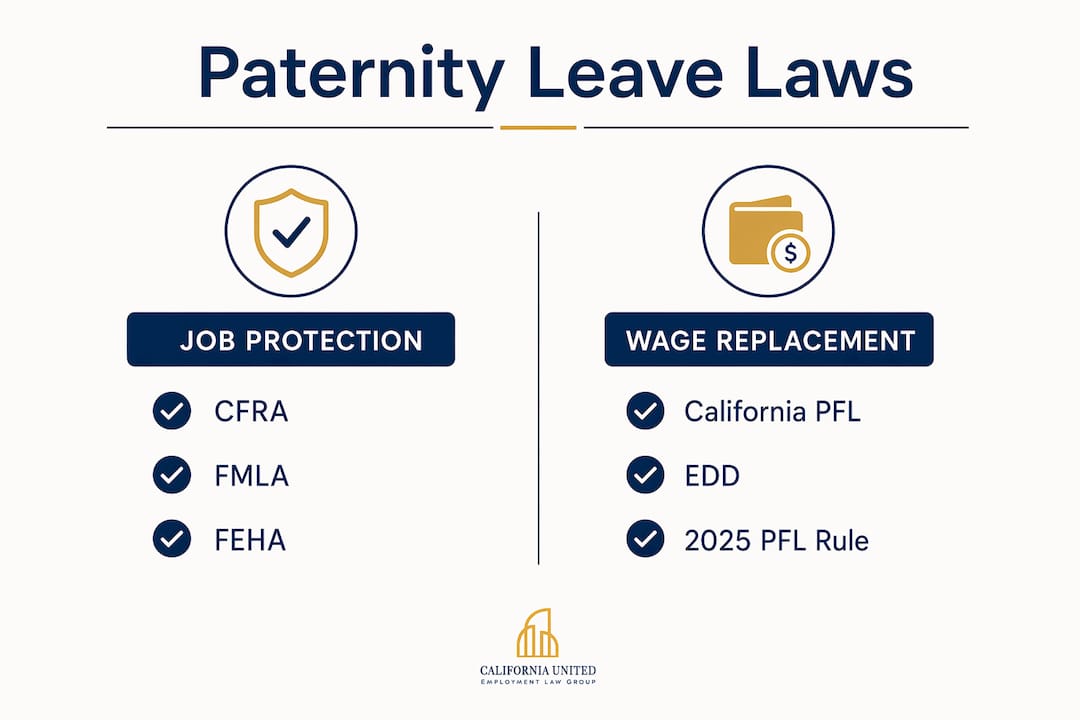
- Job protection comes from CFRA and FMLA. These laws require your employer to restore you to the same or a comparable position after leave.
- Wage replacement comes from California’s PFL program through the EDD. PFL provides benefit payments for bonding with a new child but does not, by itself, guarantee your job back.
If you believe your employer has taken adverse action because you requested or took paternity leave, your immediate priorities are:
- Preserve every relevant email, text, HR notice, and performance review
- Notify your employer of your leave in writing and keep a copy
- Document dates, names of witnesses, and any comments made about your leave
- Consult an employment attorney if you face demotion, termination, or any other adverse action
This article is general educational information about California employment law as it applies to employees working in West Hollywood. It is not legal advice, and outcomes depend on the specific facts of your situation.
Table of Contents
- Which California laws protect fathers taking paternity leave?
- Who qualifies in West Hollywood, how much leave you can take, and what pay you may receive
- How and when to tell your West Hollywood employer about planned paternity leave
- What does unlawful employer conduct look like after paternity leave?
- What to do if you believe you faced paternity discrimination
- How employment lawyers typically frame paternity discrimination claims in California
- Key Takeaways
- A West Hollywood employment law perspective
- California United Law Group is here for West Hollywood fathers
- Useful sources for West Hollywood fathers
Which California laws protect fathers taking paternity leave?
Four distinct legal frameworks apply to West Hollywood working fathers, and each covers a different piece of the picture.
| Law | What It Covers | Job Protection? | Pay? | Administering Agency | Typical Weeks |
|---|---|---|---|---|---|
| CFRA | Bonding leave for new child | Yes | No (unpaid) | CRD / employer | Up to 12 weeks |
| FMLA | Federal bonding/family leave | Yes | No (unpaid) | U.S. DOL / employer | Up to 12 weeks |
| PFL (EDD) | Wage replacement during leave | No (standalone) | Yes | EDD | Up to 8 weeks |
| FEHA | Discrimination, harassment, retaliation | N/A | N/A | CRD | N/A |
CFRA grants up to 12 weeks of unpaid, job-protected bonding leave per year when you work for a covered employer and meet eligibility thresholds. Your employer must restore you to the same or a comparable position when you return.
FMLA is the federal counterpart. It runs concurrently with CFRA in most bonding situations, meaning the two leaves typically run at the same time rather than stacking. Where CFRA and FMLA overlap, you generally get 12 weeks total, not 24.
California PFL is a state-run wage-replacement program. You apply directly to the EDD, and your employer cannot block your application. Employers do not grant PFL; the EDD does. If your PFL claim is denied, administrative appeals are available through the EDD.
FEHA is the broadest anti-discrimination law. It does not create a standalone “family caregiver” protected class, but caregiver discrimination scenarios are frequently actionable under FEHA theories such as sex stereotyping, associational disability discrimination, and retaliation. The CRD enforces FEHA and accepts complaints for discrimination, harassment, and retaliation, including family-leave issues.
Who Qualifies In West Hollywood, How Much Leave You Can Take, And What Pay You May Receive
Eligibility is where many fathers get tripped up, because the rules differ by law and by employer size.

CFRA And FMLA Eligibility
To qualify for CFRA or FMLA bonding leave, you generally must:
- Have worked for your employer for at least twelve months
- Have worked at least 1,250 hours for the employer during the 12 months before leave begins.
- Work for a covered employer. CFRA generally applies to employers with 5 or more employees, while FMLA generally applies to employers with 50 or more employees within the applicable coverage area.
An employee who has worked for a covered West Hollywood employer for 18 months and worked at least 1,250 hours in the 12 months before leave begins may be eligible for CFRA job-protected leave. An employee at the same company for only 9 months has not yet met the 12-month service requirement and would not qualify for CFRA or FMLA, though California PFL wage replacement may still be available.
California PFL Eligibility And Pay
PFL is not the same as job-protected leave. It generally provides up to eight weeks of partial wage replacement, while job protection usually must come from a separate law such as CFRA or FMLA.
PFL eligibility is separate and somewhat more accessible. Starting January 1, 2025, many lower-wage workers may receive up to 90% of weekly wages through PFL/SDI, while higher-wage workers may receive 70%, subject to EDD rules and weekly maximums. To qualify, you must have:
- Earned wages in your base period with State Disability Insurance withheld (shown as CASDI on your paystub)
- Filed your claim no later than 41 days after your family leave begins, or you may lose benefits
- Bonding leave must be taken within the first year after your child’s birth or placement
The EDD typically issues an initial eligibility decision on a complete PFL claim within up to 14 days of receiving it.
The 2025 PFL Integration Rule
Effective January 1, 2025, employers generally can no longer require employees to use accrued vacation before PFL benefits begin. Check current EDD guidance for how the rule applies to sick leave, PTO policies, and employer-provided benefits. This is a meaningful change. Previously, some employers used PTO-exhaustion requirements to delay or reduce the practical value of PFL.
Pro Tip: Check your paystub for the CASDI deduction line. If you see it, you have likely been contributing to the SDI program, which is one factor EDD considers when determining PFL eligibility. If you do not see it, ask HR whether you are covered — misclassification as an independent contractor does not automatically disqualify you; the EDD decides eligibility.
You should also look for required CFRA postings in your workplace. California employers must display CFRA rights notices in a conspicuous location. Missing postings can indicate broader noncompliance.
How And When To Tell Your West Hollywood Employer About Planned Paternity Leave
Giving proper notice protects your rights. For foreseeable bonding leave, such as a planned birth or adoption, you generally should provide at least 30 days’ advance notice when practicable. If 30 days is not practicable, notify your employer as soon as you can. If 30 days is not feasible, notify your employer as soon as practicable.
Your written leave notice should include:
- The anticipated start date and expected duration of leave
- The reason (bonding with a new child)
- Your contact information during leave
- A statement that you can provide supporting documentation if requested
Employers commonly request a birth certificate, hospital birth certificate, or Declaration of Paternity (CS-909) to verify the bonding relationship. For PFL, you will submit this documentation directly to the EDD as part of your PFL claim process. Remember the 41-day filing deadline from the date your leave begins.
Pro Tip: Send your leave notice by email rather than verbally, and request a read receipt or a written acknowledgment from HR. Save every response. If your employer later claims it had no notice of your leave, your email thread is your clearest evidence.
What does unlawful employer conduct look like after paternity leave?
Recognizing adverse action is the first step toward addressing it. Common examples of potentially unlawful conduct tied to protected paternity leave include:
- Denial of leave you are legally entitled to take
- Failure to reinstate you to the same or a comparable position upon return
- Demotion or reduction in pay, title, or responsibilities after leave
- Negative performance reviews issued shortly after you return, especially where the employer had no documented concerns before your leave
- Hostile or coercive comments about your commitment as an employee now that you are a new father
- Shift changes or schedule alterations that disadvantage you compared to your pre-leave status
- Termination occurring shortly after you take or request leave
Employers often defend these actions by citing legitimate performance issues or business-driven layoffs. Timing and documentation are critical to distinguishing a pretextual reason from a genuine one. A termination that happens two weeks after you return from leave, with no prior documented performance concerns, looks very different from one that follows months of written warnings.
Evidence to preserve right now
- All emails and text messages related to your leave request and return
- Written warnings, performance reviews, and HR notes from before and after leave
- Paystubs showing any pay changes
- Notes from any meetings where your leave or parenting status was discussed, including dates and names of anyone present
- Witness names and contact information
How sex-stereotyping claims work under FEHA
An employer’s assumption that you are now “less committed” because you became a father is not just unfair. It can be legally actionable. FEHA does not generally make parental status itself a protected characteristic, but adverse action based on sex-based stereotypes about caregiving may support a sex-discrimination theory. If your employer treated a female employee who took parental leave differently than it treated you, that disparity can also support a discrimination claim. California United Law Group handles workplace retaliation claims that arise from exactly these kinds of fact patterns.
California courts have recognized that taking CFRA leave cannot be used to undermine an employee’s job security. In Neisendorf v. Levi Strauss & Co., the court stated that an employee who takes CFRA leave is guaranteed that taking leave will not result in a loss of job security or other adverse employment actions. California authority also recognizes that a discriminatory motive under FEHA must be a substantial motivating reason for the challenged employment decision, a standard discussed in Harris v. City of Santa Monica and reflected in CACI’s employment-discrimination framework.
What To Do If You Believe You Faced Paternity Discrimination
Acting methodically matters. Here is an ordered approach to protecting your rights:
- Preserve all records immediately. Save emails, texts, HR correspondence, performance reviews, and paystubs. Screenshot electronic records and note the date and time each was captured.
- File an internal HR complaint in writing. Keep a copy. An internal complaint creates a paper trail and may trigger your employer’s own investigation obligations.
- Document dates and witnesses. Write down what happened, when, who was present, and what was said. Keep this in a dated file separate from your work devices.
- File a complaint with the California Civil Rights Department. The CRD investigates and enforces FEHA claims, including family-leave discrimination and retaliation. For many FEHA and CFRA claims, filing with the CRD and obtaining the appropriate right-to-sue authorization is a required step before pursuing a civil lawsuit.
- Consult an employment attorney for a case evaluation. An attorney can assess whether your facts support a CFRA retaliation claim, a FEHA discrimination claim, or both, and can advise on timing given applicable deadlines.
Pro Tip: For electronic records, capture screenshots that include metadata such as timestamps and sender information. Store copies somewhere your employer cannot access, such as a personal email account or a secure personal device.
When deciding between a CRD complaint and private counsel, consider that the CRD process can take time and does not guarantee a particular outcome. An employment attorney can pursue your claim through the CRD, through private litigation, or both, depending on what your facts support.
How Employment Lawyers Typically Frame Paternity Discrimination Claims In California
This section is general educational information. It is not legal advice. Employment law outcomes are fact-specific, and your situation requires an individual evaluation.
When a West Hollywood father brings a potential paternity-discrimination matter to an employment attorney, the lawyer’s first task is identifying which legal theory best fits the evidence. Common claim types include:
- CFRA retaliation: Your employer took adverse action because you exercised your CFRA leave rights. Temporal proximity between your leave and the adverse action is often the starting point.
- FMLA/CFRA interference or denial: Your employer interfered with, restrained, or denied your right to take leave. This does not require proof of discriminatory intent.
- FEHA sex stereotyping: Your employer acted on assumptions about how a father should behave or prioritize work. Framing the claim under the strongest FEHA theory often determines whether a paternity-discrimination fact pattern yields relief.
- Associational disability discrimination: If your child has a medical condition and your employer discriminated against you based on that association, FEHA may provide a separate avenue.
- Wrongful termination in violation of public policy: Wrongful termination in violation of public policy: In some termination cases, a California public-policy claim may be available alongside statutory claims, depending on the source of the policy, the facts, and available remedies.
What relief can look like
Remedies in successful paternity-discrimination cases can include:
- Reinstatement to your former position
- Back pay for wages lost during the period of discrimination
- Front pay where reinstatement is not feasible
- Emotional distress damages
- Injunctive relief requiring the employer to change its practices
- Administrative or court-ordered remedies where authorized by the applicable statute.
California United Law Group represents West Hollywood employees in CFRA retaliation, FEHA discrimination, and wrongful termination matters. The firm offers free consultations and may handle qualifying matters on a contingency-fee basis, meaning attorney fees are paid only from a recovery. Clients may still be responsible for litigation costs or expenses depending on the written fee agreement. You can learn more about the employment lawsuit process or reach out directly for a case evaluation.
Key Takeaways
Working fathers in West Hollywood have enforceable rights under CFRA, FMLA, PFL, and FEHA, and documentation is the single most important thing you can do to protect those rights.
| Point | Details |
|---|---|
| Job protection vs. wage replacement | CFRA and FMLA may protect your job; California PFL through the EDD provides partial wage replacement. These are separate programs. |
| Eligibility triggers | CFRA/FMLA generally require 12 months of service and at least 1,250 hours worked in the relevant 12-month period; PFL generally requires qualifying wages in the base period with SDI/CASDI contributions. |
| 2025 PFL rule | Since January 1, 2025, employers cannot require you to exhaust vacation or sick leave before PFL benefits begin. |
| Document everything | Preserve emails, paystubs, performance reviews, and witness names — timing between your leave and any adverse action is critical evidence. |
| California United Law Group | The firm offers free consultations and may offer contingency-fee representation in qualifying cases. Clients may still be responsible for costs or expenses depending on the written fee agreement. |
A West Hollywood Employment Law Perspective
Paternity discrimination cases in California often share a common thread: the adverse action looks routine on the surface, but the timing tells a different story. A father returns from bonding leave and finds his role restructured, his schedule changed, or a performance improvement plan waiting on his desk, with no documented concerns that predate his leave. What makes these cases worth evaluating is not just the outcome, but the pattern. California law may provide remedies when adverse action is substantially motivated by protected leave activity, retaliation, or sex-based stereotypes about caregiving. Because parental status alone is not generally a protected characteristic under FEHA, the specific facts and theory matter. If you are a working father in West Hollywood and something changed at work after you took or requested paternity leave, that change deserves a careful look, not a dismissal. This article is general educational information and does not constitute legal advice. Every situation is different, and a qualified employment attorney should evaluate your specific facts before you draw any conclusions about your options.
California United Law Group Is Here For West Hollywood Fathers
If you are a working father in West Hollywood who has faced adverse action after taking or requesting paternity leave, California United Law Group offers a free initial consultation to evaluate your situation. The firm handles case evaluation, administrative filings with the CRD or EDD, and litigation where the facts support it. Representation may be available on a contingency-fee basis in qualifying cases, meaning attorney fees are paid only if there is a recovery. Clients may still be responsible for litigation costs or expenses depending on the written fee agreement.
When you reach out, bring what you have:
- Leave request notices and any employer responses
- HR emails and written communications about your leave or return
- Paystubs showing CASDI deductions and any pay changes
- Performance reviews from before and after your leave
- Any disciplinary notices issued after your return
- Dates of key events and names of witnesses
Contact California United Law Group today to schedule your free consultation. Promptly preserving your records can help an attorney evaluate your rights and options.
Useful Sources For West Hollywood Fathers
These official and authoritative pages are the best places to verify current rules and agency guidance:
- EDD Paid Family Leave — Overview of PFL benefits, eligibility, and how to apply for bonding leave
- Am I Eligible for PFL Benefits? (EDD) — Detailed EDD eligibility criteria, including the CASDI requirement and filing deadlines
- EDD PFL Fact Sheet DE 8714CF — Official fact sheet covering bonding-period rules and the 41-day filing window
- EDD PFL Eligibility FAQ — Answers on eligibility determinations, timelines, and the 2025 PTO-exhaustion rule
- California Civil Rights Department — Employment — CRD guidance on CFRA rights, required employer postings, and enforcement
- CRD Family Care and Medical Leave Fact Sheet — Plain-language summary of CFRA protections and how to file a complaint
- California United Law Group — Contact — Schedule a free consultation with an employment attorney serving West Hollywood
Check official agency pages regularly, as benefit amounts, eligibility rules, and filing procedures can change. This article reflects general information and should not be relied on as a substitute for current agency guidance or legal counsel.