
If you work in El Monte and earn tips or work split shifts, California law gives you clear, enforceable protections. Under Labor Code §351, every gratuity is the sole property of the employee or employees to whom it was paid. Mandatory tip pools are permitted only when they exclude owners, managers, and supervisors and follow a fair and reasonable distribution. Split-shift premiums may be owed when your employer establishes a schedule interrupted by unpaid, non-working time. If owed, the premium should be reflected clearly in your pay records, but higher daily wages may satisfy the split-shift obligation in some cases.
Here is what to do right now:
- Check your paystub for a line labeled “Split Shift Premium” or another clear premium-pay entry. If you worked a split shift and do not see the premium, compare your total daily wages against the minimum wage plus one additional hour, because higher wages may satisfy the obligation.
- Look at your tip-pool policy in writing. If an owner, manager, supervisor, or other person with hiring, firing, directing, or controlling authority receives pooled tips, the arrangement may violate California law depending on the person’s actual role and authority.
- Preserve everything: paystubs, schedules, tip-pool policies, and any written communications about how tips are distributed.
Pro Tip: Take a photo of your posted schedule each week. Schedules are often changed or discarded, and a dated photo is strong evidence if you later need to show your employer created a split shift.
Table of Contents
- What do California tip pooling laws actually say?
- Who can legally participate in a tip pool?
- What violations do El Monte employees commonly face?
- When are you owed a split-shift premium in California?
- How to check your pay and calculate what you may be owed
- How do you enforce your rights in California?
- Key Takeaways
- What California United Law Group sees in El Monte wage cases
- California United Law Group can help El Monte employees
- Useful sources and further reading
What do California tip pooling laws actually say?
Labor Code §351 is the controlling statute. It states, without exception, that no employer or agent may collect, take, or receive any portion of a gratuity left for an employee by a patron.

The California Labor Commissioner’s Office and California courts generally permit mandatory tip pooling when the employer does not take tips for itself or its agents and the distribution is fair, reasonable, and tied to the service provided. The 1990 decision in Leighton v. Old Heidelberg confirmed that employer-administered tip pools do not violate §351 as long as the purpose is to share gratuities among the employees who earned them, not to funnel money back to ownership or management.
California courts have applied these rules in several workplace settings. In Leighton v. Old Heidelberg, the court approved employer-mandated tip pooling when tips were distributed among employees who earned them. Later cases confirm that eligibility depends on actual job duties and authority: a true managerial agent may be excluded from pooled tips, while a shift lead who works as part of the service team may be treated differently depending on the facts.
One rule California applies differently than federal law: employers cannot use tips as a wage credit. Under California law, your employer must pay you at least the full minimum wage regardless of how much you earn in tips. Federal tipped-wage rules that allow a lower base wage do not apply here.
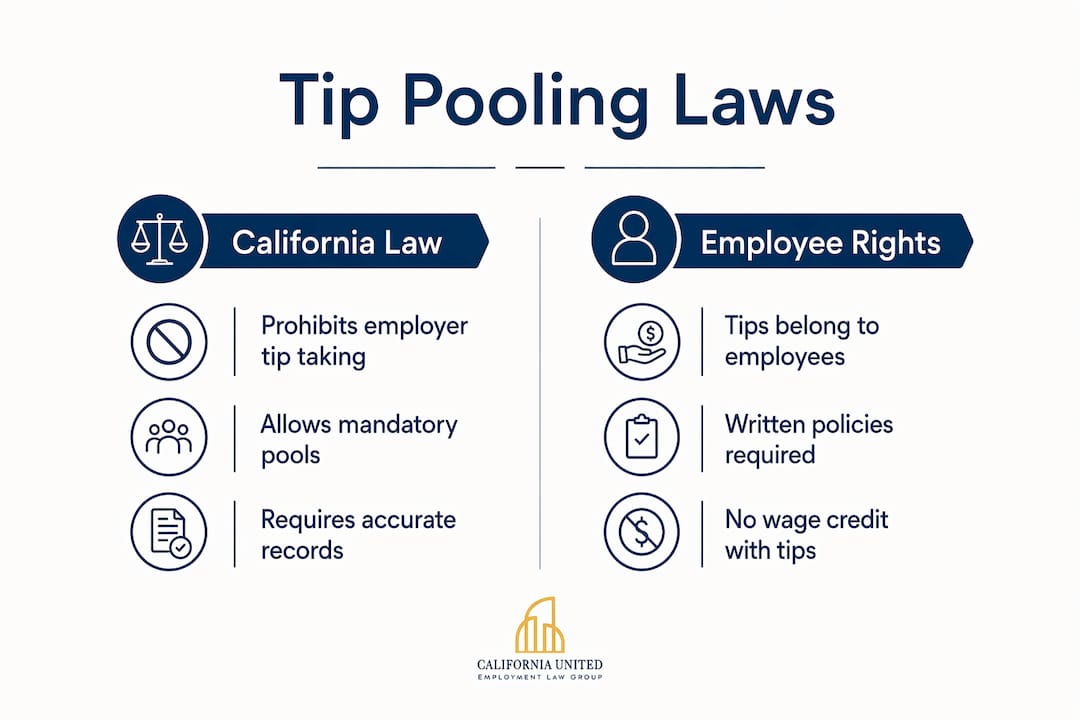
IWC Wage Orders reinforce these protections by requiring accurate gratuity records and proper paystub itemization. The DLSE opinion referencing Leighton adds that it is the correlation with prevailing industry practice that makes tip pooling a fair and equitable system — meaning distributions that ignore what is customary in your industry can themselves be unlawful.
Who can legally participate in a tip pool?
The phrase “chain of service” is the key. It refers to employees whose work directly contributes to the customer’s overall experience, not just anyone who happens to be on shift.
Typically eligible for tip pool participation:
- Servers and waitstaff who take orders and deliver food or drinks
- Bussers who clear and reset tables
- Bartenders who serve patrons directly
- Host or maître d’ staff who seat and greet guests
- In some industries: towel attendants, valet drivers, hair washers, and spa attendants
Legally excluded from any tip pool:
- Owners of the business, regardless of whether they occasionally serve tables
- Managers and supervisors with authority to hire, fire, or direct employees
- Back-of-house employees whose work is too remote from the customer’s service experience; however, some indirect-service employees may lawfully participate depending on the facts and industry practice.
- Cashiers whose duties are limited to payment collection and do not materially contribute to the patron’s service experience.
Front-of-house job title alone does not settle eligibility. The Labor Commissioner examines actual job duties and whether the role materially contributes to the patron’s service experience. A ‘floor supervisor’ may be excluded if they have authority to hire, fire, supervise, direct, or control employees, but eligibility can turn on the actual duties, authority, and how the tip was intended to be shared.
Red flags that a tip pool may be unlawful:
- A manager or owner receives any share of pooled tips
- The distribution percentages seem arbitrary and bear no relationship to industry norms
- Employees with no meaningful connection to customer service receive tip-pool shares, especially where the allocation is not tied to industry practice or the customer service experience.
- The employer applies a tip credit to reduce your base wage below minimum wage
- No accurate tip records exist, or the employer cannot explain how pooled tips are calculated and distributed.
What violations do El Monte employees commonly face?
Wage violations related to tips and split shifts often appear in predictable patterns, particularly in food service, hospitality, and retail settings in El Monte.
Common employer violations:
- An owner or manager takes a percentage of the tip pool, directly or indirectly
- Gratuities are reduced to cover business costs, such as credit card processing fees, when those deductions are not legally permitted.
- Employees are misclassified as “supervisors” to justify their exclusion from tip pools or to justify including them in pools as non-supervisors
- Split-shift premiums are never calculated or paid
- The split-shift premium is folded into regular wages with no separate itemization
On your paystub, violations often appear as an absence: no “Split Shift Premium” line, no tip-pool distribution record, or a vague “service charge” entry that does not correspond to actual gratuities. If your employer labels a mandatory charge a “service charge” rather than a gratuity, the rules governing distribution may differ, but the employer still cannot pocket it without legal basis. California courts have recognized that a mandatory ‘service charge’ may raise tip-law issues if industry custom treats the charge as a gratuity intended for service employees.
California law also protects you from retaliation. If you ask about your tip rights, request your tip-pool policy in writing, or file a complaint with the Labor Commissioner’s Office, your employer cannot legally reduce your hours, demote you, or terminate you in response. Retaliation is itself a separate violation with its own remedies. For related wage issues in El Monte, employer expense reimbursement obligations follow a similar enforcement path.
When are you owed a split-shift premium in California?
A split shift is a work schedule interrupted by unpaid, non-working time that the employer establishes, other than a bona fide rest or meal period. The IWC Wage Orders define it precisely: designated hours of work with a break in between that is not a standard meal or rest break.
How the premium is calculated
| Scenario | Calculation | Premium Owed? |
|---|---|---|
| Employee earns state minimum wage, works a split shift | (1 hr × minimum wage) added to daily pay | Yes |
| Employee earns above minimum wage; daily pay already covers the premium | Daily wages minus (hours worked × minimum wage) ≥ 1 hr minimum wage | No separate premium owed |
| Local minimum wage is higher than state minimum | If a valid local minimum wage applies and is higher than the state rate, use the applicable higher local rate. If no higher El Monte-specific rate applies, use the California minimum wage. | Yes, at local rate |
The DIR’s split-shift guidance states that one hour’s pay at the applicable minimum wage is owed in addition to the minimum wage for that workday. Higher wages earned that day may be credited toward the obligation. This means higher-paid employees may not see a separate premium line because their wages already satisfy the legal floor.
Key exceptions and requirements:
- If you requested the schedule split for your own convenience, the premium is not owed. The premium applies only when the employer establishes the interrupted schedule.
- Employees who reside at the place of employment are exempt from the split-shift premium.
- If a split-shift premium is owed, it should be clearly identified in the wage records. If the employee’s daily wages already satisfy the minimum wage plus the additional hour, a separate premium may not be owed.
- Accurate minute-by-minute time records are critical; imprecise timekeeping can obscure whether a split shift occurred at all.
Pro Tip: California courts continue to scrutinize rounding practices, and the California Supreme Court has been considering the scope of lawful time rounding. Keep your own time log as a backup.
How To Check Your Pay And Calculate What You May Be Owed
Auditing your own paystub is straightforward once you know what to look for. Gather these records first:
- Paystubs for every pay period you want to review (California law requires itemized wage statements)
- Time records showing start and end times for each work period, including the gap between shifts
- Your employer’s tip-pool policy in writing
- Your work schedule for the relevant weeks
- Names of coworkers who witnessed tip distributions or schedule practices
- Any written communications from management about tips or scheduling
Worked example A: split-shift premium calculation
Maria works in a restaurant in El Monte. Her shift runs 10:00 AM to 2:00 PM, then resumes at 6:00 PM and ends at 10:00 PM. The break is unpaid and employer-established. She earns the California state minimum wage.
| Item | Amount |
|---|---|
| Hours worked | 8 hours |
| Regular wages (8 hrs × minimum wage) | Based on current state minimum wage |
| Split-shift premium owed | 1 additional hour at minimum wage |
| Total daily pay required | Regular wages + 1 hour premium |
Because Maria earns the minimum wage, a paystub showing only 8 hours of regular pay and no split-shift premium would be a strong indication of underpayment for that day.
Worked example B: tip-pool imbalance
David is a server at an El Monte café. The tip pool distributes 30% of all tips to the manager on duty. If the manager is an ineligible owner, employer, or agent with supervisory authority, allocating 30% of the tip pool to that manager may violate California tip-pooling law. David may have remedies to recover the misallocated tip money, but the legal theory matters. Labor Code section 351 does not itself create a private cause of action; employees often pursue related remedies such as conversion, unfair competition, or civil penalties where available.
Pro Tip: Request a copy of your employer’s tip-pool policy in writing. California law requires employers to keep accurate gratuity records under Labor Code §353. If your employer refuses to provide the policy, document that refusal — it can be relevant evidence.
For context on how timekeeping accuracy affects these calculations, the Alhambra time-rounding guide explains how rounding practices can quietly reduce your recorded hours and affect premium calculations.
How do you enforce your rights in California?
El Monte employees have two primary enforcement paths: filing a wage claim with the Division of Labor Standards Enforcement (DLSE), also known as the Labor Commissioner’s Office, or consulting a private employment attorney.
Filing a DLSE wage claim:
- Submit your claim online or in person at a Labor Commissioner office. The DLSE investigates tip and split-shift violations under its authority to issue citations and recover unpaid wages.
- The agency will typically request paystubs, time records, your tip-pool policy, and any written communications about pay practices.
- After investigation, the DLSE can issue a citation, order wage recovery, and assess penalties. Cases may also be referred to civil court if the employer contests the determination.
- Deadlines vary by claim and legal theory. Many California wage claims use a three-year lookback period, but some claims or remedies may have different deadlines, so employees should act promptly.
When to contact an employment attorney:
If your employer contests the DLSE determination, if the amount at stake is substantial, or if you have experienced retaliation, a private attorney can pursue a civil wage-and-hour lawsuit. Many employment attorneys handle wage cases on a contingency-fee basis. If a firm advertises ‘no fee unless recovery,’ the fee agreement should also explain whether the client may be responsible for litigation costs or expenses. An attorney will generally request the same documents the DLSE asks for, plus any records of retaliation or adverse employment actions.
For employees who have faced related wage issues, unpaid split-shift premium claims follow a similar litigation path. The El Monte meal period violations guide also covers related enforcement timelines that apply to wage-and-hour claims in this area.
Key Takeaways
California law gives El Monte employees firm protections on tip pooling and split-shift premiums: tips belong to employees, mandatory pools must exclude management, and split-shift premiums must be separately itemized on your wage statement.
| Point | Details |
|---|---|
| Tips belong to employees | Labor Code §351 prohibits employers and managers from taking any share of employee gratuities. |
| Tip pools must be fair and reasonable | Tip pools must exclude the employer and ineligible agents, and distributions should be fair, reasonable, and connected to the service experience. |
| Split-shift premium equals one hour at minimum wage | The premium is owed when the employer creates the schedule split; higher daily wages may satisfy the obligation. |
| Paystub itemization is required | If a split-shift premium is owed, it should be clearly reflected in wage records; however, higher daily wages may satisfy the split-shift obligation. |
| California United Law Group | Represents El Monte employees in wage-and-hour claims, including tip pooling and split-shift premium disputes. |
What California United Law Group Sees In El Monte Wage Cases
Wage-and-hour issues involving tips and split shifts can arise in El Monte’s food service and hospitality sectors. The pattern repeats: a manager quietly receives a share of the tip pool, or a split-shift premium is never calculated because the employer assumes it only applies to minimum-wage workers. Both assumptions can be wrong under California law, depending on the employee’s role, authority, pay rate, and the way the employer calculated wages.
What often surprises employees is how straightforward the evidence-gathering process can be. Paystubs, schedules, tip records, and any written tip-pool policy are often important starting points, but whether they establish a violation depends on the facts. The legal standard is clear. The challenge is knowing where to look and what the numbers should say.
If you work in El Monte and suspect your tips have been improperly distributed or your split-shift premiums have not been paid, the most useful first step is collecting your records. Employment law issues are fact-specific, and outcomes vary depending on the details of each situation. This article is general educational information, not legal advice. For guidance on your specific circumstances, consult a qualified employment attorney.
California United Law Group Can Help El Monte Employees
If you believe your employer has withheld tips or failed to pay split-shift premiums, California United Law Group represents El Monte employees in wage-and-hour claims on a contingency basis. The firm handles many wage-and-hour matters on a contingency-fee basis, meaning attorney fees are owed only if the firm obtains a recovery for you. Depending on the fee agreement, clients may or may not be responsible for litigation costs or expenses, so those terms should be reviewed before representation begins. A free initial consultation may be available to help you understand whether your situation warrants a formal claim.
** Before your consultation, gather:**
- Paystubs for the relevant pay periods
- Time records showing your shift start and end times
- Your employer’s tip-pool policy (written or verbal description)
- Work schedules for the weeks in question
- Witness names among coworkers who observed tip distributions
- Any written communications about pay, tips, or scheduling
Asking about your rights is protected under California law. Your employer cannot legally retaliate against you for making a wage inquiry or filing a claim. Contact us for a consultation to discuss your situation with an employment attorney who handles El Monte wage-and-hour matters.
Useful Sources And Further Reading
- Labor Commissioner’s Office: Tips and Gratuities FAQ — Primary DIR guidance on Labor Code §351, tip pooling rules, and employer prohibitions.
- California Labor Code §351 (full text) — The controlling statute on gratuities and employer prohibitions.
- DIR Split Shift Guidance — Official DIR explanation of when split-shift premiums apply, how they are calculated, and paystub requirements.
- DLSE Opinion Letter on Tip Pool Policy (2005) — Applies Leighton v. Old Heidelberg to a specific tip-pool policy and explains the “chain of service” and “fair and reasonable” standards.
- Applicable IWC Wage Orders, including the wage order covering the employee’s industry or occupation, because split-shift rules appear across multiple California wage orders.
- Employment Lawyer El Monte — California United Law Group — Local firm profile and contact information for El Monte wage-and-hour representation.
- CACI No. 2752, Tip Pool Conversion – California’s civil jury instruction identifying the factual elements for a tip-pool conversion claim.
Recommended
- Can Culver City workers sue for unpaid split shift premiums? – California United Law Group
- El Monte Meal Period Violations: Your Rights in 2026 – California United Law Group –
- El Monte Failure to Reimburse Employee Expenses – California United Law Group –
- Employment Lawyer El Monte – California United Law Group