
Glendale off-the-clock work violations occur when employees perform work their employer knew about, or should have known about, without receiving pay for that time. This practice can violate California wage and hour laws when the employer knew or should have known about the unpaid work. California wage-and-hour law generally requires employers to pay nonexempt employees for compensable work time, including off-the-clock work the employer knew or should have known about. Glendale employees in retail, healthcare, manufacturing, and other industries face these violations regularly, often without realizing the law is on their side. Understanding what qualifies as compensable time is the first step toward protecting your earnings.
What are common Glendale off-the-clock work violations?
Off-the-clock work, formally called uncompensated work time, covers any task an employer benefits from but does not pay for. California law defines compensable time broadly, which means many activities employees assume are “just part of the job” actually trigger a pay obligation.
Common situations that lead to Glendale workplace violation laws being broken include:
- Pre-shift preparations: Changing into required uniforms, booting up work systems, or completing mandatory security screenings before clocking in. Pre-shift activities, including required security screenings in some circumstances, may count as hours worked under California law.
- Post-shift tasks: Cleaning workstations, shutting down equipment, or finishing paperwork after clocking out.
- Unpaid break work: Answering calls, responding to messages, or completing tasks during a meal or rest break that was recorded as unpaid.
- Unauthorized overtime: Completing required work after an employer forbids overtime. Employer policies generally do not eliminate the obligation to pay for time the employer knew or should have known was worked.
- Training and administrative tasks: Attending required meetings or completing compliance training off the clock.
Glendale’s diverse economy means these violations appear across many sectors. Retail workers at stores along Brand Boulevard may be asked to stay late for inventory counts. Healthcare aides at local facilities often document patient notes after their shift ends. Warehouse and light manufacturing employees in the Glendale area sometimes complete equipment checks before their official start time.
Pro Tip: Keep a personal log of every task you perform before clocking in or after clocking out. Note the date, time, and what you did. This record can be critical if you ever need to support a wage claim.

How does California law protect employees from unpaid work time?
California law gives many Glendale nonexempt employees strong protections against unpaid off-the-clock work. Important statutes include Labor Code § 510, which addresses overtime, and Labor Code § 203, which addresses waiting-time penalties when final wages are willfully unpaid.
Labor Code § 510 requires overtime pay at 1.5 times the regular rate for hours worked beyond 8 in a day or 40 in a workweek. Hours beyond 12 in a single day trigger double time. This applies to all off-the-clock hours, not just scheduled overtime.
| Situation | Pay Rate |
|---|---|
| Up to 8 hours per day | Regular rate |
| Hours 9–12 in a single day | 1.5x regular rate |
| Hours beyond 12 in a single day | 2x regular rate |
| Over 40 hours in a workweek | 1.5x regular rate |
| First 8 hours on the 7th consecutive day in a workweek | 1.5x regular rate |
| Hours over 8 on the 7th consecutive day in a workweek | 2x regular rate |
Labor Code § 203 adds another layer of accountability. Waiting time penalties can reach up to 30 days of an employee’s daily wages when an employer willfully fails to pay earned wages at termination. That penalty alone can represent a significant recovery for workers who were underpaid over months or years.
Employer record-keeping obligations are also strict. When employer records are missing or inaccurate, employees may often rely on reasonable estimates, and the employer may need evidence to rebut those estimates. Employees can then provide reasonable estimates of their uncompensated hours, and courts generally accept those estimates.
California law also establishes that employer knowledge triggers liability.
California courts have applied this rule in real wage-and-hour cases. In Morillion v. Royal Packing Co., the California Supreme Court recognized that California’s wage orders define compensable ‘hours worked’ broadly. In Jong v. Kaiser Foundation Health Plan, Inc., however, the Court of Appeal rejected an off-the-clock overtime claim where the evidence did not show the employer knew the employee was performing unrecorded overtime. These cases show why both employer knowledge and employee documentation matter.
If your supervisor saw you working before your shift, or if the circumstances gave the employer reason to know you were working, the employer may owe pay even if it did not formally approve the time. However, merely arriving early or leaving late may not be enough by itself.
Pro Tip: Request copies of your pay stubs and time records regularly. California law gives you the right to inspect your own payroll records, and having them on hand protects you if records later become unavailable.
Many California Labor Code wage claims are subject to a 3-year limitations period, while some related Unfair Competition Law theories may reach back 4 years. Certain violations pursued under the Unfair Competition Law extend that window to 4 years. Waiting too long can limit or eliminate your ability to recover.
How can you recognize and document off-the-clock violations?
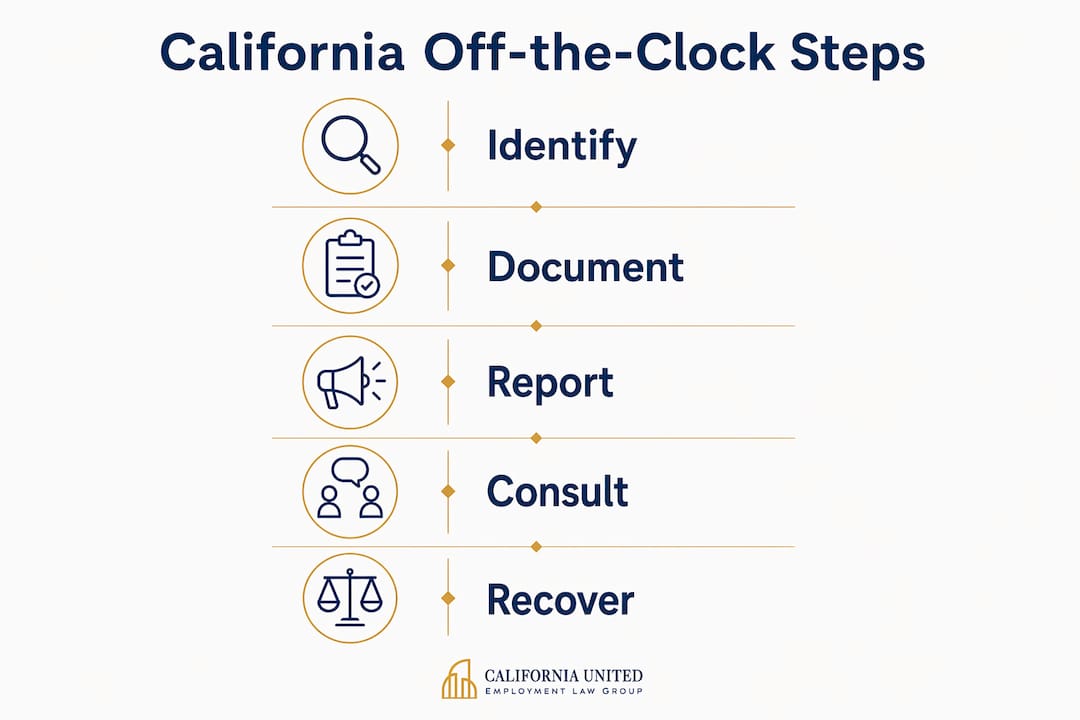
Recognizing a violation in your own daily routine takes attention. Many employees in Glendale work off the clock without realizing it qualifies as compensable time. The following steps help you identify and preserve evidence of unpaid work time.
- Compare your schedule to your pay stubs. If you regularly start tasks before your official start time or finish after your end time, check whether those minutes appear in your recorded hours.
- Review your communications. Emails, texts, or app notifications sent or received outside your clocked hours show you were working. Save these records.
- Document your own logs. Write down dates, times, and descriptions of off-the-clock tasks as they happen. Contemporaneous employee logs can strengthen a wage claim by helping estimate unpaid time and corroborate when the work occurred.
- Collect physical evidence. Keep copies of schedules, written instructions from supervisors, and any written policies that required you to perform tasks without pay.
- Note patterns. A single incident may be an oversight. A recurring pattern across weeks or months may indicate a broader wage-and-hour problem and can support a stronger factual record.
Employers sometimes argue that off-the-clock work was voluntary or that company policy prohibited it. Documentation directly counters both defenses. If official records are missing or inaccurate, your personal logs allow you to provide a reasonable estimate of hours worked. For more on how inaccurate timesheets may affect wage claims, California United Law Group has covered this issue for Glendale workers.
Preserve all evidence within the applicable statute of limitations. Waiting years to gather records makes the process harder and may reduce what you can recover.
What remedies are available for unpaid wages in Glendale?
Glendale employees who experience workplace compensation violations have several paths to recover what they are owed. The right option depends on the facts of your situation, and potential recovery varies based on the hours worked, pay rate, penalties, available evidence, and applicable legal theory.
Possible recoveries in a wage claim include:
- Unpaid wages: The base amount of all uncompensated work time at your regular rate.
- Overtime pay: Additional amounts owed under Labor Code § 510 for hours that triggered the 1.5x or 2x rate.
- Waiting time penalties: Up to 30 days of daily wages under Labor Code § 203 if your employer willfully withheld pay.
- Liquidated damages: In some minimum-wage cases, an amount tied to unlawfully unpaid minimum wages and interest may be available.
- Interest: Accrued on unpaid amounts from the date wages were due.
- Attorney’s fees and costs: California law allows prevailing employees to recover legal fees in many wage claims.
One accessible starting point is filing a wage claim with the DLSE. DLSE wage claims are free and do not require you to hire an attorney. The Labor Commissioner process can include investigation, hearing procedures, and an award if the employee proves the claim. For larger or more complex cases, a civil lawsuit may offer different procedural tools and remedies, including potential penalties, interest, attorney’s fees, and costs where authorized.
“For nonexempt employees, off-the-clock work may be compensable when the employer knew or should have known the work was being performed. Internal policies against unauthorized overtime do not automatically defeat a claim for unpaid work time.”
Employers sometimes respond to claims by disputing hours, claiming the work was voluntary, or arguing that policies prohibited overtime. Strong documentation and prompt action are your best tools against these responses. Glendale labor law claims have strict deadlines, and acting within the statute of limitations protects your full range of options. You can review the employment lawsuit process overview to understand what to expect at each stage.
Key Takeaways
California law gives Glendale employees clear rights against off-the-clock work, and documented evidence is the single most important factor in recovering unpaid wages.
| Point | Details |
|---|---|
| Off-the-clock work is illegal | Employers must pay for any work they knew or should have known about, regardless of policy. |
| Overtime rates apply | Hours beyond 8 per day or 40 per week trigger 1.5x pay; beyond 12 per day triggers 2x pay. |
| Waiting time penalties are significant | Labor Code § 203 allows up to 30 days of daily wages as a penalty for willful nonpayment. |
| Documentation strengthens your claim | Contemporaneous logs and preserved records can help estimate unpaid time and respond to employer defenses. |
| Act within the statute of limitations | Many claims have 3-year deadlines, and some related theories may reach 4 years; delay can reduce available recovery. |
What I’ve Seen Working These Cases Tells Me Most Employees Wait Too Long
Working with employees across Glendale and the broader Los Angeles area, I’ve noticed a consistent pattern. Most people who come in with off-the-clock wage claims waited months, sometimes years, before doing anything about it. By then, records are gone, memories are fuzzy, and the statute of limitations has eaten into the recovery period.
The other thing I’ve seen is how often employers rely on the employee’s own silence. A policy that says “no unauthorized overtime” sounds like a complete defense. It is not. If your manager saw you finishing a task after your shift ended and said nothing, that is constructive knowledge. The law treats it the same as explicit approval.
What often strengthens these cases is preparation. Employees who kept their own logs, saved their schedules, and held onto pay stubs come in with real leverage. Those who rely only on employer records may face problems if the records are incomplete or inaccurate. California courts and the Labor Commissioner recognize this dynamic, which is why the burden shifts to the employer when records are inaccurate.
My honest view: knowing your California Labor Code rights before a problem develops puts you in a far stronger position than learning them after the fact. The law may provide remedies if the facts support a claim. Learn your rights and act promptly.
— California United Law Group
How California United Law Group Helps Glendale Employees With Wage Claims
California United Law Group represents Glendale employees in wage and hour disputes, including off-the-clock work claims. The firm handles cases involving unpaid overtime, missed break penalties, and waiting time penalties under the California Labor Code. If you believe your employer required work without pay, a consultation can help you understand potential claims, possible remedies, and what evidence may matter.
Contact California United Law Group today for a free consultation. The firm’s employment attorneys work with Glendale employees at every stage, from gathering evidence through resolution. If representation is offered on a contingency or no-upfront-fee basis, confirm whether clients remain responsible for litigation costs or expenses. If you performed compensable work time, California law may require your employer to pay for it.
FAQ
What counts as off-the-clock work in California?
Off-the-clock work generally means compensable work performed for an employer’s benefit outside recorded work hours, such as pre-shift preparations, post-shift cleanup, required screenings in some circumstances, or work performed during unpaid breaks.
Can my employer avoid paying me by having a no-overtime policy?
Generally, no. For nonexempt employees, an employer may still owe wages for work it knew or should have known was performed, even if company policy prohibited unauthorized overtime.
How long do I have to file a wage claim in Glendale?
Many California Labor Code unpaid-wage claims have a 3-year limitations period, and some related Unfair Competition Law claims may reach back 4 years. The deadline depends on the claim and facts, so employees should act promptly.
What if my employer’s time records are wrong or missing?
When employer records are missing or inaccurate, an employee’s reasonable estimates, personal logs, schedules, messages, and other evidence may help support the claim. The effect of missing records depends on the type of claim and the evidence available.
What can I recover in an off-the-clock wage claim?
Depending on the claim, recoverable amounts may include unpaid wages, overtime pay, waiting-time penalties of up to 30 days of daily wages, interest, attorney’s fees and costs where authorized, and liquidated damages in some minimum-wage cases.
Recommended
- Glendale Employer Liability For Inaccurate Timesheets – California United Law Group
- Glendale Criminal Conviction Discrimination: Know Your Rights – California United Law Group –
- Off-the-clock work in El Monte warehouses: Know your rights – California United Law Group
- Glendale Healthcare Overtime Pay Disputes Explained – California United Law Group