
Unequal pay discrimination is defined as receiving lower wages than a coworker for substantially similar work without a lawful justification under California law. For Culver City employees, this is not a gray area. California’s Equal Pay Act, codified under Labor Code § 1197.5, prohibits wage disparities based on gender, race, and ethnicity. The law applies statewide and covers Culver City employees, including those working in Culver City’s growing entertainment, tech, and healthcare sectors. If you suspect a Culver City wage disparity is affecting your paycheck, understanding your rights is the first step toward addressing it.
How does California law define unequal pay discrimination?
California’s Equal Pay Act defines unlawful pay discrimination as paying an employee less than employees of a different gender, race, or ethnicity for substantially similar work. The law applies across the entire employer entity, not just within a single office or building. That matters for Culver City workers employed by companies with multiple California locations.

“Substantially similar work” is determined by three factors: skill, effort, and responsibility, performed under similar working conditions. Courts and employers analyze actual job duties, not job titles. A Culver City marketing coordinator and a marketing specialist at the same company may perform nearly identical work, even if their titles and pay differ.
Here is what California law looks at when comparing jobs:
- Skill: The knowledge, abilities, and training required to perform the job
- Effort: The physical or mental exertion the job demands
- Responsibility: The degree of accountability and decision-making involved
In addition to the work itself, the law separately requires that the employee worked under similar working conditions as the comparator — a distinct element of any equal pay claim.
California courts prioritize actual job duties over job titles when determining pay discrimination. That means someone performing the same core functions as a higher-paid coworker may have a valid claim, even if their official title is different. If your day-to-day work mirrors that of a better-paid colleague, the title on your business card is largely irrelevant to the legal analysis.
What defenses can employers legally use to justify pay differences?
California law does not require that all employees doing similar work earn identical wages. Employers can justify pay differences, but only through specific, recognized defenses. These defenses must be based on actual systems and consistently applied across the workforce.
The four recognized employer defenses under California’s Equal Pay Act are:
- Seniority system: Longer-tenured employees may lawfully earn more if a formal seniority structure exists and applies consistently.
- Merit system: Pay tied to documented performance evaluations is permissible when the system is applied fairly and without bias.
- Quantity or quality of production: Employees who produce more or at a higher quality level may receive higher pay under a production-based system.
- Bona fide factor other than a protected characteristic: This includes education, training, or experience, but only if the factor is job-related, consistent with business necessity, and no alternative practice could achieve the same purpose without producing the pay gap.
Importantly, under California law, the employer must prove not only that one of these factors exists, but that it was applied reasonably and that it accounts for the entire pay differential — not just part of it.
One area worth understanding is prior salary. California prohibits employers from asking job applicants about their prior salary history to break the cycle of inherited pay disparities. Using a candidate’s prior salary to justify a pay disparity is prohibited outright under California law — prior salary cannot, alone or in combination, justify any compensation differential. Note, however, that an employer may consider a current employee’s existing salary, provided the resulting differential is independently justified by one of the four recognized defenses. That restriction exists because prior salary often reflects historical discrimination rather than actual job value.
Employers must document and consistently apply pay difference justifications to withstand legal scrutiny. Ad hoc or informal explanations do not meet the legal standard. If a manager simply says “that’s what we offered,” without a documented system behind it, that defense is unlikely to hold up.
Pro Tip: If your employer claims your lower pay reflects a merit system, ask HR for the written criteria used to evaluate performance. A legitimate merit system has documented standards, not informal manager opinions.
A critical point for Culver City employees: equal pay claims do not require proof of discriminatory intent. You do not need to show your employer meant to discriminate. Demonstrating the pay gap for substantially similar work is enough to shift the burden to the employer to justify the difference.
What legal remedies are available to Culver City employees?
California law provides meaningful financial remedies for employees who prove unequal pay. The goal is to make the affected employee whole and to deter future violations.
| Remedy | What It Means |
|---|---|
| Back pay | The difference between what you were paid and what you should have been paid |
| Liquidated damages | An amount equal to the back pay, effectively doubling your recovery |
| Interest | Calculated on unpaid wages from the date they were owed |
| Attorney’s fees | The employer may be required to pay your legal costs if you prevail |
California’s Equal Pay Act allows employees who prove underpayment to recover liquidated damages equal to the unpaid wages. That doubles the back pay recovery. For example, if you were underpaid by $40,000, your potential recovery starts at $80,000 before interest and fees — though actual recovery depends on the specific facts, evidence, and circumstances of your individual case. That figure reflects how seriously California treats wage discrimination.
The attorney’s fees provision means that if you prevail, the court may order the employer to pay your attorney’s fees. Many employment attorneys also handle these cases on a contingency basis, but you should discuss the specific fee arrangement and potential costs with any attorney you consult.
Pro Tip: Keep a personal record of your job duties, responsibilities, and any pay-related conversations with managers. This documentation can be critical if you later need to demonstrate that your work was substantially similar to a higher-paid coworker.
The remedies available under Labor Code § 1197.5 are designed to incentivize employees to report unfair salary practices. Without meaningful recovery, many wage gaps would go unchallenged. California’s approach ensures that the financial cost of discrimination falls on the employer, not the employee.
How can Culver City employees recognize and respond to suspected wage disparity?
Recognizing a pay disparity is often the hardest part. Wages are rarely discussed openly, and many employees do not know what their coworkers earn. California’s salary transparency laws have changed that. Employers with 15 or more employees must now post pay scale ranges in job listings, giving current and prospective employees a clearer picture of compensation.
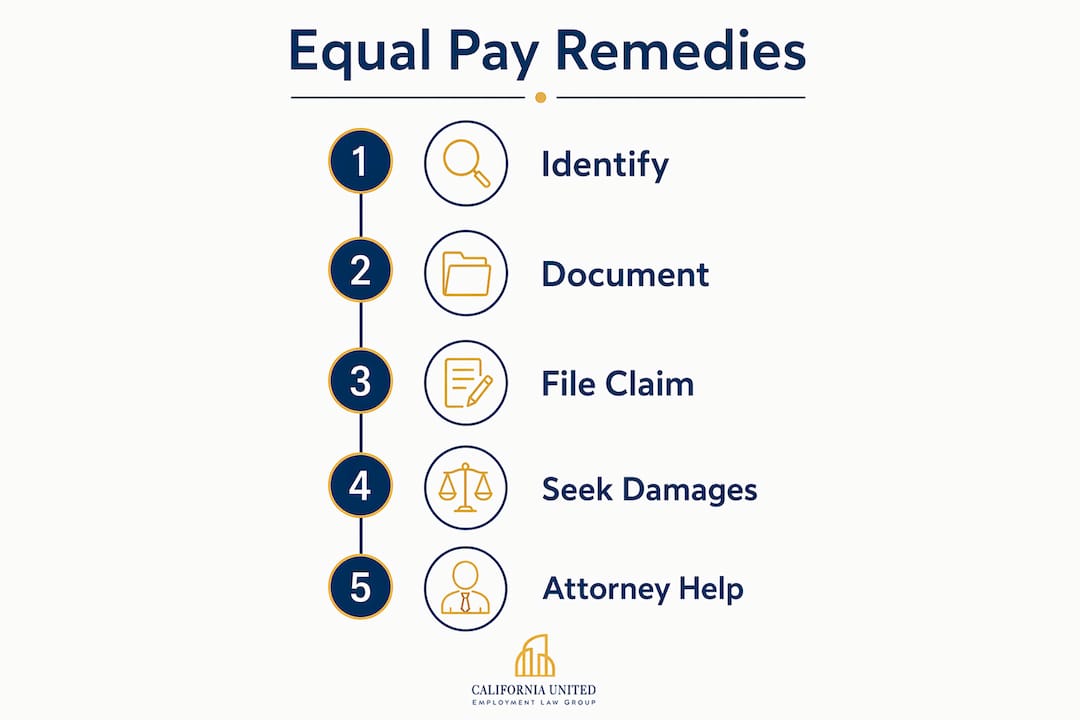
Here are practical steps you can take if you suspect a wage disparity:
- Review posted pay scales. California law requires many employers to disclose pay ranges. Compare the posted range for your role against your current salary.
- Document your job duties. Write down your daily responsibilities, the skills your role requires, and any leadership or decision-making you handle. Be specific.
- Note relevant comparisons. If you are aware of coworkers in similar roles earning more, record what you know, including job titles, departments, and any shared responsibilities.
- Preserve communications. Save emails, performance reviews, and any written feedback about your work quality or contributions.
- Report internally if appropriate. Some employees choose to raise concerns with HR first. Document any response you receive, including dates and the names of people you spoke with.
- Understand retaliation protections. California law prohibits employers from retaliating against employees who report or inquire about pay discrimination. Learn more about retaliation protections before raising a concern.
- Consult with an employment attorney. An attorney can evaluate whether your situation meets the legal standard for a pay discrimination claim and explain your options without committing you to litigation.
Pay equity audits often reveal disparities rooted not in intentional discrimination but in inherited starting salaries that compound over time. That means your lower pay may not reflect any single decision by your employer. It may reflect years of compounding inequity that started before you were hired. That history does not make the disparity lawful.
California’s reporting channels include the California Labor Commissioner’s Office and the California Civil Rights Department, formerly known as the Department of Fair Employment and Housing. Both agencies accept wage discrimination complaints and can investigate employer practices. You can also pursue a private civil lawsuit, which is often the path that leads to the largest financial recovery.
For Culver City employees considering legal action, understanding the employment lawsuit process in California helps set realistic expectations about timelines and procedures.
Key Takeaways
California’s Equal Pay Act gives Culver City employees the right to equal pay for substantially similar work, with liquidated damages that double back pay as the primary enforcement tool.
| Point | Details |
|---|---|
| No intent required | You do not need to prove your employer meant to discriminate, only that a pay gap exists for similar work. |
| Job duties over titles | Courts compare actual responsibilities, not job titles, when evaluating pay discrimination claims. |
| Employer defenses are limited | Seniority, merit, production, and bona fide factors are the only recognized justifications for pay differences. |
| Remedies can double your losses | Liquidated damages equal to back pay mean a $40,000 underpayment could yield an $80,000 recovery — though actual recovery depends on the specific facts, evidence, and circumstances of your individual case. |
| Documentation is your foundation | Records of job duties, pay communications, and comparisons strengthen any potential claim. |
What I’ve learned about proving pay discrimination in Culver City
The most common misconception I see is that employees believe they need a smoking gun. They think they need an email where a manager admits to paying them less because of their gender or race. That is not how California law works. The burden shifts to the employer once a pay gap for similar work is established. That shift is significant, and most employees do not realize how much it changes the legal picture.
What I have also observed is that Culver City’s mix of industries creates specific patterns. Entertainment and media companies often rely on informal pay structures where compensation is negotiated individually and rarely documented. That informality benefits employers when disputes arise. Employees who kept no records of their responsibilities or pay conversations are at a real disadvantage.
The salary history ban in California is one of the most underappreciated protections on the books. Prior salary has long been used to justify paying women and people of color less, not because their work was worth less, but because they were paid less before. Cutting that link is meaningful. Still, many employees do not know the ban exists or that it affects how their current pay was set.
My honest observation is that early documentation matters more than most employees realize. By the time someone contacts an attorney, months or years of evidence may already be gone. If something feels off about your pay, start writing it down now. You do not need to file a claim to protect yourself. You just need to be prepared.
California United Law Group Supports Culver City Employees Facing wage Discrimination
California United Law Group, P.C. represents employees across Culver City and the greater Los Angeles area in wage discrimination claims under California’s Equal Pay Act. The firm handles matters involving unfair salary practices, pay disparity disputes, and related employment law violations at every stage, from initial evaluation through litigation.
If you believe you are being paid less than coworkers for substantially similar work, speaking with a qualified employment attorney is a practical next step. California United Law Group focuses on California Labor Code and FEHA claims and can help you understand whether your situation warrants further action. Visit the Culver City employment law page to learn more, or contact the team to schedule a case evaluation.
FAQ
What is the California Equal Pay Act?
The California Equal Pay Act, codified under Labor Code § 1197.5, prohibits employers from paying employees less than employees of a different gender, race, or ethnicity for substantially similar work. It applies statewide, including to Culver City workers.
Do I need to prove my employer intended to discriminate?
No. California equal pay claims do not require proof of discriminatory intent. Demonstrating that a pay gap exists for substantially similar work is enough to shift the burden to the employer to justify the difference.
What counts as substantially similar work in California?
Substantially similar work is determined by comparing skill, effort, and responsibility performed under similar working conditions. California courts focus on actual job duties, not job titles, when making this comparison.
How much can I recover in a California unequal pay claim?
Recovery includes back pay for unpaid wages, liquidated damages equal to the back pay amount, interest, and potentially attorney’s fees. A $40,000 underpayment, for example, could result in an $80,000 recovery before interest and fees — though actual recovery depends on the specific facts, evidence, and circumstances of your individual case.
Can my employer retaliate against me for asking about pay?
No. California law prohibits employer retaliation against employees who inquire about, discuss, or report pay discrimination. Employees who face retaliation have separate legal protections and potential claims under California law.
Recommended
- Culver City Wage and Hour Attorneys: Unpaid Overtime Rights – California United Law Group –
- Can Culver City workers sue for unpaid split shift premiums? – California United Law Group
- Unequal Pay In Santa Monica: Your Rights Under California Law – California United Law Group
- Pay gaps at Disney and Warner Bros. in Burbank: What California employees need to know in 2026 – California United Law Group