
Pregnancy discrimination in Monterey Park workplaces is illegal under California law, and the Fair Employment and Housing Act (FEHA) is the primary statute that protects expectant mothers from adverse employment actions based on pregnancy, childbirth, or related medical conditions. Monterey Park Pregnancy Discrimination Attorneys Discuss Workplace Rights with one consistent message: California offers some of the strongest pregnancy protections in the country, and most employees in the area are covered. FEHA applies to employers with five or more employees, which captures the vast majority of Monterey Park businesses. Beyond FEHA, Pregnancy Disability Leave (PDL) and the California Family Rights Act (CFRA) provide additional layers of job-protected leave that can extend your rights for months after delivery.
What legal protections do Monterey Park employees have under FEHA?
FEHA is the foundation of pregnancy discrimination law in California. Under FEHA, employers cannot terminate or demote you, reduce your hours, deny reasonable accommodations, or take any other adverse employment action because of your pregnancy or intent to take pregnancy-related leave. These protections apply from the moment your employer becomes aware of your pregnancy.

FEHA also requires employers to engage in a timely, good-faith interactive process to find reasonable accommodations for pregnancy-related disabilities. Failing to engage in that process is itself a separate violation under FEHA, independent of any underlying discrimination claim. That distinction matters because it gives you two potential claims where an employer simply ignores your accommodation request. California courts have confirmed this principle: an employee may prevail on a FEHA interactive process claim even without proving that the disability could have been accommodated, as the employer’s failure to engage in the dialogue is itself the actionable wrong. (Wysinger v. Automobile Club of Southern Calif. (2007) 157 Cal.App.4th 413.) Additionally, to bring a claim for the employer’s refusal to provide a pregnancy accommodation, a plaintiff must show that she had a pregnancy-related condition, requested accommodation on the advice of a healthcare provider, the employer refused, and she could have performed the essential functions of her job with the accommodation. (Lopez v. La Casa De Las Madres (2023) 89 Cal.App.5th 365.)
Common forms of unlawful employer conduct under FEHA include:
- Terminating or laying off an employee shortly after a pregnancy announcement
- Demoting or reassigning an employee to a less favorable role due to pregnancy
- Denying modified duties, additional breaks, or light-duty assignments when medically necessary
- Refusing to allow pregnancy-related medical leave
- Retaliating against an employee who requests accommodations or files a complaint
If any of these situations apply to you, California law provides real remedies. Potential remedies include lost wages, emotional distress damages, and attorney fees. That means you do not need to absorb the financial cost of discrimination silently.
Pro Tip: Document every accommodation request in writing, even if your employer prefers verbal conversations. A written record of what you asked for, when you asked, and how your employer responded is your strongest foundation for any future claim.
How Does Pregnancy Leave Work In California: PDL And CFRA Explained
California’s leave system for pregnant employees is more generous than federal law, and understanding how the two main programs interact is critical for Monterey Park workers.
Pregnancy Disability Leave (PDL) allows eligible employees to take up to 4 months of job-protected leave for pregnancy-related disabilities, including prenatal care, severe morning sickness, childbirth recovery, and postpartum conditions. PDL applies if your employer has five or more employees, and there are no minimum hours or length-of-service requirements. That makes PDL accessible to many part-time and newer employees who would not qualify for federal Family and Medical Leave Act (FMLA) protections.
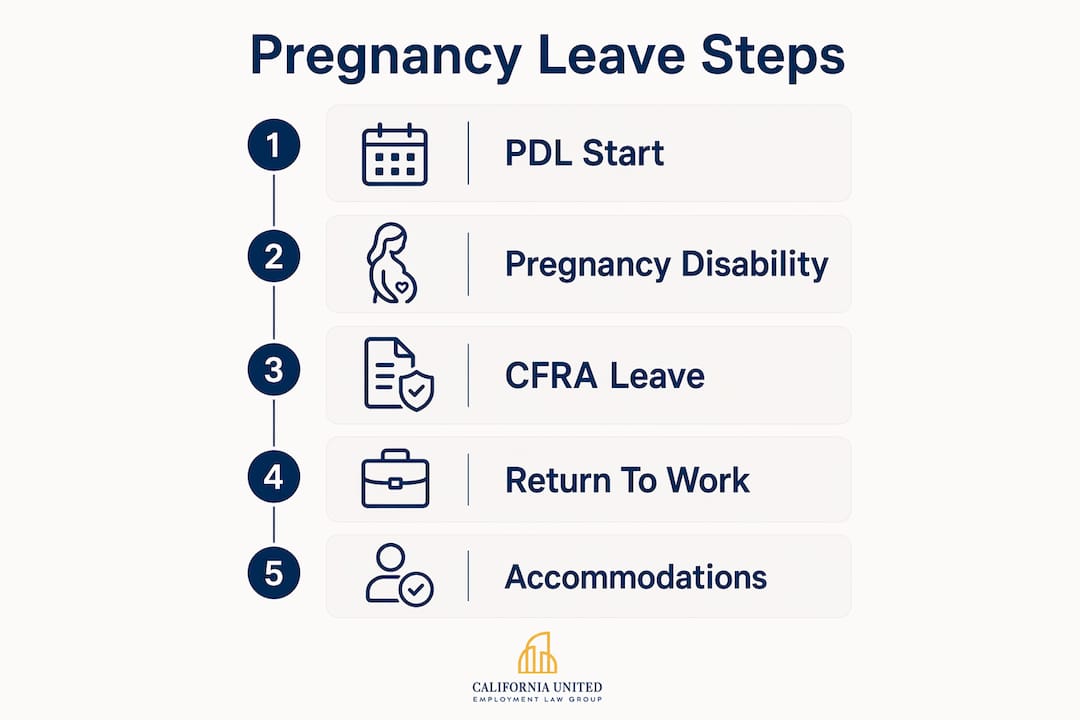
California Family Rights Act (CFRA) provides an additional 12 weeks of job-protected baby bonding leave after your PDL ends. To be eligible for CFRA, you must have worked for your employer for at least 12 months and logged at least 1,250 hours in the 12 months preceding the start of your pregnancy disability leave. Unlike PDL, CFRA is not available to all employees — newer and part-time workers who qualify for PDL may not meet CFRA eligibility requirements. The critical point is that PDL and CFRA run consecutively, not at the same time. Together, they can provide close to seven months of job protection for employees who are both actually disabled for the full PDL period and independently eligible for CFRA.
Here is how the leave sequence typically works:
- PDL begins when a pregnancy-related disability starts, which can be before your due date.
- PDL ends when your healthcare provider certifies that your disability has resolved, typically after delivery and recovery.
- CFRA bonding leave may begin immediately after PDL ends — but only for employees who independently meet CFRA eligibility requirements (12 months of employment and 1,250 hours worked). Eligible employees can take up to 12 additional weeks to bond with their newborn.
- FMLA may run concurrently with PDL for employees who qualify federally, but it does not reduce your CFRA entitlement.
- Wage replacement during PDL may come from California State Disability Insurance (SDI), accrued paid sick leave, or employer-provided disability benefits.
| Leave Type | Duration | Employer Size | Purpose |
|---|---|---|---|
| PDL | Up to 4 months | 5+ employees | Pregnancy-related disability |
| CFRA | Up to 12 weeks | 5+ employees | Baby bonding after PDL |
| FMLA | Up to 12 weeks | 50+ employees | Serious health condition or bonding |
Pro Tip: Build a written leave timeline before you speak with HR. Map out your expected PDL start date, estimated delivery, and CFRA bonding period. A clear leave timeline with medical certifications prevents payroll errors and protects your job reinstatement rights.
How do you identify and prove pregnancy discrimination at work?
Recognizing pregnancy discrimination is the first step toward protecting yourself. Pregnancy discrimination claims hinge on showing that adverse changes occurred after your employer learned of your pregnancy or related restrictions. The timing of your employer’s actions is often the most telling evidence.
California courts have recognized this evidentiary principle in decided cases. In Kelly v. Stamps.com Inc. (2005) 135 Cal.App.4th 1088, a decisionmaker’s comment that a seven-months-pregnant plaintiff had “checked out” was held to constitute direct evidence of a discriminatory motive in terminating her employment, reflecting what the court characterized as a combination of the employer’s reaction to her impending maternity leave and the diversion of attention attributable to her condition. Courts have similarly held that a prima facie case of FEHA pregnancy discrimination can be established even where an employer provides a pretextual explanation — including a false representation that no job was available — made for discriminatory reasons. (Abed v. Western Dental Services, Inc. (2018) 23 Cal.App.5th 726.) These cases illustrate that discriminatory intent need not be admitted outright; circumstantial evidence of timing and employer conduct will be carefully examined by courts.
Signs that may indicate unlawful pregnancy discrimination:
- A sudden negative performance review after disclosing your pregnancy
- Being passed over for a promotion you were previously on track to receive
- Receiving a demotion or schedule reduction shortly after announcing your pregnancy
- Your employer refusing to discuss accommodations your doctor has recommended
- Harassment or hostile comments from supervisors or coworkers about your pregnancy
“The strongest early record-building step is detailed documentation of accommodation requests, employer notification dates, and response actions.” This principle, grounded in California’s FEHA accommodation framework, applies directly to Monterey Park employees building a potential claim.
Documentation is your most reliable tool. Keep copies of emails, text messages, and written communications with HR or your supervisor. Note the dates when you disclosed your pregnancy and when any adverse actions followed. If your employer fails to engage in the good-faith interactive process required by FEHA, that failure itself can be a standalone claim.
Filing deadlines are firm. Workers must file complaints with the California Civil Rights Department within three years of the last discriminatory act to pursue FEHA remedies. Missing that deadline can eliminate your legal options entirely, so acting promptly matters. You can also learn more about proving workplace harassment under California law, since harassment based on pregnancy follows similar evidentiary standards.
What remedies are available for pregnancy discrimination victims in Monterey Park?
California law gives pregnancy discrimination victims meaningful legal recourse. The process begins with filing a complaint with the California Civil Rights Department (CRD), the state agency that investigates FEHA violations. You can file a CRD complaint without an attorney, but legal representation significantly improves your ability to gather evidence, negotiate settlements, and pursue a lawsuit after receiving a right-to-sue notice.
| Remedy Type | What It Covers |
|---|---|
| Lost wages | Back pay and future earnings lost due to discrimination |
| Reinstatement | Return to your former position or equivalent role |
| Emotional distress damages | Compensation for psychological harm caused by discrimination |
| Attorney fees | Legal costs paid by the employer if you prevail |
| Punitive damages | Available where the employer’s conduct constitutes malice, oppression, or fraud, as proven by clear and convincing evidence. |
Many attorneys who handle pregnancy discrimination cases work on a contingency fee basis. That means attorney fees are collected only if your case results in a recovery. However, clients may still be responsible for certain litigation costs — such as filing fees, deposition costs, and expert fees — regardless of outcome. Be sure to discuss cost responsibility with your attorney before signing a fee agreement. This arrangement makes legal representation accessible regardless of your current financial situation.
Successful outcomes in California pregnancy discrimination cases have included back pay awards covering months of lost income, reinstatement to positions unlawfully taken, and significant emotional distress settlements. Past results in any given case do not guarantee or predict a similar outcome in other matters, as the results in any case depend on the specific facts and legal circumstances involved. The employment lawsuit process in California involves pre-litigation negotiations, CRD administrative proceedings, and potential civil litigation, each stage offering opportunities for resolution.
Pro Tip: Request a right-to-sue notice from the CRD as soon as you are ready to pursue litigation. The CRD can issue one immediately upon request, and it opens the door to filing a civil lawsuit in California Superior Court.
Key Takeaways
California’s FEHA, PDL, and CFRA together give Monterey Park employees among the strongest pregnancy discrimination protections available anywhere in the United States.
| Point | Details |
|---|---|
| FEHA covers most employers | Any employer with 5+ employees must comply with FEHA pregnancy discrimination protections. |
| PDL and CFRA stack consecutively | Employees who are actually disabled for the full PDL period and who meet CFRA eligibility requirements can access close to 7 months of combined job-protected leave. |
| Documentation is critical | Written records of accommodation requests and employer responses form the core of any claim. |
| Filing deadlines are firm | You have 3 years from the last discriminatory act to file a CRD complaint under FEHA. |
| Legal remedies are substantial | Recoverable damages include lost wages, emotional distress, and attorney fees. |
What I’ve Seen Employers Get Wrong On Pregnancy Accommodations
After working through dozens of pregnancy discrimination matters across Monterey Park and the broader San Gabriel Valley, one pattern stands out above all others: employers consistently underestimate their obligation in the interactive accommodation process. Most employers understand they cannot fire a pregnant employee outright. Far fewer understand that simply offering one accommodation option and calling it done is not enough. FEHA requires a genuine, ongoing dialogue.
A second pattern I see regularly is the confusion workers themselves have about PDL and CFRA. Many employees accept their employer’s characterization of their leave entitlement without question. I have seen workers told they only have 12 weeks of leave when they were actually entitled to close to seven months of combined protection. That confusion costs people their jobs and their legal claims. Understanding how leave periods fit together before you speak with HR is not optional. It is necessary.
The most underused protection in pregnancy discrimination cases is the retaliation claim. If you request accommodations or file a complaint and your employer responds with adverse actions, that retaliation is a separate legal violation. California’s workplace retaliation protections are strong, and they apply directly to pregnancy-related requests. Do not assume that a negative response from your employer after you assert your rights is just “how things work.” It may be unlawful.
My consistent advice to Monterey Park employees: consult an attorney before you resign, sign any severance agreement, or accept a demotion. Many rights are waived in those moments, and they cannot be recovered later.
How California United Law Group Supports Monterey Park Employees Facing Pregnancy Discrimination
California United Law Group represents employees across Monterey Park and the surrounding San Gabriel Valley in pregnancy discrimination and FEHA claims. The firm handles every stage of a dispute, from pre-litigation accommodation negotiations through CRD filings and civil litigation. California United Law Group offers free, confidential consultations and works on a contingency fee basis, so you pay nothing unless your case results in a recovery. If you believe your employer has violated your pregnancy discrimination rights under California law, speaking with an experienced employment attorney is the most important step you can take right now.
FAQ
What is FEHA and how does it protect pregnant employees?
FEHA is California’s Fair Employment and Housing Act. It prohibits employers with five or more employees from discriminating against workers based on pregnancy, childbirth, or related medical conditions, and requires reasonable accommodations for pregnancy-related disabilities.
Can my employer deny my request for a pregnancy accommodation?
Your employer cannot deny a reasonable accommodation without first engaging in a good-faith interactive process. Refusing to discuss accommodations at all is itself a separate FEHA violation, independent of any discrimination claim.
How long do I have to file a pregnancy discrimination complaint in California?
You have three years from the last discriminatory act to file a complaint with the California Civil Rights Department. Missing this deadline can eliminate your ability to pursue FEHA remedies.
Do PDL and CFRA leave run at the same time?
No. PDL and CFRA run consecutively, not concurrently. This means eligible employees can access up to four months of PDL followed by 12 weeks of CFRA bonding leave, totaling close to seven months of combined job protection.
Do I need an attorney to file a pregnancy discrimination complaint?
You can file a CRD complaint without an attorney, but legal representation helps with evidence gathering, settlement negotiations, and any subsequent lawsuit. Many pregnancy discrimination attorneys offer free consultations and work on contingency.