
Long Beach, California gets underestimated more than almost any city on the West Coast. Most people assume it is just a suburb of Los Angeles or a stand-in for Orange County beach towns. It is neither. Long Beach is its own city with a distinct coastal identity, a port that drives a significant share of national commerce, and neighborhoods that shift from bohemian arts districts to waterfront luxury within a few blocks. Whether you are planning a visit, considering a move, or simply curious about what this city actually offers, this guide covers everything that matters in 2026.
Table Of Contents
- Key takeaways
- Long Beach California: location, climate, and getting around
- Long Beach beaches, waterfront, and top attractions
- Annual events and cultural life in 2026
- Housing market and neighborhoods in 2026
- Practical tips for visiting or relocating
- My honest take on what makes Long Beach different
- How California United Law Group supports Long Beach residents
- FAQ
Key Takeaways
| Point | Details |
|---|---|
| Distinct city identity | Long Beach is not part of Los Angeles or Orange County — it has its own government, culture, and coastal character. |
| Mild year-round climate | Temperatures range from 64°F in winter to 79°F in summer, making any season a reasonable time to visit. |
| Active housing market | The median home price hit $839,243 in early 2026, with options ranging from $490K to $1.3M depending on neighborhood. |
| Rich calendar of events | Long Beach Pride 2026 and other major cultural events make timing your visit around community life well worth it. |
| Travel logistics favor LGB | Long Beach Municipal Airport offers nonstop access to 21 airports and is far less congested than LAX. |
Long Beach California: Location, Climate, And Getting Around
Long Beach sits about 30 minutes from Los Angeles along the southern edge of Los Angeles County, directly on the Pacific coast. It borders Orange County to the south, which means you get access to both regions without being fully absorbed into either. That geographic position is one reason the city has developed such a layered character.
The climate here is genuinely mild throughout the year. Average highs range from about 64°F in February to 79.5°F in August, with roughly 14 inches of annual rainfall concentrated in winter months. You will not need to plan around extreme heat in summer or brace for cold winters. Light layers handle most of the year comfortably.
Getting To And Around The City
Your transportation options include:
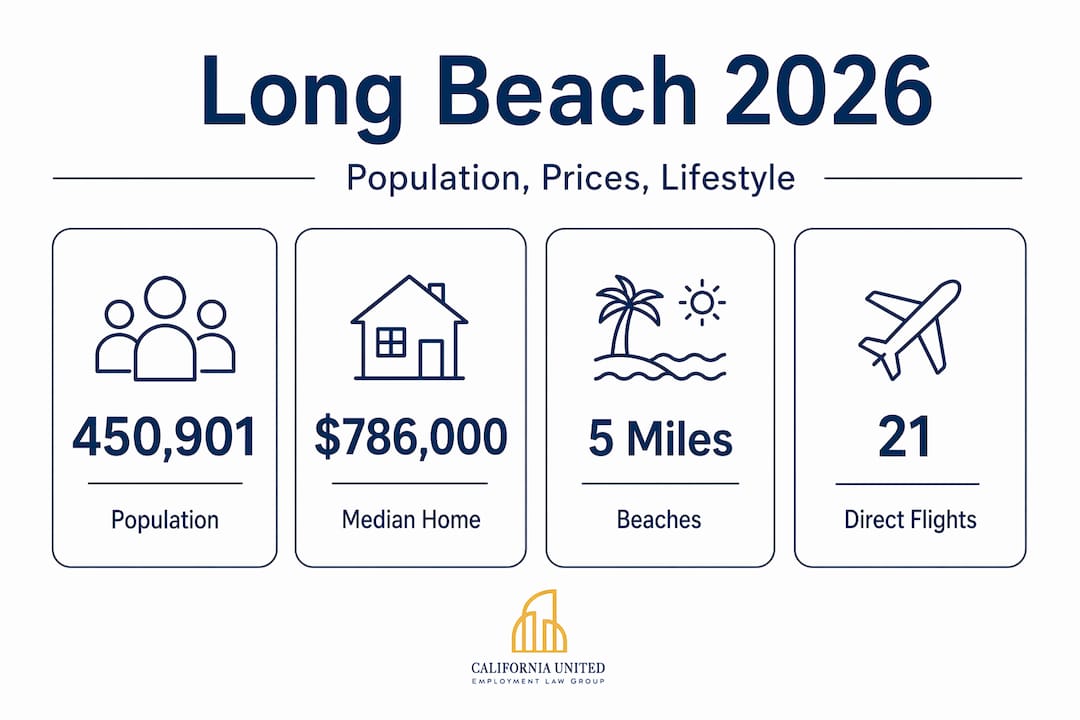
- Long Beach Municipal Airport (LGB): LGB offers nonstop service to 21 airports, with one-stop connections to nearly 400 cities globally. Because it is city-owned and significantly smaller than LAX, the experience is faster and less stressful.
- Los Angeles International Airport (LAX): About 20 miles north. Better for international flights and broader carrier options.
- John Wayne Airport (SNA): A reasonable alternative if you are coming from Orange County.
- Public transit: The Metro A Line connects Long Beach to downtown Los Angeles. Local buses serve most neighborhoods.
- Water taxis: The AquaBus and AquaLink connect the waterfront, Rainbow Harbor, and the Queen Mary with short ferry rides.
- Driving and parking: Most neighborhoods are car-friendly. Downtown and the waterfront get congested on weekends, so arrive early or use transit.
Pro Tip: If your travel originates from a city with direct LGB service, fly into Long Beach Airport instead of LAX. You will spend far less time in transit and arrive closer to most major attractions.
Long Beach Beaches, Waterfront, And Top Attractions
Long Beach has five miles of beaches stretching from Rainbow Harbor in the west to Alamitos Bay in the east. That sounds like a lot of ground to cover, and it is. Trying to visit every section in one day dilutes the experience. Pick one or two micro-areas and go deep rather than spreading yourself thin.

Rainbow Harbor anchors the main downtown waterfront and puts you within walking distance of major attractions. Alamitos Bay, on the eastern side, has a calmer, more residential feel with gondola rides through the Naples Island canals. Both are worth separate visits.
Major Long Beach Attractions At A Glance
| Attraction | Highlight | Family-friendly |
|---|---|---|
| Aquarium of the Pacific | Marine life exhibits; doubled sea turtle care capacity in Jan 2026 | Yes |
| Queen Mary | Historic ocean liner turned hotel and event venue | Yes |
| Shoreline Village | Waterfront shops, restaurants, and boat rentals | Yes |
| Naples Island Gondola Rides | Romantic canal tours through a residential island | Adults and older kids |
| Retro Row (4th Street) | Vintage shops, local restaurants, and art galleries | Teens and adults |
| Museum of Latin American Art | Regional cultural institution with rotating exhibits | Yes |
The Aquarium of the Pacific is worth calling out specifically. In January 2026, the aquarium expanded its sea turtle program by doubling its capacity to care for injured turtles. That expansion affects some programming and tour availability, so check their current schedule before booking.
Pro Tip: Pair beach time with one indoor attraction on the same day. The coastal marine layer can roll in by mid-afternoon, and having a museum or the aquarium on your itinerary keeps the day moving regardless of weather.
Whale-watching tours depart from Rainbow Harbor seasonally and offer a perspective on Long Beach that most visitors never think to include. If you are visiting between December and April, this is one of the better things to do in Long Beach that gets overlooked in standard travel guides.
Annual Events And Cultural Life In 2026
Long Beach has one of the most active community event calendars in Southern California. That is not an exaggeration. The city runs major cultural gatherings year-round, and timing your visit around them changes the experience significantly.
Here are the key events to know for 2026:
- Long Beach Pride 2026: Scheduled for May 15 through 17, the festival includes Teen Pride, vendor fairs, and the signature parade. The parade route runs along Ocean Boulevard with family activities and a festival at Marina Green Park. This event draws tens of thousands of attendees and affects parking and hotel availability across the waterfront.
- Cambodia Town Cultural Parade: Celebrates Khmer heritage and draws a large local community turnout, typically in spring.
- Long Beach Grand Prix: Street racing through the downtown core, typically in April. A major draw for motorsport fans and spectators who want front-row views from nearby restaurants and hotels.
- Long Beach Public Library programming: The library runs practical community events throughout the year. In May 2026, it hosts sessions like “AI for Job Seekers” that reflect the city’s investment in workforce development.
If you plan to visit during Pride or the Grand Prix, book your Long Beach hotels at least six to eight weeks in advance. Waterfront properties fill up fast, and rates increase significantly during those windows.
Housing Market And Neighborhoods In 2026
Long Beach has seen steady demand from buyers priced out of closer-in Los Angeles neighborhoods. The median home value reached $839,243 in February 2026, reflecting a 0.7% year-over-year increase. That modest growth signals stability rather than the volatile swings seen in some adjacent markets.
Prices vary significantly by neighborhood. The range runs from roughly $490,000 to $1.3 million depending on proximity to the water, school district quality, and neighborhood character. Here is how the broad spectrum breaks down:
| Price tier | Neighborhood type | Typical buyer or renter |
|---|---|---|
| $490K to $650K | Inland areas, east Long Beach | First-time buyers, young families |
| $650K to $950K | Mid-city, near transit corridors | Move-up buyers, remote workers |
| $950K to $1.3M | Waterfront, Belmont Shore, Naples | Equity-rich buyers, luxury renters |
One demographic factor worth noting: Long Beach’s population declined from 465,593 in 2020 to 450,901 in 2024. That slight population decrease has eased some demand pressure, which may explain why prices are rising modestly rather than aggressively. For buyers, that means less competition than you might expect given the city’s appeal.
Pro Tip: If you are considering living in Long Beach and budget is a primary concern, explore the neighborhoods east of the 710 freeway. They offer more square footage per dollar while still providing reasonable access to the waterfront and downtown.
Rental availability depends heavily on proximity to the water. Beachfront units and those near Belmont Shore command a premium year-round. Inland rentals offer better value and often include parking, which matters more than most newcomers realize.
Practical Tips For Visiting Or Relocating
Whether you are spending a weekend or considering a permanent move, a few practical realities will make your experience smoother.
- Choose lodging near your priorities. If your focus is Long Beach activities on the waterfront, stay downtown or in Belmont Shore. If you are attending Pride or the Grand Prix, a hotel within walking distance of Ocean Boulevard eliminates traffic headaches entirely.
- Balance your itinerary. A full day of beach and outdoor activities pairs well with a half-day at the Aquarium of the Pacific, the Museum of Latin American Art, or Retro Row. Combining beach time with indoor options keeps your schedule flexible against weather changes.
- Use the water taxis. The AquaBus and AquaLink are genuinely useful, not just novelties. They connect the major waterfront points and remove the need to find parking between stops.
- Check civic event schedules. The city is reviewing its public comment process for city council meetings. If you are relocating and plan to participate in local governance, check current procedures before attending.
- Know your workplace rights. Long Beach has a significant workforce across industries including the Port of Long Beach and the Port of Los Angeles:, healthcare, retail, and hospitality. California has some of the strongest employee protections in the country, covering areas like unpaid wages and safety reporting. Being generally aware of those protections is part of being informed as a resident.
My Honest Take On What Makes Long Beach Different
I have spent time in a lot of California coastal cities, and what consistently surprises me about Long Beach is how little it tries to be anything other than itself. Santa Monica performs for visitors. Venice performs for its own mythology. Long Beach just exists, and that is actually rare.
What I find genuinely compelling is how the city holds multiple identities without tension. You can spend a morning in the Naples canals where it feels like a quiet Italian-influenced neighborhood, then walk into a Cambodia Town parade in the afternoon, and end the night at a jazz bar on 4th Street. No other city in Los Angeles County offers that range in such a compact geographic area.
The misconception I hear most often is that Long Beach is gritty or industrial because of the port. The port is real, and it is visible from parts of the harbor. But it does not define the residential and visitor experience the way outsiders imagine. Most of the city feels nothing like an industrial zone.
My strongest advice for first-time visitors: do not try to cover the whole coast in one trip. Pick Belmont Shore or Rainbow Harbor, learn that area well, and come back for the other. You will leave with a much better sense of the city than if you drove from one end to the other checking boxes.
How California United Law Group Supports Long Beach Residents
If you are living in or relocating to Long Beach, knowing your workplace rights is part of building a stable life here. California has some of the most protective employee laws in the country, covering wrongful termination, wage and hour violations, workplace harassment, discrimination, and retaliation.
California United Law Group represents employees in Long Beach across a wide range of disputes, from unpaid wages to wrongful termination. The firm handles California Labor Code and FEHA claims at every stage, from initial consultation through litigation. If you work at the port, in healthcare, or in any industry where your rights may be at risk, understanding those protections matters.
California courts have consistently interpreted and enforced these protections in favor of employees. In Martinez v. Combs (2010) 49 Cal.4th 35, the California Supreme Court broadly construed employer liability for unpaid wages under Labor Code § 1194, holding that the applicable wage order defines who qualifies as an “employer” subject to liability — a ruling that strengthened accountability for workers throughout the state. For employees facing wrongful termination, Holmes v. General Dynamics Corp. (1993) 17 Cal.App.4th 1418 remains foundational, establishing the elements of a wrongful discharge claim in violation of public policy that courts continue to apply today. Employees experiencing workplace harassment have similarly strong protections: in Thompson v. City of Monrovia (2010) 186 Cal.App.4th 860, the court set out the elements of a racially hostile work environment claim under FEHA, requiring a showing that harassment unreasonably interfered with the employee’s work performance by creating an intimidating, hostile, or offensive environment. And in Kelley v. Conco Cos. (2011) 196 Cal.App.4th 191, the court confirmed that post-complaint harassment by coworkers can itself constitute unlawful retaliation where the employer had knowledge of the conduct and failed to stop it. These cases illustrate why having experienced legal representation matters when workplace rights are at stake.
You can also explore wage and hour rights and general employment law guidance for California workers on the California United Law Group website. This information is educational and not a substitute for legal advice specific to your situation.
FAQ
What is Long Beach, California known for?
Long Beach is known for its five miles of beaches, the Aquarium of the Pacific, the historic Queen Mary, an active events calendar, and one of the busiest ports in the United States.
Is Long Beach a good place to live?
Yes. Long Beach offers a mild climate, diverse neighborhoods, and a range of housing prices from $490,000 to $1.3 million. Its proximity to Los Angeles makes it popular with commuters and remote workers alike.
What is the best time to visit Long Beach?
Late spring and early fall offer the best combination of weather and events. May brings Long Beach Pride 2026 (May 15 to 17), while April hosts the Grand Prix. Summer averages a comfortable 79°F.
Is Long Beach Airport better than LAX for visiting the city?
For most domestic travelers, yes. Long Beach Municipal Airport offers nonstop service to 21 airports with far less congestion than LAX, making it a faster and more practical entry point for the city.
What are the best neighborhoods in Long Beach for newcomers?
Belmont Shore is popular for its walkable restaurant and bar scene. Naples Island appeals to those who want a quieter waterfront feel. East Long Beach offers more affordable options with good transit access to downtown.
Recommended
- Can Long Beach Workers Claim Unpaid Wages? Your Rights Explained – California United Law Group
- Long Beach Workers Reporting Safety Violations: Your Rights – California United Law Group
- Can Long Beach port workers be penalized for reporting safety? – California United Law Group
- Employment Lawyer Long Beach – California United Law Group