
Facing a sudden cut in hours at work while pregnant can stir up stress and confusion, especially when you rely on your pay and benefits. In California, state and federal laws step in to protect your right to reasonable schedule changes tied to pregnancy-related needs—not just your employer’s convenience. This guide provides general information on what may count as a legal schedule reduction, how California law compares to federal law, and potential steps to consider for protecting your rights.
Table of Contents
- Pregnancy-Related Schedule Reductions Defined
- California Law Protecting Pregnant Workers
- Types of Schedule Adjustments and Legal Limits
- Employer Obligations and Common Violations
- Legal Remedies for Unlawful Schedule Reductions
Key Takeaways
| Point | Details |
|---|---|
| Pregnancy-Related Schedule Reductions | Employers must provide reasonable accommodations for pregnancy-related work schedule needs unless doing so would create undue hardship on business operations. |
| Interactive Process Requirement | Employers are required to engage in discussions about accommodations, exploring options that do not impose undue hardship. |
| California Protections | California law offers stronger protections than federal law, including guaranteed leave and flexibility specifically for pregnancy-related needs. |
| Documentation Importance | Maintaining clear written records of accommodation requests and employer responses is critical for protecting your rights and claims. |
Pregnancy-Related Schedule Reductions Defined
Pregnancy-related schedule reductions are legally recognized accommodations that modify your work hours or schedule to address physical or mental conditions caused by pregnancy, childbirth, or related medical conditions. These adjustments allow you to maintain employment while managing pregnancy-related symptoms and medical care needs.
Under federal law, including the Pregnant Workers Fairness Act, employers must provide reasonable accommodations for known pregnancy-related limitations. This means your employer cannot simply deny schedule changes without exploring whether an accommodation is possible. However, employers may deny accommodations that would impose undue hardship on their operations.
What Schedule Reductions Can Include
These accommodations take many forms depending on your specific needs:
- Reduced work hours per week or per day
- Flexible start and end times
- Modified shift schedules (such as avoiding physically demanding shifts)
- Temporary schedule adjustments during critical pregnancy periods
- Adjusted break times for medical appointments or rest
- Remote work options when medically necessary
The key is that these adjustments address your specific pregnancy-related condition, not a general preference. Through the interactive process, you and your employer should identify accommodations that address your actual medical needs. Your employer should not unilaterally impose an accommodation without meaningful discussion of your specific limitations.
How They Differ From Other Leave
Schedule reductions are not the same as taking time off or using sick leave. Instead, you modify your regular work schedule while staying employed. You continue working, earning wages, and maintaining benefits—you simply work different hours or a different arrangement.

This distinction matters because schedule reductions preserve your job continuity and full employment status while providing the medical and physical relief you need.
The Legal Foundation
California law and federal protections require employers to engage in an interactive process with you. This means discussing your condition, exploring possible accommodations, and reaching an agreement that works for both parties—without imposing undue hardship on the business.
Your employer cannot refuse a schedule reduction simply because it is inconvenient; they must show that the accommodation creates substantial increased costs or operational difficulty.
California courts have emphasized the importance of the interactive process. In Sanchez v. Swissport, Inc. (2013) 213 Cal.App.4th 1331, the court held that additional disability leave for a pregnant employee beyond the four-month PDLL period may be required under FEHA as a reasonable accommodation, demonstrating that employers must engage meaningfully in determining appropriate accommodations.
The difference between a reasonable accommodation and an unreasonable burden on the employer is fact-specific. Your employer’s size, resources, and operational structure all matter.
Pro tip: Document all discussions about your pregnancy-related condition and any schedule reduction requests in writing—emails to your supervisor create a clear record of what was discussed and when.
California Law Protecting Pregnant Workers
California offers some of the strongest pregnancy protections in the nation. The state’s laws go beyond federal requirements, giving pregnant employees extensive rights that your employer must respect. Under FEHA, these protections apply to employers with five or more employees. Unlike some other leave laws, pregnancy disability leave does not require a minimum period of employment with your current employer.
Under California’s Fair Employment and Housing Act (FEHA), you cannot be discriminated against, harassed, or retaliated against because of pregnancy, childbirth, or related medical conditions. Your employer must treat pregnancy the same way they treat other temporary disabilities—with full legal protection and reasonable accommodations.
Key Protections You Have
California law guarantees you several specific rights:
- Pregnancy Disability Leave (PDL): Up to four months of job-protected leave for pregnancy-related disabilities (calculated as the time you would normally work in four months, which equals 88 days for full-time employees working five-day weeks), which may be taken continuously or intermittently
- Schedule flexibility: Employers must modify your work schedule to accommodate pregnancy-related needs
- Break time: You’re entitled to reasonable breaks for rest and medical appointments
- Lactation accommodations: Your employer must provide break time and a private space for nursing or pumping
- No forced leave: Your employer cannot force you to take PDL before you’re medically unable to work
- Under the Pregnant Workers Fairness Act, your employer cannot require you to take leave if another reasonable accommodation can address your pregnancy-related limitations.
How California’s Law Compares to Federal Protection
California’s protections are often more expansive than federal law. While federal law requires reasonable accommodations, California’s framework is specifically designed for pregnant workers and covers more situations. This means you may have rights under California law even if federal protections might not apply.
For example, Pregnancy Disability Leave can be taken intermittently or on a reduced schedule basis, giving you flexibility federal law doesn’t always guarantee.
Here’s how California and federal pregnancy protections compare:
| Category | California Law (FEHA & PDL) | Federal Law (PWFA, ADA, FMLA) |
|---|---|---|
| Duration of leave | Up to 4 months PDL | Up to 12 weeks unpaid FMLA (if eligible) |
| Employer size threshold | 5 or more employees | 15 or more (PWFA/ADA); 50 for FMLA |
| Coverage of intermittent/reduced schedule | Explicitly permitted | Case-by-case eligibility |
| Scope of job protections | Broader, covers more situations | Generally narrower, less flexible |
The importance of treating pregnancy-related conditions seriously is well-established. In Gelfo v. Lockheed Martin Corp. (2006) 140 Cal.App.4th 34, the court emphasized that both the employee and employer share responsibility for engaging in good faith in the interactive process, and failure to participate in good faith can result in liability.
The Reasonable Accommodation Requirement
Your employer must engage in an interactive process with you to identify accommodations. They cannot simply deny your request—they must explain why an accommodation would cause undue hardship. The burden is on your employer to prove the hardship, not on you to prove the accommodation is feasible.
Common accommodations include modified duties, reassignment to less strenuous roles, flexible start times, or working from home when medically appropriate.
California law requires employers to provide accommodations unless doing so creates genuine, substantial operational or financial hardship—not mere inconvenience.
What constitutes undue hardship depends on factors including the employer’s size, financial resources, and the nature of its operations.
If your employer refuses a reasonable accommodation without legitimate justification, this could constitute illegal discrimination or retaliation under California law.
Pro tip: Keep records of your pregnancy-related condition, any medical appointments, and all communications with your employer about accommodations—this documentation protects you if disputes arise later.
Types of Schedule Adjustments and Legal Limits
Schedule adjustments come in many forms, depending on your pregnancy-related needs and your employer’s operational capacity. The law doesn’t specify one “correct” accommodation—instead, it requires your employer to work with you to find what works for your medical situation.
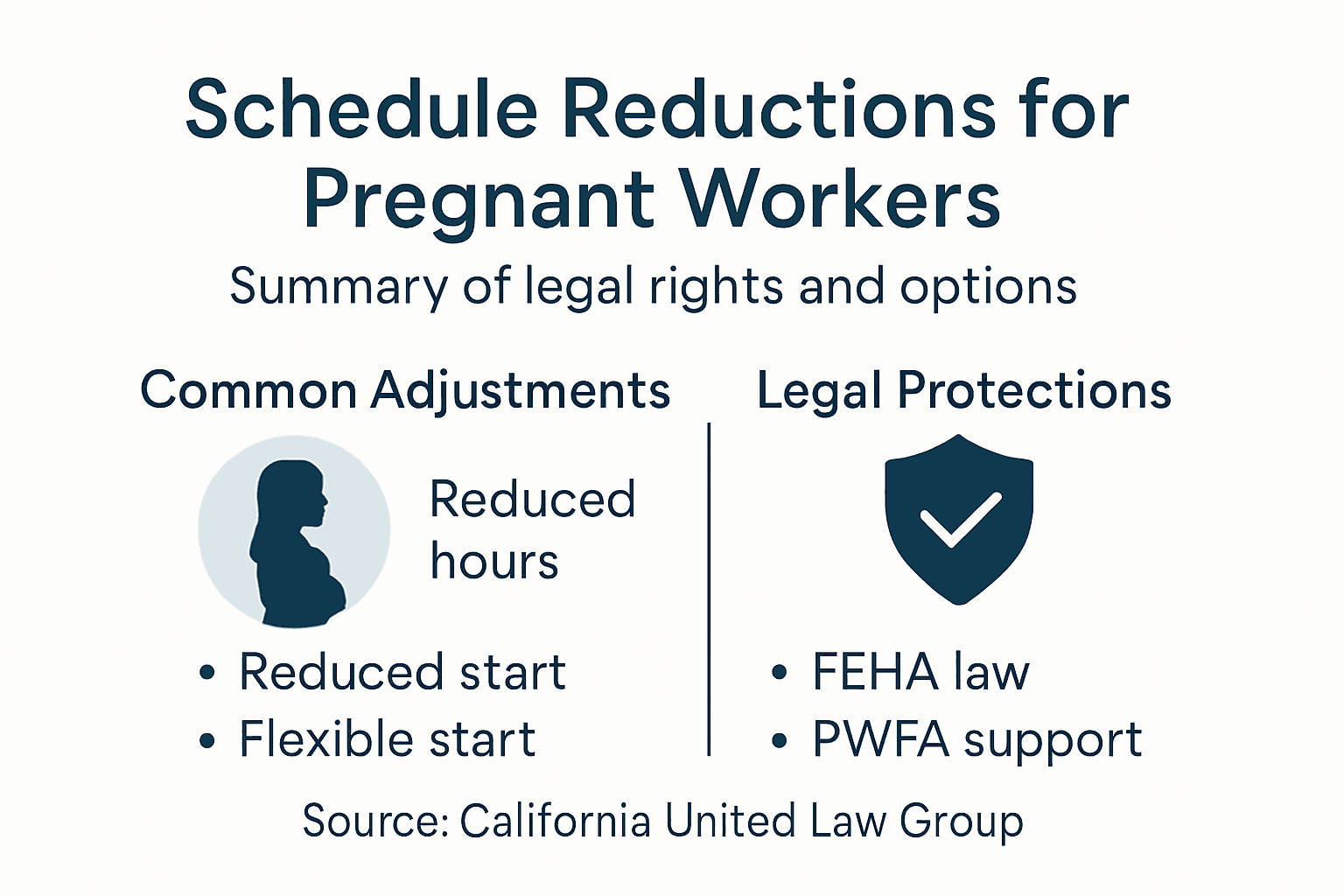
Common adjustments include reduced hours, flexible start times, part-time arrangements, and longer or more frequent breaks. Some pregnant workers need temporary reassignment to less physically demanding roles. Others need time for medical appointments or to manage symptoms like severe fatigue or nausea.
Specific Types of Adjustments
Your employer might offer several options:
- Reducing your weekly hours while maintaining your position
- Shifting your schedule to start or end at different times
- Converting to part-time work temporarily during high-symptom periods
- Adding extra breaks for rest or medical appointments
- Allowing remote work or modified duties
- Temporarily reassigning you to less strenuous tasks
- Providing flexible time off for prenatal care
The key is that your adjustment addresses your specific medical condition. A vague request for “flexibility” won’t work—you need to explain what pregnancy-related limitation requires the change.
What “Undue Hardship” Actually Means
Your employer can refuse an accommodation only if it creates undue hardship. This doesn’t mean minor inconvenience. Under the law, undue hardship requires significant difficulty or expense to the employer’s operations. This is determined on a case-by-case basis examining the specific facts of each situation.
Factors courts consider include your company’s size, budget, existing operations, and whether other employees have similar accommodations. A large corporation claiming hardship from reduced hours faces different scrutiny than a small business.
The Legal Standard Is Individualized
There’s no one-size-fits-all rule. Your employer must analyze your specific situation, your medical needs, and their actual capacity. They cannot use blanket policies that deny all schedule reductions or force everyone into the same accommodation.
An employer cannot deny an accommodation simply because it’s inconvenient or because other pregnant workers received different accommodations. Each request must be evaluated individually based on the employee’s specific medical needs and the employer’s operational constraints.
If your employer refuses without engaging in a real discussion about your condition and their capacity, they may be violating your rights.
Pro tip: Request your accommodation in writing and specifically describe the pregnancy-related limitation it addresses—this creates documentation and forces your employer to provide a detailed response rather than a quick denial.
Employer Obligations and Common Violations
Your employer has specific legal duties when you request a pregnancy-related schedule adjustment. Under FEHA, these obligations apply to California employers with five or more employees. The federal Pregnant Workers Fairness Act applies to employers with 15 or more employees. Understanding what your employer must do—and what violations look like—helps you recognize when your rights are being violated.
Your employer’s primary obligation is to engage in an interactive process with you. This means discussing your medical needs, exploring accommodation options together, and working toward a solution. It’s not a one-sided conversation where your employer simply says yes or no.
What Employers Must Do
California law requires your employer to:
- Listen to your accommodation request and take it seriously
- Gather information about your pregnancy-related limitation
- Consider feasible adjustments without forcing you to suggest them
- Explain any denial with specific reasons, not blanket policies
- Avoid discrimination, harassment, or retaliation for requesting accommodations
- Provide reasonable accommodations for pregnancy-related medical needs unless undue hardship exists
These obligations are balanced against the employer’s right to deny accommodations that would create genuine undue hardship. The interactive process is designed to find mutually workable solutions.
Common Violations That Happen in Glendale
Many pregnant workers face violations they don’t recognize as illegal. Watch for these red flags:
- Denying your accommodation request without explaining why
- Refusing to discuss your medical needs or the interactive process
- Forcing you to take leave instead of granting a schedule reduction
- Retaliating against you for requesting an accommodation
- Using blanket policies that deny all schedule adjustments
- Treating you differently than non-pregnant employees with similar limitations
- Failing to maintain confidentiality about your pregnancy
What Retaliation Actually Means
Retaliation occurs when your employer punishes you for asserting your legal rights. This might include denying a promotion, cutting hours, transferring you to an undesirable position, or creating a hostile work environment after you request an accommodation.
Retaliation doesn’t require that your accommodation request was granted. Simply requesting one—or complaining about a denial—is protected activity.
An employer cannot punish you for requesting a pregnancy-related accommodation, even if they ultimately deny the request on valid grounds. Employees are protected when they request accommodations in good faith based on actual pregnancy-related conditions.
If your situation worsened after you made your request, documentation of that timing is crucial.
Pro tip: Save copies of every email, message, and document related to your accommodation request, including your employer’s response—this timeline and documentation become critical evidence if you need to pursue a legal claim.
California courts have made clear that retaliation claims stand independently. An employee need not prove the underlying accommodation was legally required—only that they engaged in protected activity by requesting it. This principle applies across employment discrimination contexts and protects employees who assert their rights in good faith.
Legal Remedies for Unlawful Schedule Reductions
If your employer unlawfully denies or reduces your schedule accommodation, you have legal options. California law provides multiple remedies designed to compensate you for harm and hold employers accountable. Understanding these options helps you evaluate what action makes sense for your situation.
You can pursue remedies through administrative agencies, settlement negotiations, or litigation. Many cases resolve through negotiation before reaching court, but knowing the full range of remedies strengthens your position in those discussions.
Types of Available Remedies
If you prevail in a pregnancy accommodation claim, you may recover:
- Back pay and lost wages from the time your accommodation was wrongfully denied
- Front pay for future lost earnings if reinstatement isn’t feasible
- Compensatory damages for emotional distress, anxiety, or harm to your reputation
- Punitive damages in cases involving malicious or oppressive conduct by your employer, which requires clear and convincing evidence that the employer acted with fraud, malice, or oppression
- Attorney’s fees and litigation costs
- Reinstatement to your original position or an equivalent role
- Prospective injunctive relief requiring your employer to provide the accommodation going forward
The specific remedies available depend on which law your claim is based on—California’s FEHA offers broader remedies than some federal claims.
Below is a summary of possible remedies if your rights are violated:
| Remedy Type | What It Provides | When Awarded |
|---|---|---|
| Back pay | Compensation for lost wages | Denial of accommodation |
| Emotional distress | Damages for mental suffering | Employer’s unlawful conduct |
| Punitive damages | Additional penalty for egregious acts | Malicious or intentional violations |
| Reinstatement | Return to same/equivalent job | Wrongful job loss after denial |
The Two-Track Approach: Admin and Court
You can file a complaint with the California Civil Rights Department (CRD) before pursuing litigation. You must file with CRD within three years of the violation for FEHA claims, or within 180 days for federal claims under PWFA (extendable to 300 days if you also file with a state agency). This administrative route investigates your complaint and may result in settlement, but you can also request a “right to sue” letter to proceed in court.
Alternatively, you can pursue claims directly through litigation, depending on the legal theory. Retaliation claims in California often overlap with accommodation denials, expanding your available remedies.
What Damages Actually Cover
Damages aren’t just about replacing lost wages. Compensatory damages recognize the stress, anxiety, and disruption to your life caused by the violation. Punitive damages punish egregious employer conduct and deter future violations.
Remedies are designed to make you whole—to restore you to the position you would have been in if the violation never occurred. However, you bear the burden of proving your damages with credible evidence.
If your employer’s conduct was particularly severe or deliberate, punitive damages can significantly exceed your actual lost wages.
Why Documentation Matters for Remedies
Your documentation directly impacts the remedies you can recover. Clear records of your accommodation request, your employer’s response, and the impact on your pay and health establish the damages you suffered.
Without documentation, proving the amount of back pay or the extent of emotional harm becomes harder. Your timeline and communications are your strongest evidence.
Pro tip: Keep records not just of work communications, but also medical appointments you missed, symptoms that worsened, and any financial impact—these document the real harm caused by the violation and support higher damage awards.
Understanding Your Rights to Pregnancy-Related Schedule Accommodations in Glendale
If you are experiencing challenges with pregnancy-related schedule accommodations at work, you are not alone. Many pregnant employees face denied accommodation requests or pressure to take leave when schedule modifications could allow them to continue working.
Understanding your rights under California law, including the Fair Employment and Housing Act (FEHA) and the federal Pregnant Workers Fairness Act (PWFA), is important for protecting yourself from potential discrimination or retaliation.
Disclaimer: This article provides general information only and does not constitute legal advice. Every employment situation is different, and the application of these laws depends on your specific circumstances. If you believe your rights have been violated, you should consult with a qualified employment attorney who can evaluate your individual case.
California United Law Group, P.C. focuses on California employment law and represents employees in matters involving pregnancy discrimination, denied accommodations, and workplace rights. To discuss your specific situation, visit https://calunitedlaw.com/ or contact our office for a consultation.
Frequently Asked Questions
The following are general answers to common questions. These answers do not constitute legal advice and may not apply to your specific situation.
What are pregnancy-related schedule reductions?
Pregnancy-related schedule reductions are legal accommodations that modify your work hours or schedule due to physical or mental conditions caused by pregnancy, childbirth, or related medical issues. These adjustments allow you to keep your job while managing pregnancy-related symptoms.
What types of schedule reductions can I request during pregnancy?
You can request various types of schedule reductions, including reduced work hours, flexible start and end times, modified shifts to avoid physically demanding tasks, temporary schedule adjustments during critical pregnancy periods, and remote work options if medically necessary.
How do pregnancy-related schedule reductions differ from sick leave?
Schedule reductions are not the same as taking sick leave; they involve modifying your working hours or schedule while continuing to work. This means you maintain employment and benefits while accommodating your pregnancy-related needs.
What should I do if my employer denies my schedule reduction request?
If your employer denies your request, they must provide specific reasons related to undue hardship. You should document all discussions and communications regarding your request, and consider discussing your situation further or seeking legal advice if you believe your rights are being violated.
Recommended
- Employment Lawyer Glendale – Los Angeles Employment Lawyers | California United Law Group, P.C.
- Glendale Healthcare Overtime Pay Disputes Explained – California United Law Group
- Employment Lawyer Burbank – Los Angeles Employment Lawyers | California United Law Group, P.C.
- Medical Leave Retaliation in El Monte Workplaces – California United Law Group