
ATTORNEY ADVERTISING DISCLAIMER: This article is provided for informational purposes only and does not constitute legal advice. The information presented is general in nature and may not apply to your specific situation. Outcomes in legal cases vary based on individual facts and circumstances. Reading this article does not create an attorney-client relationship. For legal advice about your specific situation, consult with a qualified employment attorney.
This article discusses California state law and federal law. Laws vary by state. If you work outside California, different laws may apply. This article is intended for informational purposes regarding California employment law.
This article was published in February 2026. Laws change over time. This information may not reflect the most current legal developments.
Facing the decision to report a workplace issue often brings uncertainty, especially in the fast-paced tech scene of Culver City. Many tech employees worry about possible backlash, but various federal and California state laws may provide protections against employer retaliation when workers report certain legal violations for raising legal concerns. Knowing the laws designed to protect you can give you the confidence to speak up—this guide breaks down your key rights and steps to safeguard yourself if you witness or experience violations.
Table of Contents
- Whistleblower Protections For Tech Employees
- Federal Whistleblower Protections
- California State Protections
- What Counts As Protected Activity
- Retaliation Is Illegal
- Your Rights And Next Steps
- Types Of Violations Covered By Law
- Workplace Safety And Health
- Wage And Hour Violations
- Fraud And Financial Misconduct
- Discrimination And Harassment
- Abuse Of Authority And Illegal Conduct
- How Reporting Works
- How To Report Workplace Violations Safely
- Document Everything First
- Report Internally First (Usually)
- File A Government Complaint
- What To Include In Your Report
- Protect Yourself During The Process
- When To Consult An Attorney
- Employer Retaliation: Recognizing And Proving It
- What Counts As Retaliation
- Obvious Vs. Subtle Retaliation
- The Three Elements You Must Prove
- Gathering Evidence Of Retaliation
- Timeline And Proximity
- When To Report Retaliation
- Legal Remedies And Filing A Claim
- Types Of Legal Remedies Available
- Filing An Administrative Complaint
- Private Lawsuits Under California Law
- The Process For Filing A Claim
- What You Need To Prove
- Settlement Vs. Trial
Key Takeaways
| Point | Details |
|---|---|
| Legal Protections Exist | Tech employees in Culver City are protected when reporting violations under federal and California state laws. |
| Reporting Channels | Employees can report violations internally or externally, and both avenues are safeguarded against retaliation. |
| Retaliation is Prohibited | Employers cannot take adverse actions against employees for making protected reports; retaliation can include subtle and obvious forms. |
| Documentation is Key | Keeping thorough records of violations and interactions is crucial for proving a retaliation claim if it occurs. |
Whistleblower Protections for Tech Employees
Tech workers in Culver City have legal protections when they report workplace violations. These safeguards exist at both federal and California state levels, though they operate differently depending on what you’re reporting.
Understanding which laws protect you helps you take action confidently. The landscape includes several key federal statutes designed specifically to shield employees from retaliation.
Federal Whistleblower Protections
Multiple federal laws protect private-sector tech employees who report misconduct. Certain federal whistleblower statutes may protect employees from retaliation when they report specific types of violations, subject to the requirements and limitations of each statute. Your employer cannot fire, demote, reduce pay, or take other adverse actions in response to your report.
Key federal laws that may apply to tech workers include:
- Sarbanes-Oxley Act – Protects employees reporting fraud or securities violations at publicly traded companies
- False Claims Act – Covers reports about false claims submitted to the government
- Occupational Safety and Health Act (OSHA) – Shields workers reporting unsafe working conditions
- National Labor Relations Act (NLRA) – Defends employees discussing wages, hours, or working conditions
- Defend Trade Secrets Act – Protects employees reporting trade secret theft or misuse
These federal protections vary significantly in their scope, procedures, and remedies. Some require specific reporting procedures or have strict filing deadlines. Consultation with an attorney is important to understand which protections may apply to your situation.
Federal law explicitly prohibits retaliation for whistleblowing, meaning your employer cannot punish you for making a protected report.
These laws apply regardless of your industry, but they protect disclosures about specific types of misconduct. Fraud, safety violations, labor law violations, and trade secret abuse all qualify for protection.
California State Protections
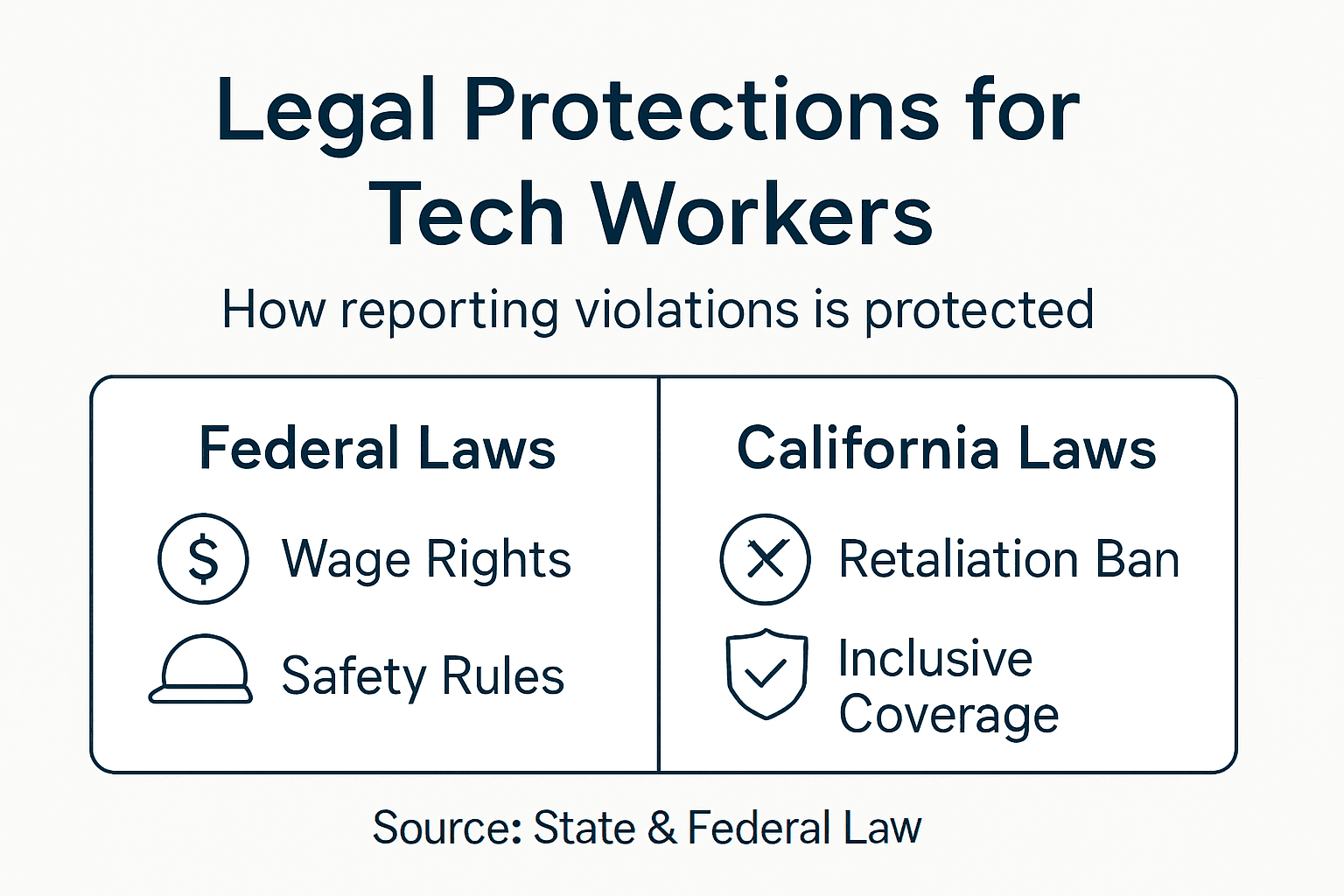
California Labor Code section 1102.5 and related provisions may provide broader protections than many federal statutes. The state offers broad retaliation protection for employees who report violations of any law to government agencies or internally.
California’s approach is stronger than federal protections in several ways:
- Protection applies to reports about violations of any law, not just specific statutes
- You can report to your employer, a government agency, or a law enforcement official
- The law covers internal complaints, not just external disclosures
- Employer retaliation claims can result in damages and attorney’s fees
This means reporting safety concerns, discrimination, wage violations, or any other unlawful conduct receives legal protection under California law.
Here’s a side-by-side overview of key differences between federal and California state whistleblower protections:
| Feature | Federal Law Focus | California State Law |
|---|---|---|
| Scope of Protection | Specific statutes only | All violations of any law |
| Who You Can Report To | Mainly government only | Employer, government, or law enforcement |
| Internal Complaints | Often limited | Fully protected |
| Remedies Available | Varies by statute | Includes damages and attorney fees |
| Industry Coverage | All industries | All industries |
What Counts as Protected Activity
Not every complaint receives protection. Your report must involve a genuine violation of law to qualify.
Protected reports typically involve:
- Safety violations or hazardous working conditions
- Wage and hour violations (unpaid overtime, misclassification)
- Discrimination or harassment based on protected characteristics
- Fraud or illegal financial practices
- Environmental violations
- Labor law violations
- Retaliation itself (reporting retaliation is protected)
Your report can be written or verbal, detailed or general. You don’t need to use specific legal terminology or cite statutes by name.
Retaliation Is Illegal
Employers are prohibited by law from retaliating against employees for making protected reports, though proving retaliation requires showing specific elements. This protection covers obvious retaliation like termination and subtle forms like reduced shifts, negative performance reviews, or exclusion from meetings.
Common forms of illegal retaliation include:
- Termination or layoff
- Demotion or transfer to less desirable position
- Reduced hours or pay
- Negative performance evaluations
- Hostile treatment from management or coworkers
- Loss of benefits or advancement opportunities
- Any adverse employment action taken because of the report
If you experience retaliation after reporting, you may have a legal claim even if you weren’t fired.
Your Rights and Next Steps
Knowing your protections empowers you to act. You have the right to report violations without fear of retaliation, and California law backs that right.
If you’re considering making a report, document everything carefully. Keep records of the violation you plan to report and any conversations about it. Having employees’ rights after reporting misconduct clearly understood before you act protects your case later.
Document dates, times, people involved, and what was said or done. This creates a clear record if retaliation occurs.
Consult with an employment attorney before making significant reports. They can advise you on which laws apply, what protections cover your situation, and how to report safely.
Best practice: Keep all documentation related to the violation and any retaliation in a secure location separate from work devices, and send copies to your personal email before taking action.
Types of Violations Covered by Law
Whistleblower protections cover a wide range of workplace violations. Understanding what qualifies helps you recognize when your report receives legal protection.

The laws protect reports about illegal conduct, safety hazards, fraud, and abuse of authority. Your industry doesn’t limit coverage—protections apply broadly across sectors, including tech.
California courts have interpreted these protections broadly. In Green v. Ralee Engineering Co. (1998), the California Supreme Court recognized that Labor Code section 1102.5 reflects a ‘broad public policy interest in encouraging workplace whistleblowers to report unlawful acts without fearing retaliation.’ The court held that an employee who internally reported that a company was shipping defective aircraft parts that endangered passenger safety was protected, even though the report was made only to management and not to a government agency.
Workplace Safety and Health
Reporting unsafe working conditions receives strong legal protection. Federal whistleblower laws specifically shield employees who disclose safety hazards and health risks.
Safety violations that qualify for protection include:
- Hazardous working conditions or exposure to dangerous substances
- Failure to provide required safety equipment or training
- Violations of workplace safety regulations (OSHA standards)
- Unsafe equipment or machinery
- Inadequate ventilation, lighting, or ergonomic conditions
- Refusal to address known health risks
For tech workers, this might include poor ventilation in data centers, inadequate ergonomic setups, or hazardous chemical exposure in hardware labs.
Below is a summary of the main types of violations protected under whistleblower laws and real-world tech workplace examples:
| Violation Type | Brief Description | Example in Tech Workplace |
|---|---|---|
| Workplace Safety | Hazardous conditions or practices | Inadequate ventilation in server rooms |
| Wage & Hour | Unpaid or misclassified work | Required unpaid overtime |
| Financial Fraud | Illegal or deceptive finances | Manipulated revenue figures |
| Discrimination | Bias based on protected status | Unequal pay for similar roles |
| Abuse of Authority | Orders to break the law | Pressured to ignore privacy breaches |
Wage and Hour Violations
Employers cannot retaliate when you report unpaid wages or overtime issues. These violations harm your paycheck directly, making them critical to report.
Covered wage violations include:
- Unpaid overtime or compensation
- Misclassification as independent contractor when you should be an employee
- Improper meal or rest break deductions
- Withheld wages or final paychecks
- Violations of minimum wage requirements
- Off-the-clock work expectations
Tech workers frequently encounter misclassification issues or expectations to work unpaid overtime without proper compensation.
Fraud and Financial Misconduct
Reporting dishonest financial practices receives protection under multiple laws. Fraud, falsified records, and illegal accounting practices all qualify.
Protected fraud reports cover:
- Securities fraud or financial statement manipulation
- False billing or false claims to government agencies
- Embezzlement or theft of company assets
- Misrepresentation to clients or regulators
- Money laundering or financial crimes
- Kickback schemes or bribery
Reporting financial crimes protects not just you, but potentially your company and clients from serious legal consequences.
Discrimination and Harassment
Retaliation for reporting discrimination or harassment is itself illegal. You’re protected when you disclose bias based on protected characteristics.
Covered violations include:
- Discrimination based on race, color, religion, sex, national origin, age, or disability
- Sexual harassment or quid pro quo harassment
- Hostile work environment harassment
- Unequal pay for equal work
- Denial of promotions or opportunities based on protected status
- Retaliation against employees who report discrimination
Tech workplaces sometimes struggle with diversity and inclusion issues, making these protections particularly important.
Abuse of Authority and Illegal Conduct
Broad protections cover reports about any illegal activity. You don’t need to prove major fraud—even general lawbreaking receives protection.
Additional covered violations include:
- Violation of environmental laws
- Labor law violations beyond wage and hour issues
- Gross mismanagement or waste of resources
- Abuse of authority by management
- Retaliation itself (reporting retaliation is protected)
If your employer directs you to do something illegal or ignores obvious lawbreaking, you can report it safely.
How Reporting Works
You can report violations internally to management or HR, or externally to government agencies. Both receive legal protection in California.
You don’t need to:
- Use formal language or legal terms
- Provide perfect evidence or documentation
- Report through specific channels
- Exhaust internal processes before reporting externally
- Prove the violation with certainty
Good faith reports about suspected violations receive protection even if you’re mistaken about the facts.
Practice tip: Document the specific violation with dates, names, and what happened before reporting, so you have a clear record if retaliation occurs later.
How to Report Workplace Violations Safely
Reporting violations requires strategy to protect yourself and build a strong case. The goal is creating a clear record while minimizing personal risk.
You have multiple reporting options, each with different advantages. Choosing the right path depends on your situation, the violation, and your comfort level.
Document Everything First
Before you report anything, create a comprehensive written record. Documentation protects you if retaliation occurs and strengthens any legal claim later.
Key information to document:
- Dates and times of the violation or harmful conduct
- Names of people involved (witnesses, managers, perpetrators)
- Specific details about what happened
- Location where the violation occurred
- Any emails, messages, or records related to the violation
- Impact on you or other employees
- Previous attempts to address the issue internally
Store this documentation securely outside your work computer. Send copies to your personal email or keep them on a personal device.
Strong documentation becomes your evidence if you need to prove retaliation or file a formal complaint later.
Report Internally First (Usually)
Many employees start by reporting to their direct manager or HR department. Internal reporting creates an internal record and may resolve the issue quickly.
When reporting internally:
- Keep it professional and factual
- Submit in writing (email works) so you have proof of the report
- Be specific about the violation, not emotional
- Include dates and names
- Request a response or confirmation of receipt
- Keep copies of everything you submit
Internal reporting doesn’t prevent you from reporting externally later. You can pursue both simultaneously.
File a Government Complaint
Reporting to government agencies provides stronger legal protections. Government reporting procedures vary by violation type, but multiple agencies accept complaints.
Common agencies for different violations:
- OSHA for workplace safety violations
- State Labor Commissioner for wage and hour issues
- DFEH for discrimination or harassment
- EPA for environmental violations
- SEC for securities fraud
You can file complaints online, by mail, phone, or in person. Filing whistleblower complaints with OSHA includes step-by-step guidance for your specific situation.
What to Include in Your Report
Whether reporting internally or to government agencies, include clear information. Vague complaints receive less attention and protection.
Your report should cover:
- Your name and contact information (you can request anonymity in some cases)
- Your job title and department
- Detailed description of the violation
- When the violation occurred
- Who was involved (names and titles)
- Why you believe it violates the law
- Any witnesses to the violation
- Previous attempts to resolve internally
- How the violation affected you
You don’t need to be a perfect writer or use legal language. Clear, straightforward descriptions work best.
Protect Yourself During the Process
Reporting creates risk of retaliation, so take precautions. Strategic choices minimize that risk while protecting your position.
Safety measures include:
- Never discuss the report with coworkers unless absolutely necessary
- Don’t use work email or devices for whistleblower communications
- Keep all correspondence copies separate from work files
- Avoid confronting the person accused of the violation
- Don’t discuss details beyond what’s necessary
- Track any changes in treatment after reporting
Monitor your work environment closely after reporting. Early detection of retaliation allows faster legal response.
When to Consult an Attorney
An employment lawyer guides your reporting strategy and protects your rights. Consider consulting before making major reports.
Attorneys can:
- Review your documentation and strengthen it
- Advise on which reporting method works best for your situation
- Represent you in complaints or investigations
- Monitor for retaliation and respond quickly
- Explain your specific legal protections
Most employment lawyers offer free initial consultations. Many handle whistleblower cases on contingency, meaning you don’t pay unless you win.
Practice tip: Consult an employment attorney before submitting major reports to government agencies, so they can review your complaint for strength and help you avoid mistakes.
Employer Retaliation: Recognizing and Proving It
Retaliation happens when an employer punishes you for reporting violations. Recognizing it early and documenting it thoroughly strengthens your legal position.
Retaliation isn’t always obvious. Sometimes it looks like normal business decisions, but the timing and circumstances tell a different story.
What Counts as Retaliation
Retaliation occurs when an employer takes adverse action against you because of protected whistleblowing activity. Adverse employment actions range from termination to subtle forms of punishment.
Common retaliation includes:
- Termination or layoff
- Demotion or reassignment to worse position
- Reduced hours, pay, or benefits
- Negative performance reviews (especially sudden ones)
- Exclusion from meetings or projects
- Hostile treatment or increased scrutiny
- Loss of mentoring or training opportunities
- Denial of promotion or raise
- Public criticism or humiliation
- Isolation from team members
Retaliation doesn’t have to be severe to be illegal. Even subtle changes in treatment count if motivated by your report.
California courts have recognized that retaliation can take many forms. For example, courts have found that changes in working conditions, increased scrutiny, negative performance evaluations following protected activity, and reassignments to less desirable positions may all constitute adverse employment actions if motivated by the employee’s protected conduct.
Obvious vs. Subtle Retaliation
Obvious retaliation is easy to spot. Your boss fires you days after you report a violation to HR. You’re demoted immediately after filing a safety complaint. These clear connections are straightforward to prove.
Subtle retaliation is trickier. Your manager suddenly starts criticizing your work quality after you reported fraud. Colleagues stop inviting you to meetings. Your shift gets cut without explanation. These changes feel like normal management decisions but pattern suggests otherwise.
The key is whether the adverse action wouldn’t have happened without your protected report.
The Three Elements You Must Prove
To establish retaliation, you need three things. Each element strengthens your claim when documented clearly.
You must show:
- You engaged in protected whistleblowing activity (made a report about a violation)
- Your employer knew about the report or protected activity
- You suffered an adverse employment action as a result
To establish causation, courts often look at the timing and proximity between the protected activity and the adverse action. As one California court explained, while temporal proximity alone may not prove retaliation, adverse action taken shortly after an employee engages in protected activity can support an inference of retaliatory motive. However, even when significant time has passed, other evidence showing the employer’s retaliatory intent may be sufficient.
Timing matters significantly. If retaliation happens days or weeks after reporting, the connection is obvious. If it happens months later, you need additional evidence of motivation.
Gathering Evidence of Retaliation
Document everything from the moment you report. Build a clear record showing the connection between your report and the adverse action.
Critical evidence includes:
- Dates of your report and the adverse action
- Written communications about the violation or your concerns
- Email correspondence showing employer knowledge of your report
- Performance records before and after the report (show changes)
- Witness statements from coworkers
- Statements from management showing retaliatory motivation
- Comparisons to how similar situations were handled for other employees
- Text messages or emails discussing the report
- Calendar entries or notes documenting conversations
Keep everything separate from work systems. Store copies in multiple places outside your employer’s control.
Timeline and Proximity
The closer the adverse action follows your report, the stronger your retaliation case. A firing one week after reporting looks intentional. A firing six months later requires more supporting evidence.
Document the timeline clearly:
- Date you made the report
- Who you reported to
- How you reported (verbally, email, in person)
- Date of first adverse action
- Any statements by management connecting the action to your report
Management sometimes makes statements showing retaliatory intent. These are gold for your case. Record them carefully if someone says something like, “We wouldn’t be laying you off if you hadn’t complained.”
When to Report Retaliation
Don’t wait to address retaliation. Report it quickly to create an additional legal record.
You can:
- Report retaliation internally (to HR or higher management)
- File a retaliation complaint with government agencies
- Contact an employment attorney immediately
- Report to the same agency where you filed the original violation complaint
Reporting retaliation itself is protected activity. You cannot be punished for reporting retaliation.
Practice tip: Create a retaliation timeline document immediately after noticing adverse treatment, listing specific dates, actions, and any statements by management showing connection to your original report.
Important Timing Considerations
Whistleblower claims are subject to strict deadlines called statutes of limitations. These deadlines vary depending on which law applies to your situation:
- Many federal whistleblower claims must be filed with the appropriate agency within 30 to 180 days of the alleged retaliation
- California Labor Code section 1102.5 claims generally must be filed within three years
- Other California employment claims may have different deadlines
Missing a filing deadline can permanently bar your claim, regardless of its merits. If you believe you have experienced retaliation, promptly consult with an employment attorney to ensure you preserve your rights.
Legal Remedies and Filing a Claim
If you experience retaliation, you have legal options to seek compensation and justice. Understanding these remedies helps you decide whether to pursue a claim.
California and federal law offer multiple pathways to address retaliation. The remedy you receive depends on where you file and what you can prove.
Types of Legal Remedies Available
If a whistleblower retaliation claim is successful, various remedies may be available depending on the specific statute, the strength of the evidence, and the circumstances of the case. These compensate you for harm and punish wrongful employer conduct.
The availability and amount of any remedy depends on multiple factors including: which statute applies, the quality of evidence, whether the claim is pursued administratively or in court, and the specific facts of each case. Not all remedies are available under every statute.
Possible remedies include:
- Reinstatement to your original job or equivalent position
- Back pay covering lost wages from termination date forward
- Front pay for future lost earnings if reinstatement isn’t practical
- Compensatory damages for emotional distress, damage to reputation, or medical costs
- Punitive damages to punish employer misconduct (available in some cases)
- Attorney’s fees and costs so you don’t pay out of pocket
- Liquidated damages (double damages in certain wage violations)
- Corrective or preventive actions requiring the employer to change policies
The specific remedies available depend on whether you file with government agencies or pursue a private lawsuit.
Depending on the circumstances, damages in whistleblower cases have varied significantly. The amount of any recovery depends on factors such as lost wages, the duration of unemployment, emotional distress damages (if available under the applicable statute), and whether punitive damages are warranted and permitted. Each case is evaluated based on its specific facts.
Filing an Administrative Complaint
Many whistleblower claims start with government agencies. Filing whistleblower complaints with OSHA or state labor agencies is often the first step.
You can file complaints with:
- OSHA (federal workplace safety violations)
- California Labor Commissioner (wage and hour issues)
- California DFEH (discrimination and harassment)
- State agencies matching the violation type
Administrative complaints are typically free to file. Agencies investigate at no cost to you. If they find retaliation, they can order the employer to remedy it.
Filings with government agencies create official records. This strengthens later legal action if needed.
Private Lawsuits Under California Law
California Labor Code allows you to sue your employer directly for retaliation. These lawsuits often result in larger awards than administrative proceedings.
You can sue for:
- Violation of California Labor Code whistleblower protections
- Wrongful termination in violation of public policy
- Intentional infliction of emotional distress
- Breach of implied covenant of good faith
- Violations of California Fair Employment and Housing Act
Private lawsuits require an attorney and involve more complex legal procedures. The employment lawsuit process overview explains how cases move through California courts from filing through trial.
The Process for Filing a Claim
Timing and proper procedure matter for successful claims. Missing deadlines or improper filing can eliminate your rights.
General steps include:
- Consult an employment attorney to evaluate your case
- Gather and organize all documentation of the violation and retaliation
- Determine which agencies or courts have jurisdiction
- File your complaint or lawsuit within required timeframes
- Respond to employer requests for information (discovery)
- Negotiate settlement or prepare for trial
The legal process can be complex and time-consuming. Cases may take months or years to resolve. While some cases settle relatively quickly, others proceed through lengthy litigation. An experienced employment attorney can provide realistic expectations based on the specific circumstances of your case.
An experienced employment lawyer guides you through each step. They handle complex procedures and protect your interests.
What You Need to Prove
Successful claims require solid evidence. Documentation you gathered earlier becomes critical here.
You must demonstrate:
- You made a protected report or disclosure
- Your employer knew about the protected activity
- You suffered an adverse employment action
- The protected activity contributed to the adverse action
- You experienced actual damages (lost wages, emotional harm, etc.)
The stronger your documentation, the better your chances of winning or settling favorably.
Settlement vs. Trial
Many whistleblower cases settle before trial, though settlement is never guaranteed. Settlement negotiations involve complex assessments of the strength of evidence, legal issues, and practical considerations. Not all cases are suitable for settlement, and employers may choose to contest claims they believe are without merit. Your attorney can advise you on the realistic prospects for your specific situation. Settlements often provide faster resolution and more predictable outcomes.
During settlement negotiations, your attorney argues the strength of your case. Employers often prefer settling to avoid trial risk and public exposure. Settlement agreements typically include non-disclosure clauses protecting both sides.
If settlement fails, your case proceeds to trial. A judge or jury decides whether retaliation occurred and what damages you deserve.
Practice tip: Hire an employment attorney on contingency so you pay nothing upfront, and they only collect fees if you win or settle favorably.
Understanding Your Options
If you believe you have experienced workplace retaliation for reporting violations, understanding your legal rights is an important first step. Whistleblower protections exist under both federal and California law, but determining which protections apply to your specific situation requires careful analysis of the facts, the type of violation reported, and the actions taken by your employer.
Employment law is complex, and every case is different. What constitutes protected activity, whether retaliation occurred, and what remedies may be available all depend on the specific circumstances. Strict deadlines apply to many claims, so timely consultation with a qualified employment attorney is important to preserve your rights.
If you would like to discuss your situation, California United Law Group, P.C. offers consultations to employees facing potential retaliation. Our attorneys can review your specific circumstances, explain which laws may apply, and discuss your options. To learn more about how we may be able to assist you, visit https://calunitedlaw.com/.
Frequently Asked Questions
What protections do tech workers have when reporting violations?
Tech workers may have protections under various federal and California state laws that prohibit retaliation for certain protected activities, subject to the requirements and limitations of each statute for reporting workplace violations, including dismissal, demotion, or other adverse actions.
What counts as a protected report?
A protected report typically involves disclosing a genuine violation of the law, which can include safety violations, wage and hour issues, discrimination, fraud, or retaliation itself.
What should I do if I experience retaliation after reporting a violation?
If you experience retaliation after making a protected report, document all details, including dates and actions taken against you, and consider consulting an employment attorney to explore your legal options.
Can I report violations internally and externally?
Yes, you can report violations internally to management or HR, and you also have the option to report externally to government agencies, both of which are protected under the law.
Recommended
- Long Beach Workers Reporting Safety Violations: Your Rights – California United Law Group
- Los Angeles Employee Rights After Reporting Misconduct – California United Law Group
- Employment Lawsuit Process Overview for California Workers – California United Law Group
- Santa Monica Sexual Harassment Laws: Employee Rights – California United Law Group