
TL;DR:
- Filing a workplace complaint in California can protect employees from retaliation, but not all terminations after a complaint are illegal.
- California law requires proof of protected activity, the employer’s knowledge of that activity, an adverse action, and a causal connection between the two. The precise legal standard depends on whether the claim arises under FEHA or Labor Code §1102.5.
You filed a complaint at work. Maybe you reported harassment, flagged a wage issue, or told HR that your manager was retaliating against a coworker. A few weeks later, you were let go. Now you’re wondering: was that illegal? The honest answer is that it depends. Not every firing after a complaint is retaliation under California law, even in Pasadena. But when the pieces line up — protected activity, adverse action, and a clear connection between the two — you may have a strong legal claim worth pursuing. This guide breaks it all down clearly.
Table Of Contents
- What is workplace retaliation under California law?
- How do courts decide if firing counts as retaliation?
- Examples: What does and does not count as retaliation?
- What can you do if you suspect retaliation?
- The uncomfortable truth: Not all terminations after complaints are retaliation
- Need help with a possible retaliation case in Pasadena?
- Frequently asked questions
Key Takeaways
| Point | Details |
|---|---|
| Retaliation is not automatic | Firing after a complaint is only retaliation if legal criteria are met. |
| State law controls Pasadena cases | California’s FEHA (Gov. Code §12940(h)) and Labor Code §1102.5 set the rules, not local ordinances. |
| Complaints must be in good faith | Protected activity covers honest reports, not malicious or false claims. |
| Proof is crucial | Timing, documentation, and motive make or break retaliation claims. |
| You have options | Employees have real remedies and can get help from local employment attorneys. |
What is workplace retaliation under California law?
Now that we’ve set the stage, it’s important to understand exactly what “retaliation” legally means in Pasadena and across California.
Retaliation is not just being treated badly after speaking up. The law defines it precisely. Under California’s Fair Employment and Housing Act, commonly known as FEHA (Gov. Code §12940(h)), and Labor Code §1102.5, your employer cannot take an adverse action against you in retaliation for engaging in a protected activity. These two statutes operate under different legal frameworks and different standards of proof, though both protect employees from workplace retaliation. That means firing after a complaint is not always considered retaliation in Pasadena, California — Pasadena follows statewide employment laws, and no local municipal code overrides those protections.
What counts as a protected activity?
- Reporting workplace discrimination or harassment to a supervisor or HR
- Filing a complaint about wage theft, unpaid overtime, or meal break violations
- Reporting illegal conduct by your employer to a government agency
- Participating in an investigation or court proceeding related to a workplace complaint
- Opposing practices you reasonably believe violate the law
Your workplace retaliation rights are grounded in state law, not city ordinance. That means the same rules apply whether you work in Pasadena, Los Angeles, or Sacramento.
Important: Not every complaint is protected. If you made a complaint you knew to be false, or if your report was malicious with no factual basis, it will not qualify as a protected activity. The law protects honest, good-faith reports, not weaponized ones.
Understanding this boundary matters. Your employee termination protections kick in when you have genuinely raised a concern in good faith — not when you use a complaint as a shield after performance problems arise.
What actions count as “adverse”?
Beyond firing, retaliation can include:
- Demotion or reduction in pay
- Sudden negative performance reviews after years of good ratings
- Being reassigned to a less desirable role or shift
- Exclusion from meetings, projects, or promotions
- Hostile treatment designed to force you to quit
The breadth of what counts as an adverse action is one reason California is considered one of the most employee-protective states in the country.
How do courts decide if firing counts as retaliation?
Understanding the law is just the start. Let’s look at the step-by-step test courts use in retaliation cases.
California courts use a structured, three-part analysis when evaluating a retaliation claim. Under Labor Code §1102.5, retaliation requires: 1) protected activity; 2) adverse action; 3) a causal link between the two. Each element must be established for a claim to move forward.
The three-step test:
- You engaged in protected activity. This is your complaint, report, or participation in a workplace investigation. It must be a good-faith action covered under FEHA or the Labor Code.
- Your employer knew about your protected activity. You must show that the person or entity who took the adverse action was aware that you had engaged in protected conduct. Without this knowledge, there is no basis to infer that the adverse action was motivated by retaliation.
- Your employer took an adverse action. Termination is the most common, but demotion, harassment, and pay cuts also qualify under Government Code §12940(h).
- There is a causal connection. The standard depends on which law applies. Under FEHA, the protected activity must have been a substantial motivating reason for the adverse action. Under Labor Code §1102.5, the protected activity need only have been a contributing factor — a lower bar. Timing is often important evidence of this connection under both frameworks.
The burden-shifting framework:
Once you establish these elements, the burden shifts — but how it shifts depends on which statute applies. Under Labor Code §1102.5, governed by §1102.6, the employer must demonstrate by clear and convincing evidence that it would have taken the same action for legitimate, independent reasons even if you had not engaged in the protected activity. Under FEHA, the McDonnell Douglas framework applies: the employer need only articulate a legitimate, nondiscriminatory reason — a lower burden — and the proof standard is preponderance of the evidence, not clear and convincing. If they meet that standard, you have a chance to prove their stated reason is just a pretext (a cover story) for retaliation.
| Step | Who bears the burden? | What must be shown? |
|---|---|---|
| Initial case | Employee | Protected activity + employer’s knowledge + adverse action + causal connection (substantial motivating reason under FEHA; contributing factor under §1102.5) |
| Employer’s response (§1102.5 claims) | Employer | By clear and convincing evidence: the action would have occurred for legitimate, independent reasons even absent the protected activity |
| Employer’s response (FEHA claims) | Employer | Articulate a legitimate, nondiscriminatory reason (preponderance standard; McDonnell Douglas framework) |
| Rebuttal | Employee | Employer’s reason is a pretext; real motive was retaliation |
California courts have provided important clarity on how these standards work. In Lawson v. PPG Architectural Finishes, Inc. (2022) 12 Cal.5th 703, the California Supreme Court settled that Labor Code §1102.6 — not the federal McDonnell Douglas test — governs all claims under Labor Code §1102.5. The court held that the employee bears the burden to show, by a preponderance of the evidence, that protected whistleblowing was a “contributing factor” in the adverse action. The employer then bears the burden to prove by clear and convincing evidence that the same action would have occurred regardless. Separately, for FEHA retaliation claims under Government Code §12940(h), the California Supreme Court held in Harris v. City of Santa Monica (2013) 56 Cal.4th 203 that the employee must show the protected activity was a “substantial motivating reason” — not the sole or primary reason — for the adverse action. Together, these decisions mean that California employees have meaningful, but not automatic, legal protections, and that the right legal theory can significantly affect how a case is pursued.
If you were fired after reporting violations and the timing was suspicious — say, two weeks after your complaint — that timing pattern is powerful evidence of a causal link.
How does timing work as evidence?
Courts look at the gap between the protected activity and the adverse action. A firing within a few weeks of a complaint raises immediate red flags. A firing six months later may still be retaliatory, but you will need other supporting evidence, like a pattern of suddenly negative treatment after the complaint.

Pro Tip: Keep a detailed written log from the moment you file any complaint at work. Note dates, times, what was said, and who witnessed it. This log becomes critical evidence if your case goes to court.
Wage retaliation protections follow the same legal framework, which means the three-part test applies whether you complained about harassment or unpaid overtime.
Examples: What does and does not count as retaliation?
Theory is important, but real-life cases help clarify — here’s how the rules apply in the workplace.
Knowing the legal test is one thing. Understanding how it plays out in real Pasadena workplaces is another. Here are some scenarios to illustrate the difference.
Examples where firing likely counts as retaliation:
- A warehouse worker in Pasadena reports wage theft to HR in January. By February, their supervisor begins writing them up for minor issues that were previously ignored. By March, they are terminated. The close timing and sudden discipline pattern strongly suggest retaliation.
- A healthcare employee reports sexual harassment by a manager. Within 10 days, she is told her “position is being eliminated.” But her role is immediately filled by someone else. That replacement is evidence her termination was not a genuine layoff.
- An office worker participates as a witness in a coworker’s discrimination investigation. Weeks later, he is transferred to a night shift with reduced pay and then fired. Adverse actions taken against witnesses are just as protected as those taken against the complainant.
Examples where firing likely does not count as retaliation:
- An employee complains about a coworker taking long lunches. This is not a protected activity under FEHA or the Labor Code, so firing them shortly after would not legally qualify as retaliation.
- An employee files a complaint but had already been placed on a formal performance improvement plan months before. If documented performance issues predate the complaint, the employer has a credible non-retaliatory reason to terminate.
- An employee makes up a harassment claim after learning they will be laid off. A complaint made in bad faith or with knowledge it is false is not protected under California law.
Per California courts, a complaint is protected even if the complaint was mistaken, as long as the employee held a reasonable good-faith belief it was valid. But complaints that are knowingly false receive no protection.
Comparison table: lawful vs. unlawful termination after a complaint
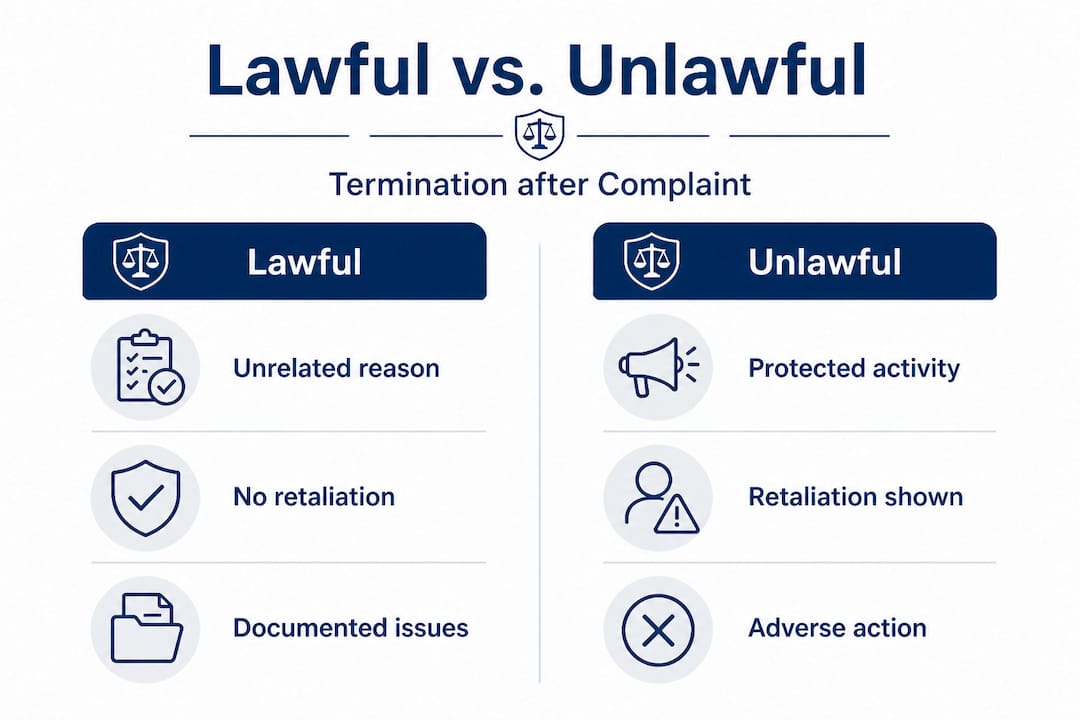
| Situation | Likely lawful? | Why |
|---|---|---|
| Fired 2 weeks after reporting harassment | Possibly unlawful | Suspicious timing, no prior discipline |
| Fired after fabricating a complaint | Lawful | No good-faith belief, no protection |
| Laid off during company-wide reduction | Likely lawful | Legitimate business reason, documented |
| “Position eliminated” but role refilled immediately | Likely unlawful | Pretext for retaliation |
| Fired after years of poor performance, complaint was recent | Likely lawful | Performance record predates complaint |
Warning signs your termination may have been retaliatory:
- No prior disciplinary record before the complaint
- Sudden shift in how your supervisor treated you after you spoke up
- Vague or shifting explanations for why you were fired
- Others who did not complain were treated more favorably
- Your role was refilled quickly after you were let go
If you are trying to prove workplace harassment or connect your termination to a complaint, documenting these warning signs early is essential. Understanding what counts as workplace harassment under California law can also help you determine whether your original complaint qualified as a protected activity.
What can you do if you suspect retaliation?
If your situation feels questionable, here’s what to do next to protect your rights.
Suspecting retaliation is stressful. But taking organized, timely steps gives you the best chance of building a strong case.
1. Start documenting immediately.
Write down everything related to your complaint and the events that followed. Include dates, names, exact words used, and any witnesses. Save emails, text messages, and documents in a personal location outside of company systems.
2. Keep a copy of your complaint.
Whether you reported orally or in writing, try to have a record. If you reported in person, follow up with an email to HR confirming what you said and when. This creates a paper trail that establishes the timeline.
3. Note any changes in treatment.
Track shifts in how your supervisor interacts with you, changes to your schedule, new or sudden performance criticism, exclusion from meetings, and any other unusual behavior after your complaint.
4. File a complaint with the Civil Rights Department (CRD).
Under FEHA, you can file a CRD complaint with a 3-year window for retaliation claims. Under Labor Code §1102.5, you also have three years to file a direct lawsuit. Remedies can include back pay, reinstatement to your former position, compensation for emotional distress (uncapped), punitive damages, and attorney’s fees.
5. Consult an employment attorney.
California retaliation cases involve complex burden-shifting rules and tight deadlines. An experienced attorney can assess whether your situation meets the legal standard and guide you through the employment lawsuit process efficiently.
Pro Tip: Subtle retaliation — like being gradually pushed out, sidelined, or given impossible workloads — can be just as actionable as outright firing. Document patterns, not just single incidents. Courts look at the totality of conduct.
If you need legal help in Pasadena, reaching out early preserves your options and prevents deadlines from quietly expiring.
Key statistic: California employees have three years to file a retaliation complaint under both FEHA and Labor Code §1102.5. Many employees wait too long and lose their right to pursue damages.
The Uncomfortable Truth: Not All Terminations After Complaints Are Retaliation
To put all of this in perspective, here’s what we’ve learned counseling employees like you.
Many employees who reach out to us feel certain they were retaliated against. Some have strong, provable claims. Others have genuinely difficult situations that may not satisfy the legal standard — because the evidence is thin or the timing is ambiguous. Every case turns on its own specific facts.
Here is the pattern we see most often. An employee files a complaint, gets fired shortly after, and assumes the connection is obvious. But “obvious” in everyday terms and “legally provable” are very different things. Courts require more than a gut feeling. They want documentation, patterns, and demonstrated pretext. Without those, even a sympathetic story can fall short.
The mechanics of a retaliation case require showing protected activity, adverse action, and clear causation through timing or patterns. Once that burden is met by you, it shifts to your employer under Labor Code §1102.6 standards. Your employer must then produce a convincing legitimate reason. If they have documented performance issues, prior warnings, or a company-wide reduction, that evidence weakens your case significantly.
This is not meant to discourage you. It is meant to prepare you. The employees who succeed in retaliation cases are the ones who documented carefully, acted quickly, and got legal guidance before the deadline passed. They did not just feel certain — they built a case.
Employees who document carefully, act quickly, and seek legal guidance before deadlines pass give themselves the best chance of success. Employees who delay or discard key evidence often lose options that cannot be recovered. Employees who keep a detailed log showing a clear pattern of escalating adverse actions after their complaint often present the strongest cases. Understanding your workplace retaliation rights fully is your first and most important step.
The bottom line: your instincts may be right. But instincts need evidence behind them to become a successful legal claim.
Need Help With A Possible Retaliation Case In Pasadena?
👉 If you believe you were fired in retaliation for a workplace complaint, do not wait. California’s three-year deadline feels long, but building a solid case takes time, and evidence fades quickly.
At California United Law Group, P.C., we represent Pasadena employees in retaliation, wrongful termination, discrimination, and wage and hour disputes. We understand the emotional and financial toll that comes with losing your job after doing the right thing. Our team can evaluate your situation and give you a candid assessment of your legal options. Every case is different, and outcomes depend on the specific facts and evidence available. Talk to a Pasadena employment lawyer today to get honest, experienced guidance. You can also explore wrongful termination basics or learn more about how our employment law help team can support you from the first step through resolution.
Frequently Asked Questions
Is firing after any workplace complaint illegal in Pasadena?
No, state law defines retaliation in California — not local Pasadena ordinances — and not every termination after a complaint is automatically illegal. The firing must meet all three elements of the retaliation test to qualify.
What counts as “protected activity” in a retaliation case?
Protected activity is defined differently under each statute. Under Labor Code §1102.5, protected activity includes disclosing information about violations of a state or federal statute, rule, or regulation to a government agency or to a supervisor or employer, or refusing to participate in an activity the employee reasonably believes violates the law. Under FEHA (Gov. Code §12940(h)), protected activity includes opposing practices reasonably believed to violate FEHA, filing a complaint, testifying, or assisting in any FEHA proceeding. Both statutes require the employee to have acted in good faith.
If my complaint was mistaken, am I still protected from retaliation?
Yes, as long as you held a reasonable good-faith belief that your complaint was valid, you are protected even if the facts turned out to be incorrect. Only knowingly false or malicious complaints lose protection.
How long do I have to file a retaliation claim in Pasadena?
You generally have three years to file a retaliation complaint under FEHA with the Civil Rights Department or a direct lawsuit under Labor Code §1102.5. Note that under FEHA, after receiving a right-to-sue notice from the CRD, you have one year to file a civil action in court. For Labor Code §1102.5 claims, the three-year period runs from the date of the retaliatory act. Consult an attorney promptly, as the applicable deadlines depend on the specific claims and facts in your case. Acting sooner rather than later protects your evidence and your options.