
TL;DR:
- California law requires paystubs to include nine specific, detailed elements for transparency.
- Inglewood follows statewide paystub rules; no additional city-specific requirements exist.
- Common violations include missing hours, incomplete employer info, inaccurate pay period dates, and improper deductions.
Every California employee receives a paystub, yet very few know exactly what the law requires on that document. Most workers assume that if they see a number and it roughly matches what landed in their bank account, things are fine. They’re not always right. California’s paystub rules are among the strictest in the nation, and employers in Inglewood are subject to the same rigid standards as every other business in the state. If even one required item is missing or inaccurate, you may be owed money, and you may not know it yet. This article gives you a clear picture of your rights, what violations look like in practice, and what steps to take when something is wrong.
Table of Contents
- What makes a paystub ‘accurate’ in California?
- Does Inglewood have different paystub requirements?
- Common paystub mistakes and wage violations
- How Inglewood employees can respond to paystub violations
- Why strict paystub rules matter more than you think
- Get help with paystub or wage violations in Inglewood
- Frequently asked questions
Key Takeaways
| Point | Details |
|---|---|
| Statewide rules apply | Inglewood employers must follow California’s uniform paystub laws without deviation. |
| Nine-point checklist | Every paystub must include nine specific details—missing even one can trigger penalties. |
| Penalties can add up | Each violation can cost employers money for each affected worker and pay period. |
| Employees have options | You can raise the issue, preserve evidence, and pursue claims if your paystub is noncompliant. |
| Strict rules protect workers | Accurate paystubs are critical for ensuring fair pay and enforcing your rights as a California employee. |
What makes a paystub ‘accurate’ in California?
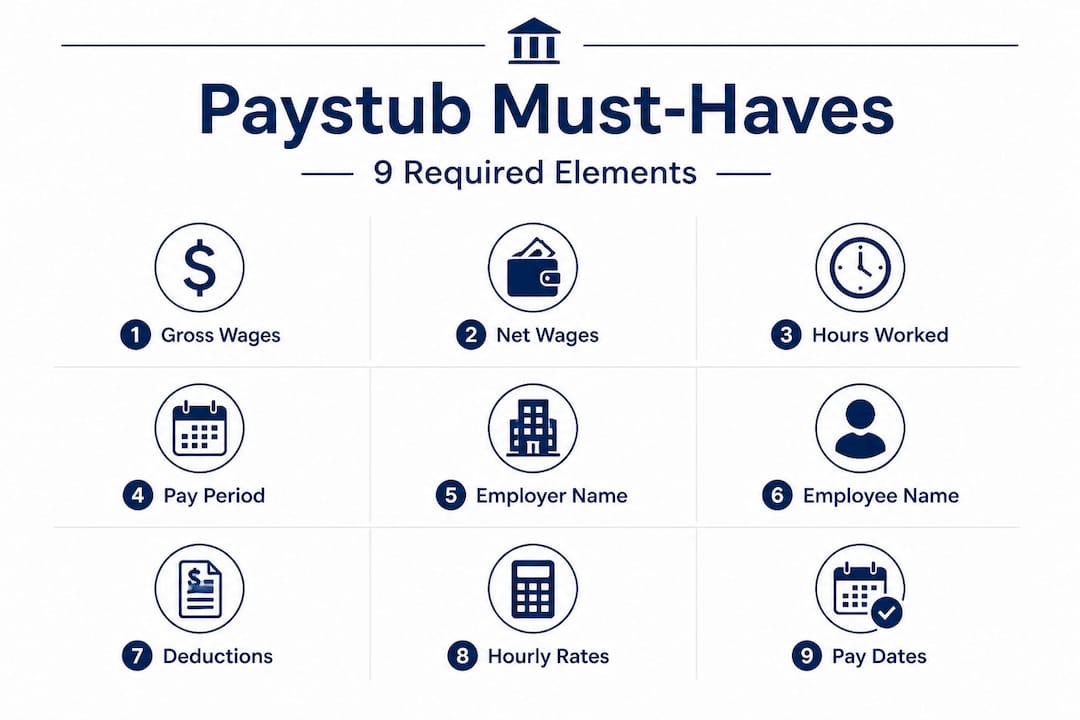
California does not leave much room for interpretation. Under California Labor Code 226, every employer must provide employees with an accurate, itemized written wage statement at every pay period. That means nine specific pieces of information must appear on every paystub, and leaving even one out can trigger penalties.
Here is what Labor Code 226 requires on every wage statement:
The nine required paystub elements under California Labor Code 226:
- Gross wages earned
- Total hours worked (for non-exempt employees)
- All deductions made from wages
- Net wages earned
- The pay period’s start and end dates
- The employee’s legal name and the last four digits of their Social Security number (or an employee ID number)
- The employer’s full legal name and address
- All applicable hourly rates in effect during the pay period and the corresponding number of hours worked at each rate
- For piece-rate workers, the applicable piece-rate and the number of pieces completed
This list matters because each element serves a distinct transparency purpose. Gross wages tell you what you earned before deductions. Net wages show what you took home. The difference between those two numbers, shown through itemized deductions, tells you exactly where your money went. The pay period dates allow you to verify that hours were counted correctly. The last four SSN digits or employee ID allow you to confirm the paystub is yours, not a filing error.

It is also worth noting that the hours-worked requirement applies only to non-exempt employees. If you are a salaried exempt worker, your employer does not need to list hours on your stub. However, every other element still applies. Many employers mistakenly omit other information for exempt employees, which is still a violation.
A common mistake workers make is confusing a minor typo with a genuine legal violation. The law cares about errors that could cause a reasonable employee to be unable to determine wages owed from the document alone. Errors that make the stub misleading or incomplete carry real legal weight.
Pro Tip: Compare your paystub against the nine-item list above every single pay period. If anything is missing, save that paystub immediately. Document the date, the specific omission, and whether the issue repeats. Even Alhambra paystub laws follow this same statewide standard, so this checklist applies across California.
| Paystub element | Required for non-exempt? | Required for salaried exempt? |
|---|---|---|
| Gross wages | Yes | Yes |
| Total hours worked | Yes | No |
| All deductions | Yes | Yes |
| Net wages | Yes | Yes |
| Pay period dates | Yes | Yes |
| Employee name and last 4 SSN or ID | Yes | Yes |
| Employer name and address | Yes | Yes |
| Hourly rates and hours per rate | Yes | No |
| Piece-rate and units (if applicable) | Yes | No |
Does Inglewood have different paystub requirements?
This question comes up often, especially among workers who know that certain California cities have local wage ordinances or added protections. The answer here is straightforward: Inglewood does not have a local ordinance that changes or adds to the paystub requirements in Labor Code 226.
California maintains statewide uniformity on wage statement requirements. Every employer in Inglewood, from hotel staff to retail workers to healthcare employees, follows the same statewide standards as employers in San Francisco, Sacramento, or San Diego. The city does not create a separate paystub checklist, and it does not add extra items to the nine required by state law.
This is an important distinction. Some workers in Inglewood are covered by the city’s minimum wage rules or local hospitality protections, but those deal with the amount of pay, not the documentation of it. If you want to learn more about how local wage rates may affect what appears on your stub, reviewing Inglewood hospitality wage rights is a helpful next step.
Here is how Inglewood compares to a few other major California cities on paystub requirements:
| City | Local paystub rules beyond Labor Code 226? | Minimum wage (local)? | Notes |
|---|---|---|---|
| Inglewood | No | Yes | Local wage applies; same state paystub rules |
| Los Angeles | No | Yes | Same state paystub rules |
| San Francisco | No | Yes | Same state paystub rules |
| Oakland | No | Yes | Same state paystub rules |
| Fresno | No | No (state rate applies) | Same state paystub rules |
The takeaway: no matter where your employer is located in California, the same nine elements must appear on your paystub every pay period. If you believe your paystub does not reflect the correct local minimum wage, that is a separate wage claim. Talking with an employment lawyer in Inglewood can help you figure out whether a paystub error is hiding a deeper pay issue.
Common Paystub Mistakes And Wage Violations
Understanding the rules is one thing. Seeing how they break down in practice is another. Paystub errors can range from innocent clerical mistakes to deliberate attempts to conceal wage theft. Here are the five most common violations employees in Inglewood and across California encounter:
Missing hours worked. An employer lists only the final net pay but fails to show total hours, hourly rates, and hours worked at each rate. This is one of the most frequent violations for non-exempt workers and often reveals unpaid overtime.
Incorrect or incomplete employer name and address. Using a shortened business name, a trade name instead of the legal entity name, or an incomplete address is a violation. This matters because it can make it difficult to identify who employs you if a dispute arises.
Wrong pay period dates. Some employers leave dates off entirely, or list dates that do not correspond to the actual work period. This makes it nearly impossible to verify whether all hours in a given window were counted and paid.
Missing deduction breakdowns. A stub that shows a lump deduction labeled “taxes” without breaking out state income tax, federal income tax, Social Security, Medicare, and any voluntary deductions is non-compliant. Each deduction must be itemized separately.
No piece-rate or multiple rate breakdowns. Workers paid under different rates for different tasks in the same week, or those paid by the piece, must see each rate and corresponding hours or units listed. Combining them into one “blended” rate hides whether overtime was properly calculated.
Why does this matter financially? Penalties for paystub violations start at $50 per employee for the first violation and rise to $100 per employee for each subsequent violation, up to a maximum of $4,000 per employee. These amounts stack every pay period, so an employer who issues bad paystubs biweekly over a year can owe thousands of dollars in civil penalties alone, before any wage recovery is calculated. Group actions under California’s Private Attorneys General Act (PAGA) can amplify these numbers dramatically.
The more significant concern is that paystub errors often signal something larger. When hours are missing from a stub, it frequently means overtime was not paid. When employer information is vague, it may mean a worker cannot identify who is actually responsible for their wages. See how similar problems have played out in claims involving Alhambra paystub violations and at-will wage violations in Los Angeles for context.
Pro Tip: Keep a physical or digital copy of every paystub you receive. If you later file a wage claim, your own records may be far more reliable than what your employer can produce. Take a photo with your phone the moment you receive each stub.
How Inglewood Employees Can Respond To Paystub Violations
When violations happen, employees are not powerless. Here is a clear, step-by-step path you can follow:
Document everything first. Gather all paystubs showing the error. Note which specific elements are missing or inaccurate. Write down dates, who issued the paystub, and whether the problem repeats across multiple pay periods.
Talk to HR or payroll. Some errors are clerical and can be corrected quickly. Raise the issue in writing so there is a record. Request corrected paystubs in writing and keep the response, whether it is a fix or a refusal.
Understand the cure period. California law gives employers 33 days to correct certain paystub errors, such as a wrong name or incorrect pay period dates. This cure period applies only to isolated technical errors, not to errors that conceal actual wages owed. If the error is corrected in time, penalties may not apply for that specific issue.
File a wage claim with the Labor Commissioner. If your employer refuses to fix the problem, you can file a Berman hearing claim with the California Division of Labor Standards Enforcement. This is a no-cost process designed to resolve wage disputes without going to court.
Consult an employment attorney. An attorney can evaluate whether your paystub violations connect to larger wage theft, whether you qualify for a class action or PAGA representative action, and what damages you may be entitled to. Understanding the full employment lawsuit process can help you decide whether litigation makes sense for your situation.
Before making any formal claim, here is a checklist of what to gather:
- All paystubs from the past three years (California’s statute of limitations for wage claims)
- Any written communications with HR or payroll about the errors
- Pay stubs showing both the error period and any corrected versions
- Your employment contract or offer letter showing pay rate
- Records of hours actually worked (personal calendar, time tracking apps, emails)
- Any documentation of how you were classified (exempt, non-exempt, hourly, salaried)
Know your rights after taking action. California law protects workers who report wage violations from retaliation. If your employer fires you or punishes you for raising paystub concerns, you have separate claims. Learn more about rights after reporting wage violations and protection from retaliation.
Why Strict Paystub Rules Matter More Than You Think
Most people, if they think about paystubs at all, see them as routine paperwork. They glance at the net pay, confirm it landed in the bank, and move on. This is understandable, but it misses something important about why California wrote such detailed rules into Labor Code 226 in the first place.
The nine required elements are not bureaucratic formality. They are a transparency mechanism. Without them, workers have no independent way to check whether they were paid correctly. Imagine receiving only your net pay with no breakdown of hours, rates, or deductions. You have no way to know whether overtime was calculated properly, whether deductions were legal, or whether the company even has a full legal identity you could use in a court filing. The legal framework around paystub enforcement exists precisely to close those gaps.
We have seen, across many cases, that paystub errors are almost never isolated. A missing hours column usually means unpaid overtime somewhere in the calculation. An employer who lists a vague business name instead of a legal entity often has more to hide than a formatting preference. Strict enforcement creates accountability that extends well beyond the document itself.
There is also a systemic dimension here. Low-wage workers, workers in high-turnover industries, and workers with limited English proficiency are disproportionately affected by paystub violations. California’s precise requirements make it easier for any worker, regardless of experience with legal documents, to identify when something is off. That is a feature, not a technicality. When you enforce your paystub rights, you are also protecting coworkers who may not know they have the same options.
Get Help With Paystub Or Wage Violations In Inglewood
If your paystubs are missing required information, show inaccurate hours, or do not reflect the wages you were actually owed, you have real legal options. California United Law Group, P.C. represents Inglewood employees in wage and hour disputes, including paystub violation claims and larger wage theft cases. Our team can review your paystubs, explain what violations exist, and help you understand what recovery looks like.
👉 Start by exploring your wage and hour legal help options, or review our employment law specialists practice page to understand the full scope of what we handle. If you are considering a formal claim, our overview of the lawsuit process in California gives you a realistic picture of what to expect. You worked for every dollar on that paystub. We are here to make sure you received it.
Frequently Asked Questions
Can employers in Inglewood use electronic paystubs?
Yes, California law allows electronic paystubs as long as all required elements are itemized and employees can easily access them. Employers must ensure workers can print or view the stub without barriers.
What if an Inglewood employer repeatedly omits required details from paystubs?
Repeated omissions can stack penalties per violation and per pay period, and they frequently become the basis for class action or PAGA lawsuits when multiple employees are affected.
Are all nine paystub elements required for salaried employees?
Salaried exempt employees do not need hours worked listed on their stubs, but all other elements apply equally, including employer name, pay period dates, and itemized deductions.
How soon must an Inglewood employer fix a paystub error?
Employers generally have a 33-day cure period to correct certain technical errors, such as a name or pay period mistake. Errors that conceal actual wages owed do not qualify for this cure window.
Recommended
- Inglewood Hospitality Worker Wages: What You Need to Know – California United Law Group
- Are Alhambra employers breaking California paystub laws? – California United Law Group
- Are Alhambra employers violating California paystub laws? – California United Law Group
- Legal Insights – California United Law Group