
TL;DR:
- California law requires employers to pay a split shift premium when wages fall below a specific threshold.
- Non-exempt hourly workers with unpaid, long breaks within a workday may be entitled to extra pay.
- Workers can analyze paystubs, seek legal advice, and file claims to recover unpaid premiums.
Most Culver City workers never see a split shift premium on their paystub. They work a morning shift, leave for hours, come back for an evening shift, and go home without any extra pay. What most don’t realize is that California law may entitle them to an additional hour of pay for exactly that kind of schedule. Under IWC Wage Orders, non-exempt employees are owed a split shift premium when their total daily pay falls short of minimum wage for all hours worked plus one additional hour. Employers sometimes skip this payment — whether out of oversight or intent — creating a real basis for wage claims and lawsuits.
Table of Contents
- What is a split shift premium and who qualifies?
- How to calculate your split shift premium claim
- When are employers exempt from paying the split shift premium?
- What Culver City workers can do if unpaid: Legal steps and risks
- The uncomfortable truth about suing for unpaid split shift premiums
- Take action: Legal help for Culver City wage & hour violations
- Frequently asked questions
Key Takeaways
| Point | Details |
|---|---|
| Split shift premium eligibility | Non-exempt Culver City workers may be owed a premium when their workday is split by unpaid breaks exceeding a meal period and total pay falls short of minimum wage plus an extra hour. |
| Culver City rate for 2026 | The state minimum wage of $16.90 per hour applies for split shift premiums in 2026, as there is no local higher rate. |
| Common exemptions | Employees living at their worksite, earning well above minimum wage, or classified as exempt may not qualify for split shift premiums. |
| Legal recourse | Workers can file wage claims or lawsuits for unpaid split shift premiums, with class and PAGA actions providing additional leverage. |
| Paystub requirements | Split shift premium pay must be clearly itemized on paystubs, and failure to do so may support further claims. |
What is a split shift premium and who qualifies?
A split shift is a work schedule that is interrupted by unpaid, non-working periods established by the employer that are longer than a standard meal period. Think of a restaurant server who works the breakfast rush from 7 a.m. to 11 a.m., goes home unpaid, then returns for the dinner shift from 5 p.m. to 9 p.m. That employee has worked a split shift. Under California’s IWC Wage Orders, when that happens, the employer may owe an additional premium payment on top of regular wages.
The IWC Wage Orders require this premium for non-exempt employees when their total gross wages for the day are less than the minimum wage for all hours worked, plus one extra hour. The 2026 California state minimum wage is $16.90 per hour, and since there is no Culver City ordinance that raises this rate higher than the state level, that $16.90 figure is what applies in Culver City for split shift premium calculations.
Who qualifies for the split shift premium?
Before you calculate anything, confirm you meet the basic eligibility criteria:
- Non-exempt status: You must be classified as a non-exempt employee. Salaried exempt workers (executive, administrative, and professional categories) are not covered. Salaried exempt workers (executive, administrative, and professional categories) are not covered.
- True split shift structure: The unpaid gap must be longer than a standard 30-minute or one-hour meal break. A routine lunch break does not create a split shift.
- Total pay shortfall: Your daily gross wages must fall below the threshold of (hours worked + 1) multiplied by the applicable minimum wage.
- Same-day work periods: Both work segments must occur within the same calendar workday, not across midnight into a new day. California courts have confirmed this rule: employees working an uninterrupted shift that spans two calendar workdays are not considered to be working a split shift. (Securitas Security Services USA, Inc. v. Sup.Ct. (2011) 197 CA4th 115, 122.)
Here is a quick-reference table showing which workers are typically covered and which are not:
| Worker type | Split shift premium applies? |
|---|---|
| Non-exempt hourly server | Yes, if pay threshold not met |
| Non-exempt retail associate | Yes, if pay threshold not met |
| Salaried exempt manager | No |
| High-earning employee (far above min wage) | Likely no premium owed |
| Employee living at worksite | No |
| Worker on voluntary split | Generally no |
Note: A written waiver of the split shift premium may also be enforceable where an employee has agreed to it — even if required as a condition of employment. See the Exemptions section below for details.
Pro Tip: If you are unsure whether your role is exempt or non-exempt, look at how your employer has classified you on your paystubs and offer letter. Misclassification itself is a separate wage violation that an employment lawyer in Culver City can evaluate for you.
The most important thing to understand is that the premium is not automatic pay for inconvenience. It is a legal wage floor designed to ensure workers are not financially penalized for returning to work after a long unpaid gap. If your total daily pay already meets or exceeds the threshold, no premium is owed. But if it falls short, your employer may be in violation of California wage law.
How To Calculate Your Split Shift Premium Claim
Understanding eligibility is just step one. The real question is how much could you actually recover? Let’s walk through the calculation and a real example so you can see exactly what the numbers look like.

The formula is straightforward:
Premium = (Hours Worked + 1) × Minimum Wage − Total Daily Gross Wages
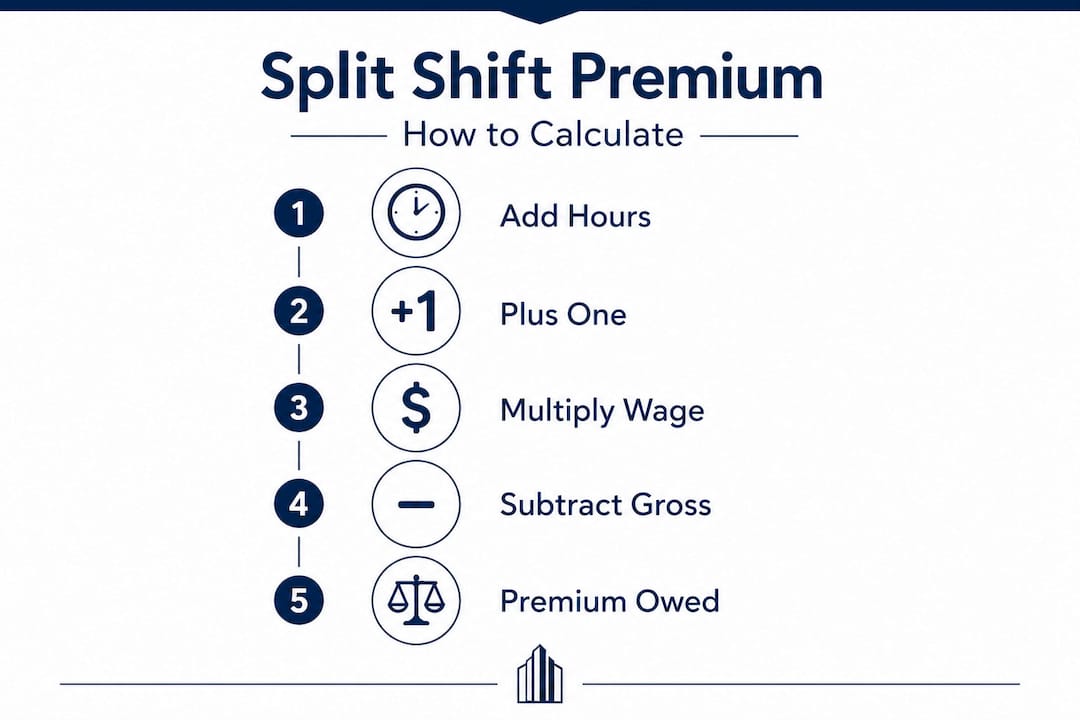
If this calculation produces a positive number, that is the premium your employer owes you for that workday. If it produces zero or a negative number, no premium is owed because your wages already exceed the threshold. This is confirmed by the IWC Wage Orders governing California wage law.
Step-By-Step Calculation
- Add up your total hours worked for that single workday across both segments. Example: 4 hours in the morning plus 4 hours in the evening equals 8 hours total.
- Add one hour to that figure: 8 + 1 = 9.
- Multiply by the 2026 minimum wage: 9 × $16.90 = $152.10.
- Calculate your actual gross daily wages: 8 hours × $17.50 (your hourly rate) = $140.00.
- Subtract actual wages from the threshold: $152.10 − $140.00 = $12.10 premium owed.
That $12.10 might seem small on its own. But if you worked a split shift four days a week for a year, that is roughly $2,500 in unpaid wages, not counting interest or penalties.
Comparison: Premium Paid Vs. Missing Premium
| Scenario | Hours worked | Hourly rate | Gross daily wages | Threshold (hrs+1 × $16.90) | Premium owed |
|---|---|---|---|---|---|
| Worker A (paid correctly) | 8 | $18.00 | $144.00 | $152.10 | $8.10 paid |
| Worker B (premium missing) | 8 | $17.50 | $140.00 | $152.10 | $12.10 unpaid |
| Worker C (high earner) | 8 | $20.00 | $160.00 | $152.10 | $0 (threshold met) |
| Worker D (part-time split) | 5 | $16.90 | $84.50 | $101.40 | $16.90 unpaid |
Notice that Worker C earns enough that the premium threshold is already satisfied. But Worker D, a part-time employee, has a significant gap. This is why lower-wage workers in food service, retail, and caregiving sectors are disproportionately affected by unpaid split shift premiums.
These calculations are grounded in well-established California case law. In Aleman v. AirTouch Cellular (2012) 209 CA4th 556, the California Court of Appeal confirmed that employees earning above minimum wage are entitled to the difference between what they actually earned and what they would have earned had they been paid minimum wage for their entire shift plus one extra hour — exactly the formula described above. This means higher-earning workers are not automatically disqualified; they receive the gap, not a flat premium.
Pro Tip: Always check for wage and hour violations across your full employment history, not just recent paychecks. California’s statute of limitations for wage claims is generally three years under state law, and potentially four years if you pursue a claim under the Unfair Competition Law. That means years of unpaid premiums may be recoverable.
The California Supreme Court confirmed in Murphy v. Kenneth Cole Productions, Inc. (2007) 40 C4th 1094 that premium wage claims are subject to the three-year statute of limitations — not the shorter one-year period applicable to penalties — because the additional hour of pay is compensation, not a punitive measure.
When Are Employers Exempt From Paying The Split Shift Premium?
California wage law is full of exceptions, and knowing who is not covered is critical before you pursue a claim. Many employees assume every split shift triggers a premium. That is simply not true. Filing a weak claim wastes time and may reduce your credibility if you have other stronger violations to pursue.
Most claims fail because of overlooked exemptions that could have been identified before filing. Knowing your situation in advance is your strongest protection against a dead-end claim.
Here are the key situations where a split shift premium is generally not owed:
- Voluntary split shifts: If you personally requested or agreed to the split shift schedule for your own convenience, California courts and the Labor Commissioner may deny the premium. The key questions are whether the employer imposed the schedule, and whether you signed any agreement waiving the premium. Under California law, a written waiver may be enforceable even when required by the employer as a condition of employment. (Leighton v. Old Heidelberg, Ltd. (1990) 219 CA3d 1062.) An attorney can evaluate whether any such waiver applies to your situation.
- Employees who live at the worksite: Workers who reside at their place of employment, such as certain live-in caregivers or on-site property managers, are typically excluded under the applicable exemptions.
- Exempt employees: Workers classified as executive, administrative, or professional employees under California law are not entitled to split shift premiums because they are exempt from most IWC Wage Order provisions.
- High earners who meet the threshold: If your hourly rate is high enough that your gross daily wages already exceed (hours worked + 1) × minimum wage, no premium is owed. This catches many workers by surprise. A $20/hour worker putting in 8 hours earns $160, which exceeds the $152.10 threshold and therefore owes nothing.
- Routine meal breaks misidentified as splits: A standard 30-minute or one-hour lunch break taken mid-shift does not create a split shift. The unpaid gap must be longer than a regular meal break and must genuinely interrupt the workday — not merely a brief pause.
Understanding these exclusions matters for another reason too. Employers sometimes claim these exemptions incorrectly. For example, an employer might argue a split was “voluntary” when the scheduling pressure made it anything but optional. If you believe an exemption is being misapplied against you, reviewing your California paystub laws and documentation with a legal professional can clarify whether the exemption genuinely applies.
What Culver City Workers Can Do If Unpaid: Legal Steps And Risks
Now you know whether you are owed split shift premiums. But what should you actually do if you haven’t been paid? The process has clear steps, and taking the right actions in the right order protects your rights and strengthens your claim.
Review your itemized paystubs immediately. California law requires employers to itemize split shift premiums separately on paystubs under Labor Code Section 226. If your paystubs don’t show this line item and you worked qualifying split shifts, that omission itself is evidence of a violation and can support additional derivative claims.
Request a written correction from your employer. Put the request in writing, whether by email or formal letter. This creates a paper trail. Some employers correct the error immediately, especially smaller businesses that weren’t aware of the requirement. If they refuse or ignore you, that response becomes part of your documentation.
File a wage claim with the California Labor Commissioner’s Office (DLSE). The Division of Labor Standards Enforcement handles individual wage claims. Filing is free, and the process does not require an attorney, though having one significantly improves your outcome. The DLSE can order your employer to pay back wages, interest, and penalties.
Consult an employment attorney about broader claims. Split shift violations rarely occur in isolation. They often accompany missed meal break premiums, unpaid overtime, or off-the-clock work issues. An attorney can assess whether your situation warrants an individual lawsuit, a class action, or a PAGA (Private Attorneys General Act) claim.
Consider collective action. California wage and hour class actions are common and financially significant. In one notable example, Cox Communications settled a California wage and hour class action for $1.85 million. When multiple employees share the same pattern of violations, group action creates far more pressure on employers and often results in larger individual recoveries.
Pro Tip: PAGA claims allow you to act as a private attorney general on behalf of yourself and other aggrieved employees. PAGA penalties go beyond back wages and can be substantial. Important: Before a PAGA lawsuit can be filed, California law requires the aggrieved employee to first provide written notice by certified mail to the employer and submit a filing to the Labor and Workforce Development Agency (LWDA) identifying the specific violations. Failure to comply with this mandatory pre-filing notice requirement can be fatal to the claim, which is one more reason to consult an attorney before proceeding. Discussing this option with an attorney early is valuable, especially when violations are systemic. Review legal insights on wage claims to understand what types of patterns typically support these filings.
One concern many workers have is retaliation. California law prohibits employers from firing, demoting, or punishing employees for asserting wage rights. Strong retaliation protections exist under the California Labor Code, and retaliation itself creates additional legal claims. You should not let fear of your employer’s reaction prevent you from pursuing wages you earned.
The Uncomfortable Truth About Suing For Unpaid Split Shift Premiums
Here is something most legal guides won’t tell you plainly: the vast majority of split shift claims never go to trial. They settle. And understanding why completely changes how you should think about pursuing your claim.
Employers are not afraid of one worker’s split shift dispute. They are afraid of what that dispute represents. When a pattern of violations exists across a workforce, class action and PAGA exposure becomes enormous. A single $12 daily premium multiplied by 50 employees, four days a week, over three years, becomes a multi-million-dollar liability. That is what motivates settlements, not the individual case itself.
This is why the most effective strategy is almost never to chase a single violation in isolation. Workers who know their wage rights across all categories, missed meal breaks, rest breaks, overtime, off-the-clock work, and split shift premiums, create a fundamentally stronger legal position than those focused narrowly on one issue.
We have seen employees walk away from settlements far larger than expected because they brought multiple, documented violations to the table. Past results do not guarantee similar outcomes — every case turns on its own facts, applicable law, and circumstances. The employer’s calculation shifts dramatically when they realize their exposure is not one claim but dozens, stacked across time.
The other thing most workers miss is the power of acting together. Co-workers who compare schedules, share paystub information, and collectively consult an attorney are far more effective than individuals going it alone. If your employer runs split shifts across a whole department, there is a strong chance this is a systemic practice, and systemic practices are exactly what class actions and PAGA were designed to address.
Don’t focus only on the obvious split shift issue. Look for the pattern. Talk to your co-workers. Gather documentation across all wage violations. That is where real leverage exists.
Take Action: Legal Help For Culver City Wage & Hour Violations
If you haven’t received your proper split shift premium, you don’t have to figure this out alone. California wage law is detailed, the calculations matter, and missing even one piece of the puzzle can mean leaving money on the table. Our wage and hour legal team at California United Law Group, P.C. represents Culver City employees at every stage, from reviewing your paystubs and calculating your claim to filing with the DLSE or pursuing litigation.
👉 We understand the nuances of California wage law and have helped employees recover back wages, penalties, and damages across a wide range of employer violations. Our experienced employment attorneys are ready to evaluate your situation with no obligation. If you believe you’re owed a split shift premium, the best next step is a confidential consultation. Don’t let the statute of limitations quietly erase wages you worked hard to earn.
Frequently Asked Questions
What counts as a split shift under California labor law?
A split shift is when your workday is interrupted by an unpaid period established by your employer that is longer than a regular meal break, and you return to work later the same day. If you voluntarily arranged the schedule yourself, different rules may apply. A standard lunch break does not qualify.
Does Culver City have a different minimum wage for split shift premiums in 2026?
No. Culver City follows the California state minimum wage of $16.90 per hour in 2026 for this purpose, as no local ordinance sets a higher rate.
What if my paystub doesn’t show a split shift premium?
By law, split shift premiums must be itemized on paystubs, and missing this information can strengthen your wage claims under Labor Code Section 226.
Can I sue alone or do I need to join a class action?
You can file individually, but PAGA and class actions often create stronger leverage and larger settlements, especially when violations affect multiple employees.
Are there situations where a split shift premium isn’t owed?
Yes. If your split shift is voluntary, you earn well above minimum wage, you live at your worksite, or you are an exempt employee, the premium typically does not apply.