
TL;DR:
- California law requires specific information on paystubs, including hours, deductions, and employer details.
- Common violations include missing hours worked, incomplete deductions, or incorrect pay period dates.
- Employees can pursue claims through free DLSE filings or civil lawsuits, and may recover statutory penalties where violations are knowing and intentional.
Most California employees glance at their paystub, confirm the deposit amount looks roughly right, and move on. But a closer look at that document might reveal something more serious: missing information that violates California law. Many workers in Alhambra are surprised to learn that their paystub doesn’t need to shortchange their pay to be illegal. A wage statement missing required details, like an employer address or accurate hours, can already be a violation. This guide explains exactly what the law requires, how violations commonly appear, and what you can do about it.
Table Of Contents
- What California paystub law requires
- Common ways Alhambra employers violate paystub laws
- How to identify and document paystub violations
- Your options: Reporting violations and seeking remedies
- Our take: Why paystub enforcement in Alhambra really matters
- Next steps: Protect your rights with expert help
- Frequently asked questions
Key Takeaways
| Point | Details |
|---|---|
| Paystubs must list nine key details | California law requires employers to provide nine specific items on every wage statement. |
| Even small errors are violations | Missing any required paystub detail may support a claim — including statutory penalties where the violation is knowing and intentional — even without proof of financial harm. |
| Document violations carefully | Save all paystubs and document discrepancies to strengthen any claim. |
| Multiple options for action | You can file a free DLSE claim or talk to a lawyer if your rights are violated. |
What California Paystub Law Requires
With confusion common among employees, it’s critical to understand exactly what the law demands before you can spot a problem on your own paystub.
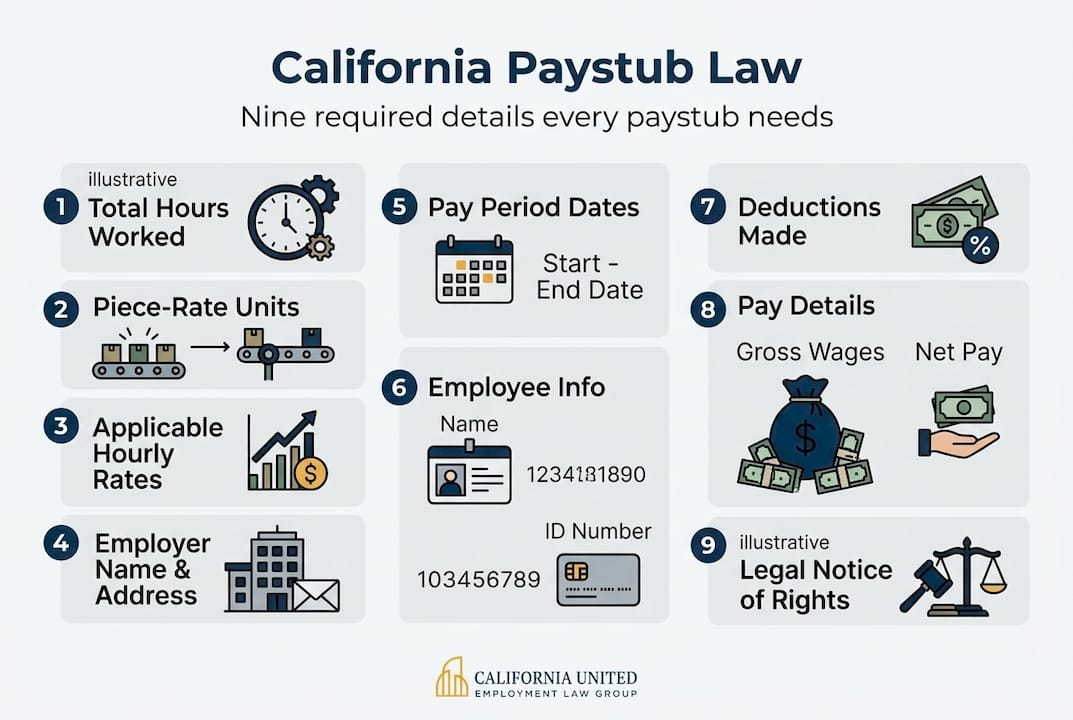
California has some of the strongest wage statement laws in the country. The legal standard is not vague. California Labor Code Section 226 requires employers to provide itemized wage statements either semi-monthly or on every payday, and those statements must contain nine specific elements. If any single element is missing or inaccurate, your employer may already be in violation.
Here are the nine mandatory elements every California paystub must include:
- Gross wages earned during the pay period
- Total hours worked (required for all non-exempt, hourly employees)
- Piece-rate units earned and the applicable rate, if you are paid by piece rate
- All deductions made from gross wages, listed separately and clearly
- Net wages earned after all deductions
- The start and end dates of the pay period
- Your full legal name and either the last four digits of your Social Security Number or an employee ID number
- The employer’s legal name and principal place of business address
- All applicable hourly rates in effect during the pay period and the corresponding number of hours worked at each rate
This list applies directly to non-exempt (hourly) employees. If you are a salaried, exempt employee, the hours worked requirement may not apply to you, but most other elements still must be present. Many employees don’t realize this distinction matters, and many employers use it as a reason to leave out information they are still required to include.
Here’s a quick reference for what a paystub must contain:
| Paystub Element | Required For Hourly Employees | Required For Exempt Employees |
|---|---|---|
| Gross wages | Yes | Yes |
| Total hours worked | Yes | No |
| All deductions listed | Yes | Yes |
| Net wages | Yes | Yes |
| Pay period dates | Yes | Yes |
| Employee name and ID/SSN (last 4) | Yes | Yes |
| Employer legal name and address | Yes | Yes |
| Applicable hourly rates | Yes | N/A |
Why does this matter beyond legal compliance? Accurate wage statements protect you financially. They are your paper trail when disputing unpaid wages, verifying overtime, or filing taxes. Missing records can cost you money you are rightfully owed, sometimes years down the line. If you want to learn more about Alhambra paystub violations and how local workers have been affected, the issue is more widespread than most people expect.

Common Ways Alhambra Employers Violate Paystub Laws
Now that you know the law, let’s look at how employers often fail to follow it.
Violations do not always look like what you might imagine. They rarely involve an employer handing you a blank piece of paper. Instead, they tend to appear as small omissions or subtle inaccuracies that are easy to miss if you are not specifically looking for them. Some of these mistakes are honest errors. Others reflect a pattern of deliberate noncompliance.
Here are the most frequent paystub violations seen among Alhambra employers:
- Missing total hours worked. Employers sometimes omit this for hourly workers, especially in industries like retail, hospitality, and food service. Without this number, you cannot independently verify your pay.
- No employer address. The law requires the employer’s principal place of business, not just a name. A paystub listing only a business name is noncompliant.
- Omitted or bundled deductions. Deductions must be itemized separately. A paystub that lists a single “deductions” line without breaking them down violates Section 226.
- Incorrect pay period dates. Dates that are vague, missing, or wrong prevent you from verifying the timeframe of the wages paid.
- Missing hourly rate breakdown. If you worked at different rates during a single pay period (for example, regular and overtime), all applicable rates and the hours worked at each must appear separately.
- Wrong employee identification. Using a full Social Security Number instead of the last four digits is actually a violation of a different kind, creating a privacy risk.
Here’s how a compliant paystub compares to a noncompliant one:
| Feature | Compliant Paystub | Noncompliant Paystub |
|---|---|---|
| Hours worked | Listed with exact total | Blank or missing |
| Employer address | Full legal business address | Name only, no address |
| Deductions | Each deduction listed separately | Single lump “deductions” line |
| Hourly rates | Multiple rates shown if applicable | Only one rate listed |
| Pay period | Clear start and end dates | Vague or absent |
| Employee ID | Last 4 SSN digits or assigned ID | Missing or full SSN shown |
California courts have interpreted these requirements carefully. In Morgan v. United Retail Inc. (2010) 186 Cal.App.4th 1136, a Court of Appeal held that a wage statement listing regular and overtime hours separately — though not combined into a single total — still satisfied the ‘total hours worked’ requirement, because the employee could determine the information from the statement itself. The takeaway: courts focus on whether an employee can ‘promptly and easily’ determine the required information without reference to outside documents. If a missing item means you have to guess, cross-reference, or call HR to figure out your own pay, that may already be a violation.
Why do violations happen? Some employers, particularly small businesses, use outdated payroll software that doesn’t generate all required fields. Others operate across multiple states and apply a different state’s standards to California employees. And in some cases, especially in industries with known pay gaps and rights issues, the omissions are intentional, making it harder for workers to track wage theft.
Statistic callout: Under California Labor Code Section 226, employers who fail to provide itemized wage statements with nine distinct elements face statutory penalties of $50 per employee per pay period for the initial violation and $100 per employee per pay period for subsequent violations, up to $4,000 per employee. These statutory penalties apply where the employer’s failure to comply is knowing and intentional. Employees may still pursue injunctive relief and separate civil penalties under Labor Code § 226.3 even for inadvertent violations.
Pro Tip: Don’t wait until you think something is seriously wrong. Check your paystub against the nine required elements every single pay period. Catching missing information early gives you a stronger and cleaner record if you later need to file a claim.
How To Identify And Document Paystub Violations
Recognizing a potential violation is only the first step. Here’s what to do next.
Knowing what the law requires is useful. Acting on it is what actually protects your rights. The good news is that documenting paystub violations is something you can start doing on your own, right now, without any legal background.
Step-by-step process to check your paystubs and build your case:
Gather every paystub you have received. Go back as far as possible. “California law governs how far back you can reach with a claim, and the timeframe depends on what type of claim you file. Claims for actual unpaid wages (damages) may reach back three years under a statutory liability theory, while claims specifically seeking the $50/$100 wage statement penalties are generally subject to a one-year statute of limitations. PAGA claims — which let employees file on behalf of themselves and other workers — are also subject to a one-year statute of limitations. Because the clock starts running on each pay period independently, acting quickly preserves the most options.
Compare each paystub to the nine required elements. Go through the checklist from Section 226 one element at a time. Flag any paystub where an element is missing, blank, or incorrect.
Cross-reference your paystubs with your own work records. If you kept notes, texts, or clock-in records showing the hours you worked, compare them to what the paystub reflects. Discrepancies between hours worked and hours listed are both a documentation gap and a potential wage theft issue.
Write down every discrepancy you find. Note the pay period date, what was missing, and any other relevant details. Keep a log in a personal document or email to yourself. This timestamped record can support your claim later.
Request your employment records in writing. Under California Labor Code Section 226, you have the right to request copies of your wage statements within 21 days. Send this request by email or certified mail so you have a record that you asked.
Keep copies of everything in a secure location. Store paystubs, request letters, and your discrepancy notes somewhere your employer cannot access. A personal email account, cloud storage, or printed copies at home all work.
Key documentation pitfalls to avoid:
- Don’t rely on memory alone. Courts and agencies want written records, not verbal accounts.
- Don’t confront your employer without a plan. If your employer knows you’re building a case, they may become uncooperative or, in some situations, retaliatory.
- Don’t assume you need to prove financial harm. Under California law, you do not need to prove financial harm to pursue a claim. If a violation is knowing and intentional, you may be entitled to statutory penalties even if you were paid the correct amount. Even for unintentional omissions, you may be entitled to injunctive relief compelling the employer to correct its wage statements going forward. To recover these statutory penalties, you must show the employer’s violation was knowing and intentional. Employees whose employers claim the errors were inadvertent may still have viable PAGA claims, which some courts have held do not require meeting that same threshold.
This last point is important. But California law is clear: a wage statement that is missing required information is a violation regardless of whether your net pay was correct. An employee is deemed to suffer injury when missing information prevents them from promptly and easily verifying required details. To recover the $50/$100 statutory penalties, however, you must also show the employer’s violation was knowing and intentional. Even where that higher bar is not met, a PAGA claim may allow for penalties without that showing. If you have also experienced issues with off-the-clock pay rights, those records become part of a broader picture of noncompliance.
Pro Tip: If your employer uses an electronic payroll system, log in and download your full pay history immediately. Some employers remove access after termination, and having a complete digital record before that happens can be critical.
Your Options: Reporting Violations And Seeking Remedies
Armed with evidence, employees have clear options for holding employers accountable.
Once you have documented the violations, you are not stuck waiting and hoping things improve. California gives employees real tools for enforcement. Understanding your options helps you choose the right path for your situation.
Step-By-Step: What You Can Do About Paystub Violations
File a free wage claim with the DLSE. The California Division of Labor Standards Enforcement (DLSE) handles wage claims at no cost to employees. Your local Los Angeles DLSE District Office accepts claims and can investigate your employer. You do not need a lawyer to start this process, and you do not need to prove you lost money.
Consider a private civil lawsuit. If your violation is significant or involves a pattern of behavior, you may want to file a lawsuit in civil court. This route can result in larger penalties and allows for attorney fee recovery, meaning your lawyer’s costs may be covered by your employer if you win.
Explore a PAGA claim. Under the Private Attorneys General Act (PAGA), you can file a claim on behalf of yourself and other employees who experienced the same violations. PAGA claims involve the state Labor and Workforce Development Agency and can result in significant civil penalties paid to employees and the state.
Key reminder: Under California law, you do not need to prove that the missing paystub information actually caused you financial harm. The statutory penalties begin at $50 per employee per pay period for the first violation and $100 for each subsequent pay period, up to a maximum of $4,000 per employee.
California courts have applied the ‘knowing and intentional’ standard in ways that matter for employees. In Gola v. University of San Francisco (2023) 90 Cal.App.5th 548, a court applied a ‘predicate facts’ test — asking whether the employer knew the facts existed that triggered the obligation to issue an accurate wage statement, such that its failure to comply was knowing and intentional. Under a different route, courts have recognized that PAGA allows employees to pursue penalties for inaccurate wage statements without needing to meet the ‘knowing and intentional’ threshold required for an individual § 226(e) claim. This approach was recognized in Lopez v. Friant & Associates, LLC (2017) 15 Cal.App.5th 773, and Raines v. Coastal Pacific Food Distributors, Inc. (2018) 23 Cal.App.5th 667. For employees whose employers argue that paystub errors were inadvertent, a PAGA claim may be an important additional avenue of recovery.
Here’s a summary of available remedies:
- Statutory penalties for each noncompliant pay period ($50 to $100 per violation)
- Actual damages if you can show you lost wages as a result of the missing information
- Interest on unpaid wages
- Attorney’s fees and court costs in successful lawsuits
- PAGA civil penalties for you and other affected coworkers
DLSE vs. private lawsuit: Which is right for you?
| Factor | DLSE Claim | Private Lawsuit |
|---|---|---|
| Cost to you | Free | Typically on contingency |
| Timeline | Can be faster | May take longer |
| Potential recovery | Capped and moderate | Higher, including PAGA penalties |
| Legal representation needed | Not required | Strongly recommended |
| Best for | Clear, straightforward cases | Complex, repeat, or large violations |
If you are unsure which path to take, speaking with a local employment lawyer can clarify your options quickly. Most employment attorneys in California offer free consultations and handle paystub cases on a contingency basis, meaning no attorney’s fees are owed unless you recover. At California United Law Group, P.C., we handle wage and hour cases on contingency. You are not responsible for litigation costs or expenses if there is no recovery.
Our Take: Why Paystub Enforcement In Alhambra Really Matters
Here is something we have seen repeatedly in our work: most employees who have a valid paystub violation claim never act on it. Not because they don’t care, but because they assume the amount at stake isn’t worth the trouble, or they fear that speaking up will cost them their job. Both concerns are understandable. Both are also reasons why wage violations continue unchecked in workplaces across Alhambra.
The real impact of paystub enforcement goes beyond any individual employee’s recovery. When employers know they will be held accountable for incomplete wage statements, they are more careful. They invest in proper payroll systems. They train managers correctly. The result is a local labor market where workers are treated with greater fairness from the start.
There’s also a broader financial justice argument. Accurate wage records affect unemployment claims, tax filings, Social Security calculations, and loan applications. When your paystub is wrong, the ripple effects can follow you for years. Enforcement of legal paystub violations in Alhambra isn’t just about recovering penalties. It’s about establishing that your records are accurate, your rights are real, and your employer is not above the law.
Next Steps: Protect Your Rights With Expert Help
If anything in this guide raised questions about your own paystubs, that’s worth taking seriously. California’s wage statement laws exist to protect you, and the process of investigating a potential violation is more straightforward than most people expect.
👉 Start by reviewing your paystubs against the nine required elements. If you spot missing information, save your records and consider reaching out for legal guidance.
At California United Law Group, P.C., we represent employees across the Los Angeles area in wage and hour disputes, including paystub violations. Our team can help you evaluate your situation and explain your options clearly. Learn more about your rights through our employment law overview or review the specifics of your wage and hour rights under California law.
You deserve accurate records. We’re here to help you get them.
Frequently Asked Questions
What details must legally be on a California paystub?
California law requires nine specific items on wage statements, including gross wages, total hours worked for non-exempt employees, all itemized deductions, net wages, pay period dates, employee name and identification, and the employer’s legal name and full address.
Can I sue my employer if paystubs are missing info?
Yes, you can file a lawsuit or a DLSE claim if required paystub elements are missing or inaccurate, and California law allows you to pursue statutory penalties without proving financial harm — but to recover those penalties, you must show the employer’s violation was knowing and intentional. An employment attorney can evaluate whether your situation meets that standard and whether a PAGA claim provides an additional avenue for recovery.
How do I file a DLSE claim for paystub violations?
You can file for free at your local Los Angeles DLSE District Office, and you do not need to demonstrate that the missing information caused you a financial loss to be eligible for penalties.
Is saving old paystubs important for my case?
Absolutely. Saving all paystubs and keeping a written log of any discrepancies between what is listed and what you actually worked is one of the most important steps you can take to support a wage claim.