
If you work in tech at a Santa Monica company like Hulu and have reported discrimination, you might worry about what comes next—whether your employer can legally retaliate, how to protect yourself, and what remedies you have if things get worse.
Note: This article references major Santa Monica tech employers like Hulu for illustrative purposes only, to provide context about the local tech industry and the types of workplaces where these legal protections apply. These references do not suggest or imply that any specific company engages in discriminatory or retaliatory practices. The legal protections discussed in this article apply equally to all California employers with five or more employees, regardless of industry, size, or reputation.
California law provides strong protections against retaliation for employees who report workplace discrimination, but navigating these protections can feel overwhelming. This article explains your rights, the legal safeguards available to you, and practical steps to protect yourself after speaking up about discrimination in your tech workplace.
Table of Contents
- Key takeaways
- Understanding your legal protections in Santa Monica
- How protections apply specifically to tech employees at companies like Hulu
- Common retaliation scenarios tech employees face in Santa Monica and how to respond
- Practical steps to protect yourself after reporting discrimination
- Get expert legal help with discrimination issues in Santa Monica tech workplaces
- Are Santa Monica tech employees protected after reporting discrimination at companies like Hulu? Frequently asked questions
Key Takeaways
| Point | Details |
|---|---|
| Information purposes only | This article provides general information about California employment law. It does not constitute legal advice for your specific situation. Consult with a qualified employment attorney for advice about your particular circumstances. |
| Retaliation protections | California and Santa Monica laws prohibit retaliation after you report discrimination and provide avenues for legal recourse. |
| Documentation importance | Keeping thorough records of incidents, communications, and dates strengthens your position if you file a claim. |
| Early legal advice | Seeking legal guidance early can clarify rights and improve outcomes if action is needed. |
| Remedies after retaliation | If retaliation occurs, you may recover lost wages, emotional distress, punitive damages, and attorney fees. |
Understanding your legal protections in Santa Monica
California law creates a protective shield around employees who report discrimination or harassment. When you speak up about bias, unequal treatment, or hostile work environments, workplace retaliation California laws make it illegal for your employer to punish you. Retaliation includes obvious actions like termination or demotion, but it also covers subtler forms like exclusion from projects, negative performance reviews you don’t deserve, or sudden schedule changes that make your job harder.
Santa Monica may have local ordinances that complement state protections. However, FEHA provides comprehensive statewide protections that apply to all California employers with five or more employees. This dual layer of legal safeguards means tech employees at companies like Hulu benefit from both California’s Fair Employment and Housing Act and municipal anti-discrimination provisions. The combination creates a robust framework that holds employers accountable when they retaliate against workers who exercise their rights.
California courts have consistently upheld strong anti-retaliation protections. In Yanowitz v. L’Oreal USA, Inc. (2005) 36 Cal.4th 1028, the California Supreme Court held that retaliation under FEHA includes any employer conduct that would be reasonably likely to deter employees from engaging in protected activity. This broad interpretation means even subtle adverse actions can constitute illegal retaliation if they would dissuade a reasonable worker from reporting discrimination.
Knowing these protections exist empowers you to report discrimination without fear. Many employees stay silent because they worry about losing their jobs or damaging their careers. Understanding that the law specifically prohibits retaliation helps you make informed decisions about when and how to report issues. Your employer cannot legally fire you, cut your pay, reassign you to worse duties, or create a hostile environment because you filed a complaint.
Documenting every incident strengthens your position if you need to prove retaliation later. Keep copies of emails, text messages, performance reviews, and any written communications about your discrimination report. Note dates, times, witnesses, and specific details of retaliatory actions. This evidence becomes crucial if you need to file a claim or lawsuit.
Pro Tip: Create a dedicated folder on your personal device to store all documentation related to your discrimination report and any subsequent workplace changes. Include screenshots, forwarded emails to your personal account, and written summaries of verbal conversations. This organized record becomes invaluable if you need legal support.
While documentation is crucial, consult with an employment attorney to ensure you’re preserving evidence properly and not violating any company policies or legal requirements in the documentation process.
Your rights extend beyond just keeping your job. If retaliation occurs, you may be entitled to compensation for lost wages, emotional distress, punitive damages, and attorney fees. California courts take retaliation claims seriously and may award damages including lost wages, emotional distress, and in appropriate cases, punitive damages, when employers are found to have violated anti-retaliation laws. Outcomes vary significantly based on the specific facts and circumstances of each case. Understanding the full scope of your protections helps you recognize when your rights are violated and take appropriate action.
Key protections include:
- Protection from termination after filing discrimination complaints
- Safeguards against demotion or pay cuts following reports
- Legal recourse for hostile treatment or isolation after speaking up
- Right to file complaints with government agencies without employer interference
- Ability to pursue legal action if retaliation occurs
How protections apply specifically to tech employees at companies like Hulu
Tech industry workplaces present unique discrimination challenges. Gender bias remains prevalent in engineering and leadership roles, with women and non-binary employees facing unequal pay, fewer promotions, and exclusion from technical projects. Disability discrimination affects workers who need accommodations for mental health conditions, chronic illnesses, or physical disabilities. Age bias targets older workers in an industry that often prioritizes youth. Racial and ethnic discrimination creates barriers for employees of color seeking advancement or fair treatment.
Companies operating in Santa Monica, including major tech employers like Hulu, must comply with California’s Fair Employment and Housing Act and local anti-discrimination ordinances. These laws prohibit discrimination based on protected characteristics including race, gender, age, disability, sexual orientation, religion, and national origin. When you report any of these forms of bias, Santa Monica sexual harassment rights laws shield you from retaliation.
After you file a discrimination complaint, your employer cannot take adverse employment actions against you. This means they cannot fire you, reduce your responsibilities, exclude you from important meetings, give you undeserved negative performance reviews, or create conditions designed to make you quit. If any of these actions occur after you report discrimination, you likely have grounds for a retaliation claim.
Understanding which type of discrimination you experienced helps you identify the specific protections available. Different forms of bias may involve different reporting procedures and legal remedies, but all share the same anti-retaliation safeguards. The following table shows common discrimination types in tech and corresponding protections:
| Discrimination Type | Common Examples in Tech | Legal Protection |
|---|---|---|
| Gender discrimination | Unequal pay, fewer promotions for women, pregnancy bias | FEHA, Equal Pay Act, Santa Monica ordinances |
| Disability discrimination | Denied accommodations, termination after medical leave | ADA, FEHA, California Labor Code |
| Racial discrimination | Hiring bias, unequal advancement, hostile comments | FEHA, Title VII, local anti-discrimination laws |
| Age discrimination | Layoffs targeting older workers, age-based harassment | ADEA, FEHA |
| Sexual harassment | Unwanted advances, hostile environment, quid pro quo | FEHA, Title VII, local protections |
The California Supreme Court emphasized the importance of the anti-retaliation provision in Yanowitz v. L’Oreal USA, Inc., noting that retaliation is established when an employer engages in conduct that would deter a reasonable employee from engaging in protected activity, even if the specific adverse action does not qualify as a traditional ‘adverse employment action’ like termination or demotion. This means California provides broader retaliation protections than federal law in many circumstances.
Timely and proper reporting through designated channels strengthens your protection claims. Most companies have internal complaint procedures outlined in employee handbooks. Following these procedures creates a clear record that you reported discrimination through official channels. If your employer lacks clear reporting procedures or if internal reporting proves ineffective, you can file complaints directly with the California Civil Rights Department or the Equal Employment Opportunity Commission.
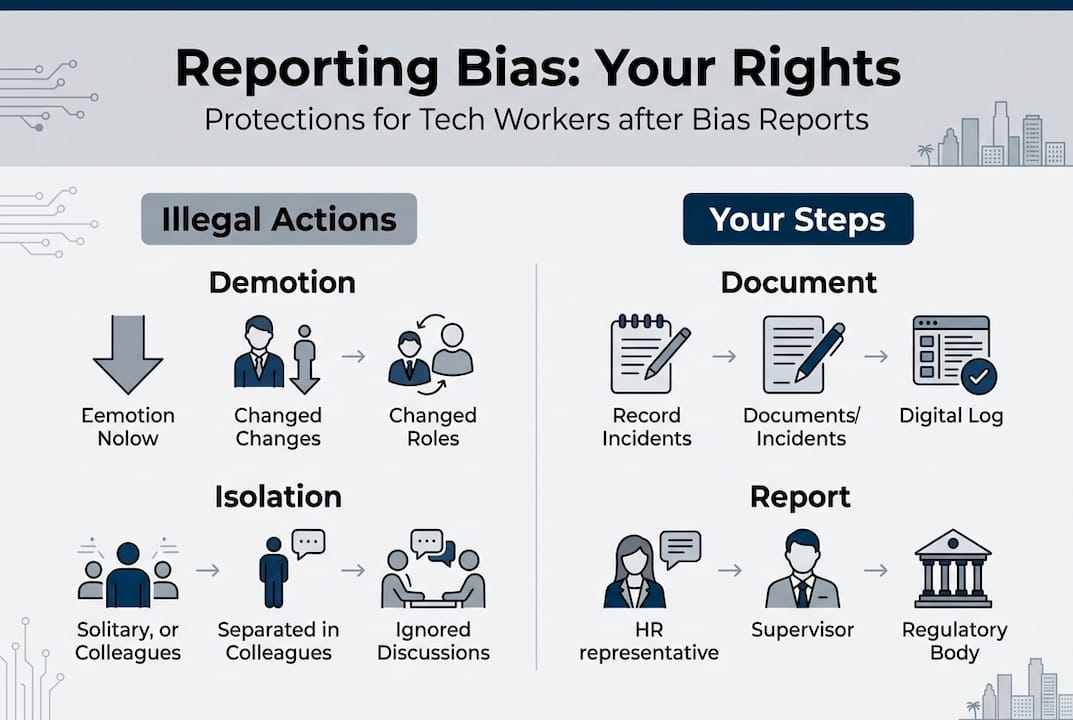
Your employee rights after reporting misconduct remain in effect regardless of how your employer responds to your initial complaint. Even if they investigate and find no discrimination occurred, they still cannot retaliate against you for making the report in good faith. This protection encourages employees to speak up about potential violations without fear of punishment.
Tech-specific discrimination often includes:
- Exclusion from technical projects based on gender or age stereotypes
- Unequal compensation for equivalent work and experience
- Hostile comments or jokes targeting protected characteristics
- Denied promotions despite strong performance records
- Retaliation for requesting disability accommodations
Common retaliation scenarios tech employees face in Santa Monica and how to respond
Retaliation rarely looks like a straightforward firing immediately after you file a complaint. Employers often use subtler tactics that create plausible deniability while making your work life difficult. You might notice your hours reduced without explanation, or suddenly you’re excluded from team meetings you previously attended. Performance reviews that were always positive might turn negative despite no change in your work quality. Your manager might reassign your key projects to other team members or move you to a less desirable role.

These actions constitute illegal retaliation if they occur because you reported discrimination. The timing matters significantly. If adverse actions happen shortly after you file a complaint, that temporal proximity suggests retaliation. Even if your employer claims legitimate business reasons for the changes, you may still have a valid retaliation claim if the real motivation was punishing you for speaking up.
Documentation becomes your strongest defense against retaliation. The moment you notice any negative change in your employment conditions, start keeping detailed records. Save emails, forward important messages to your personal account, and write down verbal conversations with dates, times, and witnesses present. Take screenshots of performance reviews, project assignments, and any communications about your role or responsibilities.
Courts recognize that retaliation often involves a series of adverse actions that, taken together, constitute unlawful conduct. In Yanowitz v. L’Oreal USA, Inc., the court held that even when individual retaliatory acts might not be actionable on their own, a series of separate acts may collectively constitute an adverse employment action. This is why comprehensive documentation of all changes in your work conditions is essential.
Responding effectively to retaliation requires both immediate action and strategic planning. Don’t wait to see if things improve on their own. Retaliation often escalates if left unaddressed, and delays can weaken your legal claims. Taking prompt steps protects your rights and creates a clear record of the retaliation timeline.
Pro Tip: Send yourself detailed emails summarizing any retaliatory incidents on the same day they occur. Include specific facts like who said what, when it happened, and how it affected your work. These contemporaneous records carry significant weight as evidence because they show you documented issues in real time, not after the fact.
This is not a substitute for legal advice. An employment attorney can advise you on what specific evidence you should preserve and how to document incidents without violating company policy.
Follow these steps if you experience retaliation:
The following steps are general guidance only. Every situation is different, and you should consult with an employment attorney to evaluate your specific circumstances and receive advice tailored to your situation:
- Document every retaliatory action with specific dates, details, and witnesses
- Report the retaliation to HR or your company’s compliance department in writing
- Keep copies of all communications about both your original complaint and the retaliation
- File a complaint with the California Civil Rights Department if internal reporting fails
- Consult an employment lawyer Santa Monica to assess your legal options
- Preserve all evidence including emails, texts, performance reviews, and project assignments
- Continue performing your job duties to the best of your ability despite the retaliation
- Avoid confrontational communications that could be used against you later
Legal counsel provides crucial guidance on the strongest claims and evidence needed to prove retaliation. An experienced employment lawyer can evaluate whether your employer’s actions constitute illegal retaliation, help you navigate agency complaint processes, and represent you in negotiations or litigation. Many retaliation cases settle before trial when employers face strong evidence and skilled legal representation.
Practical steps to protect yourself after reporting discrimination
Protecting your rights after reporting discrimination requires proactive measures and careful documentation. The actions you take immediately after filing a complaint can significantly impact the outcome if retaliation occurs. Building a strong record now makes it easier to prove your case later if you need to pursue legal action.
Keep detailed written records of every discriminatory or retaliatory incident. Create a timeline that includes dates, times, locations, people involved, and exactly what happened. Note any witnesses who saw or heard the incident. If someone made discriminatory comments, write down the exact words used. If you experienced retaliation, document the specific adverse action and how it differed from your previous treatment.
File timely complaints through proper channels to preserve your legal rights. Most discrimination claims have strict deadlines. In California, you must file a complaint with the California Civil Rights Department within three years of the discriminatory act. In limited circumstances, if you did not discover the facts of the violation until after the three-year period, you have an additional 90 days from the date of discovery. After receiving a right-to-sue notice from the CRD, you have one year to file a civil lawsuit in court. Missing these deadlines can permanently bar your claims, so prompt action is essential.
Consulting experienced employment lawyers early helps you assess case strength and preserve critical evidence. Lawyers can advise you on which claims have the strongest legal basis, what additional evidence you need, and the best strategy for resolving your case. Early legal involvement often leads to better outcomes because lawyers can guide you through the complaint process and help you avoid common mistakes that weaken claims.
Understanding your options helps you choose the best path forward. You can pursue informal resolution through internal company processes, file formal complaints with government agencies, or proceed directly to litigation. Each approach has advantages and disadvantages depending on your specific situation.
The following comparison is general information only. The best approach depends on your specific circumstances, the strength of your evidence, your employment goals, and other factors. Consult with an employment attorney to evaluate your options and determine the most appropriate strategy for your situation:
| Resolution Approach | Pros | Cons |
|---|---|---|
| Internal HR complaint | Faster resolution, maintains employment relationship, less adversarial | Limited remedies, company controls process, no legal enforcement |
| Agency complaint (CRD/EEOC) | Government investigation, potential settlement, right to sue letter | Lengthy process, limited agency resources, may not result in action |
| Direct litigation | Full legal remedies, court enforcement, public accountability | Expensive, time-consuming, adversarial, uncertain outcome |
| Mediation/settlement | Faster resolution, negotiated terms, confidential | May receive less than full damages, requires compromise |
Engaging peer or professional support groups provides emotional and procedural guidance during stressful complaint processes. Organizations focused on tech industry diversity and employee rights can offer advice based on others’ experiences. Support groups help you understand that you’re not alone and provide practical tips for navigating workplace challenges.
Essential protection steps include:
- Maintaining a detailed log of all incidents with dates and witnesses
- Forwarding work emails about your complaint to your personal account
- Requesting written confirmation of any verbal conversations about your report
- Keeping copies of performance reviews, especially those completed before your complaint
- Noting any changes in job duties, schedule, or responsibilities after reporting
- Consulting legal counsel before signing any settlement agreements or separation documents
Knowing agency timelines prevents you from losing rights through missed deadlines. The employment lawsuit process overview California involves specific procedural steps and time limits that vary depending on your claims. Understanding these requirements helps you take timely action to preserve all available remedies.
Consult An Experienced Employment Attorney
If you are experiencing discrimination or retaliation at your Santa Monica tech workplace, consulting with an experienced employment attorney can help you understand your rights and options under California law. An attorney can evaluate the strength of your potential claims based on your specific facts, advise you on evidence preservation and documentation, explain the administrative complaint process with the California Civil Rights Department, and represent your interests in negotiations or litigation if necessary.
Early consultation with legal counsel helps ensure you take appropriate steps to protect your rights and avoid common mistakes that could weaken potential claims. An employment attorney familiar with California employment law and local practices can provide personalized guidance tailored to your situation.
When selecting an employment attorney, consider looking for someone with specific experience in California employment discrimination and retaliation cases under FEHA, familiarity with the tech industry and its employment practices, a track record of representing employees (not employers) in workplace disputes, and knowledge of local court procedures and practices in Los Angeles County.
Are Santa Monica tech employees protected after reporting discrimination at companies like Hulu? Frequently asked questions
What laws protect tech employees reporting discrimination in Santa Monica?
California’s Fair Employment and Housing Act provides comprehensive protections against discrimination and retaliation for all employees in the state, including tech workers in Santa Monica. These protections cover discrimination based on race, gender, age, disability, sexual orientation, religion, and other protected characteristics. Santa Monica municipal ordinances provide additional local protections that complement state law.
Can an employer legally fire me for reporting discrimination?
No, firing you for reporting discrimination constitutes illegal retaliation under California law. Your employer cannot terminate you, demote you, reduce your pay, or take any other adverse employment action because you filed a discrimination complaint. If you’re fired after reporting discrimination, you may have grounds for both wrongful termination and retaliation claims, depending on the specific facts, timing, and evidence in your case. In Yanowitz v. L’Oreal USA, Inc. (2005) 36 Cal.4th 1028, the California Supreme Court clarified that to establish retaliation, you must prove that your protected activity was a substantial motivating reason for the adverse employment action. Whether you have viable claims depends on the evidence available to demonstrate this causal connection. Consult an employment attorney for an evaluation of your specific situation.
What should I do if I experience retaliation after reporting?
Document every retaliatory action immediately with specific dates, details, and witnesses. Report the retaliation to your HR department in writing and keep copies of all communications. File a complaint with the California Civil Rights Department and consult an employment lawyer to evaluate your legal options. Continue performing your job duties professionally while building your case.
Under California law, to prevail on a retaliation claim, you must prove that your protected activity (reporting discrimination) was a substantial motivating reason for the adverse employment action taken against you. Your attorney can help you gather and organize evidence to establish this causal connection, including timing evidence, comparative treatment, and documentation of pretextual reasons.
How long do I have to file a complaint after discrimination?
In California, you have three years from the date of the discriminatory act to file a complaint with the California Civil Rights Department (CRD). In limited circumstances involving delayed discovery, the law provides an additional 90 days from when you discovered the violation. After the CRD investigates and issues a right-to-sue notice, you have one year to file a civil lawsuit in court.
Federal claims under Title VII have much shorter deadlines—generally 300 days in California. Because these deadlines are strict and missing them can permanently bar your claims, it is critical to consult an employment attorney promptly if you believe you have experienced discrimination or retaliation. Do not wait until you are close to a deadline to seek legal advice.
Where can I get legal help if I face retaliation?
If you are facing discrimination or retaliation at work, consider consulting with an employment attorney who has experience representing employees in FEHA cases. An attorney can evaluate your situation, explain your legal rights, advise you on the administrative complaint process with the California Civil Rights Department, and represent you in negotiations or litigation if appropriate. Many employment attorneys, including California United Law Group, P.C., offer initial consultations to discuss your case and explain your options.
Recommended
- Legal Insights – California United Law Group
- Santa Monica Sexual Harassment Laws: Employee Rights – California United Law Group
DISCLAIMER
This article provides general information about California employment law and is intended for educational purposes only. It does not constitute legal advice, and you should not rely on it as a substitute for consultation with a qualified employment attorney about your specific situation.
Employment law is complex and highly fact-specific. The outcome of any legal matter depends on the unique circumstances of each case, including the specific facts, applicable law, available evidence, and many other factors. Past results do not guarantee future outcomes.
The information in this article is current as of the publication date (March 25, 2026) and may not reflect subsequent changes in the law, regulations, or legal interpretations. Laws and their applications can change.
References to specific companies or employers in this article are for illustrative purposes only to provide geographic and industry context. Such references do not suggest or imply that any specific company engages in discriminatory or retaliatory practices.
No attorney-client relationship is created by reading this article or contacting California United Law Group, P.C. based on information in this article. An attorney-client relationship is formed only through a written engagement agreement.
If you need legal advice, please consult with a licensed California employment attorney who can evaluate your specific circumstances and provide personalized guidance.