
In 2018, the California Supreme Court overturned decades of worker classification standards with a single ruling that sent shockwaves through Los Angeles businesses and gig platforms. The Dynamex decision replaced a flexible, employer-friendly test with a strict three-part standard that presumes workers are employees unless proven otherwise. Later codified by the California Legislature as Assembly Bill 5 (AB 5) in Labor Code section 2775 et seq., for thousands of Los Angeles workers previously labeled independent contractors, this shift opened the door to reclaim unpaid wages, benefits, and legal protections. Understanding how Dynamex transformed misclassification lawsuits helps you recognize your rights and take action if you’ve been wrongly classified.
Table of Contents
- Key takeaways
- Understanding the Dynamex decision and the ABC test
- Impact of Dynamex on misclassification lawsuits in Los Angeles
- Practical effects for workers and businesses after Dynamex
- Navigating your rights and legal options if misclassified in Los Angeles
- Protect your rights with California employment lawyers
- FAQ
Key Takeaways
| Point | Details |
|---|---|
| ABC test replaces Borello | The Dynamex ruling adopts the ABC test for wage order purposes. Borello still applies to certain excluded occupations and some non-wage order contexts. The ABC test was later codified in Labor Code § 2775 et seq. |
| Three prongs must be satisfied | Businesses must satisfy Prongs A, B and C simultaneously, or the worker is presumed an employee. |
| Prong B trap | Prong B often fails when workers perform core services that are central to the business, triggering employee status. |
| LA misclassification surge | The decision originated in Los Angeles and has fueled a wave of misclassification lawsuits and class actions across industries. |
Understanding the Dynamex decision and the ABC test
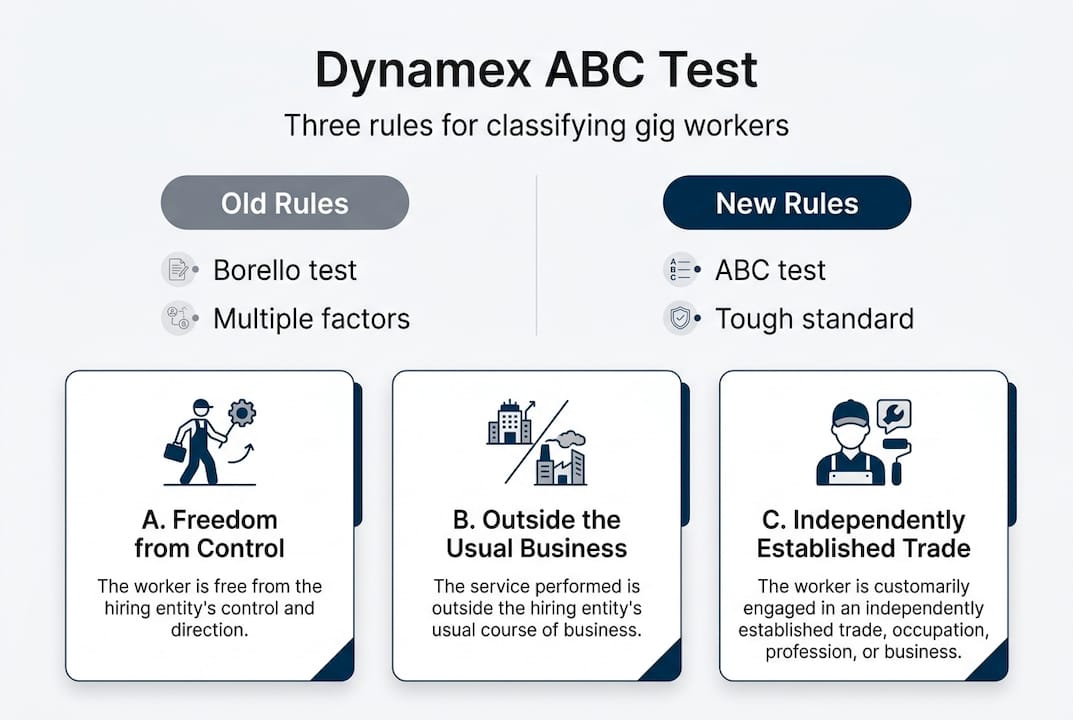
The Dynamex Operations West v. Superior Court ruling fundamentally changed how California determines whether someone is an employee or independent contractor. The court adopted the stricter ABC test for worker classification, replacing the prior Borello multi-factor test that gave employers significant flexibility. This new standard presumes all workers are employees unless the hiring entity proves otherwise through three specific criteria.
The ABC test requires businesses to satisfy all three prongs simultaneously. Prong A asks whether the worker is free from the company’s control and direction in performing the work, both under contract and in actual practice. Prong B examines whether the work performed falls outside the usual course of the hiring entity’s business. Prong C determines whether the worker is customarily engaged in an independently established trade, occupation, or business of the same nature as the work performed.
It is important to note that certain occupations are excluded from the ABC test under Labor Code section 2775, including licensed insurance professionals, certain licensed medical professionals, lawyers, architects, engineers, and various other professionals. For these excluded occupations, the Borello multi-factor test continues to apply. Additionally, while Dynamex adopted the ABC test for wage order purposes, it remains unclear whether the ABC test applies to determine employee status under the California Fair Employment and Housing Act (FEHA), where Borello factors may still control.
Under the previous Borello standard, courts weighed multiple factors without requiring any single element, making it easier for companies to classify workers as contractors. The ABC test flips this approach by creating a presumption of employee status that employers must overcome. This shift particularly impacts gig economy platforms, delivery services, and driver-based businesses that rely heavily on contractor classifications.
Pro Tip: Businesses often misjudge Prong B when workers perform core services rather than peripheral tasks. If you deliver packages for a delivery company or drive passengers for a ride service, you likely perform work within the usual course of that business, automatically failing Prong B and establishing employee status regardless of other factors.
Note: Even if you signed an agreement stating you are an independent contractor, that label is not dispositive. California courts look at the actual working relationship, not what the contract calls it.
The stricter standard means companies can no longer rely on written agreements stating contractor status or partial control measures. Every aspect of the working relationship must align with genuine independence. For Los Angeles workers, this creates stronger legal footing to challenge misclassification and demand proper treatment under employment contracts California workers are entitled to receive.
Key Cases Shaping Post-Dynamex Litigation
Several significant cases have clarified and expanded the reach of the ABC test since Dynamex:
Vazquez v. Jan-Pro Franchising International, Inc. (2021) 10 Cal.5th 944 established that the ABC test applies retroactively to all cases not yet final when Dynamex was decided, dramatically expanding potential liability for employers who had misclassified workers under the more lenient Borello standard.
Garcia v. Border Transportation Group, LLC (2018) 28 Cal.App.5th 558 analyzed which claims are governed by the ABC test versus Borello factors, holding that certain claims including wrongful termination in violation of public policy remained subject to Borello analysis, illustrating the ongoing complexity in worker classification law.
The California Legislature responded to Dynamex by enacting Assembly Bill 5 in 2019, codifying the ABC test in Labor Code section 2775 while carving out numerous industry-specific exemptions. This legislative action confirmed the importance of the ABC test while recognizing that certain professions required different treatment.
In Mejia v. Roussos Construction, Inc. (2022) 76 Cal.App.5th 811, the Court of Appeal held that workers need not make a threshold showing that they were actually hired by the hiring entity before the ABC test is applied, rejecting attempts by employers to add additional burdens of proof on workers beyond the ABC test itself.
Impact of Dynamex on misclassification lawsuits in Los Angeles
The Dynamex case originated in Los Angeles as a class action by drivers who challenged their contractor status, making LA County ground zero for the misclassification revolution.
The California Supreme Court later held in Vazquez v. Jan-Pro Franchising International, Inc. (2021) 10 Cal.5th 944 that Dynamex applies retroactively to all cases not yet final as of the date Dynamex became final. This retroactive application significantly expanded the scope of potential claims, allowing workers to challenge their classification for periods dating back years before the 2018 decision.
After the Supreme Court ruling, workers across industries gained powerful ammunition to file lawsuits under the ABC test, which made it significantly easier to prove employee status compared to the old multifactor analysis.
The litigation explosion following Dynamex transformed Los Angeles courts into battlegrounds for worker classification disputes:
- Class action certifications increased as workers in similar roles joined forces to challenge systematic misclassification across entire companies.
- Industries previously insulated by contractor models faced waves of litigation, including trucking, delivery services, janitorial companies, and construction firms.
- Courts began analyzing federal preemption arguments, particularly in transportation cases involving the Federal Aviation Administration Authorization Act (FAAAA), though these arguments have met with mixed results depending on the specific context and claims asserted.
- Settlement values climbed as the stricter standard made it harder for companies to defend contractor classifications at trial.
- Enforcement agencies ramped up audits and investigations, creating additional pressure beyond private lawsuits.
California courts upheld class certifications and rejected preemption claims in trucking and delivery cases under the ABC test, closing loopholes companies hoped would shield them from the new standard. Federal courts addressing the Federal Aviation Administration Authorization Act preemption found that California’s ABC test applies despite interstate commerce arguments, particularly affecting last-mile delivery drivers and regional truckers operating within California.
The surge in Los Angeles misclassification litigation after Dynamex reflects a fundamental power shift. Workers who previously faced uphill battles proving employee status under Borello now benefit from a presumption in their favor, forcing companies to prove independence rather than workers proving control.
For employment lawyer Los Angeles County practitioners, the decision created unprecedented opportunities to represent misclassified workers. The California worker misclassification ABC test applies broadly across industries, enabling lawyers to pursue cases that would have been difficult or impossible under the prior standard.
Practical effects for workers and businesses after Dynamex
The Dynamex ruling created dramatically different landscapes for worker classification before and after 2018, with consequences extending beyond the decision date through retroactive application.

| Aspect | Pre-Dynamex (Borello) | Post-Dynamex (ABC Test) |
|---|---|---|
| Classification standard | Multi-factor balancing test | Three-prong requirement |
| Proof burden | Worker proves control | Employer proves all ABC elements |
| Lawsuit difficulty | Harder to establish employee status | Presumption favors employees |
| Class certification | Case-by-case analysis | Broader commonality findings |
| Industry impact | Moderate compliance pressure | Widespread reclassification required |
Workers whose cases were not yet final when Dynamex was decided in 2018 can benefit from the ABC test for earlier time periods. This means you can potentially recover wages and benefits dating back years if your case wasn’t already concluded when Dynamex was decided. The practical impacts include:
- Access to minimum wage and overtime pay previously denied under contractor status
- Eligibility for expense reimbursements, including mileage, equipment costs, and supplies
- Coverage under workers’ compensation insurance for job-related injuries
- Protection from wrongful termination and discrimination under employment laws
- Participation in employer-provided benefits like health insurance and retirement plans
- Rights to meal and rest breaks mandated by California labor law
For businesses, the stricter standard created immediate compliance challenges and legal exposure. Studies show mixed outcomes post-ABC test, with employment drops in some sectors but not consistent reclassification gains across all industries. Companies faced difficult choices between reclassifying workers as employees with associated costs or restructuring operations to ensure genuine contractor relationships meeting all three ABC prongs.
Pro Tip: Workers facing potential misclassification should document job duties, control measures, and any evidence showing work performed within the company’s usual business. Save emails directing how to perform tasks, schedules imposed by the company, and records of work performed exclusively for one entity. This documentation becomes critical evidence in employment lawsuit process overview California proceedings.
The retroactive application means businesses cannot simply adjust classifications going forward. They face potential liability for past misclassification, making audits of historical practices essential to assess exposure and consider proactive remediation.
Navigating your rights and legal options if misclassified in Los Angeles
Recognizing misclassification under the ABC test starts with examining your actual working relationship against the three prongs. You may be misclassified if your employer controls when, where, and how you work, if you perform core services central to the company’s business, or if you work exclusively for one company without operating your own independent business serving multiple clients.
If you suspect misclassification, take these steps to protect your rights and build a potential claim:
- Gather comprehensive evidence including contracts, pay stubs, emails, text messages, and any documentation showing control over your work or integration into company operations.
- Consult an employment lawyer Long Beach or Los Angeles area attorney experienced in California misclassification cases to evaluate your situation under the ABC test.
- Understand critical deadlines, including statute of limitations periods that may bar claims if you wait too long to file.
- Consider whether your situation involves other misclassified workers, potentially supporting a class action for broader impact and shared legal costs.
- Document ongoing misclassification if you’re still working, creating a record that strengthens your case without relying solely on memory or verbal agreements.
Potential legal remedies available to misclassified workers extend beyond simple back wages:
- Recovery of unpaid minimum wages and overtime compensation calculated under employee standards
- Reimbursement for business expenses you shouldn’t have borne as an employee
- Penalties for wage statement violations and waiting time if proper final pay wasn’t provided upon separation
- Interest on unpaid amounts dating back to when payments should have been made
- Attorney fees and costs, making it financially feasible to pursue claims even for moderate amounts
- Injunctive relief requiring proper classification going forward for you and similarly situated workers
Choosing the right legal representation makes a significant difference in misclassification cases. Look for attorneys who specialize in California employment law and have specific experience with ABC test litigation. Your lawyer should understand industry-specific applications, know recent case law developments, and have resources to handle complex class actions if appropriate.
Timing matters critically in employment cases. California’s statute of limitations for wage and hour claims varies by claim type: three years for actions upon statutory liability such as overtime pay claims (Code of Civil Procedure § 338(a)), four years for written employment contract claims, two years for oral employment contract claims, and three years for waiting time penalties under Labor Code section 203. Because limitations periods vary, prompt consultation with an attorney is essential to preserve all potential claims. If you’re currently misclassified, continuing to work while building a case may be strategic, but if you’ve already separated from the employer, prompt action preserves your maximum recovery window.
Protect Your Rights with Experienced California Employment Lawyers
Navigating misclassification claims under the Dynamex ABC test requires attorneys who understand both the legal standards and practical realities of California worker classification. California United Law Group represents employees throughout Los Angeles and surrounding areas in misclassification disputes, wage and hour violations, and class actions against employers who deny workers their rightful status and protections.
Our employment law services cover comprehensive case evaluation, evidence gathering, negotiation, and litigation when necessary to recover what you’re owed. Whether you’re a gig worker, delivery driver, construction laborer, or any other misclassified employee, we provide tailored guidance based on your specific industry and circumstances. Our employment lawyers serving Long Beach and Los Angeles bring substantial experience with post-Dynamex litigation and understand how courts apply the ABC test across different work arrangements. Contact us to discuss your rights under California law and explore your options through our employment lawsuit process overview consultation.
Disclaimer: This blog post is provided for general informational purposes only and does not constitute legal advice. The information presented is current as of the publication date and may not reflect the most recent legal developments. Every case is unique, and outcomes depend on specific facts and circumstances. Reading this article does not create an attorney-client relationship. If you have questions about your specific situation, please consult with a qualified employment attorney.
FAQ
Did the Dynamex decision apply retroactively to cases before 2018?
Yes, Dynamex applies retroactively to non-final cases according to Vazquez v. Jan-Pro Franchising International, Inc. (2021) 10 Cal.5th 944. This means if your case wasn’t already concluded with a final judgment when Dynamex was decided in 2018, you can use the ABC test for classification periods before that date. Workers can file claims covering earlier misclassification and potentially recover wages, benefits, and penalties dating back several years. The retroactive application significantly expanded the scope of potential claims and increased employer liability for past practices that would have been analyzed differently under the old Borello standard.
What are the ABC test criteria in Dynamex for worker classification?
The ABC test requires employers to prove three elements to classify someone as an independent contractor. Prong A requires the worker to be free from the company’s control and direction in performing the work, both contractually and in actual practice. Prong B demands the work performed be outside the usual course of the hiring entity’s business, meaning you can’t do core company functions and be a contractor. Prong C requires the worker to be customarily engaged in an independently established trade, occupation, or business of the same nature as the work performed, meaning you operate your own independent business serving multiple clients. Failing any single prong establishes employee status regardless of the other two.
How has Dynamex affected gig and delivery workers in Los Angeles?
Gig and delivery workers often meet Prong B criteria because they perform work central to platform businesses, qualifying them as employees rather than contractors. Delivering packages for a delivery company or transporting passengers for a ride service falls squarely within the usual course of those businesses. This classification shift has increased legal protections and enabled numerous misclassification claims in Los Angeles, with courts consistently applying the ABC test despite company arguments about technology platforms or flexible scheduling. Legal rulings uphold the ABC test over federal preemption attempts, closing potential escape routes for gig companies and creating ongoing litigation over proper worker treatment and compensation.
What should I do if I believe I’m misclassified under Dynamex?
Document your work duties, control level, and relationship details immediately to preserve evidence supporting employee status. Save contracts, communications showing company control, schedules, performance requirements, and records of work performed exclusively for one business. Consult an employment lawyer familiar with California law and the ABC test to evaluate your situation and explain potential remedies. Consider possible claims for back wages, overtime, expense reimbursements, and benefits you should have received as an employee. Act promptly because statute of limitations deadlines limit how far back you can recover, and waiting reduces both your recovery period and the strength of available evidence.