
If you work in Los Angeles and think you were treated unfairly, the first question is which kind of discrimination claim you have. Disparate treatment means an employer intentionally treated you worse because of a protected trait such as race, sex, age, disability or pregnancy. Disparate impact means a rule that looks neutral on paper pushes out or holds back a protected group, whether or not anyone meant it to. The two claims are proved differently, and choosing the right one shapes your evidence from day one. At California United Law Group, we represent only employees, and we help Los Angeles workers work out which theory fits their facts.
TL;DR
- Disparate treatment is intentional: you were treated less favorably than similar coworkers because of a protected characteristic.
- Disparate impact is about effect: a neutral-seeming policy disproportionately harms a protected group, and no proof of bad motive is required.
- Treatment cases usually turn on comparators and the employer’s stated reasons. Impact cases usually turn on statistics and the specific policy.
- In California, both theories can generally be brought under FEHA, the Fair Employment and Housing Act, and under federal law such as Title VII. FEHA generally covers employers with five or more employees, while Title VII covers employers with 15 or more and does not cover age or disability, which fall under separate federal statutes.
- Many real situations fit one theory better than the other, so a case evaluation early on saves evidence and time.
Table of Contents
- The difference in plain terms
- Is being treated differently at work discrimination?
- Disparate treatment: how it works
- Disparate impact: how it works
- Federal law and California law
- Which claim fits your situation?
- Steps to take if you are in Los Angeles
- How we can help
- Our perspective
- FAQ
- Sources
The difference in plain terms
The U.S. Equal Employment Opportunity Commission (EEOC), the federal agency that enforces job discrimination laws, describes disparate treatment as less favorable treatment of similarly situated people because of a protected trait, and it requires discriminatory motive. Disparate impact, by contrast, involves an evenhanded policy that disproportionately excludes a protected group, with no motive required.
A simple way to hold the two apart:
| Disparate treatment | Disparate impact | |
|---|---|---|
| What it targets | A decision about you or a group | A policy or practice applied to everyone |
| Intent | Must be shown, directly or by inference | Not required |
| Typical proof | Comparators, timing, comments, inconsistent explanations | Statistics showing who is screened out, plus the specific policy |
| Typical question | Why was I treated differently? | Why does this rule keep removing people like me? |
| Employer’s response | A legitimate, nondiscriminatory reason | The practice is job-related and consistent with business necessity (the employer’s burden to prove). |
Both theories are recognized in California’s civil jury instructions. CACI No. 2500 covers FEHA disparate treatment. CACI No. 2502 covers FEHA disparate impact, which requires an employment practice or selection policy that had a disproportionate adverse effect on a protected group. Business necessity is an affirmative defense the employer must prove (CACI No. 2503), and the employee may rebut it (CACI No. 2504).
Is being treated differently at work discrimination?
Not automatically. A boss who is harsh with everyone, or who plays favorites for reasons unrelated to a protected trait, may be a bad manager but not a lawbreaker. Under the EEOC’s approach, different treatment supports a disparate treatment claim when you were treated less favorably than similarly situated people because of a protected characteristic, and there is evidence linking that characteristic to an adverse employment decision.
In practice, an “adverse employment decision” can be a firing, demotion, denied promotion, cut in hours, worse assignments or a pay gap. The link to your protected trait is what turns unfair treatment into unlawful treatment.
Disparate treatment: how it works
What you have to show
California’s FEHA instruction lists the pieces of a disparate treatment case: a covered employer, an employment relationship, an adverse action, a protected characteristic that was a substantial motivating reason for that action, harm to you, and employer conduct that was a substantial factor in causing the harm (CACI No. 2500). The California Supreme Court adopted the “substantial motivating reason” standard in Harris v. City of Santa Monica (2013) 56 Cal.4th 203, explaining that it ensures liability is not imposed based on mere thoughts or passing statements unrelated to the disputed decision.
You can prove motive with direct evidence, such as a manager’s discriminatory remark, or with circumstantial evidence. The EEOC’s guide for complainants explains that under the McDonnell Douglas framework, once you make an initial showing, the employer must state a legitimate, nondiscriminatory reason, while you keep the overall burden of persuasion. Your task then is to show that reason is not the real one. California courts apply the same McDonnell Douglas burden-shifting test to FEHA claims, as the California Supreme Court confirmed in Guz v. Bechtel National, Inc. (2000) 24 Cal.4th 317. The initial showing is not meant to be onerous.
Comparators are the heart of most cases
A comparator is a coworker in a similar position who was treated better. The EEOC’s guide says comparator evidence is strongest where employees share the relevant circumstances: the same supervisor, similar job function, the same time period and substantially similar conduct (EEOC guide).
Example: a Los Angeles warehouse employee over 50 is fired after a third attendance warning. A 28-year-old coworker under the same supervisor had more absences and received only a verbal reminder. That gap, combined with comments about “fresh energy” in team meetings, could support an age discrimination claim based on disparate treatment.
Evidence worth saving now
- Performance reviews and praise before the change in treatment
- Texts, emails and chat messages with discriminatory remarks or shifting explanations
- Names of comparators and how they were handled
- The timeline: when you disclosed a pregnancy, disability or complaint, and when the treatment changed
- Written discipline, and any policy the employer says you violated
Statistics can help too, but the EEOC cautions that statistics alone do not necessarily prove an individual’s claim. Your own story, documented, carries the case.
Disparate impact: how it works
The neutral rule problem
Impact claims target practices that apply to everyone but fall harder on one group. The EEOC’s guidance says impact review applies to criteria such as recruiting, hiring, promotion, layoffs, termination, grooming standards, education and experience requirements, and employment tests, subject to statutory exceptions such as seniority systems.
The framework exists to remove barriers to equal opportunity that were not necessarily designed to discriminate.
Examples a Los Angeles worker might recognize:
- A physical test for a delivery or warehouse role that screens out most women applicants but has little to do with the job
- A rule requiring a clean-shaven face with no medical or religious exceptions, which can fall harder on some racial or religious groups
- A promotion process that relies on a single subjective interview and consistently advances one group
California has a real appellate case on this theory. In Turman v. Turning Point of Central California (2010), a rule that staff could only conduct same-sex urinalysis was neutral on its face. Also change the sentence before it from California has a real appellate case on this theory. to California appellate courts have applied this theory. Because the residents were predominantly male, it could disproportionately hurt women, and the court upheld a disparate impact jury instruction. The theory traces back to the U.S. Supreme Court’s decision in Griggs v. Duke Power Co. (1971) 401 U.S. 424, which held that a high school diploma requirement and general intelligence test that excluded Black applicants, and bore no demonstrable relationship to job performance, violated Title VII.
What proof looks like
The EEOC says an impact claim requires identifying the particular practice causing a significant adverse impact, ordinarily supported by statistical evidence. California courts agree. In Jumaane v. City of Los Angeles (2015) 241 Cal.App.4th 1390, the court described valid statistical evidence as required to prove disparate impact discrimination. If a process’s parts cannot be separated, it may be analyzed as one practice.
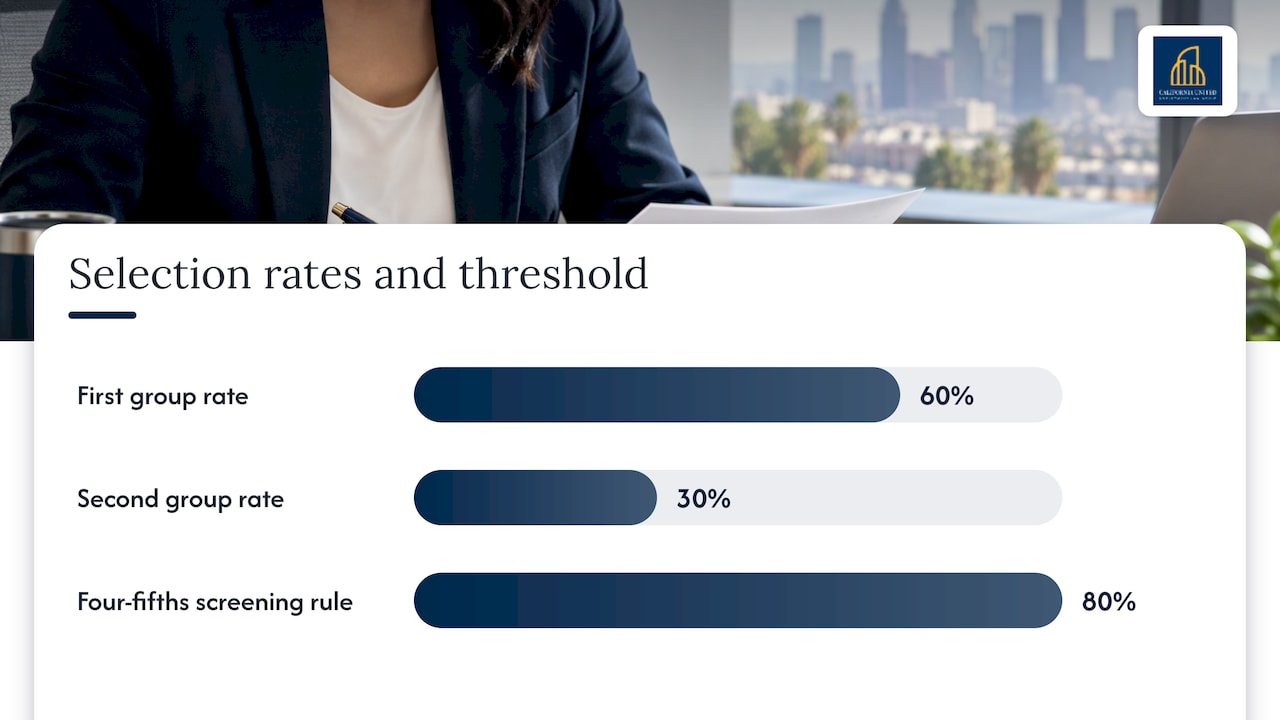
A common screening tool is the four-fifths rule. A Congressional Research Service report updated April 28, 2026 explains that EEOC regulations generally treat selection of a group at less than 80% of the rate of the most-selected group as evidence of adverse impact. It is a screening rule, not an automatic finding of liability.
Worked example: a Los Angeles employer’s online test passes 60 of 100 applicants from one group (60%) and 24 of 80 applicants from another (30%). The second group’s rate is half the first group’s, well below 80%, so the test deserves scrutiny. Whether it is unlawful then depends on the next step.
The employer’s defense and your answer
Under Title VII, an employer can defend a practice by showing it is job-related for the position and consistent with business necessity. You can still prevail by showing a less discriminatory alternative that meets the same business need and that the employer refused to adopt. That last step keeps business necessity from ending every impact claim (CRS). Under FEHA, California’s jury instruction asks whether an alternative would have accomplished the business purpose equally well with less adverse impact. No published California decision has decided whether the federal “refused to adopt” requirement also applies.
Federal law and California law
The same two theories appear under federal Title VII and California’s FEHA. Congress codified Title VII disparate impact in 1991, and the CRS report notes that a statistical imbalance alone does not establish liability. A California Women’s Law Center guide says FEHA is broader in scope than Title VII, while the standards are substantially similar. That guide also describes how statistical expert evidence about a city lifeguard promotion process supported a prima facie sex discrimination impact claim.
For California workers, FEHA is the main vehicle. Before filing a FEHA lawsuit, workers generally must first file a complaint with the California Civil Rights Department (CRD), the state agency that handles workplace discrimination complaints, and obtain a right-to-sue notice. The FEHA complaint deadline is generally three years from the unlawful practice, and federal EEOC deadlines are much shorter. Filing deadlines are strict, so do not wait. Our page on CRD filing deadlines and evidence for race discrimination claims walks through the process, and the same ideas apply to workers across Los Angeles County.
Algorithms and hiring software
Impact theory matters more as employers use automated screening. The California Civil Rights Council announced that its regulations on artificial intelligence and automated-decision systems in employment were approved on June 27, 2025 and took effect October 1, 2025. They clarify how existing antidiscrimination law applies when employers use such tools. If a resume filter or video-interview tool keeps rejecting people in a protected group, that is the kind of pattern impact analysis is built for.
Which claim fits your situation?
Many Los Angeles cases involve both theories at once. Ask yourself:
- Was one person singled out? Think about comments, timing and comparators. That points to disparate treatment.
- Does a rule apply to everyone but keep hurting people like you? Think about tests, height or weight requirements, schedules, grooming rules or screening software. That points to disparate impact.
- Did you complain first? If you were punished after reporting discrimination, you may also have a retaliation claim, which generally does not depend on proving the original discrimination. See our guide on proving workplace retaliation.
- Are other people affected? A policy that harms many workers may support a group or class case. Our class action practice handles those matters.
A few related topics show how the theories play out in specific settings: glass ceiling discrimination in Los Angeles often combines subjective promotion practices with comparator evidence, and gender discrimination claims in Culver City show how filing and evidence preservation work.
Steps to take if you are in Los Angeles
- Write down what happened while it is fresh: dates, names, exact words, witnesses.
- Save documents you are lawfully allowed to keep, such as your own reviews, pay records and messages sent to you. Do not take confidential company files.
- Identify the rule or decision. Is it a person’s choice, or a policy that applies broadly?
- Note who was treated differently, and in what way.
- Do not resign in anger. Leaving can complicate a claim; talk to a lawyer first.
- Get a case evaluation before signing a severance or separation agreement.
How we can help
We exclusively practice employment law for employees across California, and our attorneys include lawyers with prior employer-side experience, which helps us anticipate how a company will defend a claim. We handle discrimination cases on a contingency fee basis, which means you pay no attorney fees unless we recover money for you. How costs are handled is explained in our written fee agreement before you hire us. Consultations and case evaluations are free.
👉 Talk to our team about your Los Angeles employment case, or read about our employment law services for discrimination, harassment, retaliation and wrongful termination.
Our perspective
Workers often come to us saying, “I can’t prove they meant it.” That sentence is the reason this distinction matters. Intent is hard to show, but it is not the only path. When a policy keeps pushing out people in a protected group, the law asks about the effect of the rule, not the manager’s state of mind.
We start every case by asking two questions: what happened to you, and what rule or pattern sits behind it? Our attorneys include lawyers who have worked on the employer side, so we know how employers build their legitimate-reason defenses and where those defenses tend to be thin. We use that insight to develop your claim from the first conversation.
Because we represent employees only, and our attorney fees depend on your recovery, our interests are aligned with yours. If you are unsure which theory applies, that is exactly what a free evaluation is for.
California United Law Group
FAQ
What is the main difference between disparate treatment and disparate impact?
Disparate treatment is intentional: an employer treats you worse because of a protected trait. Disparate impact is about results: a neutral policy disproportionately harms a protected group, and intent is not required. The evidence differs, with comparators and motive for treatment, and statistics and the specific policy for impact.
Can I bring both claims in the same case?
Yes, when the facts support both. A worker might be singled out by a supervisor and also be affected by a company-wide screening rule. The two theories can be pleaded together under FEHA and, where it applies, Title VII.
How do I prove disparate treatment at work?
You can use direct evidence, like discriminatory comments, or circumstantial evidence, like a better-treated coworker in a similar position, suspicious timing or an explanation that keeps changing. The EEOC says comparator evidence is strongest when employees share a supervisor, job function, time period and similar conduct.
Do I need statistics to win a disparate impact claim?
Usually, yes. Impact claims ordinarily rest on statistical evidence that a specific practice has a significant adverse effect on a protected group. The four-fifths rule is a common screening measure, but it is not a final answer on liability.
What should I do first if I think I’m affected in Los Angeles?
Write down the facts, save the documents you are entitled to keep, and get a free case evaluation before any deadline passes or you sign a separation agreement. We can help you decide whether the claim is about treatment, impact or both.
This article provides general information about California and federal employment law and is not legal advice. Reading it or contacting us does not create an attorney-client relationship. Every case depends on its own facts, and past results do not guarantee a similar outcome.
Sources
- CM-604 Theories of Discrimination, EEOC
- Section 15 Race and Color Discrimination, EEOC
- A Guide to Legal Standards for Unrepresented Complainants, EEOC
- What Is Disparate-Impact Discrimination? Congress.gov
- CACI No. 2500, Disparate Treatment
- CACI No. 2502, Disparate Impact
- Turman v. Turning Point of Central California
- Federal and California State Sex-Based Discrimination guide, California Women’s Law Center
- Civil Rights Council AI employment regulations announcement