
Yes, in many situations. “Glass ceiling” is a description, not a named cause of action, but California law prohibits denying promotions or advancement because of a protected characteristic such as sex, race, age, or disability. If you work in Los Angeles and believe you keep being passed over for reasons that have nothing to do with your performance, the facts of your situation may support a claim under the Fair Employment and Housing Act (FEHA). FEHA generally applies to California employers with five or more employees. This article explains how the law treats these situations, what evidence tends to matter, and which deadlines and agencies apply.
This article is for general educational purposes only and is not legal advice. Employment law is fact-specific, and outcomes vary from case to case.
TL;DR
- “Glass ceiling” is not a standalone claim. It is usually pursued as discrimination (failure to promote, unequal advancement) under FEHA.
- The core question is whether a protected characteristic was a substantial motivating factor in the decision to deny you advancement.
- In California, a complaint to the Civil Rights Department (CRD) generally must be filed within three years of the discriminatory act, and each denied promotion can start its own clock.
- Retaliation for raising concerns is a separate violation under FEHA.
- Potential remedies can include back pay, promotion, and damages, depending on the facts. No outcome is guaranteed.
Table of Contents
- What “glass ceiling” means in a Los Angeles workplace
- When a blocked promotion can become unlawful discrimination
- Which protected characteristics are involved
- What kind of evidence helps show a protected-characteristic link
- Deadlines and agencies that apply in California
- Retaliation for raising concerns
- What remedies may be available
- Questions Los Angeles employees often ask themselves
- Talk to an employment attorney about your situation
- FAQ
- Sources
What “glass ceiling” means in a Los Angeles workplace
The term describes an invisible barrier that keeps certain groups, particularly women and minorities, from rising to senior roles even when they are qualified. It is shorthand for a pattern: repeated promotion denials, being steered away from leadership tracks, or being told to “wait your turn” while others advance.
In a courtroom, nobody files a lawsuit titled “glass ceiling.” Instead, the facts are measured against California’s anti-discrimination statutes. A pattern that looks like a ceiling becomes a claim when it can be tied to a protected characteristic. FEHA covers categories including race, color, sex, gender, gender identity and expression, sexual orientation, age (40 and over), disability, national origin, ancestry, religion, and pregnancy. CRD describes the employment discrimination it enforces, along with available remedies, on its employment page.
A real-world illustration of how the term appears in enforcement: in a 2024 settlement announcement, CRD described allegations that women at one technology company encountered a glass ceiling, were told to wait their turn, were discouraged from applying for promotions, or lost opportunities to less qualified male colleagues. The CRD settlement release shows the kinds of facts regulators connect to the phrase. These were allegations in a settlement, not findings that apply to any other employer.
When a blocked promotion can become unlawful discrimination
Not every missed promotion is unlawful. Employers may lawfully choose among candidates based on performance, experience, and business needs. A claim arises when the decision is tied to who you are, not what you do.
Under FEHA, a California appellate decision in 2025, Stewart v. County of Los Angeles, explains that discrimination must be a substantial motivating factor in the adverse employment decision. That has a practical meaning: disagreeing with the employer about who was more qualified is generally not enough by itself. The evidence should point, directly or circumstantially, toward a discriminatory motive.
The California Supreme Court set this standard in Harris v. City of Santa Monica (2013) 56 Cal.4th 203. There, the Court explained that “[r]equiring the plaintiff to show that discrimination was a substantial motivating factor, rather than simply a motivating factor, more effectively ensures that liability will not be imposed based on evidence of mere thoughts or passing statements unrelated to the disputed employment decision.” California’s civil jury instructions describe a “substantial motivating reason” [as] a reason that actually contributed to the [adverse employment action]. It must be more than a remote or trivial reason. It does not have to be the only reason.
Common situations Los Angeles employees describe include:
- Being repeatedly passed over for roles that go to less experienced colleagues of a different gender, race, or age group
- Promotion criteria that change after you apply
- Being excluded from the assignments, clients, or training that lead to advancement
- Comments about your age, family plans, accent, or appearance in connection with advancement decisions
- Pay or title gaps compared with colleagues doing similar work, which may also raise claims under California’s Equal Pay Act
Each of these may or may not amount to unlawful conduct depending on the full facts. A single data point rarely tells the story.
Which protected characteristics are involved
Glass ceiling concerns are most often raised around sex and gender, but they are not limited to that. The same analysis applies to other protected categories:
| Situation | Protected category often involved |
|---|---|
| Women overlooked for management roles | Sex or gender, pregnancy |
| Qualified employees of color stalled at mid-level | Race or color, national origin |
| Older workers told leadership “needs fresh energy” | Age |
| Employees with a disability denied advancement after requesting accommodation | Disability |
| Parents or pregnant employees steered off leadership tracks | Pregnancy, sex |
If your concern involves disability, you may find our overview of disability discrimination rights in Los Angeles useful alongside this one.
What kind of evidence helps show a protected-characteristic link
Employers rarely announce a discriminatory reason. Most cases rely on circumstantial evidence, meaning facts from which a reasonable person could infer motive. Federal guidance describes this framework: the EEOC explains that disparate-treatment claims without direct evidence are generally analyzed through the three-part McDonnell Douglas test, and that showing pretext takes specific evidence that the employer’s stated reason is not true or believable, not just a suspicion. See the EEOC guide to legal standards. That guide is written for federal-sector complainants, but it illustrates the general approach courts take to indirect proof. California courts follow a similar approach. As the California Supreme Court noted in Guz v. Bechtel National, Inc. (2000) 24 Cal.4th 317, “[b]ecause of the similarity between state and federal employment discrimination laws, California courts look to pertinent federal precedent when applying our own statutes.”
Types of information that can be relevant include:
- Your performance reviews, awards, and written praise
- The qualifications posted for the role and who ultimately received it
- Written communications about the decision
- Statements by decision makers about the protected characteristic
- How similarly situated colleagues were treated
- Changes in the employer’s explanation over time
Which of these matter, and how much, depends on the facts. An attorney can assess whether what you have is meaningful, which is one reason a confidential case evaluation is often worthwhile before you decide anything.
Deadlines and agencies that apply in California
Timing is one of the most important parts of any failure-to-promote claim.
The CRD filing window
CRD, California’s civil rights agency, states that a complaint of employment discrimination generally must be filed within three years of the date the discriminatory act occurred. It also states that you must file with CRD even if you want to bring a case in court, and that you can request an immediate right-to-sue notice when you file. Review the CRD employment page for the current rules. Older materials you may find online cite a one-year period, which no longer reflects the current CRD guidance. Special rules and exceptions can extend or shorten this window, so confirm your specific dates with an attorney.
Each promotion denial can have its own clock
In Stewart, the court described a failure-to-promote claim as accruing when the employee knows or reasonably should know of the decision not to promote, and treated individual promotion denials as discrete acts. Claims based on promotions the employee learned of years earlier were time-barred in that case, and arguments that the denials formed one continuing violation did not rescue them. The court’s opinion is a good illustration of why waiting can limit options.
Investigation versus right-to-sue
CRD’s instructions explain that once it issues a right-to-sue notice, it will not investigate the complaint, and that it does not file your complaint with the EEOC for you, so a federal claim requires contacting the EEOC separately. If you receive a right-to-sue notice, you generally have one year from the date of the notice to file a lawsuit in court. Read the CRD right-to-sue instructions to understand the consequences of each path. Because the choice has procedural effects, many employees speak with an employment attorney before deciding how to proceed.
Federal charge-filing deadlines with the EEOC are shorter than California’s, generally 300 days in California, so confirm the current deadline with the EEOC or an attorney.
Retaliation for raising concerns
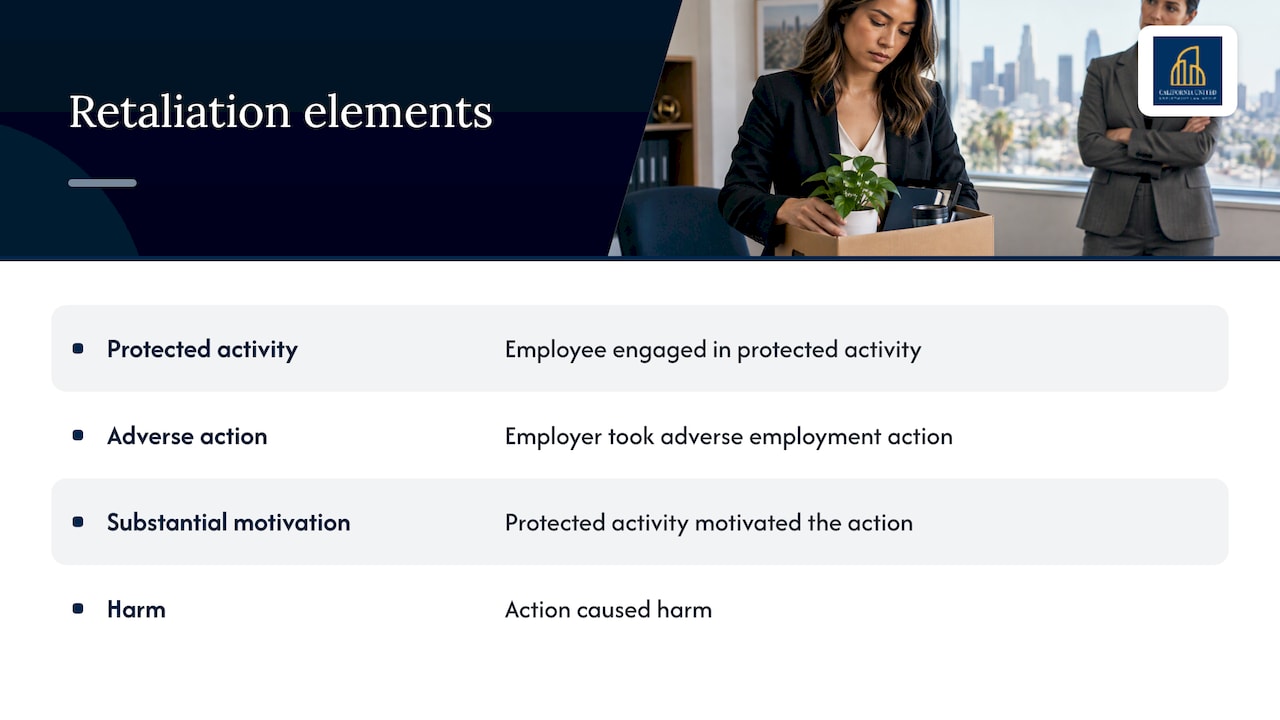
Employees often hesitate to question a promotion decision for fear of consequences. FEHA separately prohibits retaliation. California’s civil jury instruction on retaliation, CACI No. 2505, lists what an employee must prove: that they engaged in protected activity, that the employer took an adverse employment action, that the protected activity was a substantial motivating reason for that action, that the employee was harmed, and that the employer’s conduct was a substantial factor in causing that harm.
The California Supreme Court has read protected activity broadly. In Yanowitz v. L’Oreal USA, Inc. (2005) 36 Cal.4th 1028, it held that an employee’s refusal to follow a supervisor’s order that the employee reasonably believes is discriminatory can qualify as protected activity, even if the employee does not explicitly state that belief, as long as the circumstances show the employer knew the employee was opposing discrimination.
Retaliation also does not have to be a firing. Acts that might not individually be sufficient to constitute retaliation can, taken as a whole, establish prohibited conduct, a principle the California Supreme Court recognized in Yanowitz and that the jury instruction commentary notes. Examples workers describe include sudden negative reviews, reduced duties, schedule changes, or exclusion from meetings. Our guide to signs of employer retaliation walks through common patterns, and if you lost your job, see your legal protections after termination.
What remedies may be available
If discrimination in promotion or advancement is proven, CRD lists a range of potential remedies for employment discrimination: back pay, front pay, hiring or reinstatement, promotion, out-of-pocket expenses, policy changes, training, reasonable accommodations, emotional-distress damages, punitive damages, and attorney’s fees and costs. See the CRD employment page for the list. Punitive damages require a heightened showing and are generally not available against public entities. Which remedies apply, if any, depends on the facts and the outcome of the case. Nothing is guaranteed.
Questions Los Angeles employees often ask themselves
If you are weighing whether what you are experiencing could be a claim, these questions frame the issue:
- Is there a pattern, or one decision? A single denial and a series of denials raise different questions.
- Can the decision be connected to a protected characteristic, through comments, comparisons, or inconsistent explanations?
- When did you learn of each decision?
- Have you raised concerns, and has anything changed in how you are treated since?
- What records do you already have, such as reviews, postings, and emails?
The answers do not determine whether you have a claim. They are the facts a lawyer will want to understand.
Our perspective
At California United Law Group, we represent employees only, and our practice is focused on California employment law, including FEHA and Labor Code claims. That focus matters in glass ceiling situations, because these matters rarely come down to one dramatic event. They are built from patterns, timing, and small details that an employee living through them can find hard to evaluate alone.
Several of our attorneys have prior experience on the employer side, which means we understand how employers explain promotion decisions and how those explanations are typically presented. We use that understanding on behalf of the employees we represent.
We also know that many Los Angeles employees wait because they are worried about their jobs. We handle cases on a contingency fee basis, which means you pay no attorney’s fees unless we obtain a recovery for you. How case costs are handled is explained in our written fee agreement. A conversation with us does not commit you to anything, and every situation is evaluated on its own facts. Past results do not guarantee a similar outcome in any future matter.
California United Law Group
Talk to an employment attorney about your situation
If you work in Los Angeles and believe a pattern of denied promotions may be tied to who you are, we can review your situation in a free consultation. Our employment law practice covers discrimination, retaliation, harassment, and wrongful termination for California employees.
👉 Contact California United Law Group to discuss your situation.
FAQ
Is “glass ceiling discrimination” a separate legal claim in California?
No. It is a descriptive term. The underlying conduct is usually pursued as discrimination, such as failure to promote or unequal terms of advancement, under FEHA or federal law. What matters is whether a protected characteristic was a substantial motivating factor in the decision.
How long do I have to file a complaint?
CRD states that employment discrimination complaints generally must be filed within three years of the discriminatory act. Each promotion denial may be treated as its own event, and the clock can start when you learn of the decision. Federal EEOC deadlines are shorter, generally 300 days in California, so ask an attorney about your specific dates.
Can I be punished for complaining about being passed over?
FEHA prohibits retaliation against employees who engage in protected activity, such as opposing discrimination. Retaliation can include actions short of termination, and conduct can be considered as a whole. Whether something qualifies depends on the facts.
What if the employer says the other candidate was simply more qualified?
Employers may lawfully choose among candidates, so that explanation alone is not unlawful. The question is whether the stated reason is the real one or whether discrimination was a substantial motivating factor. Evidence about qualifications, comparisons, and statements can bear on that question.
Do I need a lawyer to file with CRD?
You are not required to have one to file, but the choice between a CRD investigation and an immediate right-to-sue notice carries consequences. Many employees consult an attorney first so they understand those consequences.
Sources
- California Civil Rights Department: Employment
- CRD settlement release, June 2024
- Stewart v. County of Los Angeles (Cal. Ct. App. 2025)
- EEOC: A Guide to Legal Standards for Unrepresented Complainants
- CRD: Instructions for Obtaining a Right-to-Sue Notice
- CACI No. 2505, Retaliation: Essential Factual Elements
- Yanowitz v. L’Oreal (California Supreme Court)