
Yes, in many situations a Burbank employee or job applicant can challenge an employer’s decision that relied on a criminal conviction. California does not treat a conviction as an automatic bar to work. Under the Fair Chance Act, most employers must wait until after a conditional job offer to consider conviction history. They must also give you a written notice and a chance to respond before rejecting you because of it. Separately, a conviction-based policy that disproportionately harms people in a protected group can be unlawful discrimination under FEHA.
This article is general education, not legal advice. Employment law is fact-specific, and outcomes vary from case to case.
TL;DR
- Employers with five or more employees generally may not ask about or consider conviction history until after a conditional offer.
- Before a final rejection based on a conviction, a covered employer must give you written notice and time to respond.
- A conviction-based policy can also be discriminatory if it disproportionately affects a protected group without a legitimate business purpose.
- Complaints can go to the California Civil Rights Department (CRD) or, for federal claims, the EEOC. Strict deadlines apply, and state-law complaints to CRD generally must be filed within three years.
- Exceptions exist for certain jobs, so whether you have a claim depends on your facts.
Table of Contents
- What California law says about conviction history and hiring
- Who the Fair Chance Act covers
- When an employer may ask about or consider a conviction
- The notice and response process employers must follow
- When a conviction policy becomes discrimination
- What kinds of evidence can matter
- Time limits and where complaints go
- Burbank workers and applicants: how this plays out locally
- Our perspective
- Talk with an employment lawyer in Burbank
- FAQ
- Sources
What California law says about conviction history and hiring
Two bodies of law matter here, and they work together.
The first is the Fair Chance Act, found in California Government Code section 12952. It makes it unlawful for an employer with five or more employees to ask about or consider an applicant’s conviction history before making a conditional job offer. It also limits what an employer may consider afterward. Employers generally may not consider certain arrests, diversion records, or convictions that have been sealed, dismissed, expunged, or statutorily eradicated. The statute contains exceptions.
The second is the California Fair Employment and Housing Act (FEHA). It does not make “criminal record” a protected class by itself. But it can prohibit an employer from using criminal history when doing so adversely affects people because of a protected characteristic and there is no legitimate business purpose. CRD says this in its Criminal History and Employment fact sheet.
So when people ask about “conviction discrimination,” the legal answer usually falls into one of two buckets:
- A process violation. The employer asked too early, skipped the required notice, or considered records it should not have.
- A discrimination claim. The employer’s use of conviction history disproportionately excludes a protected group, or it applied its screening differently to different people.
Who the Fair Chance Act covers
The protection reaches beyond people filling out a first application. According to CRD’s June 2025 fact sheet, the Act covers:
- Job applicants
- People who begin work before a background check is run
- Employees seeking a promotion
- Employees who are otherwise undergoing a background check
The same fact sheet says the Act applies to public and private employers with five or more employees. That includes union hiring halls, labor contractors, and temporary employment agencies. A Burbank worker placed through a staffing agency may therefore be covered even though the agency, not the worksite, ran the check.
Smaller employers with fewer than five employees fall outside the Act. Other laws may still apply to them, so the size of the employer is one fact worth knowing early.
When an employer may ask about or consider a conviction
The timing rule is the heart of the Act. A covered employer generally cannot include a conviction-history question on an application, and cannot ask about or consider a record until after a conditional offer. Under Government Code section 12952 and CRD’s regulations, the ban also covers background checks and internet searches done before that point.
After a conditional offer, the employer may look at a conviction. It must then follow the required process before withdrawing the offer.
Exceptions that can change the answer
Some jobs are different. The Fair Chance Act does not apply to positions for which an employer is otherwise required by law to conduct a conviction history background check or restrict employment based on criminal history, or to positions with criminal justice agencies or Farm Labor Contractors. Separately, California Labor Code section 432.7 allows an employer to ask about a particular conviction in limited circumstances, including when:
- Federal or state law requires the employer to obtain that information.
- The job requires possessing or using a firearm.
- The conviction legally bars the applicant from the position.
- The employer is legally prohibited from hiring someone with that conviction.
Public employers can have their own rules. For example, a 2009 Burbank resolution authorized state and federal criminal-history checks for city employment, volunteers, contract employees, and certification. It also allowed violent or serious felony or misdemeanor convictions to be disregarded for mitigating circumstances or lack of job relation. Rules and practices change over time, so a city job should be looked at against the current law and policy, not only an older document.
The practical point: an exception is a reason an employer may lawfully ask. It is not a blank check to reject anyone with a record.
The notice and response process employers must follow
Even after a conditional offer, an employer cannot simply withdraw it. CRD’s June 2025 fact sheet describes the required sequence for a covered employer:
- The employer makes an individualized assessment of whether the conviction has a direct and adverse relationship with the specific job duties. That assessment must consider the nature and gravity of the offense or conduct, the time elapsed since the offense or conduct and completion of the sentence, and the nature of the job in question.
- If it preliminarily decides to disqualify you, it sends a written notice identifying the convictions at issue. It includes a copy of the background-check report if one was obtained.
- The notice explains your right to respond before the decision becomes final, including with evidence of inaccuracy, rehabilitation, or mitigating circumstances. You get at least five business days.
- If you tell the employer within those five business days that you dispute the accuracy of the report and are taking steps to get evidence, you receive at least five additional business days to respond.
- After reassessing, a final decision to withdraw must be in writing. It must identify any process for challenging the decision and state your right to complain to CRD.
This list describes what the employer must do. It is not a set of instructions for you. What you actually submit in response is a decision that often benefits from advice about your own situation.
CRD’s Fair Chance Act FAQ says people may submit things like employment history, an explanation of the circumstances, education or training records, and evidence of rehabilitation efforts. The law is designed to give the person a real hearing. The same FAQ explains the Act’s purpose: reducing barriers to employment, which supports individuals and families and can strengthen community ties and mental health.
When a conviction policy becomes discrimination
A policy that looks neutral can still be unlawful. This is called disparate impact. It occurs when a rule applied to everyone falls more heavily on one protected group without a sufficient justification.
On the federal side, the EEOC’s enforcement guidance on arrest and conviction records explains that a conviction-record policy can violate Title VII when it disproportionately excludes people based on race, national origin, or another protected characteristic. The employer must then show the policy is job-related and consistent with business necessity. The guidance points to targeted screening, individualized assessment, and less discriminatory alternatives as things employers should consider.
Courts have recognized these principles for decades. In Griggs v. Duke Power Co. (1971) 401 U.S. 424, the U.S. Supreme Court held that a facially neutral requirement is unlawful if it operates to exclude racial minorities and bears no demonstrable relationship to job performance. Applying that reasoning to criminal records, the court in Green v. Missouri Pacific Railroad Co. (8th Cir. 1975) 523 F.2d 1290 found that a rule automatically excluding “every individual convicted of any offense” could have a discriminatory impact. Courts also recognize the employer’s side. In El v. Southeastern Pennsylvania Transportation Authority (3d Cir. 2007) 479 F.3d 232, the court found business necessity for rejecting an applicant for a paratransit driver position based on a decades-old violent conviction. The outcome depends on how closely the policy fits the job.
California adds its own layer. CRD’s Fair Chance Act FAQ states that even when considering criminal history is job-related and consistent with business necessity, it remains unlawful if a less discriminatory method would meet the business need.
Two caveats are worth knowing. First, federal enforcement priorities can shift, so the strength of federal agency action on disparate impact is not something to assume. Second, California law operates independently through FEHA and the Fair Chance Act, which is why the state process matters for Burbank workers.
Disparate treatment is a separate theory
A different kind of claim arises when an employer treats people differently because of a protected trait. For example, an employer might overlook a conviction for one worker but use the same kind of record to reject another of a different race. Our page on race or color discrimination explains how workplace race claims are generally analyzed, and the same logic applies when a conviction is the stated reason.
What kinds of evidence can matter
Every case turns on its own facts, and we cannot predict what a claim will look like. In general, the EEOC guidance identifies several types of evidence that can show a conviction was used in a discriminatory way:
- Biased statements. Comments by an employer or decisionmaker expressing derogatory views or stereotypes about a protected group’s criminality.
- Inconsistent treatment. Different questions about criminal history, or different chances to explain a record, for different applicants.
- Comparators. Similarly situated people with similar records who were treated differently.
- Testing and statistics. Matched-pair testing and statistical evidence about who is screened out.
For a disparate-impact theory, the guidance also points to the written screening policy and how it was applied, the offenses and lookback period used, the jobs affected, applicant and workforce data, and whether the policy is actually tied to the job.
The written notices described above are also part of the picture. A missing or defective notice can itself show a Fair Chance Act problem.
Time limits and where complaints go
Deadlines are one of the most common reasons valid claims are lost, so they deserve early attention.
California Civil Rights Department. Applicants and employees can challenge Fair Chance Act violations through CRD’s complaint process, as described on its Know Your Rights page. CRD’s employment page says it may investigate by interviewing witnesses, issuing subpoenas and interrogatories, and seeking temporary restraining orders. So a complaint can trigger a formal investigation, not only informal discussion. A complaint generally must be filed with CRD within three years of the date the alleged unlawful practice occurred, with a possible 90-day extension if the facts were first discovered after that period. After CRD issues a right-to-sue notice, a civil lawsuit under FEHA generally must be filed within one year. Confirm the deadline that applies to you with CRD or an attorney.
EEOC. Title VII generally applies to employers with 15 or more employees. For a federal discrimination charge, the EEOC generally requires filing within 180 calendar days of the discriminatory act. That extends to 300 days where a state or local agency enforces a law prohibiting discrimination on the same basis. Federal employees and applicants generally have 45 days to contact an EEO counselor.
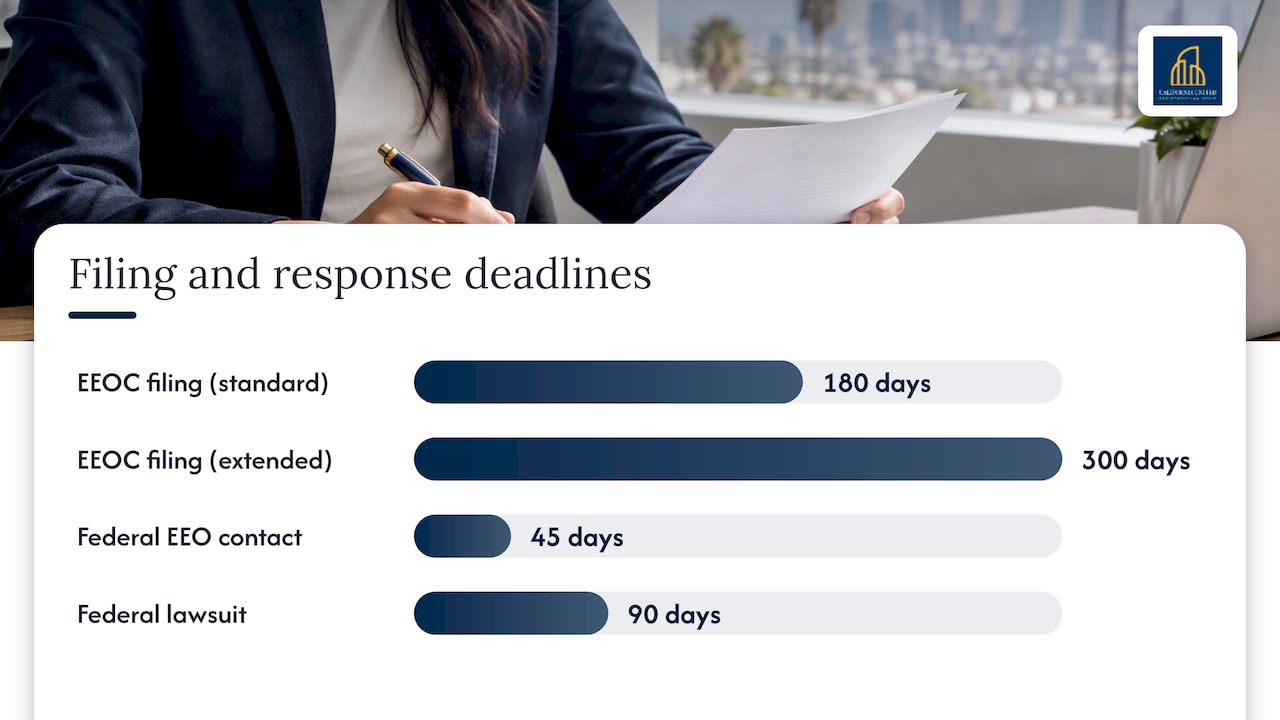
Federal lawsuits. After you receive a Notice of Right to Sue, you must file a federal discrimination lawsuit within 90 days.
Which deadline applies depends on the type of claim and the employer. Because the windows are short and different, speaking with an employment attorney sooner is usually better than later.
Burbank workers and applicants: how this plays out locally
Burbank has a large and varied job market, from entertainment and media to aviation, healthcare, retail, and city government. That variety matters because the rules differ by role. A warehouse hire through a staffing agency, a studio support position, and a job with a public agency can each involve different screening practices and different legal exceptions.
Common situations we see described by workers include:
- A job application that asks about convictions before any offer.
- An offer withdrawn after a background check with no written notice.
- A rejection that cites an old or unrelated conviction.
- A promotion denied after a background check.
- A termination that follows a conviction check, where the worker also suspects another motive such as retaliation.
If a job ended, our overview of California employee termination rights explains how termination claims are generally evaluated. For broader questions about your options at work, our Burbank workplace rights guide covers counseling and filing paths.
Our perspective
We represent employees only, and we focus on California Labor Code and FEHA claims. Several of our attorneys have prior experience on the employer side, so we know how screening policies are usually designed and defended.
What we want Burbank workers to understand is that a conviction does not end your employment rights. The Fair Chance Act exists because the Legislature decided people deserve an individualized look, not an automatic rejection. At the same time, the law has real exceptions. Not every rejection that mentions a record is unlawful, and we do not promise any particular result.
Evaluating a potential claim starts with the details: when the question was asked, what the employer sent you in writing, what the record actually is, and how others were treated. Those facts decide whether a claim exists and which agency or court is the right place for it.
— California United Law Group
Talk with an employment lawyer in Burbank
If you believe a conviction was used against you unlawfully, we offer free consultations and case evaluations. We handle employee claims on a contingency fee basis. You pay no attorney fees unless we obtain a recovery. You may be responsible for case costs whether or not there is a recovery, as explained in our written fee agreement.
👉 Learn about our employment law services
👉 Contact us to discuss your situation
You can also read about our Burbank employment lawyer services, or browse more articles in our Legal Insights library.
FAQ
Can a Burbank employer ask about my criminal record on a job application?
Generally not, if it has five or more employees. Under Government Code section 12952, a covered employer cannot ask about or consider conviction history until after it makes a conditional offer. Some jobs fall under exceptions, such as positions where the law requires a conviction check or bars certain convictions.
Can an employer withdraw a job offer because of a conviction?
It can in some cases, but only after following the required process. That includes an individualized assessment, a written preliminary notice, and a chance for you to respond. The final decision must also be in writing. Whether a specific withdrawal was lawful depends on your facts.
Is a criminal record a protected class under California law?
Not by itself. However, FEHA can bar an employer from using criminal history when it adversely affects people because of a protected characteristic and lacks a legitimate business purpose. The Fair Chance Act also separately restricts when and how conviction history can be used.
Does an expunged or dismissed conviction count against me?
Under Government Code section 12952, covered employers generally may not consider sealed, dismissed, expunged, or statutorily eradicated convictions, subject to the statute’s exceptions. If you are unsure whether your record qualifies, an attorney can review your specific situation.
How long do I have to file a complaint?
It depends on the claim. For federal charges, the EEOC generally requires filing within 180 days, or 300 days where a state or local agency enforces a similar law. For state claims under FEHA, a complaint generally must be filed with CRD within three years. Speak with an attorney early because exceptions and shorter deadlines can apply.
Sources
- Know Your Rights | California Civil Rights Department
- Employment | California Civil Rights Department
- California Government Code section 12952
- California Labor Code section 432.7
- Criminal History and Employment fact sheet (CRD, June 2025)
- Fair Chance Act: Criminal History and Employment FAQ (CRD)
- EEOC Enforcement Guidance on Arrest and Conviction Records
- Time Limits for Filing a Charge | EEOC
- Filing a Lawsuit | EEOC
- Burbank City Council resolution on criminal-history checks (2009)