
Alhambra employees can challenge inaccurate timesheets by filing a wage claim with the California Labor Commissioner’s Office using DLSE Form 1, or by consulting employee-side counsel before filing. Helpful first steps include gathering paystubs, personal time logs, schedule messages, and copies, not originals, of employer records. Because filing deadlines vary by claim type, employees should check the applicable deadline before waiting to file. See the DLSE guidance on wage claims for the applicable periods. Timing matters, so starting this process sooner rather than later protects your options.
TL;DR:
- Keep dated personal logs, paystubs, schedule messages, and copies of employer records; DLSE Form 55 permits reasonable estimates when your hours varied.
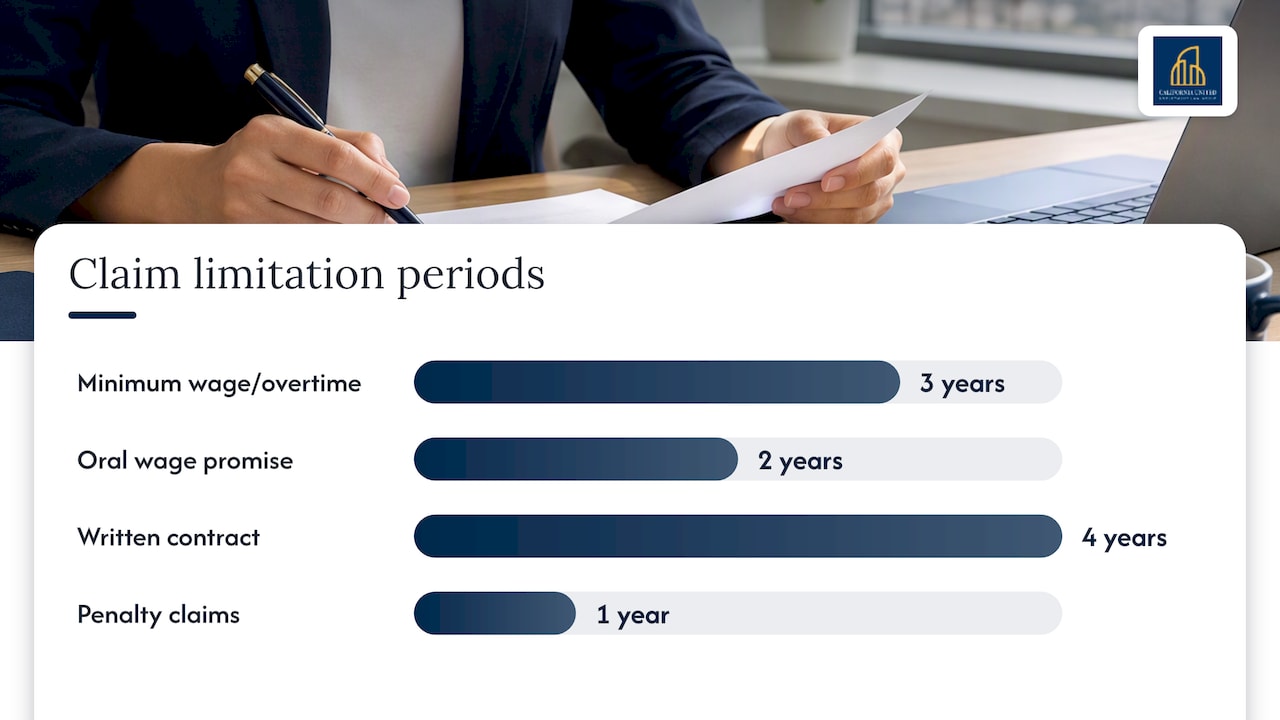
- Many wage and break claims have a three-year filing period, oral wage promises may have a two-year period, written contract claims may have a four-year period, and some penalty claims may have a shorter one-year period. Confirm the deadline that applies to your specific claim.
- Employers generally must retain time records and issue itemized wage statements; failure to maintain required records may result in civil penalties, depending on the violation.
- File DLSE Form 1 online, by mail, or in person; add Form 55 for irregular hours and Form 155 for unpaid commissions.
- Raising a payroll error internally is optional and does not pause filing deadlines, so document the report and confirm the applicable time limit.
Table of Contents
- What counts as a timesheet violation?
- Employee rights and employer duties under California law
- How to gather and preserve evidence in Alhambra
- How to file a DLSE wage claim from Alhambra
- What to expect after filing a wage claim
- Remedies and penalties you can seek in a wage claim
- Reporting timesheet violations internally before filing a claim
- Common timesheet violations in Alhambra workplaces
- Why some Alhambra employees consult employee-side counsel
- Get help with wage and hour concerns in Alhambra
- FAQ
- Sources
What counts as a timesheet violation?
Not every payroll mistake is a legal violation, but several patterns show up again and again in wage claims we see from workers across California. Recognizing these patterns helps you decide whether your situation warrants formal action.
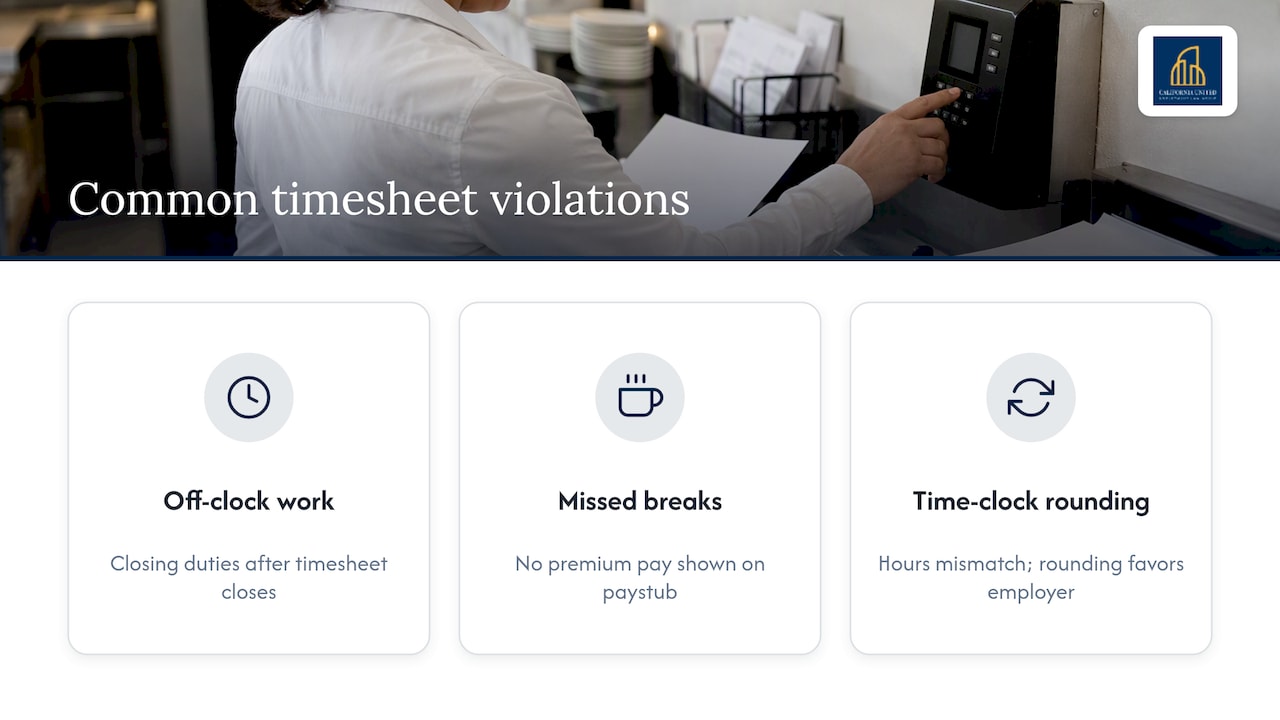
- Off-the-clock work: work performed before clocking in or after clocking out may be relevant to a wage claim.
- Missed meal or rest breaks: missed or shortened breaks may be relevant to a wage claim. The rules depend on the work period and applicable exceptions. See the DLSE guidance.
- Falsified or altered hours: a supervisor shaving minutes off a shift or rounding down worked time in a way that favors the employer.
- Unlawful rounding practices: time-clock rounding that consistently shortchanges employees instead of balancing out over time.
Retail closing shifts, warehouse pre-shift briefings, and restaurant service during peak hours are common settings where these issues surface. California employers generally must keep accurate records of hours worked and provide itemized wage statements under California wage-and-hour laws. A difference between those records and the hours worked may be relevant to a wage claim.
Employee rights and employer duties under California law
California law places recordkeeping obligations on employers that can help employees verify their pay. Understanding these duties helps you see where your employer’s responsibilities may have fallen short.
- Employers must maintain accurate time records showing hours worked each day under Labor Code 1174.
- Employers generally must provide itemized wage statements showing required wage, hour, rate, deduction, and employer information.
- DLSE instructions say to submit copies of your records and allow claimants to estimate hours when completing Form 55 if their hours were irregular. See the DLSE instructions.
- Depending on the facts, available remedies may include unpaid wages, meal and rest period premiums, wage statement penalties, waiting-time penalties, and other relief available under California wage-and-hour law.
Failure to maintain required records may expose an employer to civil penalties, and record-retention rules can matter because payroll disputes often arise after the pay period has closed. Employees should preserve their own copies of paystubs, schedules, messages, and time logs in case employer records are incomplete or disputed.
These statutes exist because wage disputes often hinge on whose version of the hours is accurate, and California wage-and-hour law recognizes that employer records can be important evidence in determining hours worked and wages owed.
California courts have addressed these issues in several important wage-and-hour decisions. In Brinker Restaurant Corp. v. Superior Court, the California Supreme Court explained that an employer satisfies its meal-period obligation when it relieves employees of all duty, relinquishes control over their activities, permits a reasonable opportunity to take an uninterrupted 30-minute break, and does not impede or discourage the break. In Donohue v. AMN Services, LLC, the Court addressed meal-period records and recognized a rebuttable presumption of meal-period violations when employer time records show missed, short, or late meal periods. In Ferra v. Loews Hollywood Hotel, LLC, the Court held that meal and rest break premium pay must be calculated using the employee’s regular rate of pay, not merely the base hourly rate. Brinker language supported by CACI. Donohue-related rebuttable presumption supported by CACI. Ferra language supported by CACI.
How to gather and preserve evidence in Alhambra
Building a credible record of your hours does not require legal training, just consistency and care. DLSE guidance identifies categories of supporting documents that may be submitted as copies. See the DLSE document list.
- Personal time logs noting dates, start and end times, and break periods.
- Paystubs covering the period in question.
- Any evidence of dishonored paychecks.
- Your Notice of Employment Information, if your employer provided one.
- Other documents that may help explain the hours or pay at issue.
Keeping a personal time log is one of the most practical steps you can take. Record the date, the time you started and ended your shift, and when breaks occurred, as close to real time as possible. Consistency and honesty in these entries matter more than polish. If your hours were irregular, DLSE instructions say Form 55 may be completed using your best estimate or your own records. See the DLSE instructions.
Beyond a written log, screenshots of scheduling apps, saved emails or texts about shift changes, and the names of coworkers who witnessed your hours can all support your claim. DLSE guidance lists copies of supporting documents for the initial claim. Check the DLSE document guidance for what to submit.
Pro Tip: Keep your time log in a single notebook or digital file rather than scattered notes, so the dates stay in order if you later need to share it with the Labor Commissioner’s Office, your lawyer, or another appropriate reviewer.
How to file a DLSE wage claim from Alhambra
Filing a wage claim starts with the Initial Report or Claim, known as DLSE Form 1. Depending on your situation, you may need to attach supplementary forms:
- DLSE Form 1: the core claim form, where you check boxes for the type of pay you are owed, such as regular wages, overtime, or meal and rest period premiums.
- DLSE-55: used when your hours varied or were irregular, allowing you to provide a reasonable estimate of hours worked when exact records are unavailable.
- DLSE-155: used specifically when you are claiming unpaid commissions.
Claims can be filed online, by mail, or in person at a Labor Commissioner’s Office location. DLSE guidance lists copies of supporting documents for the initial claim. See the DLSE document guidance.
Timing affects which claims you can still bring. According to the Department of Industrial Relations, many wage claims involving minimum wage, overtime, or missed meal and rest breaks may have a three-year filing period. Claims based on an oral promise to pay wages may have a two-year period, while claims based on a written contract may have a four-year period. Certain penalty claims may have a shorter one-year period. Because these timeframes vary by claim type and your situation is fact-specific, confirming which window applies to your circumstances is worth doing early rather than near a deadline.
What to expect after filing a wage claim
Once your claim is filed, the process often follows a general sequence, though outcomes and timing vary case by case.
- The Labor Commissioner’s Office reviews your Initial Report or Claim and may schedule a settlement conference.
- At the settlement conference, both you and your employer have the chance to resolve the dispute informally, without a hearing.
- If no settlement is reached, the case may proceed to a formal hearing, where testimony and documents are presented.
- At a Labor Commissioner hearing, the hearing officer may consider testimony and documents under procedures that differ from civil court litigation.
- DLSE materials describe a process for requesting a subpoena. See the DLSE wage claim policies.
- After a hearing, the Labor Commissioner issues an Order, Decision, or Award, known as an ODA, which states the outcome.
DLSE describes a process that may include a settlement conference and a hearing. The path and outcome depend on the claim.
Remedies and penalties you can seek in a wage claim
A successful wage claim may result in several categories of recovery, and the DLSE Form 1 includes checkboxes that let you specify which types of pay you are pursuing.
- Unpaid regular and overtime wages: back pay for hours actually worked but not compensated.
- Meal and rest period premiums: a wage claim may include requested remedies related to missed meal or rest breaks. The applicable remedy depends on the circumstances.
- Waiting-time penalties: potential penalties when final wages are not timely paid after separation, depending on the facts and applicable law.
- Wage statement penalties: potential penalties when itemized wage statements are inaccurate or incomplete in a legally significant way.
- Liquidated damages: additional amounts available under certain wage laws, depending on the specific violation.
DLSE explains that a claim may proceed to a hearing, where the Labor Commissioner issues an Order, Decision, or Award. For information about what may follow, consult the official DLSE wage claim guidance. Because remedies depend heavily on the specific facts of your employment and your documentation, the amount and type of recovery available in any individual case will differ.
Reporting timesheet violations internally before filing a claim
Before turning to the Labor Commissioner’s Office, many employees first raise the issue directly with a supervisor or human resources department. This step is not required, but it can sometimes resolve a straightforward payroll error faster than a formal claim.
When raising the issue internally, it helps to be specific and to keep a written record of the conversation. Stating the exact dates and shifts affected, referencing your own time log, and following up by email so there is a written trail all support you if the issue is not resolved. Asking for a corrected wage statement in writing, rather than accepting a verbal promise to fix it, gives you something concrete to point to later.
If your employer corrects the error and issues any required corrected wage documentation, the practical dispute may be resolved, though employees should still preserve records of what occurred. If the issue persists, is dismissed without explanation, or your employer retaliates against you for raising it, that pattern itself becomes relevant. If you believe you experienced retaliation after raising a payroll concern, the facts and applicable protections may require individual review.
An internal report does not replace checking the applicable filing period. The time limit depends on the claim type; consult the DLSE wage claim guidance.
Common timesheet violations in Alhambra workplaces
Alhambra’s mix of retail centers, restaurants, medical offices, and small manufacturing employers can present recurring wage-and-hour issues. Recognizing these patterns in your own workplace can help you decide what documentation to prioritize.
Retail and restaurant employees may encounter disputes involving closing duties, such as counting a register or restocking shelves, after their timesheet has already been closed out for the day. Employees in food service and healthcare settings may face disputes involving missed or interrupted meal breaks during a demanding shift, with no corresponding premium pay reflected on their paystub. Workers paid on irregular or variable schedules, including some warehouse and logistics workers, may notice that their recorded hours do not match the schedule they actually worked, particularly when a time-clock rounding policy consistently favors the employer.
Documenting these patterns works the same way regardless of industry: note the specific date, the scheduled versus actual hours, and whether a break was missed or shortened. Comparing your personal log against your paystub each pay period, rather than waiting until a problem has accumulated over months, makes discrepancies easier to spot and easier to support with contemporaneous records if you decide to pursue a claim.
Why some Alhambra employees consult employee-side counsel
When timesheet records are disputed, particularly where multiple employees are affected, retaliation is a concern, or an employer is uncooperative, some employees find it useful to speak with an attorney who focuses on employee-side wage and hour matters before filing. A consultation may help clarify which forms apply, what documentation may be useful, and whether deadlines or retaliation concerns require closer review.
Contact the firm to ask about consultation availability and fee arrangements. For readers who want to discuss a potential wage claim, Gerardo J. Sosa may be available as a point of contact within our firm, depending on consultation availability and the facts presented. Outcomes in any individual matter depend on the specific facts involved, and a consultation is simply a chance to understand your options.
— California United Law Group
Get help with wage and hour concerns in Alhambra
We represent California employees on wage and hour matters, including disputes over inaccurate timesheets, unpaid overtime, and missed breaks. Contact the firm to ask about consultation availability and costs. Whether you decide to gather your own documentation, file directly with the Labor Commissioner’s Office, or speak with an attorney first, each of these is a reasonable starting point depending on your comfort level and the complexity of your situation.
- Review our employment law services for an overview of the claims we handle, including wrongful termination and retaliation.
- Learn more about our wage and hour representation, including unpaid overtime claims.
- If your situation involves coworkers facing the same issue, our class action page explains how shared claims are evaluated.
- Reach out through our contact page to ask about consultation availability.
Organizing your paystubs or contacting the firm may be a starting point for discussing your concerns. If you want to discuss your options, you may contact the firm to ask about consultation availability.
This article provides general information and is not legal advice. Consult a qualified legal professional about your own circumstances before acting on anything here.
FAQ
Who investigates FMLA violations?
Federal Family and Medical Leave Act violations are investigated by the U.S. Department of Labor’s Wage and Hour Division, which handles complaints separately from California’s Labor Commissioner’s Office. California employees may also have related protections under state law, depending on the facts of their situation.
What is the penalty for providing an inaccurate wage statement in California?
An inaccurate itemized wage statement can result in penalties under Labor Code 226, separate from any unpaid wage claim. Whether penalties are available, and in what amount, depends on the specific violation, the employee’s injury, the employer’s conduct, and the applicable statutory requirements.
What is the most commonly litigated wage and hour violation?
Unpaid overtime, missed meal or rest breaks, off-the-clock work, and wage-statement issues are commonly raised in California wage-and-hour disputes, often alongside off-the-clock work disputes. The specific type of violation that applies to your situation depends on your schedule, job duties, and how your employer tracked your hours.
What are waiting-time penalties in California?
Waiting-time penalties may apply when an employer willfully fails to timely pay final wages after separation. The amount and availability of any penalty depend on the facts, the employee’s wage rate, the timing of payment, and the applicable statutory requirements.
Sources
- Dir
- Leginfo
- Frequently Asked Questions: Complaints and the Investigation Process | U.S. Department of Labor