
If you worked through your lunch, had it cut short, or missed required rest breaks in Torrance, you may be able to pursue a DLSE wage claim or a civil lawsuit. California law generally provides one additional hour of pay at the employee’s regular rate for each workday a required meal period was not provided, and one additional hour for each workday a required rest period was not provided, meaning some cases may involve up to two premium hours in a workday. You generally have three years to bring that claim. The path you choose depends on your records, your goals, and the complexity of your situation.
TL;DR:
- Employees can generally pursue unpaid meal and rest period premium claims within a three-year window, with premium pay calculated by workday rather than by each individual missed break.
- Proper documentation, including logs, pay stubs, schedules, and witness statements, significantly strengthens a claim before filing with the DLSE or in court.
- Filing with the DLSE involves specific forms and can lead to informal resolutions or formal hearings, but estimates on hours should be honest and well-supported.
- Civil lawsuits are an alternative when records are complex or multiple employees are affected, allowing for class claims and different procedural rules.
- Common meal-period issues include being required to keep working, being interrupted, being prevented from leaving the workplace, or having pay docked without receiving a genuine 30-minute duty-free meal period.
Table of Contents
- Quick Action Checklist to Protect Your Torrance Meal-Period Claim
- Filing With the DLSE: Forms, Attachments, and What Happens Next
- When a Civil Lawsuit Makes More Sense Than a DLSE Claim
- How Meal and Rest Period Remedies Are Calculated
- Deadlines Employees in Torrance Need to Track
- What Counts as a Meal Period Violation Under California Law
- Building Your Evidence File: Hours, Breaks, and Interruptions
- Our Experience With Wage and Hour Claims in Torrance
- A Few Honest Thoughts on Pursuing These Claims
- Talk to Our Team About Your Meal Period Claim
- FAQ
- Sources
Quick Action Checklist to Protect Your Torrance Meal-Period Claim
Before deciding how to proceed, take a few organized steps now. Good documentation early on makes every later option, whether a DLSE claim or a lawsuit, stronger.
- Start a daily log noting your start and stop times, along with any missed, shortened, or interrupted breaks.
- Collect pay stubs, posted schedules, and any written communications about your employer’s break policies.
- Write down witness names and brief notes about what they observed; save any relevant texts or emails.
- Estimate the period covered by your claim and confirm whether the main premium-pay claim falls within the general three-year window, while also checking whether any related claims have different deadlines.
- Decide whether to file a DLSE claim on your own first or speak with an employment attorney before filing.
None of these steps requires guessing at legal strategy. They simply preserve what already exists so a later reviewer, whether a Deputy Labor Commissioner or a judge, has something concrete to evaluate.
Filing With the DLSE: Forms, Attachments, and What Happens Next
The Division of Labor Standards Enforcement handles wage claims through a defined administrative process, and most employees begin with two forms.
- Use DLSE Form 1 (Initial Report or Claim) to open a wage claim for unpaid meal or rest period premiums.
- Use DLSE Form 55 when your hours varied from week to week, since it helps estimate the total owed.
- Attach copies, never originals, of time records, pay stubs, employment notices, and any witness information you have gathered.
Once filed, the DLSE assigns a Deputy Labor Commissioner to your case. Many claims proceed to an initial conference, where the parties try to resolve the matter informally. When no resolution is reached, the case can move to a hearing, followed by an Order, Decision, or Award (ODA), and in some cases further enforcement steps if the employer does not comply.
Pro Tip: Fill in estimated hours honestly rather than leaving fields blank. The DLSE weighs your personal records against employer records and witness statements, so a reasonable, good-faith estimate on Form 55 can be important.
When a Civil Lawsuit Makes More Sense Than a DLSE Claim
Some employees pursue a private civil action instead of, or sometimes after, a DLSE claim. California law allows employees to pursue certain unpaid wage claims through the DLSE process or through a private civil action, depending on the claim, records, deadlines, and litigation goals.
- Civil suits involve pleadings, formal discovery, and, where legally appropriate, the possibility of class or representative claims that a single DLSE wage claim may not resolve.
- Attorney-fee rules can differ between court proceedings and the DLSE’s administrative setting, and fee exposure may depend on the specific claim and outcome.
- Employees often consider litigation when records are complex, when multiple coworkers faced the same policy, or as a next step after a DLSE outcome did not fully resolve the dispute.
Civil court moves on a different timeline than DLSE proceedings and carries different procedural requirements, which is one reason this decision is worth discussing with someone familiar with both routes.
How Meal and Rest Period Remedies Are Calculated
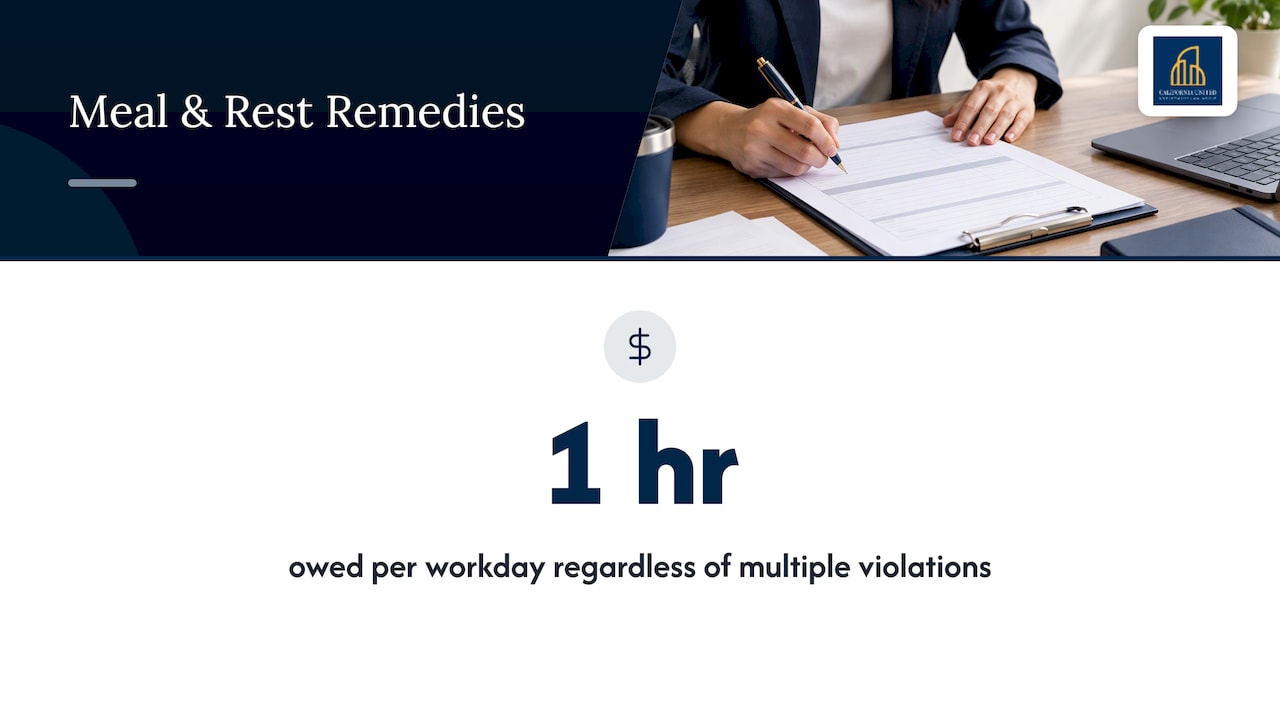
California law generally requires one additional hour of pay at the employee’s regular rate for each workday a required meal period was not provided, and one additional hour for each workday a required rest period was not provided. This figure is the standard remedy referenced throughout California wage and hour enforcement.
A common misunderstanding is that missing both a meal period and a rest period on the same day doubles the premium. The better way to state the rule is that meal-period premiums and rest-period premiums are capped separately: a meal-period violation can support one premium hour for the workday, and a rest-period violation can support one additional premium hour for the same workday. From there, outcomes vary by case. A DLSE claim can end in a negotiated settlement, an Order, Decision, or Award, or dismissal if the evidence does not support the claim. A civil suit follows its own path toward settlement or judgment.
California courts have addressed these issues in several major decisions. In Brinker Restaurant Corp. v. Superior Court, the California Supreme Court explained that an employer must relieve employees of all duty, relinquish control over their activities, and provide a reasonable opportunity to take an uninterrupted 30-minute meal break. In Naranjo v. Spectrum Security Services, Inc., the Court confirmed that premium pay for missed or noncompliant meal and rest breaks is treated as wages. In Murphy v. Kenneth Cole Productions, Inc., the Court treated meal and rest period premium pay as compensation rather than a penalty, supporting the general three-year limitations period for these claims.
Deadlines Employees in Torrance Need to Track
The statute of limitations for meal and rest period premium claims is generally three years, a conclusion tied to the treatment of these premiums as wages rather than penalties. Some claims related to the same workplace conduct may have shorter or longer deadlines, so employees should avoid assuming that every possible claim follows the same timeline.
- Meal and rest period premium pay claims are generally subject to a three-year statute of limitations.
- Some related penalty or record-access claims carry shorter deadlines, so it helps to identify every type of violation early rather than assuming one clock covers everything.
- DLSE scheduling, conferences, and any appeals can extend the total time before a claim resolves, even when the underlying filing deadline has been met.
Filing well before the three-year mark gives you more room to gather records and respond to scheduling delays without added pressure.
What Counts as a Meal Period Violation Under California Law
California law requires a genuine break, not just a pause on paper. Under Labor Code §512, employees working more than five hours in a day are generally entitled to a meal period of at least 30 minutes, with a second meal period generally required when they work more than 10 hours in a day.
- A compliant off-duty meal period generally means the employee is relieved of all duties, free from employer control, and given a reasonable opportunity to take an uninterrupted 30-minute break.
- On-duty meal periods are allowed only in limited circumstances where the nature of the work prevents relief from duty and there is a valid written agreement; even then, the time must generally be paid.
- Common violation patterns include being required to stay at your workstation, having your break interrupted by work tasks, or having time docked from your pay without an actual break having occurred.
If any of these patterns sound familiar, it is worth looking closely at your own records before deciding on next steps.
Building Your Evidence File: Hours, Breaks, and Interruptions
Strong documentation can make a claim easier to evaluate. The DLSE’s own filing instructions note that personal logs and estimates are accepted when employer records are incomplete.
- Keep a contemporaneous log with the date, times, and a short note describing any interruption to your break.
- Save pay stubs, posted schedules, emails, text messages, and clock-in or clock-out screenshots whenever they exist.
- Write down witness names with brief statements, and keep copies of every document. Never send DLSE your only originals.
Pro Tip: A simple notes app entry made the same day may be more persuasive than a reconstructed memory written weeks later.
Our Experience With Wage and Hour Claims in Torrance
We focus exclusively on employment law, including wage and hour matters involving unpaid meal and rest period premiums. Our work spans case evaluation, assistance with DLSE filings, and litigation when a claim calls for it, and like most employee-side firms handling wage disputes, many wage and hour cases are handled on a contingency-fee basis, meaning attorney fees are paid from a recovery if there is one. Clients should review the fee agreement to understand whether they may be responsible for any costs or expenses.
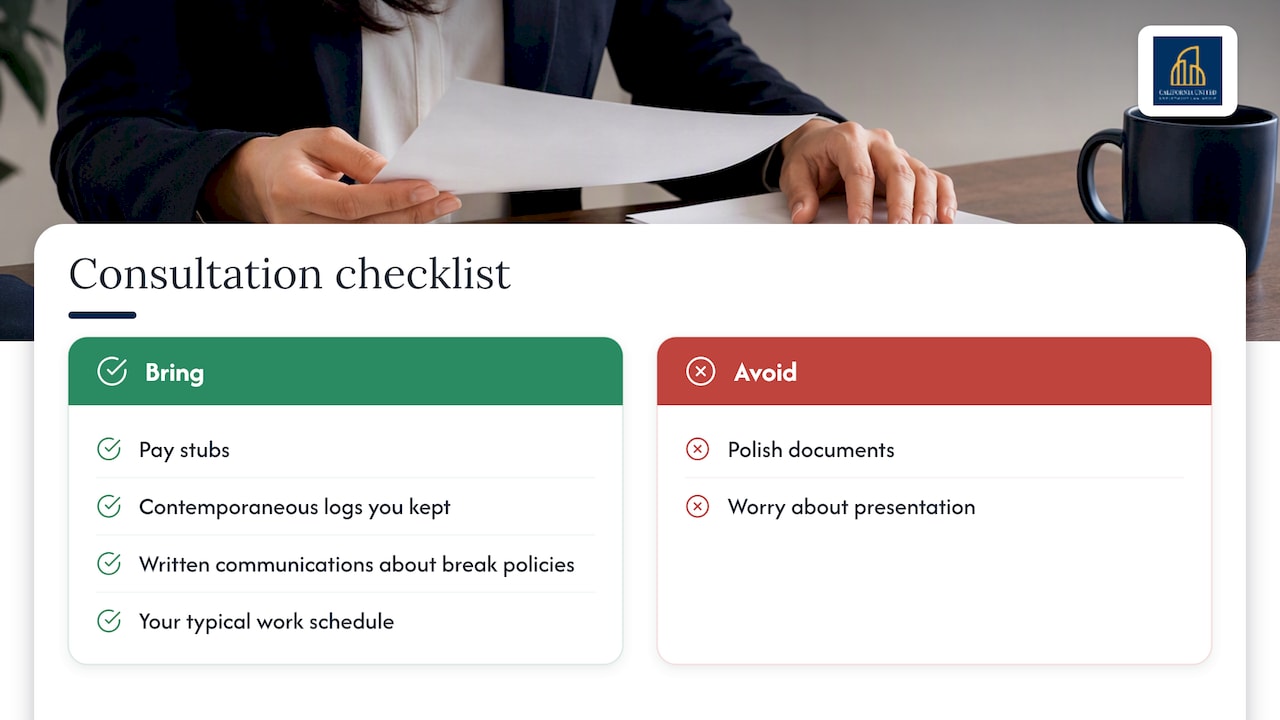
If you are weighing a consultation, having a few things ready helps: pay stubs, any contemporaneous logs you have kept, written communications about break policies, and your typical work schedule. None of this needs to be polished. It simply gives us a clearer starting point to assess what you are dealing with.
A Few Honest Thoughts on Pursuing These Claims
Meal period rules sound simple on paper, but real workplaces rarely match the textbook version. Many Torrance employees assume a missed break is too minor to pursue, when in fact premium pay can add up over months or years of repeated violations. Others wait too long, unaware that the three-year clock is already running.
We represent Torrance employees and provide case evaluations, but this article is educational only and not a substitute for advice on your specific situation. Outcomes vary by the facts of each case, and we encourage you to reach out for a review if you believe your rights were affected.
— California United Law Group
Talk to Our Team About Your Meal Period Claim
We offer free consultations for Torrance employees who suspect their meal or rest periods were not handled correctly, and we offer free consultations, and many wage and hour matters may be handled on a contingency-fee basis. During a consultation, we can explain how fees and any potential costs would work for your situation.
- We assist with DLSE filings and represent employees through the administrative claims process from start to finish.
- We handle wage and hour litigation, including meal and rest period disputes, when a civil action is the better fit.
- You can also explore our broader employment law services if your situation involves more than one type of workplace issue, or learn about our class action work if coworkers faced the same policy.
Reach out through our contact page to schedule a case review with our team and learn what options may be available based on your facts.
FAQ
What is considered a meal violation in California?
A meal-period violation may occur when an employee who is entitled to a meal period is not provided a timely, uninterrupted meal break of at least 30 minutes, is required to keep working, is interrupted for work, or is prevented from taking a legally compliant break. When a required meal period is not provided, California law generally requires premium pay, and improper automatic deductions may create additional wage issues.
Can a company deduct 30 minutes from your day if you don’t take a lunch?
An employer generally should not deduct time for an unpaid meal period unless the employee actually received a legally compliant, duty-free meal period. If the deduction occurred without a genuine 30-minute break, that pattern itself may support a meal period claim for premium pay.
Can you waive a meal period in California?
Employees may waive the first meal period only under specific conditions, including when the total work period is no more than six hours and both the employer and employee consent. Outside those narrow circumstances, the meal-period requirement and any applicable premium-pay remedy generally still apply.
How do meal-period premium pay work in California?
When a required meal or rest period is not provided, the employer owes one additional hour of pay at the employee’s regular rate for that workday. Meal-period and rest-period premiums are capped separately, so a workday may involve one meal-period premium hour and one rest-period premium hour if both types of violations occurred. The claim is generally subject to a three-year filing deadline.