
California law requires your employer to pay all final wages the moment you’re fired, or within 72 hours if you quit without notice. When a Burbank employer misses that deadline, waiting time penalties under Labor Code §203 can add up to a full day’s pay for every calendar day the wages stay unpaid, up to 30 days. Your most useful first move is to send a dated written demand for payment, keep copies of everything, and then decide between a Labor Commissioner’s Office wage claim or a civil action, which may stop further waiting time penalties from accruing once the action is commenced, depending on the facts and procedural posture.
TL;DR:
- Employers in Burbank must pay final wages immediately upon termination or within 72 hours if the employee quits without notice, with penalties applying for delays.
- Final pay must include all earned wages, accrued unused vacation, and calculable bonuses or commissions but not accrued sick leave unless blended into vacation.
- Waiting time penalties can equal the employee’s daily wage rate for each calendar day the wages remain unpaid, up to 30 days, and may stop accruing when wages are paid or an action is commenced.
- Filing a Labor Commissioner wage claim is generally free and accessible, but employees should compare that process with a civil action because the filing choice can affect timing, remedies, fees, and penalty calculations.
- Proper documentation, including paystubs, communication records, and precise calculations of owed wages, is crucial before filing a claim or lawsuit.
Table of Contents
- When Is Final Pay Due, and What Must It Include?
- How Do Waiting Time Penalties Add Up?
- DLSE Wage Claim or Civil Lawsuit: Which Fits Your Situation?
- How Do You Document a Late Paycheck and Prepare a Claim?
- What Defenses Do Employers Raise, and Where Do They Fail?
- Are There Burbank-Specific Rules That Affect Final Pay?
- Can Your Employer Deduct Money From Your Final Paycheck?
- What Should You Do in the First Few Days After a Late Paycheck?
- California United Law Group’s Perspective on Late Paycheck Cases in Burbank
- How California United Law Group Can Help With Your Late Paycheck
- Where to Find Official Forms and Guidance
- Sources
- FAQ
When Is Final Pay Due, and What Must It Include?
California Labor Code sections 201 and 202 set two different deadlines depending on how the job ended. If your employer fired you, laid you off, or ended the position, your final wages are due immediately at the time of termination. If you quit and gave at least 72 hours’ notice, your final check is due on your last day. If you quit without that notice, your employer has 72 hours to get you paid, and you can request that the check be mailed to an address you choose, according to DLSE guidance on final pay.
A final paycheck in Burbank has to reflect more than your base hourly or salary rate through your last shift; it must include:
- All earned regular wages through the last day worked
- Any overtime that has accrued but hasn’t been paid out yet
- Accrued, unused vacation time, which California treats as earned wages once it accumulates
- Commissions and bonuses that are calculable at the time of separation, even if the exact figure requires a short calculation
- Reimbursable business expenses owed under existing company policy
One frequent point of confusion: accrued sick leave is not required to be paid out at termination under state law, unlike vacation time. Employers who lump paid sick leave into a single “PTO” bucket with vacation may owe it anyway, since California treats blended PTO policies as vacation for payout purposes. If your final paycheck was mailed, the timing can depend on whether mailing was authorized and when payment was actually made or tendered, so keep the envelope, postmark, and any written mailing request.
How Do Waiting Time Penalties Add Up?
The penalty formula is simple, but it surprises a lot of Burbank workers with how fast it grows. Under CACI No. 2704, an employee seeking waiting time penalties must prove that employment ended and that the employer willfully failed to pay all wages when due. California’s jury instruction explains that willfully means the employer intentionally failed or refused to pay wages, without any additional bad motive requirement. Under Labor Code §203, the penalty equals your daily rate of pay, multiplied by every calendar day your wages remain unpaid, capped at 30 days. Weekends and holidays count. There’s no discount for a payday that happens to fall on a Saturday.
A worked example: An employee earning $30 an hour who worked eight-hour shifts has a daily rate of roughly $240. If a Burbank employer delays a final paycheck for several weeks, the waiting time penalty can become a substantial amount, separate from the wages actually owed.
The word “willful” trips people up. It does not mean your employer had to act with malice or intend to cheat you. Courts apply willfulness broadly: Gonzalez v. Downtown LA Motors, LP explains that an employer’s refusal to pay need not involve an evil purpose to defraud workers; willful means the employer intentionally failed or refused to do what was required.
A few points matter for anyone trying to calculate exposure:
- Penalties are generally calculated based on the number of calendar days wages remained unpaid, up to 30 days, and the filing or payment timeline should be reviewed carefully before choosing a forum.
- A Labor Commissioner wage claim and a civil court action are different procedures, and employees should evaluate how each may affect timing, remedies, and penalty calculations.
- The 30-day cap means the maximum waiting time penalty is up to 30 days of the employee’s daily wage rate.
- The filing choice matters because payment timing, claim procedure, and the date an action is commenced can affect the penalty analysis.
That last point is the one most Burbank employees miss, and it shapes almost every decision that follows.
DLSE Wage Claim or Civil Lawsuit: Which Fits Your Situation?
Both paths can recover unpaid wages and waiting time penalties, but they work very differently, and the choice affects how quickly your penalty accrual stops.
- A wage claim with the Labor Commissioner’s Office (DLSE) has no filing fee and moves through an administrative process: an initial report or claim, often a settlement conference, and if that fails, a hearing before a deputy labor commissioner. It’s designed to be accessible without a lawyer, and depending on the type of wage violation, the Labor Commissioner process may allow recovery of certain statutory penalties, but the available remedies should be confirmed for the specific final-pay claim. The tradeoff: it can take months to reach a hearing, and collecting on an award, often called an Order, Decision, or Award, may require additional enforcement steps if the employer does not pay voluntarily.
- A civil lawsuit, filed in small claims court for smaller amounts or superior court for larger ones, may stop further waiting time penalties from accruing once the action is commenced. Superior court cases may also involve attorney’s fee issues that differ from small claims or administrative wage claim proceedings.
- When more than one employee is affected, patterns of late final paychecks sometimes point to a broader payroll practice rather than an isolated mistake. That can raise questions about representative claims under the Private Attorneys General Act or class treatment, which is a different analysis than a single wage claim and usually calls for a case-specific evaluation.
The practical trigger for choosing court over a DLSE claim usually comes down to three things: how large the unpaid wages and penalties are, whether commencing a civil action may affect further penalty accrual, and how complicated the underlying dispute is (a straightforward missed deadline versus a contested commission calculation, for instance).
How Do You Document a Late Paycheck and Prepare a Claim?
Before filing anything, gather the paper trail. Documentation can significantly affect how clearly you prove the claim, and the Labor Commissioner’s Office specifically recommends attaching supporting records rather than relying on a bare narrative.
- Collect your paystubs covering at least the last several pay periods, along with any time sheets or punch records showing hours worked.
- Save written communications with your employer or HR about your separation date, final pay, or any promises about when the check would arrive.
- Pull your offer letter, commission plan, or bonus policy if any part of your final pay depends on a calculation rather than a flat hourly rate.
- Keep bank records if a final paycheck bounced or was never deposited, since that’s separate evidence of nonpayment.
- Calculate your daily rate. For hourly or weekly pay, divide your regular weekly earnings by your normal number of workdays. For salaried employees, a daily wage rate calculation may require a case-specific analysis of compensation structure, work schedule, and applicable authority, so document exactly how you arrived at the number.
- Count the calendar days late, from the date wages were legally due through the date they were actually paid (or through today, if they still haven’t arrived), remembering the 30 day cap.
Pro Tip: Write down your calculation method in plain language before you file anything. A claim that shows “$240/day × 22 days = $5,280” is far easier for a deputy labor commissioner to verify than a vague total with no math behind it.
Depending on your situation, you may need more than the standard Initial Report or Claim form. The DLSE-55 form applies to claims involving irregular hours, and the DLSE-155 form is used for commission-based wage claims. All of these are available through the Labor Commissioner’s forms page.
What Defenses Do Employers Raise, and Where Do They Fail?
Employers facing a waiting time penalty claim often raise a good-faith dispute defense. A good-faith dispute must be supported by evidence and must be objectively reasonable; Diaz v. Grill Concepts Services, Inc. explains that defenses unsupported by evidence, unreasonable, or presented in bad faith do not qualify as good-faith disputes.
The defense has real limits, though.
- The dispute has to cover a genuine legal or factual question, such as whether a commission had actually been earned, not simple payroll disorganization or an oversight.
- An employer generally has to pay whatever amount is undisputed to preserve the defense on the disputed portion. If a company owes undisputed regular wages but disputes only a separate commission or bonus amount, withholding the undisputed wages can weaken the employer’s good-faith dispute argument.
- Employers sometimes conflate a DLSE filing with a court filing when arguing about penalty accrual. They are not the same procedure legally, and the distinction can affect timing, remedies, and penalty calculations.
Understanding this distinction matters because it directly affects how much an employer may ultimately owe by the time a case resolves.
Are There Burbank-Specific Rules That Affect Final Pay?
California’s final pay statutes apply uniformly across the state, so the deadlines and penalty structure in Burbank are identical to those in any other California city. What differs locally is enforcement access. Burbank employees file wage claims through the Los Angeles regional office of the Labor Commissioner’s Office, which handles a high volume of claims from across the greater Los Angeles area, including Burbank’s substantial entertainment, media, and production-industry workforce.
That industry mix matters more than people realize. Burbank’s concentration of production companies, studios, and related vendors means a lot of final pay disputes involve project-based work, irregular schedules, and commission or bonus structures tied to production milestones. Those situations tend to raise more complicated wage calculations than a standard hourly job, which is part of why documentation (and sometimes a case-specific legal review) carries extra weight for Burbank workers.
There’s no separate Burbank municipal ordinance governing final paycheck timing. The applicable law is entirely the state Labor Code, enforced through the same DLSE offices and courts available to every California employee. If your claim involves a Burbank-based employer, your options for filing (Labor Commissioner’s Office or civil court) remain exactly what state law provides.
Can Your Employer Deduct Money From Your Final Paycheck?
California limits what employers can subtract from a final paycheck far more than many workers assume. Wages already earned belong to the employee, and unauthorized deductions can create a separate wage claim on top of the timing issue.
Employers face strict limits on deductions for items such as cash shortages, breakage, or equipment loss; CACI No. 2700 notes that California Wage Orders allow deductions for cash shortage, breakage, or loss of equipment only if the employer proves the loss was caused by the employee’s dishonest or willful act or gross negligence. Deductions are typically limited to items such as taxes, court-ordered wage garnishments, authorized benefit contributions, and other deductions allowed by law or valid written authorization.
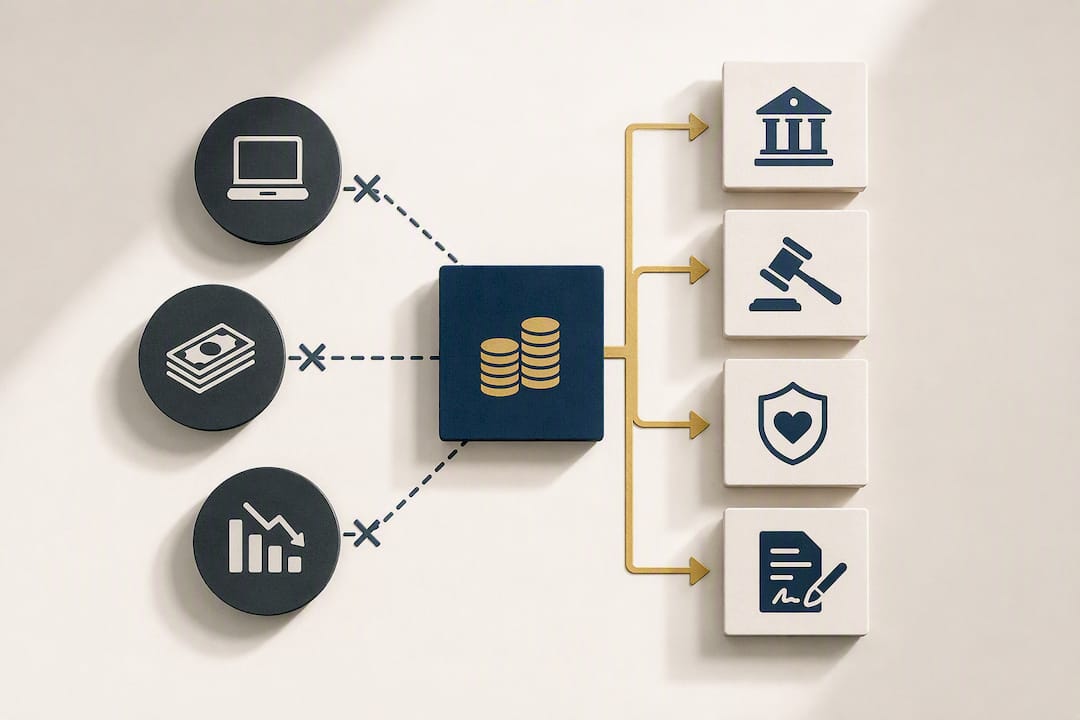
A common dispute involves unreturned company property, like a laptop or a uniform. Employers sometimes try to withhold an entire final paycheck until property is returned. That practice can be legally risky for the employer because final wages are generally due on the statutory deadline, and withholding earned wages over a separate property dispute may support a waiting time penalty claim. If your Burbank employer told you your check was being held until you returned something, that delay is worth documenting as part of a potential wage claim, not treated as a normal or acceptable practice.
What Should You Do in the First Few Days After a Late Paycheck?
Before filing any government claim, a short paper trail with your employer can sometimes resolve things faster and always strengthens your position if it doesn’t.
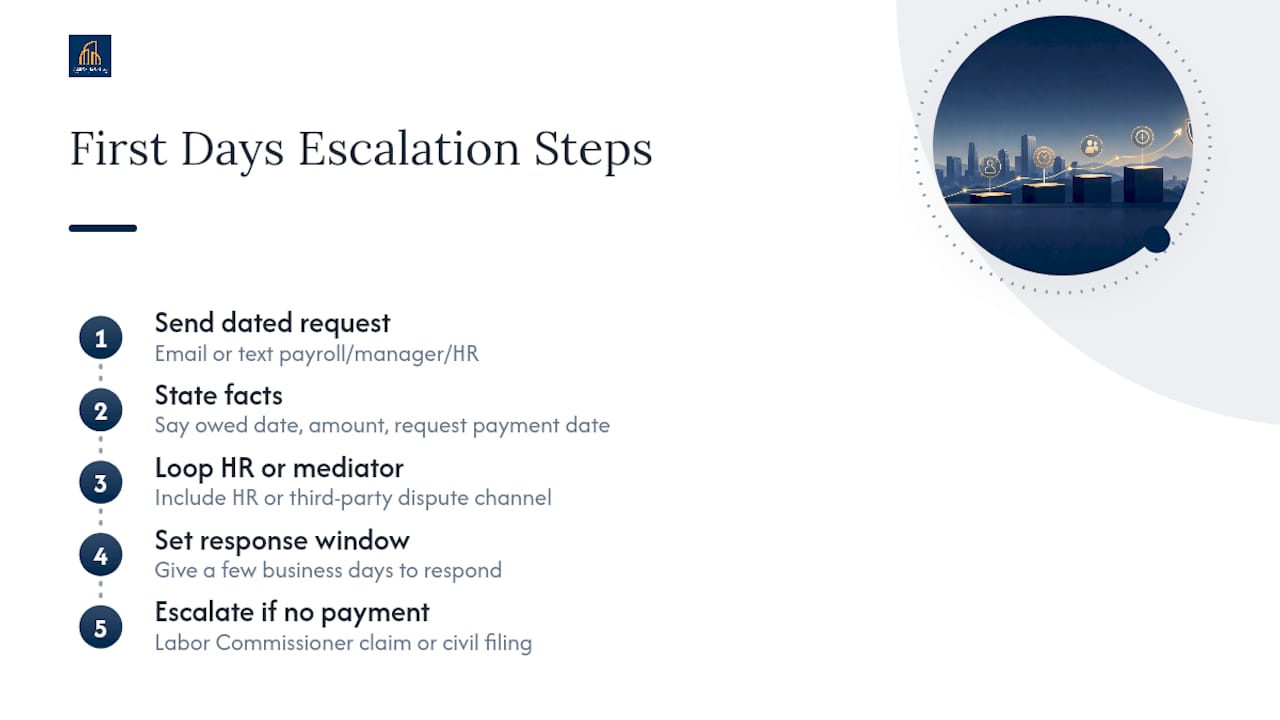
Start with a dated, written request, sent by email or text so there’s a record, stating clearly that your final wages were due on a specific date and haven’t been received. Address it to whoever handles payroll, whether that’s a manager, HR department, or an outside payroll service the company uses. Keep the tone factual: state the date pay was owed, reference the amount if you know it, and ask for a specific date of payment.
If the company has an HR department separate from your direct manager, looping them in often moves things faster than relying on one supervisor who may not control payroll timing. Some employers also use third-party mediation or an internal dispute process for pay issues, particularly larger companies with formal HR structures; using that channel doesn’t waive your right to later file a wage claim if it doesn’t resolve things.
Give the employer a reasonable but limited window, typically a few business days, before escalating. If the deadline passes with no payment and no clear explanation, that’s the point to move toward a Labor Commissioner’s wage claim or, for larger or more urgent situations, a civil filing that may affect further penalty accrual.
California United Law Group’s Perspective on Late Paycheck Cases in Burbank
Late final paycheck cases look simple on paper. Multiply a daily rate by the number of days late, and you have a penalty figure. In practice, the calculations get contested more than people expect, usually over what the “true” daily rate is when commissions, bonuses, or irregular schedules are involved, which is common among Burbank’s production and media employers.
California appellate decisions emphasize how strictly final wage timing rules are applied. Kao v. Holiday states that an employer may not delay final wages until the next regular pay period and that unpaid wages are due immediately upon discharge. Pineda v. Bank of America, N.A. describes California’s public policy favoring full and prompt payment of earned wages as fundamental and well established. Mamika v. Barca explains that the waiting time penalty is calculated by multiplying the employee’s daily wage rate by each day of nonpayment, up to 30 days.
A California-based employment law firm represents employees across the state in wage and hour disputes, including final paycheck and waiting time penalty claims. We don’t promise a specific outcome or dollar figure. Every case turns on its own facts, and the Labor Commissioner’s Office, not any law firm, ultimately decides administrative claims. What we can say generally: DLSE wage claims often take several months from filing to resolution, and penalty exposure can grow meaningfully up to the 30-day statutory cap if wages remain unpaid, which is exactly why documenting dates early matters so much.
If your final paycheck involves a large dollar amount, a disputed commission structure, or an employer who has stopped responding entirely, a case-specific consultation is usually worth the time before you decide which filing route to take.
— California United Law Group
How California United Law Group Can Help With Your Late Paycheck
If you’re weighing a Labor Commissioner’s claim against a civil filing, or you’re simply not sure whether your final paycheck was calculated correctly, California United Law Group offers case-specific assessments for Burbank employees who want guidance from attorneys who handle employee-side employment law matters. If accurate, keep this sentence. If not accurate for the attorneys handling these matters, delete it.
We handle wage and hour claims, including unpaid overtime and final paycheck disputes, on a contingency fee basis, meaning attorney’s fees are owed only if we recover for you; case costs and expense responsibility are addressed in the written fee agreement. A free case evaluation typically starts with the same documents this article describes: paystubs, time records, and any written communication about your final pay. If your situation involves multiple affected coworkers, we also evaluate potential class action exposure. Reach out through our contact page to schedule a free consultation and discuss your options based on your specific facts.
Where to Find Official Forms and Guidance
The Labor Commissioner’s Office publishes the primary resources for anyone filing a wage claim in California. The DLSE’s waiting time penalty guidance explains how penalties are calculated and how payment and filing events may affect accrual. The Initial Report or Claim form and instructions walk through what to submit, and the full DLSE forms page lists supplemental forms like DLSE-55 and DLSE-155 along with district office locations. For the statutory language itself, Labor Code §203 sets out the penalty rule directly. Employees pursuing small claims court can also review the California Courts self-help resources for filing procedures and limits.
This article is general information, not a substitute for advice from a qualified lawyer. Consult a qualified legal professional about your own circumstances before acting on anything here.
Sources
- Final Pay – DLSE (California Department of Industrial Relations)
- California Labor Code §203
- CACI No. 2700, Nonpayment of Wages
- CACI No. 2704, Waiting-Time Penalty for Nonpayment of Wages
- CACI No. 2753, Failure to Pay All Vested Vacation Time
- Pineda v. Bank of America, N.A.
- Kao v. Holiday
- Gonzalez v. Downtown LA Motors, LP
- Mamika v. Barca
- Diaz v. Grill Concepts Services, Inc.
- Davis v. Farmers Ins. Exchange
- Suastez v. Plastic Dress-Up Co.
FAQ
How Long Can an Employer Hold Your Final Paycheck in California?
Final wages are due immediately if you’re fired and within 72 hours if you quit without giving notice, under Labor Code §§201 and 202. Once that deadline passes, waiting time penalties start accruing daily.
What Are the Legal Consequences of a Late Final Paycheck in California?
An employer that misses the deadline can owe waiting time penalties equal to the employee’s daily rate for every calendar day the wages stay unpaid, up to 30 days, under Labor Code §203. A civil action may affect further penalty accrual once commenced, while a Labor Commissioner wage claim follows a different administrative process.
What Does California Law Say About Final Paychecks?
California requires immediate payment of all earned wages, including accrued vacation, when an employee is terminated, and payment within 72 hours when an employee quits without notice. Accrued sick leave generally does not have to be paid out, but blended PTO policies often do.
Can You Sue Your Employer Over a Late Paycheck?
Yes. You can file a civil lawsuit, in small claims or superior court depending on the amount involved, to recover unpaid wages and waiting time penalties, and doing so may affect whether further waiting time penalties continue to accrue. Many employees instead start with a no-fee wage claim through the Labor Commissioner’s Office, then consider court if the amount or urgency warrants it.
Does a Good-Faith Dispute Excuse a Late Final Paycheck?
Only partly, and only under specific conditions set by Title 8 CCR §13520. An employer should pay any undisputed wages owed; withholding the entire paycheck over a dispute involving only part of the amount can weaken or defeat a good-faith dispute defense.