
Pasadena employees may be able to pursue unpaid minimum wages through the City of Pasadena, the California Labor Commissioner’s Office, or civil court, and available remedies can include unpaid wages, interest, penalties, liquidated damages, attorney’s fees, and costs depending on the facts and the claim type.
Start here before anything else:
- Preserve your paystubs and work schedules right now. Do not wait until you file.
- Write down the dates, hours, and pay you received for each affected pay period.
- Save any communications with your employer about pay, hours, or complaints.
- Note the names of any coworkers who witnessed your hours or pay practices.
- Consider filing with the DLSE or the City of Pasadena (both routes are explained below).
For step-by-step filing details, go directly to the DLSE and City complaint sections below. If you want to discuss your specific situation, you can reach California United Law Group for a free consultation through the contact page linked later in this article.
This article is general educational information, not legal advice. Employment law issues are fact-specific and outcomes vary. Confirm current rules with the relevant agency or a qualified attorney.
Key Takeaways
Pasadena employees may have multiple enforcement options, including a City of Pasadena complaint, a DLSE wage claim, or a civil lawsuit, and acting promptly helps preserve available remedies.
| Point | Details |
|---|---|
| Current Pasadena minimum wage | Pasadena’s minimum wage is listed in this article as $18.57/hour effective July 1, 2026 through June 30, 2027; verify the current rate on the City’s official page before relying on it. |
| Filing deadlines vary by claim | Many California minimum wage and overtime claims carry a three-year limitations period, written contract claims may carry a four-year period, and other wage-related claims may have shorter deadlines. Act before the earliest possible deadline. |
| Retaliation is illegal | Certain adverse actions taken within 90 days after protected wage-related activity may trigger a rebuttable presumption of retaliation. |
| Preserve records now | Paystubs, schedules, and communications are the foundation of any wage claim; bank records substitute if paystubs are missing. |
| California United Law Group | Offers free case evaluations and, when appropriate, contingency-fee representation for Pasadena employees with unpaid wage claims. Case acceptance, fees, costs, and outcomes depend on the facts and the written fee agreement. |
This article is for general educational purposes only and is not legal advice. Consult a qualified employment attorney or the relevant agency for guidance specific to your situation.
Table of Contents
- How Pasadena’s minimum wage laws work and where to find the current rate
- Who Pasadena’s minimum wage ordinance covers and what the common exceptions are
- How to calculate whether your employer paid you below the required minimum
- What Pasadena employees can recover for unpaid minimum wages
- How to file a wage claim with the California Labor Commissioner (DLSE)
- When and how to file a complaint with the City of Pasadena
- How long you have to file a wage claim in California
- Retaliation protections for Pasadena employees who assert wage rights
- Documents and details to gather before you file a claim
- When hiring an employment attorney helps with your wage claim
- What to expect from the DLSE investigation process
- A perspective on Pasadena wage claims from California United Law Group
- California United Law Group can help with your Pasadena wage claim
- Sources
How Pasadena’s Minimum Wage Laws Work And Where To Find The Current Rate
Pasadena has its own local minimum wage ordinance that sets a citywide hourly floor, and that floor can be higher than the California state minimum wage. The City of Pasadena’s official notice effective July 1, 2026 sets the citywide minimum wage at a rate effective through June 30, 2027.
📌 Current Pasadena minimum wage: $18.57/hour (effective July 1, 2026 – June 30, 2027). The City adjusts this rate annually based on the Consumer Price Index (CPI). Always verify the current rate directly on the City of Pasadena minimum wage page rather than relying on a third-party source.
The relationship between city and state law works like this: California’s state minimum wage sets a baseline, and Pasadena’s ordinance can set a higher local rate. Whichever rate is higher applies to covered workers.
California courts have recognized the strong public policy behind wage-and-hour enforcement. In Martinez v. Combs, the California Supreme Court treated a Labor Code section 1194 unpaid minimum wage claim as a claim under the applicable wage order’s definitions, including who may be liable as an employer. In Sav-on Drug Stores, Inc. v. Superior Court, the Court recognized that class actions can serve California’s public policy of enforcing overtime laws when common issues predominate.
One special category to check is fast-food employment. California has a separate statewide fast-food minimum wage framework, and covered workers should confirm whether the statewide fast-food rate, Pasadena’s local rate, or another applicable rule controls for their specific employer and pay period. If you work for a fast-food chain, confirm which rate applies to your specific employer.
The City of Pasadena coordinates enforcement with the California Department of Industrial Relations and the DLSE, meaning both agencies can be involved in a single wage dispute.

Who Pasadena’s Minimum Wage Ordinance Covers And What The Common Exceptions Are
The ordinance applies broadly, but there are specific thresholds and exceptions worth knowing.
Coverage basics:
- The ordinance applies when you perform at least two hours of work in Pasadena in a given workweek. This means part-time employees and employees who split time across multiple locations may fall under the ordinance for weeks they meet that threshold. Workers labeled as “gig workers” or independent contractors should confirm whether they are legally employees for wage-law purposes.
- California wage protections generally apply regardless of immigration status, and documentation status generally does not defeat the right to recover unpaid minimum wages for work already performed. Specific remedies can still depend on federal and state law.
- The two-hour rule means even short or irregular assignments in Pasadena can trigger coverage for that week.
Common exceptions and special rules to check:
- Independent contractors are not covered. However, misclassification is common. Control over schedule, tools, and work methods can be relevant, but California classification rules are fact-specific and may involve statutory tests that look beyond the label in the paperwork.
- Piece-rate and commission-based employees generally must still receive at least the applicable minimum wage for all compensable hours worked. If total compensation for the pay period does not satisfy the required minimum wage for the hours worked, the employee may be owed the shortfall, subject to the governing wage order and pay structure.
- Fast-food chain employees should verify whether the state’s separate fast-food minimum wage framework applies to their employer.
If you are unsure whether you are classified correctly, that question alone can be worth discussing with an employment attorney.
How To Calculate Whether Your Employer Paid You Below The Required Minimum
The math is straightforward. The key is applying the right rate for the right pay period.
Basic formula:
(Hours worked × applicable minimum wage rate) − gross wages paid = potential underpayment
Use the Pasadena rate ($18.57/hour as of July 1, 2026) if it is higher than the state rate for your category. If a state-specific rate applies (such as for fast-food workers), use whichever is higher.
Worked example:
- You worked 38 hours in Pasadena during a pay period.
- The applicable minimum wage is $18.57/hour.
- Your gross wages should be at least: 38 × $18.57 = $705.66
- Your paystub shows gross wages of $665.00.
- Potential underpayment for that period: $705.66 − $665.00 = $40.66
Repeat this calculation for every pay period you believe was short, then total the amounts. That running total is the back pay figure you would claim.
What to verify on your paystubs and records:
- Total hours worked (compare paystub totals against your own schedule records)
- Pay basis listed (hourly, piece-rate, commission, salary)
- Any deductions taken and whether they were lawful
- Tip credits, if your employer applied any
- Whether overtime hours were paid at the correct rate, including California daily overtime, weekly overtime, and any applicable double-time rules
California employers generally must provide itemized wage statements, and missing or inaccurate wage statements may create separate claims or penalties depending on the violation and resulting injury.
What Pasadena Employees Can Recover For Unpaid Minimum Wages
Depending on the facts and claim type, available remedies may go beyond simply recovering the wages you were shorted. California law and Pasadena’s ordinance together create several layers of potential recovery.
Common remedies:
- Back pay (unpaid wages): The difference between what you were paid and what you were owed. This is the core of any wage claim.
- Waiting-time penalties (Labor Code §203): If your employer willfully failed to pay all final wages owed when your employment ended, you may be entitled to waiting-time penalties measured by your daily wage rate for each day the wages remain unpaid, up to 30 days.
- Statutory penalties for late payment: Under AB 673 (2019), which amended Labor Code §210, employees can recover statutory penalties for late payment of wages through the Labor Commissioner’s wage claim process. The DLSE’s late-payment FAQs describe specific penalty amounts for initial and subsequent violations.
- Liquidated damages: Under California Labor Code §1194.2, an employee who prevails in a minimum-wage underpayment action may recover liquidated damages equal to the unpaid wages plus interest. A court or Labor Commissioner can reduce or deny liquidated damages if the employer demonstrates a good-faith, reasonable belief that their pay practices complied with the law.
- Interest: Prejudgment interest on unpaid wages is recoverable in civil actions.
- PAGA penalties: The Private Attorneys General Act allows employees to pursue civil penalties on behalf of themselves and other aggrieved employees, with a portion going to the state. PAGA claims generally require compliance with PAGA’s notice and procedural requirements and are pursued in court rather than through an ordinary DLSE wage claim.
Some remedies, like waiting-time penalties and statutory late-payment penalties, flow directly to the employee. PAGA penalties are allocated according to the governing version of PAGA and the type of claim, so workers should confirm the current allocation rules before filing. The specific remedies available in your case depend on the facts, the claim type, and how the claim is filed.
How To File A Wage Claim With The California Labor Commissioner (DLSE)
The DLSE is the state agency that enforces California’s wage laws, and filing a claim there is one of the most direct routes to recovering unpaid wages. Here is how the process generally works:
- Download and complete the DLSE wage claim form. The form is available on the DLSE’s how-to-file page, which also lists filing methods: online, by email, by mail, or in person at a DLSE office.
- Attach supporting documents. Include copies of paystubs, any schedules or timecards you have, and a clear written computation showing the wages you believe you are owed.
- Provide complete employer information. Include the employer’s legal name, address, and any other names the business operates under. Missing employer details are one of the most common reasons claims are delayed.
- Submit your claim. Choose the filing method that works best for you. In-person filing at a local DLSE office allows you to ask procedural questions directly.
- Intake and investigation. After filing, a DLSE investigator reviews your claim, may contact your employer, and may request additional records from both sides.
- Settlement conference. Many DLSE claims proceed to a settlement conference, where a deputy labor commissioner may facilitate a resolution between you and your employer. Many claims resolve at this stage.
- Hearing (if unresolved). If the settlement conference does not produce an agreement, the matter proceeds to a formal hearing before a hearing officer, who issues a decision.
- Enforcement. If you receive a favorable decision and the employer does not pay voluntarily, the DLSE has enforcement tools to collect the award.
Pro Tip: Submit a clear, line-by-line computation of your claimed wages with your initial filing. Organized documentation and specific dollar amounts can help the DLSE evaluate the claim more efficiently than vague or incomplete submissions.
When And How To File A Complaint With The City Of Pasadena
The City of Pasadena enforces its minimum wage ordinance through Code Compliance, and this local route operates alongside, not instead of, the DLSE process. You can use both channels when appropriate.
City enforcement powers: Under the City of Pasadena’s official notice, Code Compliance can investigate payroll records, order back wages and penalties, require reinstatement, and in extreme cases pursue criminal prosecution. The City may also coordinate with the DLSE, which can help direct complaints to the appropriate enforcement channel.
DLSE vs. City of Pasadena enforcement at a glance:
| Factor | DLSE (State) | City of Pasadena Code Compliance |
|---|---|---|
| Governing law | California Labor Code | Pasadena Minimum Wage Ordinance |
| Geographic scope | Statewide | Pasadena only |
| Typical remedies | Back pay, waiting-time penalties, statutory penalties, liquidated damages | Back wages, local penalties, reinstatement |
| Filing method | Online, email, mail, in person | City complaint portal or Code Compliance office |
| Best used when | State wage law violations, multi-location employers | Ordinance-specific violations, local employer |
For the current complaint portal and Code Compliance contact information, visit the City of Pasadena minimum wage news page, which lists administrative contacts and links to the official notice download.
How Long You Have To File A Wage Claim In California
Filing deadlines vary by claim type. Missing a deadline can bar your recovery entirely, so knowing which window applies to your situation matters.
| Claim type | Filing window | Where to file |
|---|---|---|
| Bounced payroll check / payroll record access | 1 year | DLSE or civil court |
| Oral promise to pay above minimum wage | 2 years | DLSE or civil court |
| Minimum wage and overtime claims based on statutory wage liability | Often 3 years | DLSE or civil court |
| Written employment contract | 4 years | Civil court |
These are general limitations periods, and the correct deadline can change depending on the legal theory, whether penalties are sought with wages, whether a written agreement exists, and whether tolling applies.
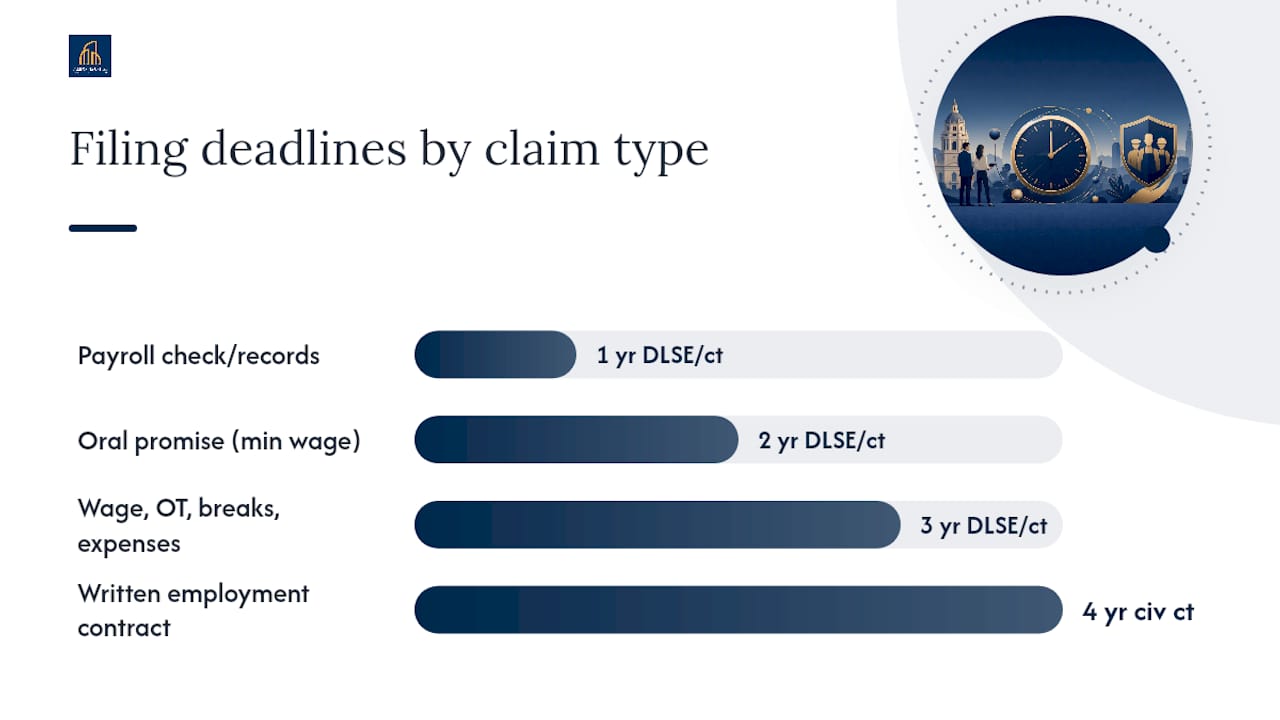
These windows are drawn from DLSE filing guidance and related California Labor Code provisions. Limited exceptions exist (such as tolling for minor claimants or certain employer concealment), but they are narrow and fact-specific.
Pro Tip: If your deadline is approaching, file a timely claim with the DLSE or City first, then continue gathering evidence while the claim is pending. Filing before the applicable deadline may help preserve the claim, but incomplete documentation can still delay or weaken the case.
Retaliation Protections For Pasadena Employees Who Assert Wage Rights
Asserting your wage rights is legally protected. Both Pasadena’s ordinance and California state law prohibit employers from retaliating against you for filing a complaint, cooperating with an investigation, or simply asking about your pay.
The 90-day rebuttable presumption: Under the City’s official notice, if your employer takes an adverse action against you within 90 days of you asserting your wage rights, that timing creates a rebuttable presumption of retaliation. The presumption shifts the burden to the employer to rebut retaliation by showing a legitimate, independent reason for the action.
Examples of retaliatory actions to document:
- Termination or constructive discharge shortly after a complaint
- Reduction in hours, pay, or job duties
- Demotion or removal of responsibilities
- Threats, intimidation, or hostile treatment tied to your complaint
- Negative performance reviews that appear after, not before, your complaint
If you believe you were retaliated against, preserve this evidence immediately:
- Dates and descriptions of every adverse action
- Emails, texts, or written notices from your employer
- Names of coworkers who witnessed the retaliation or your original complaint
- Any documentation of your protected activity (the complaint you filed, the question you asked)
For more on how timing and documentation affect retaliation claims in Pasadena, see When Firing After a Complaint Counts as Retaliation in Pasadena.
Documents And Details To Gather Before You File A Claim
Strong documentation is the foundation of any wage claim. Gather as much of the following as you can before filing.
Primary evidence:
- Paystubs for every pay period in question, including entries showing hours worked, pay rates, gross wages, deductions, and net wages where applicable
- Timecards, punch records, or posted schedules
- Offer letters, employment contracts, or any written pay agreements
- Employer communications about pay, hours, or your complaint (emails, texts, written notices)
- Bank deposit records showing amounts actually received
If paystubs are missing: Bank deposit records, text messages about your schedule, photos of posted timecards, and coworker witness statements can substitute. Alternative records may help support the claim when original paystubs, schedules, or timecards are unavailable.
Additional details that help:
- Your employer’s full legal name and any trade names
- The employer’s address and, if possible, a license plate number for mobile employers
- Names and contact information for coworkers who can corroborate your hours
- Piece-rate logs or invoices if you were paid by the piece
Organize everything chronologically in a folder, either physical or digital, before your DLSE intake or attorney consultation. A clear timeline with specific dates and dollar amounts makes the difference between a claim that moves quickly and one that stalls. For related guidance on gathering records for wage claims, see Torrance Unpaid Wages: Recovering Missing Compensation.
When Hiring An Employment Attorney Helps With Your Wage Claim
Not every unpaid wage situation requires an attorney. But certain circumstances make legal representation worth considering.
Factors that favor consulting counsel:
- The unpaid amount is substantial, covering multiple pay periods or multiple employees
- Your employer has retaliated against you or threatened to do so
- Your employer is concealing payroll records or denying you access to your wage statements
- The claim involves complex issues like misclassification, piece-rate calculations, or multi-week class claims
- Your employer has not responded to direct requests for back pay and shows no sign of cooperating voluntarily
How attorneys typically work in wage cases: Many employment lawyers handle unpaid wage matters on a contingency-fee basis, meaning attorney’s fees may be paid from a settlement or award rather than upfront by the client. Clients should review the written fee agreement carefully, including how litigation costs are handled and whether any costs may be owed regardless of the result. Most offer a free initial consultation to evaluate your situation. Fees, costs, and outcomes vary by case, and no attorney can guarantee a specific result.
In practice, an employment attorney can prepare detailed wage computations, represent you at DLSE settlement conferences and hearings, negotiate directly with your employer, and file a civil lawsuit when the administrative process is not sufficient. For PAGA claims or class actions, civil litigation is typically the required path.
For an overview of how Pasadena employment law works and what local representation looks like, see Pasadena CA Employment Law: What Workers Need to Know.
What To Expect From The DLSE Investigation Process
Understanding the DLSE timeline helps you prepare realistic expectations and avoid common delays.
- Intake: After you file, the DLSE assigns your claim to an investigator. The intake phase involves reviewing your submission for completeness. Incomplete forms or missing employer information are the most common causes of early delays.
- Investigation: The investigator contacts your employer, may request payroll records, and reviews the evidence from both sides. This phase can take several weeks to several months depending on the complexity of the claim and the DLSE office’s caseload.
- Settlement conference: A deputy labor commissioner schedules a conference with you and your employer. Most DLSE claims resolve here. Arriving with organized documentation and a clear computation of your claimed wages can help the conference proceed more efficiently and may improve the likelihood of productive settlement discussions.
- Hearing: If the settlement conference does not produce an agreement, the matter proceeds to a formal hearing. A hearing officer reviews the evidence and issues a written decision.
- Enforcement: A favorable decision does not automatically result in payment. If the employer does not comply, additional enforcement steps may be needed, including filing the decision as a court judgment.
The DLSE’s own guidance notes that organized documentation, including representative paystubs and a clear line-by-line wage computation, helps investigators move claims forward. Submitting a disorganized or vague claim is one of the most avoidable reasons cases take longer than necessary.
A Perspective On Pasadena Wage Claims From California United Law Group
Wage disputes in Pasadena carry a layer of complexity that state-level guidance alone does not always capture. The City’s ordinance has its own enforcement track and may involve local remedies or penalties, while California wage law provides separate state-law remedies. Understanding how these channels fit together can help workers choose an appropriate path.
In our experience, employees who preserve records early, understand which rate applies, and act before deadlines expire are often better prepared to present their claims than those who wait. The 90-day retaliation window, the three-year statute of limitations for minimum wage claims, and the settlement conference process all reward preparation.
California United Law Group works with Pasadena employees on wage and hour matters, including minimum wage underpayment, misclassification, and retaliation claims. Outcomes depend entirely on the facts of each case, and nothing in this article constitutes legal advice. What a case evaluation can do is help you understand your options clearly, without pressure, so you can make an informed decision about how to proceed.
California United Law Group Can Help With Your Pasadena Wage Claim
Recovering unpaid wages in Pasadena means navigating both the City’s local ordinance and California’s state enforcement system. California United Law Group, P.C. provides case evaluations for Pasadena employees dealing with unpaid minimum wages, wage theft, misclassification, and related retaliation. The firm handles DLSE administrative claims, settlement negotiations, and civil litigation when the situation calls for it.
Services available for wage matters:
- Free initial case evaluation
- DLSE wage claim preparation and representation
- City of Pasadena complaint coordination
- Settlement negotiation with employers
- Civil litigation for PAGA claims and complex wage disputes
Consultations are available at no cost. If the firm takes your case on a contingency-fee basis, attorney’s fees are typically paid from any recovery rather than upfront by you. Specific fee arrangements, responsibility for costs, and case terms vary and will be explained in the written fee agreement.
👉 Contact California United Law Group to schedule a free consultation and discuss your Pasadena wage claim. This is general information, not legal advice.
Sources
- OFFICIAL NOTICE EFFECTIVE JULY 1 2026 (City of Pasadena)
- How to file a wage claim (Division of Labor Standards Enforcement, DIR)
- FAQs – Late Payment of Wages (DLSE)
- California Labor Code §1194.2 (LegInfo)
This article is general information, not a substitute for advice from a qualified lawyer. Consult a qualified legal professional about your own circumstances before acting on anything here.
Recommended
- Do Pasadena Employees Face Pay Gaps Like Google? Rights Explained – California United Law Group
- Pasadena CA Employment Law: What Workers Need To Know – California United Law Group –
- Pasadena Failure to Reimburse Employee Expenses – California United Law Group –
- Pasadena Severance Agreements: What to Know Before You Sign – California United Law Group –