
If your Los Angeles employer has refused a reasonable disability accommodation, you have enforceable rights under California’s Fair Employment and Housing Act (FEHA) and, in many cases, the federal Americans with Disabilities Act (ADA). Under FEHA, once an employer knows that an employee may need a disability accommodation, including through a written request, the employer generally must engage in a timely, good-faith interactive process. Refusing to participate in that process may support a separate legal claim, depending on the facts and the available accommodations.
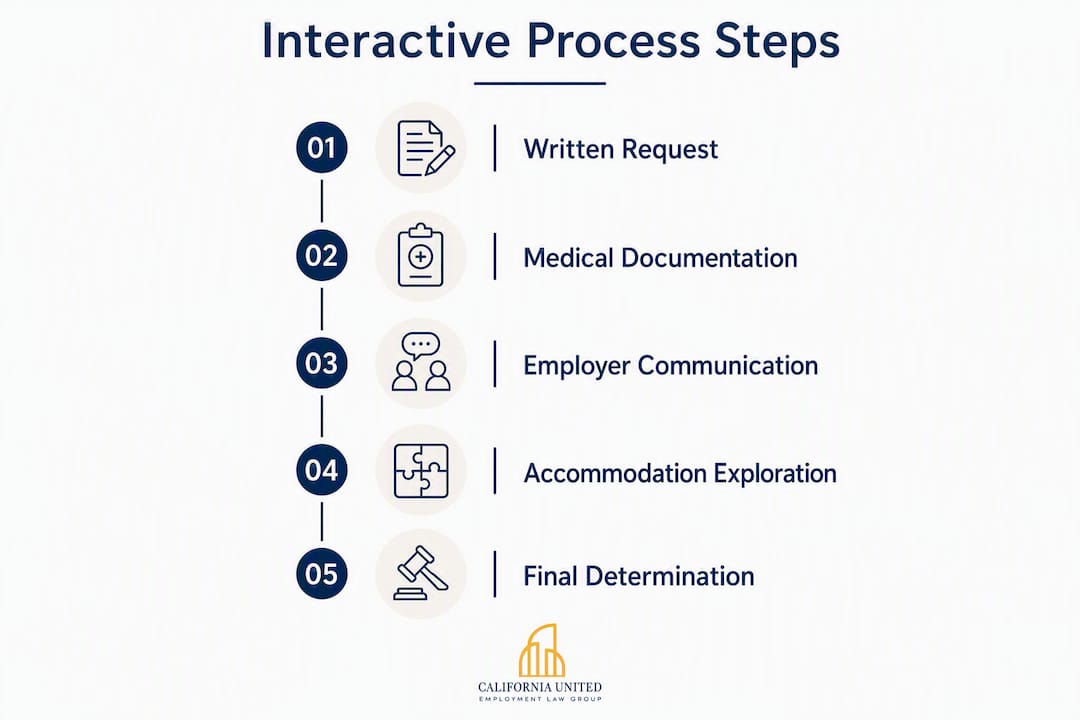
Your most immediate steps: put your request in writing when possible, document every response or non-response, preserve focused medical documentation, and consider whether to file with the California Civil Rights Department (CRD), the EEOC, or both, depending on your claims and deadlines. Consulting an employment attorney early does not mean you are filing a lawsuit. It means you understand your options before a deadline passes.
Table of Contents
- What should you do right after your employer refuses an accommodation?
- Which laws protect you in Los Angeles: FEHA or the ADA?
- What does the interactive process require, and where do employers go wrong?
- What remedies can you recover, and what are the filing deadlines?
- How do you build the strongest evidence record after a refusal?
- When should you contact a Los Angeles employment attorney?
- Key Takeaways
- Why early action protects more than just your claim
- How California United Law Group helps Los Angeles employees
- Authoritative sources and where to file in Los Angeles
What should you do right after your employer refuses an accommodation?
Acting quickly and methodically after a refusal protects your legal options. Here is a practical sequence to follow in the days and weeks after your employer refuses or ignores your request.
- Consult an employment attorney before filing — An attorney can evaluate whether the employer’s cited reason is a legitimate undue hardship or a pretext, and can help you file correctly with the CRD or EEOC.
Pro Tip: Make your written request specific. Describe the functional limitation (e.g., “I cannot stand for more than 30 minutes due to a documented back condition”), the accommodation you are requesting (e.g., a sit-stand workstation), and how it would allow you to continue performing your core duties. A specific request is harder for an employer to ignore and helps create a clearer record that the employer knew accommodation was needed.
Early consultation with counsel does not commit you to litigation. Many employees in Los Angeles find that a well-documented request, combined with a brief attorney letter, prompts an employer to engage where they previously had not.

Which laws protect you in Los Angeles: FEHA or the ADA?
Both statutes may apply to many Los Angeles employees, but FEHA is often broader and more protective where it applies.
FEHA is California’s primary anti-discrimination law, found in Government Code section 12900 et seq., including section 12940. For covered employers, it prohibits disability discrimination, requires reasonable accommodation of known disabilities unless an undue hardship applies, and requires a timely, good-faith interactive process. The CRD enforces FEHA and provides sample forms for accommodation requests, though those forms are not required.
The ADA is the federal counterpart, enforced by the EEOC. It covers employers with 15 or more employees and provides a parallel framework for reasonable accommodations. California’s OAG guidance confirms that both statutes often apply simultaneously in Los Angeles cases.
| Dimension | FEHA (California) | ADA (Federal) |
|---|---|---|
| Employer size threshold | 5+ employees | 15+ employees |
| Enforcing agency | California Civil Rights Department (CRD) | EEOC |
| Interactive process required? | Yes, explicitly by statute and regulation | Yes, by EEOC guidance |
| Potential remedies | Back pay, front pay, compensatory damages, attorney fees, and punitive damages where legally supported | Back pay, front pay, compensatory damages, attorney fees, and punitive damages where legally supported |
| Broader disability definition? | Yes, FEHA’s definition is broader | Narrower by comparison |
For most Los Angeles employees, FEHA is the stronger path because of its lower employer-size threshold, broader disability definition, and explicit interactive-process requirement under Cal. Code Regs., tit. 2, § 11069. That said, filing with the CRD, the EEOC, or both may help preserve state and federal claims if the filing is timely and identifies the relevant legal theories and facts.
What does the interactive process require, and where do employers go wrong?
Under FEHA and its implementing regulations, an employer’s duty to engage in the interactive process generally arises when the employer knows that an employee or applicant may need a reasonable accommodation. The CRD explains that this process is meant to be individualized and informal, a flexible back-and-forth in which both parties share information quickly and in good faith, not a rigid procedural ritual.
Common employer mistakes that produce actionable claims:
- Ignoring the request entirely. This is a common basis for failure-to-engage claims. A failure-to-engage claim may focus on whether the employer participated in the required dialogue, although courts may also examine whether a reasonable accommodation was available.
- Asking for unnecessary medical details. Employers may request reasonable documentation of functional limitations, but accommodation-related requests should generally be limited to information needed to evaluate the disability, restrictions, and accommodation, not unrelated medical history.
- Refusing to discuss alternatives. If one accommodation is not feasible, the employer must explore others. Stopping at “no” without discussion is a red flag.
- Delaying indefinitely without explanation. Prolonged silence after a request, with no timeline or meaningful follow-up, may support an argument that the employer failed to engage in good faith.
- Terminating before completing the process. California courts recognize that failure to accommodate and failure to engage in the interactive process are separate FEHA theories, and that an employer’s failure to participate in good faith can create liability even when the parties dispute what accommodation was available. California cases give this rule practical force. In Wysinger v. Automobile Club of Southern California, the court recognized that failure to engage in the interactive process is a separate FEHA violation because the process itself may reveal accommodations neither side initially identified. In Moore v. Regents of University of California, the court explained that failure-to-accommodate and failure-to-engage claims are independent, but each often implicates the other. In Nealy v. City of Santa Monica, the court emphasized that FEHA requires an informal process to identify reasonable accommodations, not ritualized discussions.” CACI summarizes Wysinger as recognizing failure to engage in the interactive process as a separate FEHA violation and explaining that the process can reveal solutions neither party envisioned. CACI quotes Moore for the point that failure-to-accommodate and failure-to-engage claims are independent but necessarily implicate each other. CACI quotes Nealy for the point that FEHA requires an informal process, not necessarily ritualized discussions.
A legitimate employer refusal looks different. It involves documented evidence that no reasonable accommodation exists, that every alternative was genuinely explored, and that the accommodation would impose an undue hardship given the employer’s size, resources, and the nature of the job. Vague hardship claims are weaker when the employer cannot explain why and how the requested accommodation would significantly affect operations or costs.
Employers may request reasonable medical documentation to understand your functional limitations. They cannot, however, require you to disclose your full diagnosis or unrelated health history. Keep your documentation focused on what you cannot do and what you need, not on the underlying medical details.
What remedies can you recover, and what are the filing deadlines?
California employees who prove FEHA disability discrimination, failure to accommodate, or failure to engage in the interactive process may be awarded several categories of remedies, depending on the claim and evidence. Under FEHA’s remedies framework, these typically include:
- Back pay: Wages and benefits lost from the date of the discriminatory act.
- Front pay: Projected future earnings when reinstatement is not practical.
- Reinstatement: Return to your position, when appropriate.
- Compensatory damages: Emotional distress and other non-economic harm.
- Punitive damages: Available in cases of malice or oppression, though not guaranteed.
- Attorney fees: FEHA allows fee-shifting, meaning a prevailing employee may recover attorney fees from the employer in appropriate cases. This can make contingency-fee representation viable for many employees, but any fee agreement should explain whether the client may remain responsible for litigation costs.
Filing deadlines matter. Before you can file a civil lawsuit under FEHA, you must first file an administrative complaint with the CRD. Under FEHA, employees generally must file with the CRD within three years of the alleged unlawful practice, subject to limited exceptions, and must file any civil lawsuit within one year after receiving a right-to-sue notice. The EEOC has its own filing windows for ADA claims. Check the exact current deadlines directly with the CRD and EEOC, as these windows can vary by circumstance. Do not wait.
One practical note on settlements: back pay is typically treated as wages for tax purposes, while punitive damages are taxed differently. Before finalizing any settlement, consulting a tax professional about how the allocation affects your tax liability is worth the time. This article does not provide tax advice.
For employees who were terminated alongside a refusal of accommodation, understanding how California employee termination rights intersect with FEHA claims is an important part of evaluating your full range of remedies.
How do you build the strongest evidence record after a refusal?
Proving a failure-to-accommodate claim under FEHA often comes down to the paper trail. Some California decisions require plaintiffs to identify a reasonable accommodation that was available when the interactive process should have occurred, while other decisions treat failure to engage as an independent violation. Either way, documentation helps show what accommodations were requested, discussed, or ignored. Your documentation supports that showing.
Evidence to collect and preserve:
- Original written accommodation requests and any employer responses
- Time-stamped emails and HR portal messages
- Screenshots or copies of digital communications, preserved lawfully and without taking confidential or proprietary employer information beyond what is needed
- Contemporaneous notes of verbal conversations, dated and specific
- Medical documentation limited to functional limitations, not full records
- Performance reviews that contradict any stated reason for denial
- Witness contact information for colleagues who observed relevant interactions
A documented follow-up to an ignored request is particularly valuable. In litigation or an administrative review, the record may matter because both sides’ participation in the process can affect how responsibility for any breakdown is evaluated.
Pro Tip: After any verbal conversation with HR or a manager about your accommodation, send a brief follow-up email the same day: “Per our conversation today, I am confirming that I requested X and was told Y.” This creates a contemporaneous written record without requiring the other party to sign anything.

Employers may ask for reasonable medical documentation to understand work-related limitations and accommodation needs. In most accommodation situations, the documentation should be focused rather than a broad disclosure of unrelated medical history. Share only what describes your functional limitations and the accommodation you need. If you are unsure what to share, an employment attorney can help you calibrate that before you respond.
For context on how remote work denials can constitute disability discrimination under FEHA, that pattern of evidence-building applies equally when telework is the accommodation at issue.
When should you contact a Los Angeles employment attorney?
The short answer: earlier than you think. Consulting an attorney does not mean you are committed to suing your employer. It means you understand your rights, your deadlines, and whether the employer’s stated hardship is genuine before those options narrow.
What an employment attorney typically does in these cases:
- Reviews your documentation and evaluates the strength of your claim
- Advises on whether to file with the CRD, the EEOC, or both
- Helps you respond to employer requests for medical documentation
- Negotiates directly with the employer or HR for an accommodation or resolution
- Handles administrative filings and represents you through the complaint process
- Pursues litigation if the employer refuses to resolve the matter
What to expect at a first consultation:
- Bring your written accommodation request, any employer responses, and your contemporaneous notes.
- The attorney will review the timeline and identify any gaps in the record.
- You may receive an overview of potential remedies, filing deadlines, and the likely stages of the process.
- The attorney will explain the contingency-fee structure, including when attorney fees are owed and whether you may remain responsible for case costs.
Early counsel can also help you evaluate whether your employer’s undue hardship claim is supported by actual evidence or is a pretext. That assessment, made before you file, can significantly affect how you frame your administrative complaint.
California United Law Group represents Los Angeles employees in FEHA disability discrimination and failure-to-accommodate claims. The firm handles cases at every stage, from pre-litigation through trial, and offers free consultations for employees who want to understand their options.
Key Takeaways
Under FEHA, a Los Angeles employer who refuses to engage in the interactive process after a written accommodation request may be liable for disability discrimination, and early documentation is the most effective step an employee can take.
| Point | Details |
|---|---|
| FEHA is your strongest protection | California’s FEHA covers employers with 5+ employees and requires a timely, good-faith interactive process. |
| Document everything in writing | Written requests, follow-ups, and contemporaneous notes form the core of a failure-to-accommodate claim. |
| Filing deadlines are strict | You must file with the CRD before pursuing a civil FEHA lawsuit; missing the deadline can bar your claim. |
| Remedies include back pay and attorney fees | FEHA allows recovery of back pay, front pay, damages, and attorney fees through fee-shifting. |
| California United Law Group | The firm offers free consultations for Los Angeles employees facing employer refusal of disability accommodations. |
Why early action protects more than just your claim
Many employees who contact us after a refusal of accommodation share one regret: they waited too long to document the follow-up. They made a clear initial request, heard nothing, and assumed the silence would resolve itself. It rarely does. What it does instead is erase the clearest evidence of employer non-engagement.
The interactive process under FEHA is not a formality. It is a legal obligation, and an employer’s unexplained failure to respond may support a failure-to-engage claim. The employees who preserve their options most effectively are those who respond to silence with a second written request, a follow-up email, and a contemporaneous note. That paper trail does not require a lawyer to create. It requires discipline and a clear understanding that your rights depend on what you can prove, not just what happened.
This article is for general educational purposes only and does not constitute legal advice. Employment law outcomes are fact-specific and vary by circumstance. Consult a qualified employment attorney for guidance on your individual situation.
How California United Law Group helps Los Angeles employees
Facing a disability accommodation refusal at work is serious, and you should not have to navigate California’s administrative process alone. California United Law Group represents employees in Los Angeles in FEHA disability discrimination and failure-to-accommodate claims, from the first written request through litigation if necessary.
What the firm offers:
- Administrative filings — with the CRD and EEOC on your behalf
Contact California United Law Group to schedule your free consultation. Bring your written requests, any employer responses, and your notes. The consultation is confidential, there is no obligation to proceed, and attorney-client representation begins only if both you and the firm agree to an engagement.
This article is for general educational purposes only and does not create an attorney-client relationship or provide legal advice. Employment law outcomes are fact-specific and vary by circumstance. Consult a qualified California employment attorney about your individual situation.
Authoritative sources and where to file in Los Angeles
- California Civil Rights Department (CRD) — Reasonable Accommodation: Primary agency for filing FEHA complaints; provides sample accommodation request forms and guidance on the interactive process.
- CRD — Employment Discrimination Based on Disability (PDF): Plain-language overview of FEHA protections, employer obligations, and how to file.
- California Government Code § 12940: Statutory text addressing disability discrimination, failure to accommodate, retaliation for accommodation requests, and the interactive-process requirement.
- Cal. Code Regs., tit. 2, § 11069 (LII): Regulatory details on the interactive process, including employer and employee obligations and documentation standards.
- EEOC — Facts About the ADA and Reasonable Accommodation: Federal guidance on ADA accommodation obligations; file ADA complaints directly with the EEOC.
- California OAG — Disability Rights in Employment (PDF): State Attorney General summary of ADA and FEHA interplay for California employees.
- ADA.gov: Official federal ADA resource for employees and employers.
Recommended
- Remote work denials and disability discrimination: 3 key facts – California United Law Group
- Must Torrance Employers With 5+ Staff Accommodate Disabilities? – California United Law Group
- Pasadena Tech Employers’ Duty to Accommodate Disabled Workers – California United Law Group
- West Hollywood Failure To Provide Reasonable Accommodations – California United Law Group –