
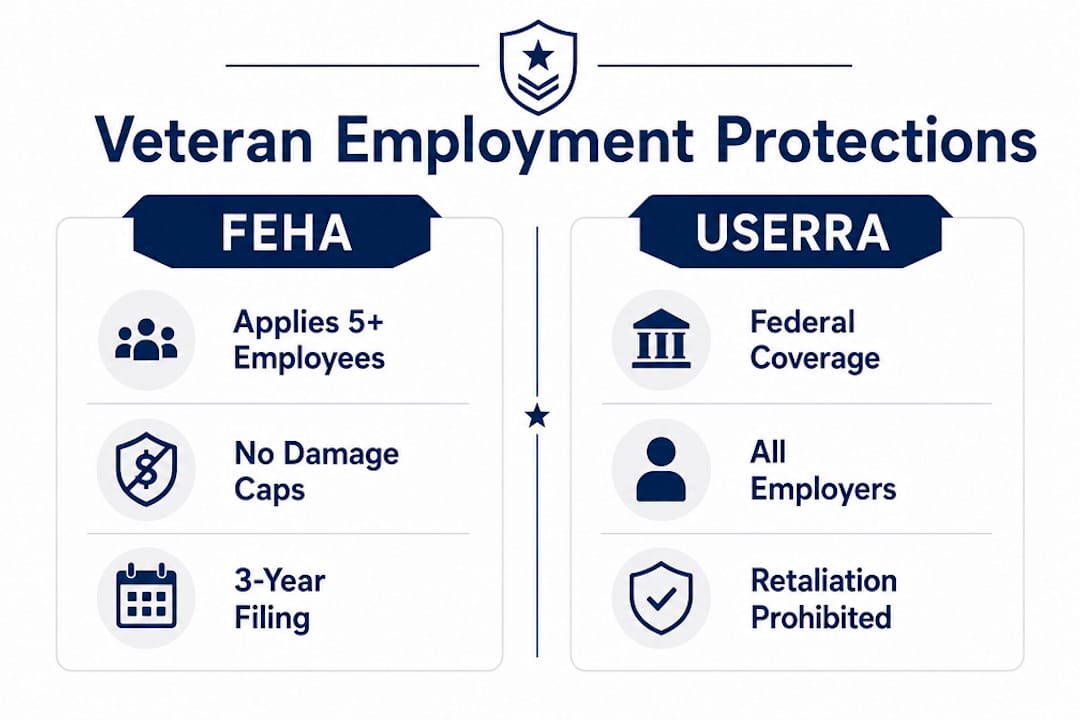
Military and veteran status discrimination in Long Beach workplaces is prohibited under California’s Fair Employment and Housing Act (FEHA), which provides state-law protections that are broader than Title VII in important respects, including protection for military and veteran status. FEHA covers employers with 5 or more employees and applies to all major employment decisions, including hiring, promotion, compensation, and termination. The federal Uniformed Services Employment and Reemployment Rights Act (USERRA) adds a separate layer of protection that applies regardless of employer size. Together, these two laws may provide important protections for Long Beach veterans and service members, depending on the facts of the employment situation.
What federal and state laws protect military and veteran employees in Long Beach?
Two laws form the core of military and veteran employment protection in California: FEHA and USERRA. Understanding how they work together helps you know exactly where you stand.
FEHA: California’s primary protection
FEHA prohibits workplace discrimination based on military and veteran status for employers with 5 or more employees. That threshold covers the vast majority of Long Beach employers. FEHA’s protections apply to every stage of employment, including:
- Hiring and job applications
- Promotions and pay increases
- Work assignments and scheduling
- Disciplinary actions and termination
- Leave policies and benefits
FEHA may provide remedies and procedures that are more favorable than some federal employment-discrimination laws. There is no statutory cap on damages, and the filing deadline is 3 years from the date of the discriminatory act. This California deadline is longer than many federal administrative filing deadlines, but the correct deadline depends on the specific statute and claim. The California Civil Rights Department (CRD) enforces FEHA and issues right-to-sue notices that allow veterans to file civil lawsuits.
USERRA: Federal coverage for all employers
USERRA applies nationwide, regardless of how many employees a company has. This matters in Long Beach, where some veterans work for small businesses that fall below FEHA’s 5-employee threshold. USERRA can protect service members and veterans at smaller firms where FEHA’s employer-size threshold may not apply. USERRA has its own enforcement scheme and remedies, which differ from FEHA’s remedies. It does not offer the same broad damages available under California law.

The two laws complement each other. FEHA provides broader remedies for most Long Beach veterans. USERRA fills the gap for those working at very small employers.
What practices constitute military or veteran status discrimination?
Military status discrimination covers a wider range of conduct than most veterans realize. It is not limited to outright firing. Under FEHA, a plaintiff generally must show that military or veteran status was a substantial motivating reason for an adverse employment action, meaning it actually contributed to the decision and was more than a remote or trivial reason.
Common examples of prohibited conduct include:
- Refusing to hire an applicant because of prior military service or anticipated Guard or Reserve obligations
- Passing over a veteran for promotion when their qualifications are equal to or better than other candidates
- Harassing an employee through severe or pervasive comments, mockery, or pressure related to military service, where the facts support a hostile work environment claim
- Penalizing Guard or Reserve members for taking legally protected military leave
- Asking unlawful questions during the hiring process designed to screen out veterans or service members
- Using veterans’ preference policies as a cover for other forms of discrimination, such as age or gender bias. Lawful veterans’ preference programs may be permitted, but an employer cannot use a preference policy as a pretext for discrimination based on another protected characteristic or as a reason to take adverse action against a service member.
That last point deserves attention. Employers cannot use veteran service history as a pretext for discrimination, even when framed as a preference policy. Proving employer intent in these cases is complex, but California’s “substantial motivating reason” standard does not require military or veteran status to be the only reason for the adverse action. The issue is whether the protected status actually contributed to the decision and was more than a remote or trivial reason.
Pro Tip: Keep a written record of any comment, policy, or decision that seems connected to your military service. Even offhand remarks from a supervisor can become relevant evidence.
How can Long Beach veterans document and respond to suspected discrimination?
Acting promptly after a suspected discriminatory incident gives you the strongest position. Prompt documentation can be important because military-status discrimination may be subtle and may be explained by the employer as ordinary scheduling, attendance, or performance enforcement.
Follow these steps to protect your rights:
- Write down what happened. Record the date, time, location, what was said or done, and the names of any witnesses. Do this as soon as possible after the incident.
- Save relevant documents. Keep copies of performance reviews, emails, job postings, offer letters, and any written communications related to the incident.
- Report internally if safe to do so. Notify your HR department or a supervisor above the person involved. This creates an official record and may trigger the employer’s own investigation.
- File a complaint with the CRD. In many FEHA cases, the CRD complaint deadline is 3 years from the discriminatory act, but the correct deadline can depend on the claim and facts.
- Consider whether to request a right-to-sue notice. A right-to-sue notice allows a civil lawsuit to proceed, but whether to request one immediately or allow the CRD process to continue depends on the facts and litigation strategy.
FEHA also prohibits retaliation against employees who file complaints. If your employer fires you, demotes you, or takes other materially adverse action because you reported discrimination or opposed unlawful practices, that conduct may support a separate retaliation claim. Retaliation claims may allow additional remedies when the facts and evidence support liability and damages.
Pro Tip: Do not delay reporting because you are unsure whether the conduct “rises to the level” of discrimination. Document first and let a qualified employment attorney assess the facts.
How does Long Beach’s local employment landscape affect veteran rights?
Long Beach is one of California’s largest cities and home to a diverse employment base, including the Port of Long Beach, healthcare systems, logistics companies, and a significant defense and aerospace sector. Many Long Beach employers will meet FEHA’s 5-employee threshold, but coverage should be evaluated based on the specific employer.
The table below summarizes how the two primary laws apply based on employer size in Long Beach:
| Employer size | Applicable law | Key benefit |
|---|---|---|
| 5+ employees | FEHA (California) | No damage caps, 3-year filing deadline |
| Any size | USERRA (federal) | Reemployment rights, benefit protections |
| 5+ employees | Both FEHA and USERRA | Broadest combined protection |
| Fewer than 5 employees | USERRA may apply; other laws may depend on the facts | Federal military-service protections even where FEHA discrimination coverage may not apply |
Veterans and service members in industries involving irregular schedules, leave-sensitive staffing, or public-safety operations may face disputes over military leave, reemployment, or scheduling. USERRA directly addresses reemployment rights after service-related absence, and FEHA adds state-level enforcement for qualifying employers.
Long Beach also has local veteran support organizations and resources through the Los Angeles County Department of Military and Veterans Affairs. These organizations do not provide legal representation, but they can help you understand your options and connect you with appropriate services. Knowing your local resources is part of protecting your rights effectively.
Key Takeaways
California’s FEHA gives Long Beach veterans and service members strong workplace discrimination protections, including a 3-year CRD filing window, broad coverage of employment decisions, and no statutory damages cap of the kind found in some federal employment-discrimination laws.
| Point | Details |
|---|---|
| FEHA covers many Long Beach employers | Employers with 5 or more employees generally must comply with FEHA’s military and veteran status discrimination protections. |
| USERRA fills the gap | USERRA applies regardless of employer size and may protect service members and veterans where FEHA’s employer-size threshold is not met. |
| 3-year filing deadline | FEHA gives you 3 years from the discriminatory act to file with the California Civil Rights Department. |
| Document immediately | Contemporaneous notes with dates, times, and witnesses are the foundation of any discrimination claim. |
| Retaliation is also illegal | FEHA prohibits retaliation for protected complaints or opposition to unlawful practices, and remedies depend on the facts, harm, and proof. |
What I’ve Seen Veterans Get Wrong About California Protections
A common misconception is that military and veteran workplace protections are limited to federal law. USERRA is well known in the military community. FEHA is not. That gap in awareness can affect how employees evaluate deadlines, remedies, and legal options.
California’s protections are materially stronger. FEHA’s 3-year CRD filing deadline can be important because some federal employment-law deadlines are shorter, and different statutes may impose different filing or litigation requirements. In some cases, a missed deadline can affect whether a claim can move forward. Some employees delay because they do not know which California deadlines may apply.
The other pattern I see repeatedly is veterans dismissing subtle conduct as “not serious enough” to report. A supervisor’s repeated comments about Guard weekends. A promotion that went to a less-qualified candidate right after a deployment. These situations often have legal significance, but only if they are documented. Under FEHA’s causation standard, military or veteran status does not need to be the only reason for an adverse employment action. It must be a substantial motivating reason, meaning more than a remote or trivial reason.
My honest advice: treat documentation as a habit, not a reaction. You do not need to be certain discrimination occurred before you start writing things down. You need to be prepared.
— California United Law Group
California United Law Group Supports Long Beach Veterans
California United Law Group represents employees facing workplace discrimination throughout California, including Long Beach veterans dealing with military and veteran status claims. The firm evaluates FEHA and USERRA matters at multiple stages, including pre-litigation, administrative filings, settlement negotiations, and litigation where appropriate. If you believe your employer has treated you unfairly because of your military service or veteran status, speaking with an employment attorney is a practical next step. California United Law Group offers consultations without obligation, so you can understand your rights before deciding how to proceed. Contact Kenneth A. Seligson to discuss your situation with an attorney who focuses on California employment law.
FAQ
What is military and veteran status discrimination under California law?
employment action, such as refusing to hire, denying promotion, disciplining, or terminating an employee, because military or veteran status was a substantial motivating reason for the decision. FEHA prohibits this conduct for covered California employers.
How long do Long Beach veterans have to file a discrimination complaint?
FEHA gives you 3 years from the date of the discriminatory act to file a complaint with the California Civil Rights Department. This deadline is significantly longer than the 300-day limit under federal law. In many FEHA cases, an employee has 3 years from the discriminatory act to file a complaint with the California Civil Rights Department. Other statutes and claims may have different deadlines, so employees should evaluate deadlines promptly.
Does FEHA protect veterans at all Long Beach employers?
FEHA applies to employers with 5 or more employees. Veterans and service members at smaller employers may still have protection under USERRA, which applies regardless of employer size but has its own remedies and enforcement rules.
What should I do if my employer retaliates after I report discrimination?
FEHA prohibits retaliation against employees who file discrimination complaints. FEHA prohibits retaliation against employees who oppose unlawful practices or file discrimination complaints. If your employer fires, demotes, disciplines, or takes other materially adverse action because of your complaint, you may have a separate retaliation claim. Remedies depend on the facts, evidence, and harm. You can learn more about your employment lawsuit process options through California United Law Group.
Can an employer use a veterans’ preference policy to discriminate?
A lawful veterans’ preference may be permitted, but an employer cannot use a preference policy as a cover for unlawful discrimination, such as age, gender, race, disability, or another protected characteristic. In a FEHA discrimination case, the protected characteristic must be a substantial motivating reason for the adverse employment decision.
Recommended
- Long Beach California Rest Break Violations: Know Your Rights – California United Law Group –
- Long Beach Employee Misclassification: Employee or Contractor? – California United Law Group –
- Long Beach Sexual Harassment in the Workplace: Know Your Rights – California United Law Group –
- Long Beach Workers Reporting Safety Violations: Your Rights – California United Law Group