
Many disabled employees in Pasadena’s thriving tech and research sectors believe their employers can choose whether to provide workplace accommodations. This misconception causes workers to hesitate before requesting necessary support, fearing rejection or retaliation. California and federal laws actually create clear requirements for disability accommodation, but the specifics can seem confusing when navigating complex employment situations. This guide clarifies your rights and employer obligations in Pasadena as of 2026, helping you understand when accommodations are required and how to secure the support you need to succeed in your role.
Table of Contents
- Understanding Disability Accommodation Laws For Pasadena Tech And Research Employers
- How Pasadena Tech And Research Employers Determine Reasonable Accommodations
- Your Rights And Steps To Request Accommodations In Pasadena Tech And Research Workplaces
- Challenges And Protections: What To Do If Accommodations Are Denied Or You Face Discrimination
- Get Expert Help With Disability Accommodation And Employment Law In Pasadena
- Frequently Asked Questions About Pasadena Tech Employer Accommodation Duties
Key takeaways
| Point | Details |
|---|---|
| Legal coverage | Employers in Pasadena’s tech and research sectors must provide reasonable accommodations under federal ADA and California FEHA laws. |
| Undue hardship exception | Accommodation is required unless it causes significant difficulty or expense to the employer. |
| Interactive process | Disabled employees should communicate needs clearly and engage in cooperative discussions with employers. |
| Size threshold | Legal protections apply to California employers with 5 or more employees under FEHA, covering most Pasadena tech companies and research facilities. |
| Retaliation protection | Requesting accommodations is legally protected and employers cannot punish workers for asserting rights. |
Understanding disability accommodation laws for Pasadena tech and research employers
Two major legal frameworks protect disabled workers in Pasadena’s tech and research industries. California’s Fair Employment and Housing Act (FEHA) requires reasonable accommodations for disabled employees in most workplaces, including Pasadena. FEHA applies to employers with 5 or more employees in California, covering many startups, research labs, and tech companies throughout the city. This lower threshold means more workers receive protection compared to federal law alone.
The federal Americans with Disabilities Act (ADA) also mandates reasonable accommodations for qualified disabled workers. The ADA covers employers with 15 or more employees, but FEHA often provides broader coverage and stronger protections for California workers. When both laws apply, employees benefit from whichever standard offers greater protection. This dual framework creates a safety net for Pasadena tech workers who might fall outside ADA coverage but still deserve workplace support.
California courts have consistently affirmed that FEHA provides broader protections than federal ADA requirements. In Gelfo v. Lockheed Martin Corp. (2006) 140 Cal.App.4th 34, the California Court of Appeal clarified that employers must reasonably accommodate individuals falling within any of FEHA’s statutorily defined disabilities and must engage in an informal, interactive process to determine effective accommodations. This case established important precedent for how California employers must approach accommodation requests.
Both laws require employers to provide reasonable accommodations that enable disabled employees to perform essential job functions. These accommodations remove barriers that prevent qualified workers from doing their jobs effectively. The legal definition focuses on necessity and effectiveness rather than convenience or preference.
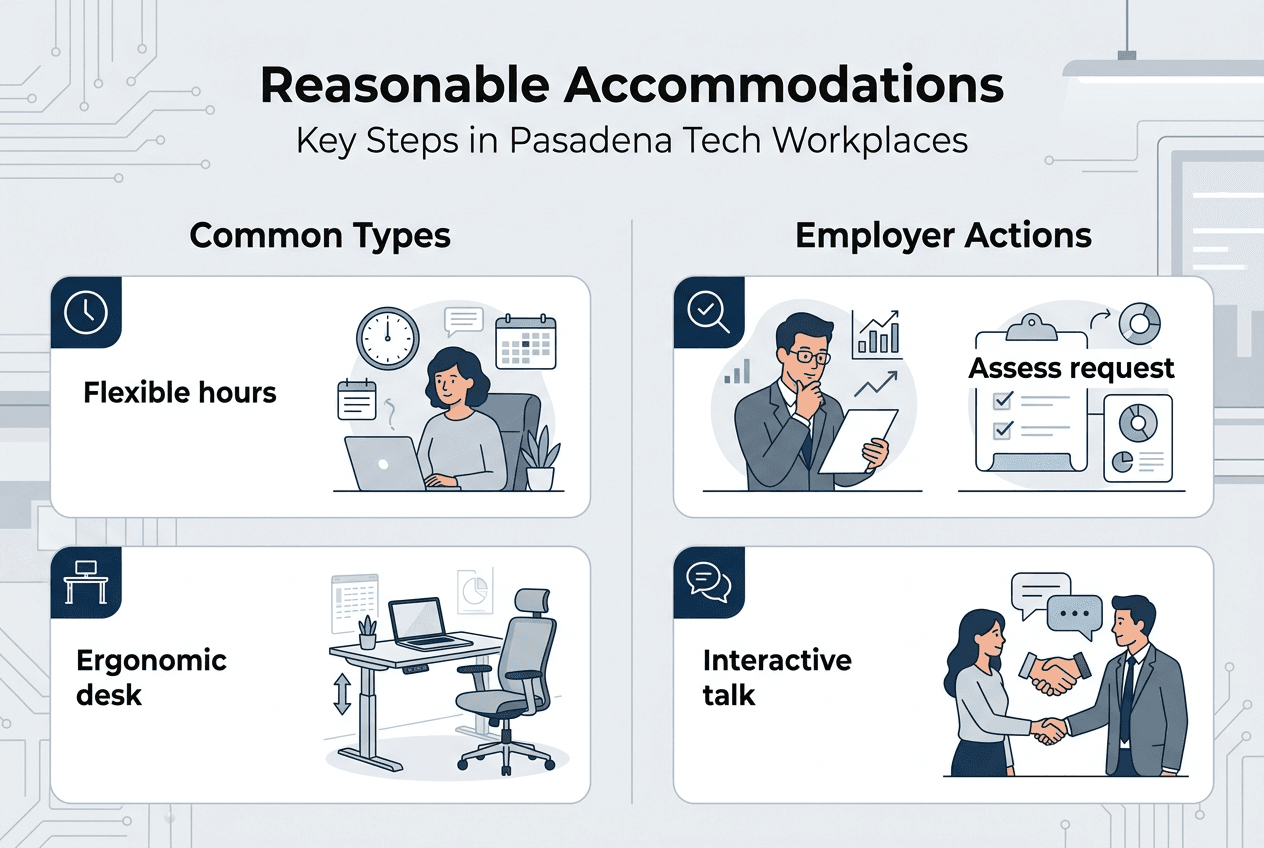
Common accommodations in Pasadena’s tech and research sectors include:
- Modified work schedules allowing flexible start times or remote work days
- Assistive technologies like screen readers, voice recognition software, or specialized keyboards
- Accessible workplaces with ramps, adjustable desks, or modified lighting
- Restructured job duties that reassign marginal tasks while maintaining essential functions
- Additional break time for medical needs or medication management
Employers and employees must participate in an interactive process to identify suitable accommodations. This collaborative approach requires good faith efforts from both parties. You share information about limitations and needs while your employer explores feasible solutions. The process should be ongoing and adaptive as circumstances change. Disability assistance dogs represent another accommodation option that tech employers may need to consider for workers who rely on service animals for safety and independence.
The California Court of Appeal in Gelfo v. Lockheed Martin Corp. emphasized that ‘[t]wo principles underlie a cause of action for failure to provide a reasonable accommodation. First, the employee must request an accommodation. Second, the parties must engage in an interactive process regarding the requested accommodation and, if the process fails, responsibility for the failure rests with the party who failed to participate in good faith.’ More recently, Moore v. Regents of University of California (2016) 248 Cal.App.4th 216 confirmed that while failure to accommodate and failure to engage in interactive dialogue are independent claims, they necessarily implicate each other.
Pro Tip: Document every conversation about accommodations in writing, even if initial discussions happen verbally. Send follow up emails summarizing what was discussed and agreed upon to create a clear record.
Legal Framework Established by California Courts
California appellate courts have developed substantial case law clarifying employer obligations. In Wysinger v. Automobile Club of Southern California (2007) 157 Cal.App.4th 413, the court held that failure to engage in the interactive process is a separate FEHA violation independent from failure to provide reasonable accommodation. The court explained that ‘if [the employer] did not engage in a good faith interactive process, it cannot be known whether an alternative job would have been found.’ This means employers can face liability for failing to engage in the interactive process even when arguing no reasonable accommodation existed.
Additionally, Claudio v. Regents of University of California (2005) 134 Cal.App.4th 224 established that employees may file civil actions specifically for an employer’s failure to engage in the interactive process. These cases demonstrate that the interactive process is not merely procedural but represents a substantive legal obligation.
How Pasadena tech and research employers determine reasonable accommodations
Reasonable accommodations enable disabled employees to do their jobs without lowering essential duties or performance standards. The key word is reasonable, which means the accommodation must be effective and feasible given the employer’s resources and operational needs. Employers cannot require disabled workers to accept lower productivity targets or reduced responsibilities as a substitute for genuine accommodation.
Undue hardship refers to significant difficulty or expense for the employer and can justify denying an accommodation request. Courts evaluate undue hardship by examining the employer’s size, financial resources, and the accommodation’s impact on operations. A small research startup might face undue hardship from an expensive structural renovation, while a large tech corporation likely cannot claim the same expense creates hardship. The analysis is always fact specific and considers the employer’s overall circumstances.
In Atkins v. City of Los Angeles (2017) 8 Cal.App.5th 696, the California Court of Appeal emphasized that ‘an employer must do more than simply assert that it had economic reasons to reject a plaintiff’s proposed reassignment to demonstrate undue hardship. An employer must show why and how asserted economic reasons would affect its ability to provide a particular accommodation.’ This case underscores that employers cannot rely on general economic concerns but must provide specific evidence of hardship.
Under federal and California law, once an employee shows that an accommodation appears reasonable on its face, the burden shifts to the employer to demonstrate undue hardship. As the U.S. Supreme Court explained in U.S. Airways, Inc. v. Barnett (2002) 535 U.S. 391, an employee need only show the accommodation ‘seems reasonable on its face, i.e., ordinarily or in the run of cases.’ The employer then must provide specific evidence showing why the accommodation would cause significant difficulty or expense in their particular circumstances.
Typical accommodations in tech environments include modified workstations with ergonomic furniture, flexible hours that allow medical appointments, software adjustments like color contrast settings, or remote work options for mobility limitations. Many of these accommodations cost little or nothing to implement. According to the Job Accommodation Network, the majority of workplace accommodations involve little to no cost to implement, with many tech companies already equipped with remote work infrastructure that facilitates accommodations at minimal expense. Employers should note that undue hardship is evaluated on a case-by-case basis relative to the employer’s specific resources and circumstances. Tech companies already equipped with remote work infrastructure face minimal burden when approving work from home arrangements.

| Accommodation Type | Cost Range | Implementation Difficulty |
|---|---|---|
| Flexible scheduling | $0 | Low |
| Ergonomic equipment | $100 to $1,000 | Low to Medium |
| Software modifications | $0 to $500 | Low |
| Remote work setup | $0 to $300 | Low |
| Workspace restructuring | $500 to $5,000+ | Medium to High |
Some accommodations may not be reasonable if they compromise workplace safety or operational efficiency. An accommodation that eliminates an essential job function is not required. For example, a software developer who cannot write code due to disability limitations might not be qualified for that specific role, even with accommodations. However, employers must consider reassignment to vacant positions as a potential accommodation before concluding no reasonable option exists.
Government Code section 12940(n) requires employers to ‘engage in a timely, good faith interactive process’ in response to accommodation requests. The California Court of Appeal has clarified that ‘FEHA requires an informal process with the employee to attempt to identify reasonable accommodations, not necessarily ritualized discussions.’ (Nealy v. City of Santa Monica (2015) 234 Cal.App.4th 359, 379). Courts may impose liability for failure to engage in this process, even when it cannot be known whether an alternative accommodation would have been found. You initiate the process by notifying your employer of your disability and need for accommodation. Your employer must then engage meaningfully, asking relevant questions and exploring options. Neither party can simply refuse to participate or declare the process complete without genuine effort. Failure to engage in good faith can itself violate disability discrimination laws.
Pro Tip: Suggest specific accommodations when making your request, but remain flexible about alternatives. Your employer might propose different solutions that accomplish the same goal while better fitting their operational structure.
Your rights and steps to request accommodations in Pasadena tech and research workplaces
Securing workplace accommodations requires clear communication and proper documentation. Follow these steps to protect your rights and increase the likelihood of a successful outcome:
Notify your employer or HR department in writing about your disability and need for accommodations. You do not need to use specific legal terminology or mention ADA or FEHA. Simply explain that you have a medical condition requiring workplace adjustments.
Describe specific barriers you face and suggest possible accommodations. Focus on how your disability limits your ability to perform job functions. Provide enough detail for your employer to understand the issue without disclosing unnecessary medical information.
Provide medical documentation if requested. Your employer can ask for verification that you have a disability and need accommodation. However, they cannot demand your entire medical history or unrelated health information. A letter from your healthcare provider describing functional limitations and recommended accommodations usually suffices.
Participate actively in the interactive process. Respond promptly to employer questions and attend scheduled meetings. Your cooperation demonstrates good faith and helps move the process forward efficiently.
Keep records of all communications related to your accommodation requests. Save emails, meeting notes, and written responses. This documentation becomes crucial if disputes arise later about what was requested, discussed, or agreed upon.
If denied, ask for written reasons and consider consulting a specialized employment lawyer. Employers must explain why they cannot provide requested accommodations or why alternatives are not feasible. Vague refusals or silence may indicate discrimination rather than legitimate hardship.
Know that retaliation for requesting accommodations is illegal and report any such behavior. Retaliation includes termination, demotion, reduced hours, hostile treatment, or other adverse actions taken because you asked for accommodations. California law protects your right to request support without fear of punishment. If you experience retaliation, document the incidents and seek legal guidance immediately.
Timely action helps protect your rights and supports resolving issues amicably. Do not wait until performance reviews or disciplinary actions to request accommodations you need now. Early requests allow more time for the interactive process and reduce the risk of misunderstandings about performance issues versus disability related limitations.
Pro Tip: If your employer seems unfamiliar with accommodation obligations, offer to provide educational resources about FEHA requirements. Sometimes employers need guidance rather than confrontation to understand their legal duties.
Challenges and protections: What to do if accommodations are denied or you face discrimination
Employers must provide reasonable accommodations unless documenting undue hardship through specific evidence about costs, resources, or operational impact. Vague claims about inconvenience or preference for current practices do not constitute undue hardship. Denying accommodations without valid reasons may constitute discrimination under FEHA and ADA. This discrimination can take multiple forms beyond simple refusal.
Discrimination can include harassment, retaliation, or disparate treatment connected to disability. Harassment involves unwelcome comments, jokes, or conduct related to your disability that creates a hostile work environment. Disparate treatment means your employer treats you worse than similarly situated employees without disabilities. Retaliation occurs when your employer punishes you for requesting accommodations or asserting your rights. All these behaviors violate California law.
Common discrimination scenarios in tech workplaces:
- Refusing to consider remote work for mobility limitations while allowing it for other employees
- Excluding disabled workers from team activities or professional development opportunities
- Making offensive comments about disability or accommodation needs
- Terminating employment shortly after an accommodation request
- Assigning undesirable projects or shifts as punishment for requesting support
Employees have rights to file complaints with the California Civil Rights Department (formerly DFEH) if accommodations are denied or discrimination occurs. Under FEHA, you generally must file a complaint with the California Civil Rights Department (CRD) within three years of the alleged discriminatory act (Government Code § 12960(e)), though you should consult with an attorney promptly as various procedural requirements and limitations may apply depending on your specific circumstances. The CRD investigates complaints and may facilitate settlement or issue a right to sue notice allowing you to pursue litigation.
| Legal Remedy | Description | Potential Outcome |
|---|---|---|
| Reinstatement | Return to your position | Job restoration with back pay |
| Back pay | Lost wages from termination or reduction | Compensation for financial losses |
| Compensatory damages | Emotional distress and suffering | Monetary award for harm |
| Punitive damages | Punishment for willful violations | Additional monetary penalty |
| Attorney fees | Legal costs and expenses | Reimbursement of legal fees |
Legal remedies can involve reinstatement, back pay, or damages for emotional distress and other harm. California courts can also award punitive damages when employers act with malice or reckless indifference to your rights. Attorney fees are often recoverable, making legal representation more accessible for workers who cannot afford upfront costs. These remedies aim to make you whole and deter future violations.
Early legal counsel may prevent prolonged disputes and protect rights more effectively than waiting until situations escalate. An experienced employment lawyer can review your situation, advise on documentation strategies, and communicate with your employer on your behalf. Sometimes a lawyer’s involvement prompts employers to take accommodation obligations more seriously. Other times, legal action becomes necessary to vindicate your rights and obtain fair compensation.
Pro Tip: Consult an employment lawyer before accepting any settlement offer from your employer. What seems like fair compensation might undervalue your claims, and you may waive important rights by signing a settlement agreement without legal review.
Get expert help with disability accommodation and employment law in Pasadena
Navigating disability accommodation disputes requires specialized knowledge of California employment law and federal protections. California United Law Group, P.C. handles disability accommodation and employment discrimination cases in Pasadena. The firm represents workers in matters involving denied accommodations and disability discrimination claims under FEHA and ADA. Experienced employment counsel can help evaluate your situation, document your case, and pursue available remedies through administrative proceedings or litigation. Every case outcome depends on specific facts and circumstances.
The firm offers guidance and legal representation for workers denied reasonable accommodations or subjected to disability discrimination. Their attorneys help clients understand their rights, document their situations, and pursue effective remedies. Whether you need help initiating the interactive process, responding to an accommodation denial, or filing a discrimination complaint, experienced legal counsel makes a significant difference in outcomes.
They assist in navigating legal options including filing complaints with the California Civil Rights Department and pursuing lawsuits when necessary. Contacting experienced Pasadena employment lawyers can help protect your workplace rights and achieve fair outcomes. Early consultation often resolves issues before they escalate into costly litigation, but when litigation becomes necessary, having skilled advocates ensures your case receives the attention and expertise it deserves.
Frequently asked questions about Pasadena tech employer accommodation duties
Do all Pasadena tech and research employers have to provide disability accommodations?
Most do under California law. FEHA requires accommodations from employers with 5 or more employees, covering the majority of Pasadena tech companies and research facilities. The federal ADA applies to employers with 15 or more workers. Very small operations with fewer than 5 employees may fall outside FEHA coverage, but most established tech and research employers must comply.
What accommodations are common in Pasadena tech workplaces?
Tech sector accommodations frequently include flexible work schedules, remote work arrangements, ergonomic workstation modifications, assistive software, and adjusted break schedules. Many tech companies already use collaboration tools and remote infrastructure that make accommodations relatively simple to implement. Screen readers, voice recognition software, and keyboard alternatives are standard assistive technologies in software development and research environments.
What does undue hardship mean for tech employers?
Undue hardship refers to accommodations causing significant difficulty or expense relative to the employer’s size and resources. A $2,000 accommodation might create undue hardship for a 6 person startup but not for a tech company with hundreds of employees and millions in revenue. Courts examine financial resources, accommodation costs, and operational impact when evaluating hardship claims. Most requested accommodations do not reach the undue hardship threshold.
What can I do if my Pasadena employer denies my accommodation request?
Request written explanation of the denial and reasons why your proposed accommodation creates undue hardship. If the explanation seems inadequate or pretextual, consult an employment lawyer to evaluate whether the denial violates FEHA or ADA. You can file a complaint with the California Civil Rights Department or pursue legal action to enforce your rights and obtain necessary accommodations.
Can my employer fire me for requesting disability accommodations?
No, termination for requesting accommodations constitutes illegal retaliation under California law. However, employers may terminate employment for legitimate, non-retaliatory reasons unrelated to the accommodation request. The key legal question is whether the accommodation request was a motivating factor in the adverse employment action. If you believe you were terminated in retaliation for requesting accommodations, consult an employment attorney immediately to evaluate your specific situation. FEHA explicitly protects employees who assert their rights to reasonable accommodations. If you are fired, demoted, or otherwise punished after requesting accommodations, you may have claims for both disability discrimination and retaliation. Document the timeline and consult an employment lawyer immediately to protect your rights and explore legal remedies.