
Many employees in Torrance believe only large corporations must provide disability accommodations. California law says otherwise. Under FEHA, employers with five or more workers must accommodate disabilities unless undue hardship is proven. This guide explains your rights, employer obligations, and steps to take when accommodations are denied or retaliation occurs.
Table of Contents
- Overview Of Disability Accommodation Laws In Torrance, California
- FEHA Accommodation Requirements For Torrance Employers
- The Interactive Process: How Accommodation Decisions Are Made
- Comparison Of FEHA Vs. ADA Accommodation Standards
- Employer Defenses And When Accommodations Can Be Denied
- Legal Protections Against Retaliation For Accommodation Requests
- Practical Steps For Torrance Employees To Request And Enforce Accommodations
- Common Misconceptions About Disability Accommodation In California Workplaces
- Get Expert Legal Help For Disability Accommodation Issues In Torrance
Key Takeaways
| Point | Details |
|---|---|
| FEHA applies to employers with 5+ employees; ADA applies to those with 15+ | California law covers far more workplaces than federal law |
| Reasonable accommodations must be provided unless undue hardship is proven | Employers bear the burden to justify denials with concrete evidence |
| Interactive process is a required good faith dialogue between employee and employer | Both parties must collaborate to identify feasible accommodations |
| Retaliation for requesting accommodations is illegal under FEHA and ADA | Protections cover firing, demotion, or hostile treatment |
| Employees can file complaints with the California Civil Rights Department (CRD) or EEOC for violations | Legal remedies exist when employers fail accommodation duties |
Overview of Disability Accommodation Laws in Torrance, California
Torrance employees work under two main accommodation laws. FEHA sets California standards, while ADA provides federal protections. The differences matter for your rights.
FEHA applies to employers with five or more employees in California. This threshold is significantly lower than the ADA, which requires 15 or more workers. Under California’s FEHA, employers with five or more employees must provide reasonable accommodations to qualified individuals with disabilities unless it causes undue hardship. Both laws operate simultaneously in Torrance, giving you layered protections.
Disability definitions differ between these laws. FEHA recognizes physical disabilities, mental impairments, temporary conditions, and recurring health issues. The ADA uses a narrower definition focused on substantial life limitations. FEHA’s broader scope means more conditions qualify for accommodations in California workplaces.
Basic employer duties under both laws include:
- Providing reasonable accommodations to qualified employees with disabilities
- Engaging in an interactive process to identify appropriate accommodations
- Considering employee accommodation requests seriously and promptly
- Documenting all steps taken during the accommodation process
- Avoiding discrimination or retaliation against employees requesting accommodations
Employers must make good faith efforts to accommodate unless doing so creates undue hardship. Hardship means significant difficulty or expense relative to business size and resources. The California Civil Rights Department (CRD), formerly known as the Department of Fair Employment and Housing, provides detailed guidance on these requirements.
If you work for a company with five or more employees in Torrance, you have robust accommodation rights. Consulting an employment lawyer in Torrance helps you understand how these laws apply to your specific situation.
FEHA Accommodation Requirements for Torrance Employers
California’s FEHA imposes clear obligations on Torrance employers with five or more workers. These requirements go beyond federal minimums.
Employers must engage in a timely, good faith interactive process once they know about your disability. This duty triggers when you request accommodations or when the employer becomes aware of your condition through observation or medical documentation. Delays or refusals to engage violate FEHA.

Under California’s FEHA, employers with five or more employees working on a regular basis within California must provide reasonable accommodations to qualified individuals with disabilities unless it causes undue hardship. ‘Regular basis’ refers to the recurring nature of the business rather than constant operation – an employer with at least five employees on its payroll during its operating season is covered, even if not every day throughout the year. Employers have an affirmative obligation, meaning they must act proactively rather than wait for perfect requests.
Common reasonable accommodations include:
- Modified work schedules or part time hours
- Leave of absence for medical treatment or recovery
- Assistive technology or specialized equipment
- Job restructuring to eliminate non essential functions
- Reassignment to vacant positions that match your abilities
- Workspace modifications like ergonomic furniture or lighting adjustments
California courts have consistently reinforced these accommodation duties. In Wysinger v. Automobile Club of Southern California (2007) 157 Cal.App.4th 413, the court held that an employee may prevail on an interactive process claim under FEHA without proving that the disability could have been accommodated, emphasizing the independent importance of the good faith interactive process requirement.
Pro Tip: Keep detailed records of all accommodation requests and employer responses. Document dates, times, participants, and outcomes of meetings. Save emails, medical notes, and written communications. This documentation protects your rights if disputes arise later.
The interactive process is not a formality. It requires substantive dialogue between you and your employer. Both parties must participate honestly and explore options collaboratively. Employers who treat this as a checkbox exercise rather than meaningful engagement violate their legal duties.
The California Civil Rights Department accommodation guidance offers employees and employers detailed standards for compliance. Understanding these requirements empowers you to advocate effectively for your needs.
The Interactive Process: How Accommodation Decisions Are Made
The interactive process forms the heart of disability accommodation law. This collaborative dialogue determines what accommodations fit your needs and your employer’s capabilities.
Here’s how the process works step by step:
- You notify your employer or HR about your disability and need for accommodations
- Your employer responds promptly and schedules a meeting to discuss options
- Both parties review your job duties and identify essential versus non essential functions
- You provide medical documentation explaining your limitations and capabilities
- Together you explore possible accommodations and assess their feasibility
- Your employer investigates costs, logistics, and operational impacts
- A decision is reached and documented with clear explanations for any denials
Both parties carry responsibilities. You must participate cooperatively, provide timely medical information, and suggest workable solutions. Your employer must explore all reasonable options, explain any limitations clearly, and document the entire process.
The interactive process requires individualized assessment of both the job’s essential functions and the employee’s limitations directly related to the accommodation need. Generic responses or blanket denials violate this requirement.
Failure to engage in good faith is itself a legal violation. Employers who ignore requests, delay unreasonably, or refuse to consider options face complaints and lawsuits. You can challenge accommodation denials when the interactive process is inadequate.
As stated in Gelfo v. Lockheed Martin Corp. (2006) 140 Cal.App.4th 34, two principles underlie a cause of action for failure to provide reasonable accommodation: First, the employee must request an accommodation. Second, the parties must engage in an interactive process regarding the requested accommodation and, if the process fails, responsibility rests with the party who failed to participate in good faith.
Pro Tip: Provide updated medical information promptly and keep communications clear and documented. Request written summaries of meetings and decisions. If your employer drags out the process or refuses to engage meaningfully, consult an employment lawyer who can intervene and enforce your rights.
The interactive process explanation from California’s civil rights agency details what good faith engagement looks like. Use this as a benchmark when evaluating your employer’s actions.
Comparison of FEHA vs. ADA Accommodation Standards
Understanding how FEHA and ADA interact clarifies the full scope of your protections in Torrance workplaces.
| Feature | FEHA (California) | ADA (Federal) |
|---|---|---|
| Employer Size Threshold | 5 or more employees | 15 or more employees |
| Disability Definition | Broad: includes temporary, mental, recurring conditions | Narrower: substantial life limitations |
| Interactive Process | Rigorous requirement with detailed documentation | Required but less prescriptive |
| Retaliation Protections | Strong with enhanced remedies | Standard federal protections |
| Medical Leave | Integrated with CFRA for extended leave rights | Limited to reasonable accommodation period |
The California Supreme Court has emphasized that FEHA provides protections independent from the federal ADA. As stated in Gov. Code § 12926.1(a), ‘Although the federal act provides a floor of protection, this state’s law has always, even prior to passage of the federal act, afforded additional protections.’
FEHA applies to more Torrance employers because of its lower five employee threshold. If you work for a small business, state law may be your only protection. Both mental and physical disabilities, including temporary and recurring impairments, can qualify for accommodation under FEHA’s broader definition of disability.
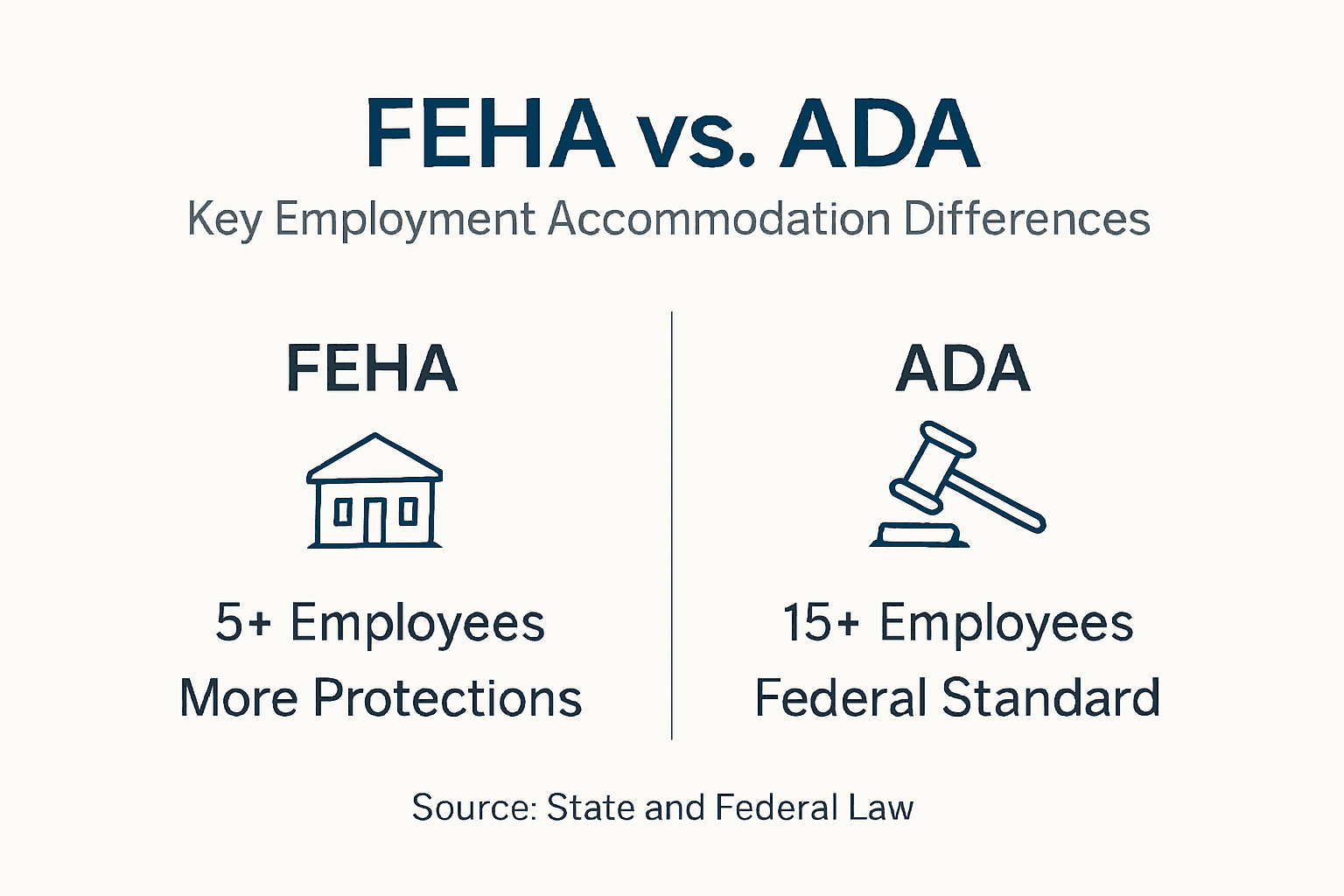
FEHA mandates a more detailed interactive process than ADA. California employers must document discussions thoroughly and justify decisions with specificity. This creates stronger enforcement opportunities when employers fail their duties.
Anti retaliation protections under FEHA are more robust. California law provides enhanced damages and remedies when employers punish workers for requesting accommodations or filing complaints.
Employers in Torrance must comply with both laws when applicable. Where standards differ, the law providing greater protection applies. This means you benefit from FEHA’s broader coverage even if ADA also applies to your employer.
The FEHA and ADA comparison shows how California law strengthens federal baselines. Understanding these FEHA vs ADA differences helps you identify which protections apply to your situation.
Employer Defenses and When Accommodations Can Be Denied
Accommodation obligations have limits. Employers can refuse requests under specific circumstances, but they carry the burden to prove their case.
Undue hardship is the primary legal defense. This means the accommodation would cause significant difficulty or expense relative to the employer’s resources and operations. Employers must prove that providing an accommodation would cause significant difficulty or expense to lawfully deny it.
Factors courts consider include:
- The accommodation’s actual cost compared to the employer’s budget and resources
- Disruption to business operations or other employees’ duties
- Safety risks to you, coworkers, or customers
- Whether the accommodation fundamentally alters the job’s nature or essential functions
- Alternative accommodations that might work with less burden
Employers cannot rely on assumptions or hypothetical concerns. They must provide concrete evidence of hardship. Vague claims about cost or inconvenience fail legal scrutiny.
Employers are not required to eliminate essential job functions or create new positions. If your disability prevents you from performing core duties even with accommodations, reassignment to a vacant position may be required instead.
A common misconception is that employers can deny requests arbitrarily. They cannot. Every denial requires engagement in the interactive process and clear documentation of why the requested accommodation creates undue hardship.
The undue hardship legal standard sets a high bar for employers. Understanding this standard helps you evaluate whether your employer’s undue hardship defense is legitimate or pretextual.
Legal Protections Against Retaliation for Accommodation Requests
California and federal law forbid retaliation when you request accommodations. These protections ensure you can assert rights without fear.
Retaliation takes many forms:
- Termination or layoff shortly after requesting accommodations
- Demotion or reduction in responsibilities or pay
- Negative performance evaluations that contradict prior assessments
- Exclusion from meetings, projects, or professional development opportunities
- Hostile treatment including increased scrutiny or isolation
- Denial of promotions or transfers you would otherwise receive
In Yanowitz v. L’Oreal USA, Inc. (2005) 36 Cal.4th 1028, the California Supreme Court held that where a retaliatory course of conduct is alleged, a series of separate retaliatory acts collectively may constitute an adverse employment action, even if none of the acts individually would be actionable. The court emphasized that enforcing a requirement that each act separately constitute an adverse employment action would subvert the purpose and intent of the statute.
Employers cannot retaliate against an employee for requesting a reasonable accommodation under FEHA, with protections against demotion, termination, or other penalties. ADA provides parallel federal protections.
Timing matters in retaliation cases. Adverse actions occurring soon after accommodation requests create strong inference of retaliation. However, retaliation can also be subtle and delayed, making documentation critical.
Document everything. Keep records of your accommodation request, the employer’s response, and any negative treatment that follows. Note dates, witnesses, and specific incidents. Save emails and texts that show changing attitudes or treatment.
Legal options when retaliation occurs include filing complaints with the California Civil Rights Department (CRD) or the Equal Employment Opportunity Commission (EEOC). You can also pursue lawsuits seeking damages, reinstatement, and attorney fees. Understanding your workplace retaliation rights empowers you to act decisively.
Prompt action improves enforcement chances. Retaliation claims have time limits, so consult legal counsel quickly if you suspect your employer is punishing you for requesting accommodations. The disability discrimination and retaliation protections give you powerful remedies.
Practical Steps for Torrance Employees to Request and Enforce Accommodations
Knowing your rights means little without action. Follow these steps to request accommodations and enforce your protections effectively.
- Notify your employer or HR in writing about your disability and accommodation needs. Be specific but focus on limitations rather than diagnoses. State clearly you are requesting reasonable accommodations under FEHA and ADA.
- Participate in the interactive process by attending scheduled meetings and providing requested medical documentation. Bring a notebook to meetings and take detailed notes.
- Suggest specific reasonable accommodations based on your knowledge of your job and limitations. Research options beforehand and propose multiple alternatives to show flexibility.
- Keep personal copies of all communications, medical records, accommodation requests, and employer responses. Create a dedicated folder or file to organize documentation chronologically.
- If your request is denied or you face retaliation, consider filing a complaint with the California Civil Rights Department (CRD) or the Equal Employment Opportunity Commission (EEOC). These agencies investigate violations and can order remedies. Alternatively, consult an employment lawyer about direct legal action.
Consulting legal help for accommodation enforcement provides strategic advantages. Lawyers can communicate with your employer on your behalf, evaluate the strength of your claims, and pursue litigation if necessary.
Early legal consultation often leads to better outcomes. Attorneys can guide you through the interactive process, identify employer violations, and position your case for success if disputes arise.
Common Misconceptions About Disability Accommodation in California Workplaces
Misunderstandings about accommodation laws prevent many employees from asserting their rights. Let’s clear up the confusion.
- Only permanent physical disabilities qualify: False. FEHA covers temporary conditions, mental health issues, and recurring impairments. A broken leg requiring crutches for three months qualifies just as much as a permanent mobility impairment.
- Employers with fewer than 15 employees don’t have to accommodate: False. FEHA requires employers with five or more workers to provide accommodations. Small businesses in Torrance must comply with state law even if federal ADA doesn’t apply.
- Employers can deny accommodation requests without justification: False. Denials require proof of undue hardship based on concrete evidence. Employers must engage in the interactive process and document their reasoning thoroughly.
- Accommodation requests are always granted: False. Employers can deny requests that create genuine undue hardship or require elimination of essential job functions. However, they must explore all reasonable alternatives first.
- Retaliation for requesting accommodations is allowed: False. Both FEHA and ADA prohibit retaliation. Employers who punish workers for asserting accommodation rights face legal consequences including damages and penalties.
These myths discourage employees from requesting needed accommodations. Understanding the truth empowers you to advocate confidently for your rights without unnecessary fear or confusion.
Get Expert Legal Help for Disability Accommodation Issues in Torrance
Navigating accommodation laws requires expertise. California United Law Group, P.C. assists Torrance workers with disabilities in accommodation disputes, wrongful denials, and retaliation claims. Our employment law services focus on protecting employee rights under FEHA and ADA. If your employer refuses reasonable accommodations or retaliates after your request, contact an experienced Torrance employment lawyer for personalized guidance. Understanding the employment lawsuit process helps you make informed decisions about pursuing legal remedies. Legal representation levels the playing field when employers violate accommodation duties.
FAQ
Can my employer in Torrance refuse to provide accommodations if it’s inconvenient?
No. Employers can only refuse if accommodation causes undue hardship, meaning significant difficulty or expense. Mere inconvenience does not meet this legal standard. They must provide concrete evidence and engage in the interactive process before denying accommodations. The undue hardship legal standard requires substantial proof.
What should I do if my employer retaliates after I request an accommodation?
Document all retaliation incidents carefully, including dates, witnesses, and specific actions. Contact an employment lawyer promptly to discuss your options and evaluate your claims. File complaints with the California Civil Rights Department (CRD) or the Equal Employment Opportunity Commission (EEOC). Employers cannot retaliate against employees for requesting accommodations, and you have strong legal remedies. Understanding your workplace retaliation rights helps you respond effectively. The disability discrimination and retaliation protections provide enforcement options.
Do temporary or mental disabilities qualify for accommodations under FEHA in Torrance?
Yes. Both mental and physical disabilities, including temporary and recurring impairments, can qualify for accommodation under FEHA’s broader definition of disability. This contrasts with the narrower ADA definition but complements federal protections. If your condition limits your ability to perform job duties, you have rights regardless of whether it’s permanent. The FEHA disability definitions cover a wide range of conditions.