
Many Glendale employees believe their employers can deny religious accommodations over minor inconveniences or small costs. However, California law sets a higher standard. California law sets a much stricter standard. Under the Fair Employment and Housing Act (FEHA), employers with five or more employees must provide reasonable religious accommodations unless doing so creates significant difficulty or expense. This article clarifies your legal rights, explains employer duties, and outlines practical steps for requesting and enforcing religious accommodations in your workplace.
Table of Contents
- Understanding Religious Accommodation Under California Law
- Common Forms of Religious Accommodations In California Workplaces
- The Interactive Process: How Employers And Employees Collaborate
- Understanding Undue Hardship And Its Strict Interpretation
- Protections Against Retaliation When Requesting Religious Accommodations
- Common Misconceptions About Religious Accommodations In California
- Practical Steps For Employees To Request And Enforce Religious Accommodations
- How California United Law Group Supports Glendale Employees
- Frequently Asked Questions
Key takeaways
| Point | Details |
|---|---|
| Legal mandate | California employers with 5+ employees must provide reasonable religious accommodations unless there is undue hardship. |
| Accommodation types | Reasonable accommodations include schedule modifications, dress and grooming exceptions, and religious leave. |
| Stricter standard | FEHA requires employers to prove significant difficulty or expense. Note: Recent U.S. Supreme Court case law in Groff v. DeJoy (2023) has changed federal standards, requiring ‘substantial increased costs’ rather than the prior ‘de minimis’ test. |
| Retaliation protection | Employees are protected from adverse actions when requesting accommodations or filing complaints. |
| Interactive process | Clear written requests and good faith dialogue between employers and employees resolve most accommodation issues. |
Understanding religious accommodation under California law
California’s Fair Employment and Housing Act establishes robust protections for employees seeking religious accommodations. FEHA applies to employers with five or more employees, covering most Glendale workplaces. The law requires employers to reasonably accommodate employees’ sincerely held religious beliefs unless doing so creates undue hardship.
Reasonable accommodation means adjusting work conditions, policies, or practices to eliminate conflicts between job requirements and religious beliefs. California law under FEHA requires employers to reasonably accommodate employees’ sincerely held religious beliefs unless it causes undue hardship defined as significant difficulty or expense. This framework protects diverse religious practices and observances in the workplace.
California courts have consistently interpreted these protections broadly. In Soldinger v. Northwest Airlines, Inc. (1996) 51 Cal.App.4th 345, the court held that once an employee establishes a prima facie case of religious conflict, the employer must prove it initiated good faith efforts to accommodate or that no accommodation was possible without producing undue hardship. Similarly, in California Fair Employment & Housing Commission v. Gemini Aluminum Corp. (2004) 122 Cal.App.4th 1004, the court found an employer violated FEHA by refusing an employee time off to attend a Jehovah’s Witness convention without initiating a good faith effort to accommodate the employee.
Key concepts every employee should understand include:
- Religious creed encompasses traditional and nontraditional beliefs, moral or ethical beliefs, and sincerely held convictions
- Undue hardship requires proof of substantial burden, not mere inconvenience or minimal cost
- Reasonable accommodation balances employee rights with legitimate business operations
- Discrimination based on religion includes failure to accommodate religious practices
The law’s broad definition of religious creed protects employees regardless of whether their beliefs align with mainstream religions. Your sincerely held convictions deserve respect and accommodation under California law.
Common forms of religious accommodations in California workplaces
Glendale employers routinely provide various accommodations respecting religious practices. Understanding common accommodation types helps you recognize your rights and formulate effective requests.
Schedule modifications represent the most frequent accommodation category. Accommodations may include exceptions for religious dress, flexible leave for religious holidays, adjusting break times for prayer, and temporary shift swaps, balancing operational needs with employee rights. Employers often approve shift trades with coworkers, flexible start times, or unpaid leave for religious observances.
Dress and grooming accommodations protect religious expression through clothing and appearance. These include head coverings like hijabs or turbans, religious jewelry or symbols, facial hair maintained for religious reasons, and modest dress requirements. California law prohibits employers from enforcing uniform or grooming policies that conflict with religious practices unless safety concerns create genuine hardship.
However, there is an important limitation: an accommodation is not reasonable if it requires segregating the employee from other employees or the public. Gov. Code § 12940(l)(2).

| Accommodation Type | Common Examples | Employer Considerations |
|---|---|---|
| Schedule flexibility | Shift swaps, prayer breaks, floating holidays | Operational coverage, coworker fairness |
| Dress and grooming | Head coverings, beards, religious jewelry | Safety requirements, customer interaction |
| Leave requests | Religious holidays, observances, pilgrimage | Business needs, advance notice |
| Workspace modifications | Private prayer space, dietary considerations | Available facilities, cost |
Workplace modifications might include designating quiet spaces for prayer, providing refrigeration for religious dietary needs, or excusing employees from tasks conflicting with beliefs. Remote work arrangements sometimes serve as accommodations when in person requirements conflict with religious practices.
Pro Tip: When requesting accommodations, propose specific solutions demonstrating how your needs can be met without disrupting operations. Employers respond more favorably to concrete, feasible suggestions.
The interactive process: how employers and employees collaborate
California law mandates a collaborative dialogue between employers and employees to identify reasonable accommodations. This interactive process begins when your employer learns of a conflict between job requirements and your religious beliefs.
You should initiate the process by providing a clear, written request specifying your religious practice and the accommodation needed. Effective requests explain how current policies or duties conflict with your beliefs and suggest potential solutions. Written documentation creates a record protecting your rights if disputes arise.
The interactive process follows these essential steps:
- Employee notifies employer of religious conflict requiring accommodation
- Employee submits written request detailing beliefs, conflicts, and proposed solutions
- Employer and employee engage in timely, good faith discussions exploring options
- Both parties consider multiple accommodation approaches balancing religious needs and business operations
- Employer provides written response approving, modifying, or denying accommodation with justification
Good faith participation requires both parties to communicate openly, consider alternatives, and work toward mutually acceptable solutions. Employers cannot ignore requests, delay unreasonably, or refuse to engage in dialogue. You must similarly participate honestly, provide necessary information, and consider employer concerns.
Documenting every communication proves critical if accommodation disputes escalate to legal claims. Save emails, written requests, meeting notes, and employer responses. This evidence demonstrates whether both parties fulfilled their legal obligations during the interactive process.
Pro Tip: Follow up verbal conversations with written summaries confirming what was discussed and agreed upon. This practice prevents misunderstandings and creates documentation for your records.
Understanding undue hardship and its strict interpretation
California imposes a demanding standard before employers can deny religious accommodations. Undue hardship means significant difficulty or expense, not the minor inconveniences employers sometimes cite to reject requests.
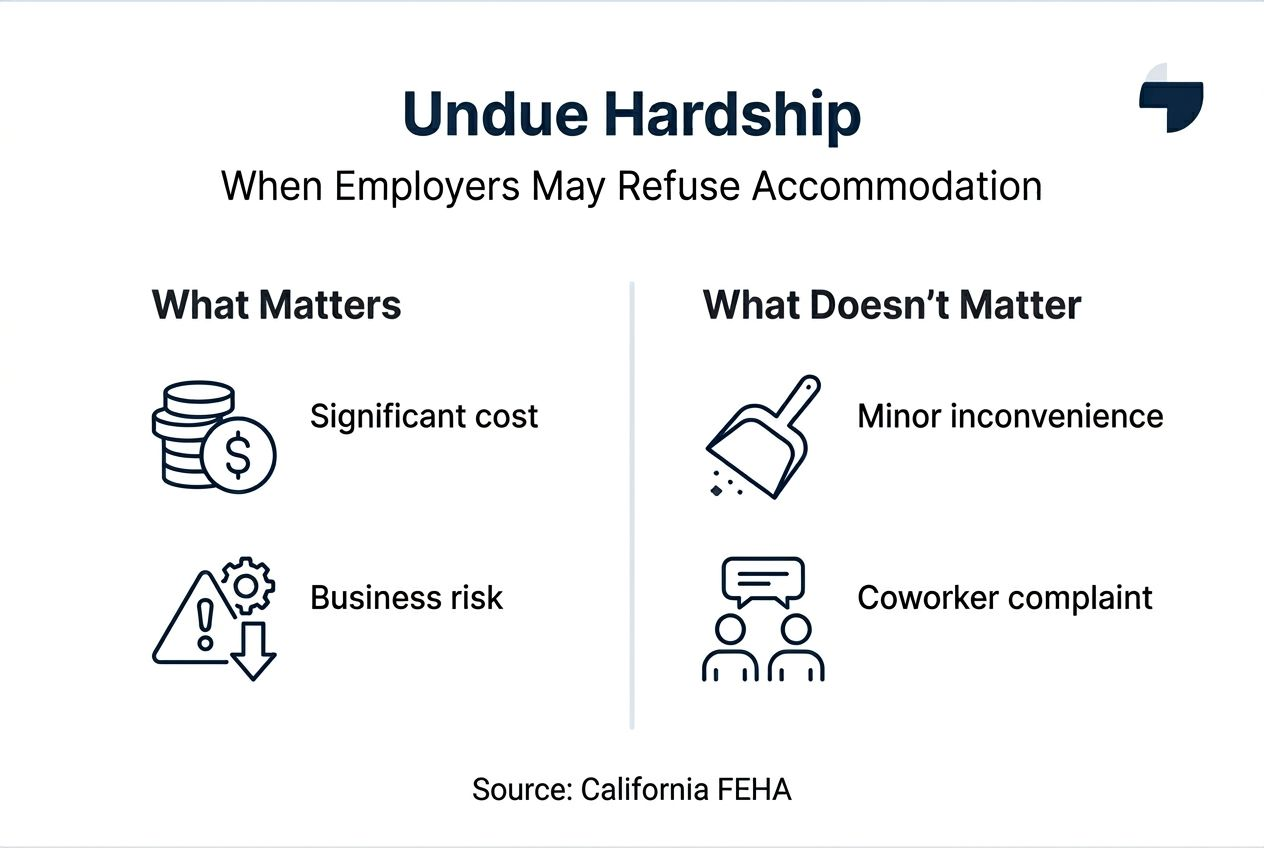
FEHA requires substantial burden, not just minimal cost or inconvenience, distinguishing California law from federal Title VII standards. Historically, federal law under the ‘de minimis’ test permitted denials based on more than minimal cost. However, the U.S. Supreme Court in Groff v. DeJoy (2023) 600 U.S. 447 revised this standard, holding that undue hardship requires showing that the burden of accommodation would result in ‘substantial increased costs in relation to the conduct of its particular business.’ While this brings federal law closer to California’s standard, FEHA’s ‘significant difficulty or expense’ test remains the applicable standard for California employers. This stricter protection benefits California employees seeking accommodations.
Employers must consider multiple factors when evaluating hardship claims:
| Factor | Employer Must Prove |
|---|---|
| Financial impact | Accommodation creates significant expense relative to budget and resources |
| Operational disruption | Business functions suffer substantial impairment, not mere inconvenience |
| Employer size and resources | Small employers face different thresholds than large corporations |
| Nature of workplace | Accommodation impossibly conflicts with essential business operations |
| Safety requirements | Genuine safety risks that cannot be mitigated through alternatives |
| Coworker impacts | Only coworker impacts that affect the conduct of the business constitute undue hardship; mere complaints do not |
Mere inconvenience to supervisors, minor schedule adjustments, or customer preferences never constitute undue hardship. Employers cannot claim hardship because accommodating you requires effort or upsets workplace norms. The burden of proving undue hardship rests entirely on employers, not employees.
Misusing inconvenience as hardship represents a common employer mistake. Coworker complaints about fairness, customer preferences for employees without religious dress, or supervisor frustration with schedule changes fail to meet California’s strict standard. Legal challenges succeed when employers cannot demonstrate substantial burden.
Understanding this high legal bar empowers you to evaluate whether employer denials comply with California law. Most accommodation requests impose minimal actual hardship when employers engage creatively in problem solving.
Protections against retaliation when requesting religious accommodations
California law shields you from retaliation when exercising your right to request religious accommodations. Retaliation includes any adverse employment action taken because you requested accommodations, complained about discrimination, or participated in investigations.
Under Gov. Code § 12940(m)(2), California law specifically prohibits discrimination against a person for requesting an accommodation of a religious practice, regardless of whether the request was granted.
Adverse actions encompass termination, demotion, discipline, reduced hours, undesirable assignments, harassment, or creating hostile work conditions. Protection applies whether your accommodation request was granted, denied, or pending. Simply asking for religious accommodations cannot legally trigger negative consequences.
Common retaliation scenarios include:
- Firing or disciplining employees shortly after accommodation requests
- Giving negative performance reviews following religious accommodation complaints
- Excluding employees from opportunities after they assert religious rights
- Creating impossible work conditions to force resignations
You can report suspected retaliation to human resources, the California Civil Rights Department, or through legal counsel without fearing job loss. Retaliation claims often succeed even when underlying accommodation disputes remain unresolved. Courts recognize that punishing employees for asserting rights violates public policy.
Documentation strengthens retaliation claims significantly. Record dates of accommodation requests, employer responses, and any subsequent adverse actions. Note changes in supervisor treatment, work assignments, or performance evaluations following your requests. This evidence establishes causal connections between protected activity and employer retaliation.
Pro Tip: If you experience retaliation after requesting accommodations, document everything immediately and consult an employment attorney. Quick action preserves evidence and protects your legal rights.
Common misconceptions about religious accommodations in California
Misunderstandings about religious accommodation rights prevent many employees from asserting legitimate claims. Correcting these misconceptions empowers you to exercise your legal protections confidently.
Employers cannot deny accommodations merely because they create inconvenience or modest costs. Many supervisors wrongly believe minor schedule adjustments or uniform exceptions justify denials. California law requires proof of significant hardship, making most convenience based denials illegal.
Religious protections extend far beyond major world religions. Employees practicing nontraditional faiths, ethical belief systems, or newer religious movements receive equal protection. Your beliefs need not align with mainstream religions to qualify for accommodations. Sincerity matters more than whether others share your convictions.
California courts apply a three-part test to determine whether a belief system qualifies as a protected ‘religious creed’: (1) it addresses fundamental and ultimate questions about life’s meaning and purpose; (2) it is comprehensive in nature, consisting of a belief system rather than an isolated teaching; and (3) it can be recognized by certain formal and external signs. Friedman v. Southern California Permanente Medical Group (2002) 102 Cal.App.4th 39, 69-70. Under this test, veganism was found not to be a religious creed because it was limited to valuing animal life, but many diverse belief systems do qualify for protection.
Common false beliefs include:
- Employers can deny accommodations that cost any money or create minor inconvenience
- Only traditional religious practices like Christianity, Judaism, or Islam receive protection
- Accommodations apply only to practices performed during work hours
- Requesting accommodations risks job security or career advancement
Off duty religious practices receive accommodation when they impact work. If your faith requires Friday evening observance conflicting with on call duties, Saturday Sabbath observance affecting weekend shifts, or religious dietary restrictions during company events, employers must accommodate these needs despite occurring partially outside work hours.
You should never fear exercising your legal rights. California law explicitly prohibits discrimination and retaliation against employees requesting religious accommodations. Employers violating these protections face significant legal consequences including damages, penalties, and attorney fees.
Practical steps for employees to request and enforce religious accommodations
Taking strategic action ensures your accommodation requests receive proper consideration and creates documentation supporting potential legal claims. Follow these steps to protect your rights effectively.
Identify the specific conflict between your sincerely held religious beliefs and workplace requirements. Articulate clearly which policies, duties, or conditions create religious conflicts.
Research potential accommodations addressing your needs while minimizing operational impact. Propose concrete solutions demonstrating feasibility.
Submit a written accommodation request to your supervisor or human resources detailing your religious beliefs, the workplace conflict, and proposed accommodations. Keep copies of all submissions.
Engage in good faith interactive discussions when your employer responds. Answer questions honestly, provide necessary information, and consider alternative solutions.
Document every communication including dates, participants, topics discussed, and outcomes. Save emails, letters, and written responses.
Follow up promptly if your employer delays responding or fails to engage in meaningful dialogue. Written follow ups create accountability.
Seek legal consultation if your employer denies your request without proving undue hardship, retaliates against you, or refuses to participate in the interactive process.
Pro Tip: Frame accommodation requests positively, emphasizing your commitment to job performance while honoring religious obligations. Collaborative tone improves employer receptiveness while protecting your legal position.
Time matters when addressing accommodation issues. Prompt requests allow employers to plan coverage and explore options. Delayed requests complicate implementation and may weaken your position if disputes arise. Act quickly when you identify religious conflicts with workplace requirements.
Legal counsel provides invaluable guidance when employers resist reasonable accommodations or retaliate against you. Employment attorneys evaluate whether denials comply with California law, negotiate with employers, and pursue legal remedies when necessary. Early legal consultation often resolves disputes without litigation.
How California United Law Group, P.C. supports Glendale employees
Navigating religious accommodation disputes requires understanding complex legal standards and your rights under California law. California United Law Group helps Glendale employees enforce their religious accommodation rights when employers fail to meet legal obligations. Our employment law team represents employees facing accommodation denials, retaliation, discrimination, and FEHA violations.
We provide guidance through every stage of accommodation disputes, from initial requests through litigation if necessary. Each case is unique, and outcomes depend on the specific facts and circumstances. Our Glendale employment lawyers evaluate your situation, communicate with employers, and pursue legal remedies protecting your rights. Whether you need advice on requesting accommodations or representation in retaliation claims, we provide experienced advocacy supporting your religious freedom at work.
Understanding the employment lawsuit process helps you make informed decisions about protecting your rights. Contact California United Law Group for a consultation discussing your religious accommodation concerns and legal options.
Disclaimer: This article provides general information about California employment law and should not be construed as legal advice for any specific situation. The outcome of any legal matter depends on its unique facts and circumstances. If you are facing a religious accommodation issue, consult with a qualified employment attorney to discuss your specific situation.
Frequently asked questions
Must Glendale employers provide religious accommodations?
Yes, Glendale employers with five or more employees must provide reasonable religious accommodations under California’s Fair Employment and Housing Act. Employers can only deny accommodations by proving they create significant difficulty or expense, a high legal standard protecting employee rights.
What counts as a reasonable religious accommodation?
Reasonable accommodations include schedule modifications for religious observances, dress and grooming exceptions, prayer breaks, religious leave, and workspace adjustments. Any modification eliminating conflict between job duties and sincerely held religious beliefs qualifies if it does not create undue hardship.
Can my employer deny accommodations due to customer preferences?
No, customer preferences never justify denying religious accommodations. California law prohibits employers from rejecting accommodations because customers prefer employees without religious dress or because accommodations might affect customer perceptions. Business image concerns do not constitute undue hardship.
What should I do if my employer retaliates after I request accommodations?
Document the retaliation immediately, including dates, actions, and witnesses. Report the retaliation to human resources in writing. Consult an employment attorney promptly to evaluate your legal options and protect your rights under California’s anti retaliation laws.
How long do employers have to respond to accommodation requests?
California law does not specify exact statutory timeframes, but employers must respond promptly and engage in timely good faith dialogue as part of the interactive process requirement. What constitutes ‘prompt’ depends on the circumstances of each case.