
Standing up to unfair treatment at work because of your sexual orientation can be challenging. California provides robust legal protections under the Fair Employment and Housing Act (FEHA), which prohibits discrimination and harassment based on sexual orientation. For many employees in West Hollywood, even the clear safeguards under the Fair Employment and Housing Act (FEHA) have not eliminated bias or harassment on the job. This guide breaks down how the law defines sexual orientation discrimination, what actions are illegal, and how you can protect your rights and seek justice.
Table of Contents
- Sexual Orientation Discrimination Defined in California
- Types of Workplace Discrimination and Harassment
- Legal Protections Under FEHA for Employees
- Qualifications for Filing a Discrimination Claim
- Employer Risks and Employee Remedies
Key Takeaways
| Point | Details |
|---|---|
| Sexual Orientation Discrimination is Prohibited | California law explicitly prohibits discrimination based on sexual orientation, including perceived orientation, across all employment decisions. |
| Understanding Discrimination and Harassment | Discrimination affects job status, while harassment creates a hostile work environment; both are illegal and can be claimed simultaneously. |
| Legal Framework and Protections | Under the Fair Employment and Housing Act (FEHA), employees have multiple legal protections against discrimination in California. |
| Employer Accountability | Employers face strict liability for harassment by supervisors. For discrimination claims and coworker harassment, different liability standards apply depending on the circumstances. |
Sexual Orientation Discrimination Defined in California
Sexual orientation discrimination occurs when an employer treats you unfavorably based on your sexual orientation—whether you’re gay, lesbian, bisexual, or perceived to be any of these. In California, this conduct is explicitly prohibited across all aspects of employment. The law doesn’t distinguish between actual orientation and perceived orientation; discrimination based on what someone assumes about you is equally illegal.
California recognizes sexual orientation as a protected characteristic under the Fair Employment and Housing Act (FEHA). This means employers cannot legally make employment decisions—hiring, firing, pay, promotions, scheduling, or anything else—based on your sexual orientation. West Hollywood, with its significant LGBTQ+ population, still sees discrimination cases despite strong legal protections.
What Qualifies as Discrimination
Discrimination takes many forms beyond outright termination. It includes:
- Hostile work environment based on sexual orientation-related comments or conduct
- Exclusion from opportunities, meetings, or social events
- Unequal pay or benefits compared to heterosexual coworkers
- Denial of promotions or transfers based on orientation
- Differential treatment in discipline or performance reviews
- Harassment by supervisors or coworkers about your personal life
California law focuses on whether sexual orientation was a motivating factor in an adverse employment decision, regardless of the employer’s stated justification.
California’s Legal Framework
California law goes further than many states. The Fourteenth Amendment’s Equal Protection Clause provides federal constitutional protection, while state law adds additional safeguards through FEHA. This dual protection means you have multiple legal avenues to address discrimination.
Under California Government Code Section 12965, you’re protected from discrimination in hiring, firing, advancement, compensation, job training, and other terms and conditions of employment. The statute is intentionally broad to catch discrimination in any employment decision.
The Legal Standard
You don’t need to prove your employer acted with malice or hatred. The law prohibits discrimination regardless of intent. If your sexual orientation was a motivating factor in an adverse employment decision, that’s discrimination. Even if other factors also influenced the decision, your orientation cannot be one of them.
Discrimination includes both obvious adverse actions and subtle patterns of unequal treatment. Your sexual orientation cannot be any part of any employment decision.
Pro tip: Document instances of differential treatment immediately, including dates, what happened, who witnessed it, and any comments about sexual orientation. Written records can be important evidence if you decide to file a claim, though documentation alone does not guarantee a particular outcome.
Types of Workplace Discrimination and Harassment
Discrimination and harassment are related but distinct violations. Discrimination means treating you unfavorably in employment decisions based on sexual orientation. Harassment means creating an offensive or hostile environment through unwelcome conduct. Both are illegal in California, and both can be used to build a claim against your employer.
The key difference: discrimination affects your job status (hiring, firing, pay, promotion), while harassment affects your working conditions. You can experience both simultaneously—for example, being denied a promotion because of your orientation (discrimination) while also enduring offensive comments daily (harassment).
Here is a summary comparing sexual orientation discrimination and harassment in California workplaces:
| Aspect | Discrimination | Harassment |
|---|---|---|
| Core Impact | Affects employment decisions | Creates hostile or offensive environment |
| Examples | Firing, demotion, pay decrease | Slurs, exclusion, offensive jokes |
| Legal Standard | Law forbids motivation by orientation | Conduct must be severe or pervasive |
| Employer Liability | Direct liability for discriminatory decisions | Supervisors: strict liability; Coworkers: liable if knew or should have known and failed to act |
Harassment Based on Sexual Orientation
Harassment occurs when unwelcome conduct based on protected characteristics becomes severe or pervasive enough to create a hostile work environment. This isn’t about one-off rude comments. It’s a pattern or intensity of conduct that a reasonable person would find hostile, offensive, or abusive.
Courts evaluate the totality of circumstances, considering factors such as frequency, severity, whether conduct is threatening or humiliating, and whether it unreasonably interferes with work performance. California courts apply federal standards regarding the severe or pervasive threshold.
In Lyle v. Warner Brothers Television Productions (2006) 38 Cal.4th 264, the California Supreme Court held that harassment must be severe or pervasive enough to alter the conditions of employment and create an abusive work environment. The court emphasized that ‘workplaces are not always harmonious locales, and even in the absence of discrimination, a difficult and demanding supervisor may make an employee’s life miserable.’
Common forms include:
- Slurs, jokes, or derogatory comments about sexual orientation
- Questions about your personal life or romantic relationships
- Exclusion from social or professional gatherings
- Touching or physical conduct of a sexual nature
- Displaying offensive posters, images, or messages
- Mimicking stereotypical behavior or mannerisms
- Isolating you from team activities or information
The conduct doesn’t need to be sexual to be harassment. Anti-gay remarks, stereotyping, or creating an intimidating environment all qualify.
Discrimination in Employment Decisions
Discrimination happens when your sexual orientation influences hiring, firing, compensation, scheduling, assignments, or any other employment decision. Your employer might use obvious language (“We don’t hire gay people”) or mask the real reason, but the effect is the same: unequal treatment.
Examples of discriminatory decisions include:
- Rejecting your application or not hiring you
- Firing you while keeping heterosexual coworkers with similar performance
- Paying you less than similarly situated coworkers
- Passing you over for promotions or desirable assignments
- Assigning you negative performance reviews without justification
- Reducing your hours or reassigning you to worse positions
California employers must have policies addressing discrimination and harassment. They must provide a complaint process ensuring confidentiality, impartial investigations, and prompt remedial actions.

The Intersection: When Both Occur
Often, discrimination and harassment happen together. You might be harassed constantly, then fired when you complain. This creates both a harassment claim and a retaliation claim. West Hollywood employers should understand that these violations compound legal exposure.
Both discrimination in decisions and harassment in conditions violate California law. Either one alone is actionable; together they strengthen your claim.
Pro tip: Keep records of both types of conduct separately: note discriminatory decisions (dates, job impacts, who decided) and harassment incidents (date, time, what was said, who witnessed it). This clarity helps if you choose to pursue a legal claim and need to present your allegations clearly.
Legal Protections Under FEHA for Employees
The Fair Employment and Housing Act (FEHA) is California’s primary state law protecting employees from discrimination and harassment. It covers sexual orientation explicitly and provides broader protections than federal law in many ways. If you work for an employer with five or more employees in California, FEHA protects you.
FEHA applies to all aspects of employment: hiring, firing, pay, promotions, scheduling, training, and working conditions. Your employer cannot discriminate or allow harassment based on sexual orientation at any stage of your employment relationship.
What FEHA Covers
FEHA protections extend beyond obvious discrimination. Isolated acts of harassment can constitute a hostile work environment if severe enough. This means even a single incident might be actionable depending on its severity and context.
Key protections include:
- Prohibition on discrimination in hiring, firing, and all employment decisions
- Protection from harassment based on sexual orientation
- Right to reasonable accommodations for disabilities (if applicable)
- Protection against retaliation for reporting violations
- Right to a workplace free from hostile conditions
- Access to a complaint process with impartial investigation
Unlike federal law, California’s FEHA does not require you to prove intent. Your employer’s motive doesn’t matter; what matters is the discriminatory effect of their actions.
To help you understand FEHA employee protections, see the table below:
| FEHA Protection | Applies To | Unique Advantage |
|---|---|---|
| Explicit sexual orientation protection | Employees at 5+ staff firms | Broader than federal law |
| Harassment strict liability | Supervisor harassment in employment context | Employer strictly liable unless harassment from completely private relationship |
| No intent required | All covered actions | Employee needs only show impact |
| Written policies required | All covered employers | Promotes prevention and remedies |
Employer Liability and Your Rights
California law imposes strict liability on employers for supervisor harassment. However, to avoid strict liability, the employer can show the harassment resulted from a completely private relationship unconnected with the employment and not occurring at the workplace or during normal working hours. Your employer is responsible for harassment by supervisors regardless of whether they knew it occurred. This is a significant advantage compared to federal law.
For coworker harassment, your employer must act immediately upon learning of the conduct to avoid liability. This means they cannot ignore complaints or delay investigations. They must take corrective action promptly.
Your employer must maintain written anti-discrimination and anti-harassment policies. Employers with five or more employees must provide reasonable accommodations unless doing so creates undue hardship. This covers both disability accommodations and other protected situations.
Your Right to Complain Without Fear
You have the right to report discrimination or harassment to your employer, a government agency, or an attorney without facing retaliation. California law prohibits retaliation against employees who oppose practices they reasonably believe to be discriminatory or who participate in FEHA proceedings. To prevail on a retaliation claim, you must show the employer took adverse action because of your protected activity.
Retaliation claims are separate from discrimination claims and are equally strong legal grounds for action.
FEHA imposes strict accountability on employers and creates direct liability for harassment. Your employer cannot hide behind “not knowing” about supervisor misconduct.
Pro tip: Report discrimination or harassment in writing whenever possible—email your HR department or supervisor with dates, details, and the behavior that occurred. Written complaints create documented evidence and trigger the employer’s legal obligation to investigate.
Qualifications for Filing a Discrimination Claim
Not every unfair workplace situation qualifies as a legal discrimination claim. You must meet specific criteria under California law for your complaint to proceed. Understanding these qualifications helps you determine whether you have a viable claim and what steps to take next.
You must show that adverse employment action occurred based on sexual orientation as a motivating factor. This isn’t always straightforward, especially when employers hide their real reasons. But California law doesn’t require their reason to be the only reason—just one of the reasons they made the decision.
Who Can File a Claim
You can file a discrimination claim if you are or were an employee of the defendant employer. This includes full-time, part-time, and temporary workers. Contractors and independent contractors may have different protections depending on their circumstances.
Your employer must have had at least five employees working in California for FEHA to apply. This is the threshold that triggers California’s anti-discrimination requirements. Sole proprietors with no employees are excluded, but almost all other businesses qualify.
You must have experienced an adverse employment action based on sexual orientation. Examples include:
- Termination or layoff
- Denial of promotion or transfer
- Reduction in pay or hours
- Reassignment to worse position or duties
- Exclusion from opportunities or training
- Harassment creating a hostile work environment
Required Elements of a Claim
To have a viable claim, you must establish that sexual orientation was a motivating factor in the adverse action. You don’t need direct evidence like a recorded statement from your boss saying “I’m firing you because you’re gay.” Circumstantial evidence works—timing, comments, disparate treatment compared to similarly situated coworkers.
You must also show the employer failed to prevent or correct the discrimination. If you reported the conduct and your employer ignored it or retaliated against you, that strengthens your claim significantly.
Filing Procedures and Timelines
Before filing a lawsuit under FEHA, you must first file a complaint with the California Civil Rights Department (CRD). Important: You must file your administrative complaint within three years from the date of the alleged unlawful practice (Gov. Code § 12960). After the CRD issues a right-to-sue notice, you have one year to file a civil lawsuit (Gov. Code § 12965(b)). Missing these deadlines can permanently bar your claim, regardless of its merits.
Deadlines exist for filing complaints. While specific dates vary by circumstances, acting quickly protects your rights. Consult a qualified employment lawyer about deadlines applicable to your situation.
Filing a complaint does not guarantee investigation, but it is the necessary first step to seek remedy through the administrative process.
You don’t need perfect evidence to file a claim—you need facts showing sexual orientation played a role in an adverse employment decision.
Pro tip: Gather documents before filing: performance reviews, emails, pay stubs, text messages, and witness contact information. These materials can support your complaint. Note that the CRD has discretion in how it handles complaints, and not all complaints result in formal investigation.
Employer Risks and Employee Remedies
When employers discriminate based on sexual orientation, they face significant legal and financial consequences. Understanding what employers risk—and what you can recover—shows why these cases matter and why employers take them seriously.
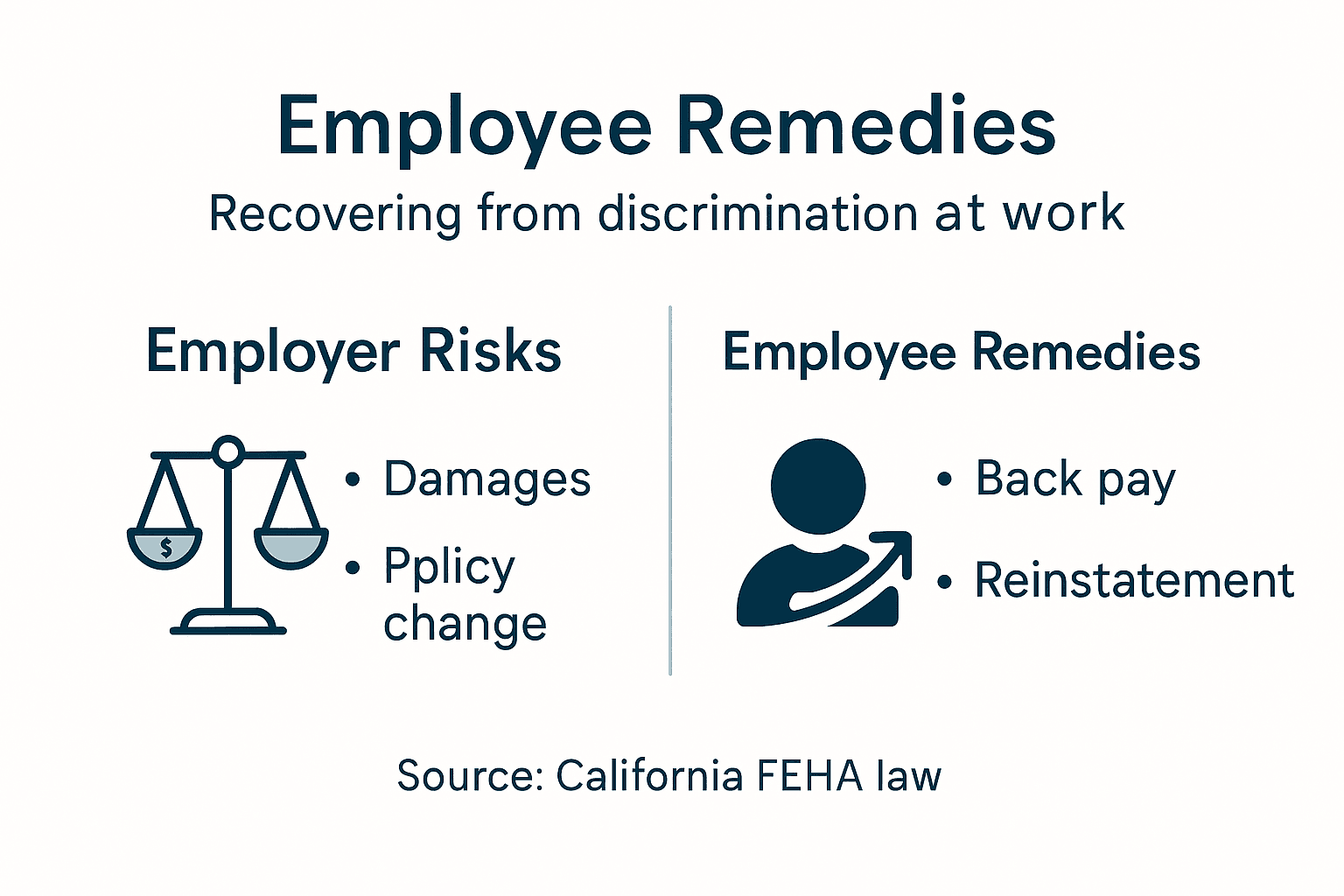
Employers who discriminate face compensatory damages, back pay, reinstatement, and mandatory policy changes. The costs add up quickly. Beyond money, they face reputational damage, loss of talent, and operational disruption. This is why smart employers prevent discrimination rather than defend it.
What Employees Can Recover
If you prevail in a discrimination claim, remedies include:
- Back pay and lost wages from the date of the discriminatory action
- Front pay (future lost earnings) if reinstatement isn’t possible
- Compensatory damages for emotional distress, damage to reputation, and mental health harm
- Reinstatement to your job or a comparable position
- Promotion if you were denied advancement based on orientation
- Attorney fees and costs (California law allows this, making representation accessible)
These remedies aim to make you whole—returning you to where you would have been absent the discrimination. Courts don’t cap emotional distress damages in California employment cases, meaning recovery can be substantial. However, recovering damages requires proof of actual harm. The amount of any recovery depends on the specific facts and evidence in each case, and outcomes vary significantly.
The California Supreme Court in Commodore Home Systems, Inc. v. Superior Court (1982) 32 Cal.3d 211 held that FEHA remedies are intended to make victims whole by restoring them to the position they would have occupied absent the discrimination. However, each case outcome depends on its specific facts, the strength of evidence, and various other factors.
Injunctive Relief and Systemic Change
Beyond individual compensation, California Civil Rights Department investigations may result in corrective measures requiring employers to implement training, revise policies, and prevent future discrimination. This protects not just you but future employees.
Injunctive relief means courts order the employer to stop the conduct and prevent recurrence. Your employer might be required to:
- Revise anti-discrimination policies
- Conduct mandatory training for all employees
- Monitor hiring and promotion decisions
- Provide regular compliance reporting
- Establish clear reporting and investigation procedures
Employer Liability and Why It Matters
Employers cannot hide behind ignorance. Legal liability includes compensatory damages and required policy changes when discrimination occurs. California law holds employers strictly liable for supervisor harassment regardless of knowledge.
This strict standard means employers cannot claim “we didn’t know.” They must actively prevent discrimination through policies, training, and investigation. West Hollywood employers face particularly scrutiny because the city has strong civil rights enforcement and a large LGBTQ+ population acutely aware of their rights.
Pro tip: Document all harms caused by discrimination: lost income, medical treatment for stress, job search expenses, and emotional impacts. These details strengthen damage claims and show the full scope of harm you experienced.
Understanding Your Options
California law provides significant protections against sexual orientation discrimination and harassment in the workplace. If you believe you have experienced unlawful treatment, consider consulting with an employment attorney to understand your rights and evaluate your specific situation. An attorney can help you assess the strength of your potential claims, explain applicable deadlines, and discuss your options.
Many employment attorneys offer initial consultations to discuss your circumstances. When selecting an attorney, consider their experience with FEHA cases, their approach to client communication, and whether they have handled cases similar to yours.
Frequently Asked Questions
What constitutes sexual orientation discrimination in the workplace?
Sexual orientation discrimination occurs when an employer treats an employee unfairly based on their sexual orientation, which includes being gay, lesbian, bisexual, or being perceived as such.
What legal protections do employees have against sexual orientation discrimination?
Employees are protected from sexual orientation discrimination under the Fair Employment and Housing Act (FEHA), which prohibits discrimination in hiring, firing, compensation, promotions, and other employment decisions.
How can I document instances of sexual orientation discrimination?
To document discrimination, keep a record of specific incidents including dates, details of what happened, who witnessed it, and any comments related to your sexual orientation. This documentation can be essential if you decide to file a claim.
What should I do if I experience discrimination or harassment at work?
If you experience discrimination or harassment, you have several options: reporting it to your employer or HR department (preferably in writing), filing a complaint with the California Civil Rights Department, or consulting with an employment attorney. Be mindful of filing deadlines, particularly the three-year deadline for filing administrative complaints with the CRD.
Selected Legal References
This article discusses rights and protections under California’s Fair Employment and Housing Act (FEHA), Government Code § 12900 et seq. Key cases interpreting California’s protections against sexual orientation discrimination and harassment include:
• Lyle v. Warner Brothers Television Productions (2006) 38 Cal.4th 264 – Established that harassment must be severe or pervasive to alter employment conditions
• State Department of Health Services v. Superior Court (2003) 31 Cal.4th 1026 – Clarified employer strict liability for supervisor harassment under FEHA
• Commodore Home Systems, Inc. v. Superior Court (1982) 32 Cal.3d 211 – Explained that FEHA remedies aim to make victims whole
• Bostock v. Clayton County (2020) 590 U.S. ___, 140 S.Ct. 1731 – U.S. Supreme Court held that Title VII’s prohibition on sex discrimination encompasses sexual orientation discrimination
Note: Laws and their interpretations change over time. This article provides general information and should not be considered legal advice. For guidance on your specific situation, consult with a qualified employment attorney.
Recommended
- Employment Lawyer West Hollywood – Los Angeles Employment Lawyers | California United Law Group, P.C.
- What Counts as Workplace Harassment in California? – Los Angeles Employment Lawyers | California United Law Group, P.C.
- Employment Law – Los Angeles Employment Lawyers | California United Law Group, P.C.
- Retaliation in the Workplace: Your Rights and Legal Options in California – Los Angeles Employment Lawyers | California United Law Group, P.C.
- LGBTQ+ Employment Discrimination in West Hollywood – Law Office of Brian Y. Shirazi, PC
Disclaimer: This article is provided for informational purposes only and does not constitute legal advice. It should not be relied upon as a substitute for consultation with a qualified employment attorney. The information may not reflect the most current legal developments, and laws vary by circumstance. California United Law Group, P.C. makes no representations or warranties regarding the accuracy or completeness of this information. No attorney-client relationship is created by reading this article.