
Many Los Angeles employees fear retaliation when reporting wage violations. California Labor Code 98.6 protecting workers who assert their rights to file wage complaints or participate in labor law proceedings. At-will employment creates confusion about whether workers can challenge wage theft without losing their jobs. This guide clarifies how California law protects employees from retaliation and wage violations, even under at-will status, and provides actionable steps to defend your rights.
Table of Contents
- Understanding At-Will Employment In California
- Common Wage Violations Encountered Under At-Will Employment
- California Labor Laws Protecting Employees Despite At-Will Status
- How At-Will Employment Can Be Used To Mask Wage Violations
- Debunking Common Misconceptions About At-Will Employment And Wage Rights
- Real-World Cases Of Wage Violations Hidden By At-Will Employment Tactics In Los Angeles
- Practical Steps For Employees To Protect Their Rights Under At-Will Employment
- Protect Your Rights With Experienced California Employment Lawyers
Key takeaways
| Point | Details |
|---|---|
| At-will employment allows firing without cause but never waives wage protections under California law. | |
| Common violations include unpaid overtime, minimum wage theft, and illegal deductions targeting at-will workers. | |
| Labor Code Section 98.6 prohibits retaliation against employees who report wage violations or assert labor rights. | |
| Employers misuse at-will status to intimidate workers and suppress wage complaints through threats and terminations. | |
| Employees can protect themselves by documenting violations, recognizing retaliation, and consulting employment lawyers early. |
Understanding at-will employment in California
At-will employment means either the employer or employee can end the working relationship anytime, with or without cause or advance notice. California operates predominantly under this framework, giving employers flexibility in workforce management. However, this status creates vulnerability for workers who may believe they have no recourse against unfair treatment.
Despite at-will status, employees retain critical legal rights to fair wages, safe working conditions, and protection from discrimination. The at-will doctrine does not eliminate statutory protections established by California labor laws. Workers can challenge violations without fearing lawful termination solely for asserting their rights.
Common myths suggest at-will employment strips away all protections. This is false. California law carves out explicit exceptions where termination becomes illegal, including retaliation for wage complaints. Understanding these boundaries empowers workers to recognize when employers cross legal lines. Consulting an employment lawyer in Los Angeles County helps clarify your specific situation and rights.
California courts have recognized narrow exceptions to at-will employment where termination violates fundamental public policy. In Tameny v. Atlantic Richfield Co. (1980) 27 Cal.3d 167, the California Supreme Court established that employees may bring tort claims when discharged for reasons that violate public policy, such as refusing to commit perjury. This principle extends to retaliation for asserting wage rights.
Key characteristics of at-will employment include:
- Either party terminates the relationship without notice requirements
- No obligation to provide reasons for termination in most cases
- Flexibility benefits employers in managing workforce needs
- Does not override federal or state labor protections
- Cannot be used to mask illegal discrimination or retaliation
Common wage violations encountered under at-will employment
Wage theft takes many forms in Los Angeles workplaces, particularly affecting at-will employees who fear job loss if they complain. Unpaid overtime remains one of the most frequent violations, where employers fail to compensate time worked beyond eight hours daily or 40 hours weekly at one and one-half times the employee’s regular rate of pay, as required by California Labor Code Section 510. Minimum wage violations occur when workers receive less than California’s mandated hourly rate, often through incorrect calculations or illegal tip pooling.
Illegal paycheck deductions represent another widespread problem. Employers sometimes subtract costs for uniforms, cash register shortages, or business expenses that California law prohibits deducting from wages. These practices disproportionately harm hourly workers in hospitality, retail, and service sectors across Los Angeles County.
The at-will employment structure amplifies these issues because workers hesitate to report violations. Fear of immediate termination creates a chilling effect where employees tolerate wage theft rather than risk unemployment. Employers exploit this dynamic, knowing many workers lack knowledge about wage and hour protections that remain enforceable regardless of employment status.

Documentation gaps further complicate matters. Without detailed records of hours worked and wages received, employees struggle to prove violations occurred. Many workers lack copies of pay stubs or timekeeping records, weakening their ability to challenge systematic wage theft. Keeping personal records becomes essential for building strong claims.
Common wage violation patterns include:
- Unpaid or miscalculated overtime compensation
- Paying below California minimum wage standards
- Forcing employees to work off the clock
- Illegal deductions for business costs or shortages
- Misclassifying employees as independent contractors
- Denying required meal and rest breaks
California labor laws protecting employees despite at-will status
California Labor Code Section 98.6 prohibits retaliation against employees who assert rights related to wages or labor standards, providing a key protection despite at-will employment. This statute makes it illegal for employers to discharge, threaten to discharge, demote, suspend, or in any manner discriminate or retaliate against workers for filing wage complaints, making oral or written complaints that wages are owed, or participating in labor law investigations. The protection extends to both formal complaints filed with government agencies and informal internal grievances.
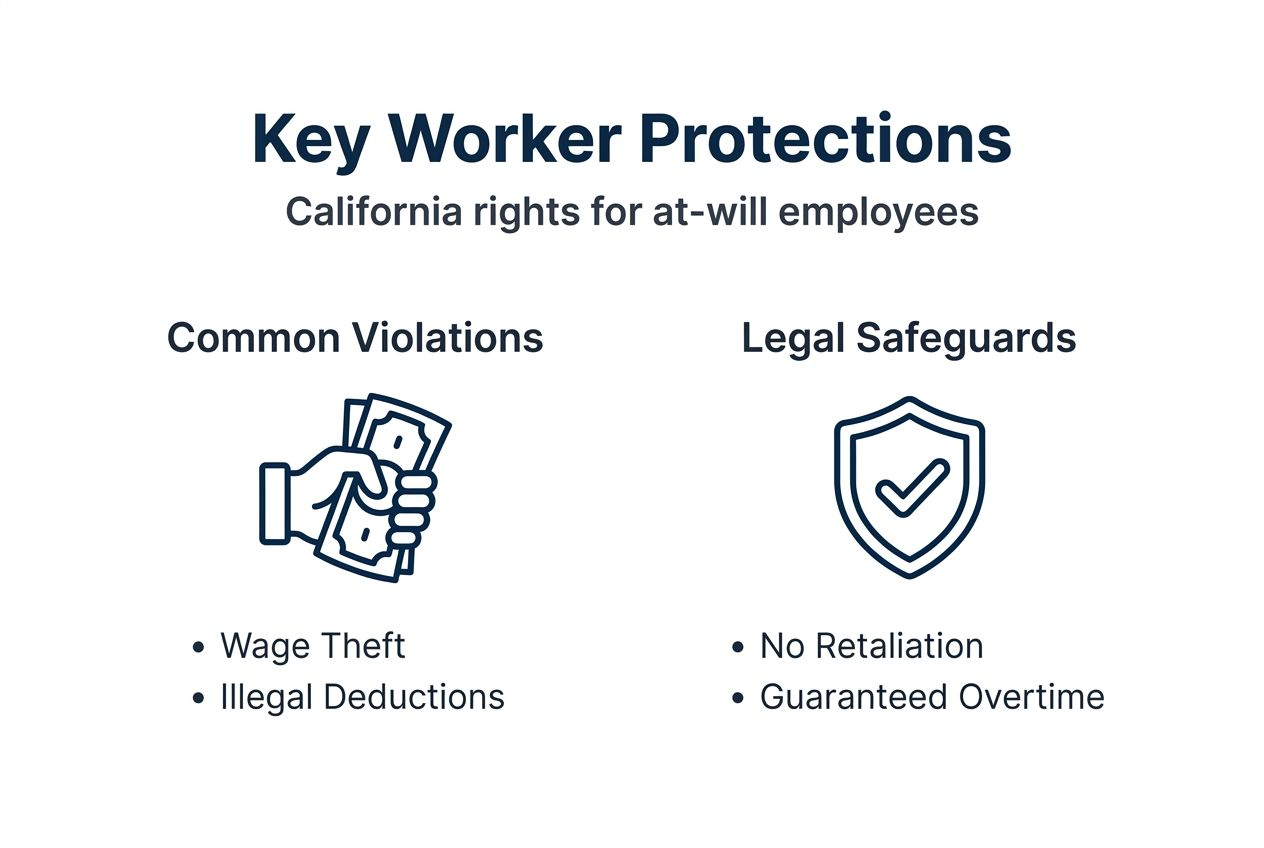
California minimum wage and overtime laws create non-waivable rights that persist regardless of employment classification. Courts consistently uphold wage claims even after at-will termination, recognizing that allowing retaliation would nullify statutory protections. An employee terminated for reporting unpaid wages can pursue both the wage claim and a separate retaliation claim against the employer.
Retaliation takes various forms beyond termination. It includes demotion to less desirable positions, reduction in hours or pay, negative performance reviews following complaints, harassment creating hostile work environments, and exclusion from training or advancement opportunities. California courts recognize these subtle forms as violations when they occur after employees assert wage rights.
Workers can file complaints with the California Labor Commissioner’s Office without attorney representation. The agency investigates claims and can order employers to pay back wages, penalties, and interest. Successful retaliation claims may result in reinstatement, back pay for lost wages, and additional damages. Understanding these retaliation protections in 2026 strengthens employee confidence to report violations.
California law creates a rebuttable presumption of retaliation when an employer takes adverse action against an employee within 90 days of the employee engaging in protected activity, such as filing a wage complaint. This presumption shifts the burden to the employer to prove the action was taken for legitimate, non-retaliatory reasons.
| Protection Type | Legal Basis | Remedies Available |
|---|---|---|
| Wage Payment Rights | CA Labor Code Sections 200-244 | Back wages, penalties, interest |
| Overtime Protections | CA Labor Code Section 510 | Unpaid overtime, liquidated damages |
| Anti-Retaliation | CA Labor Code Section 98.6 | Reinstatement, lost wages, damages |
| Minimum Wage | CA Labor Code Section 1197 | Wage differential, penalties |
Pro Tip: Document the exact date and time you report a wage violation to your employer. If negative employment actions occur within days or weeks afterward, this timeline strengthens retaliation claims by establishing a causal connection.
How at-will employment can be used to mask wage violations
Employers sometimes exploit at-will employment to intimidate workers and suppress wage complaints through vague or pretextual termination reasons. An employee who raises concerns about unpaid overtime may suddenly face termination for “performance issues” or “not being a good fit” despite years of positive reviews. These nebulous justifications make it harder to prove retaliation, though patterns of timing often reveal the true motive.
Intimidation tactics extend beyond outright termination. Managers may threaten reduced hours, schedule changes to undesirable shifts, or removal from preferred assignments when employees question wage practices. These actions create a chilling effect throughout the workplace, deterring other employees from reporting similar violations. The implicit message becomes clear: challenge wage practices and face consequences.
The fear factor proves especially powerful for vulnerable workers who lack emergency savings or alternative job prospects. Employees supporting families or holding work visas face heightened pressure to remain silent about wage theft. Employers who understand this dynamic weaponize at-will status as leverage to maintain illegal practices without internal challenge.
Many workers incorrectly believe at-will employment eliminates their ability to challenge unfair treatment. This knowledge gap allows violations to persist unchecked. Without understanding that employee rights after reporting misconduct remain protected by law, workers accept wage theft as unavoidable rather than actionable.
Recognizing these manipulation tactics empowers employees to resist them:
- Sudden negative performance reviews after wage complaints
- Vague termination reasons following labor law inquiries
- Threats about job security when questioning pay practices
- Isolation from colleagues after raising wage concerns
- Increased scrutiny or micromanagement post-complaint
“The at-will employment doctrine does not permit employers to terminate employees for reasons that violate public policy, including retaliation for asserting wage rights protected by the California Labor Code.”
Debunking common misconceptions about at-will employment and wage rights
Misconception 1: At-will employment means you have no wage rights. This belief is completely false. California Labor Code establishes minimum wage, overtime, meal break, and payment timing requirements that apply to all employees regardless of at-will status. These statutory protections cannot be waived through employment agreements or policies. Your right to fair compensation exists independently of your employer’s right to terminate the relationship.
Misconception 2: Employers can retaliate without consequences if you complain about wages. Labor Code Section 98.6 specifically prohibits retaliation against employees who file wage complaints or participate in labor law proceedings. Employers who violate this protection face significant penalties, including paying back wages, reinstatement, and damages. Courts take retaliation claims seriously and often rule in favor of employees who can demonstrate timing and causation.
Misconception 3: You cannot pursue wage claims after being terminated. Termination does not eliminate your right to unpaid wages earned during employment. California law allows workers to file wage claims for up to three years after violations occurred, regardless of current employment status. Many successful wage recovery cases involve former employees who discovered violations after leaving. Understanding employment contracts in California clarifies how termination affects various legal rights.
Misconception 4: Only full-time employees have wage protections. Part-time, temporary, and seasonal workers enjoy identical wage rights under California law. Your hours or schedule do not determine whether minimum wage and overtime protections apply. Even employees working just a few hours weekly must receive proper compensation according to state standards.
In Dynamex Operations West, Inc. v. Superior Court (2018) 4 Cal.5th 903, the California Supreme Court established the ‘ABC test’ for determining whether workers are employees or independent contractors under California wage orders and the Labor Code. Under this test, a worker is presumed to be an employee unless the hiring entity proves: (A) the worker is free from control and direction; (B) the worker performs work outside the usual course of the hiring entity’s business; and (C) the worker is customarily engaged in an independently established trade or business of the same nature as the work performed. This test was subsequently codified in Labor Code Section 2775.
Educating yourself about these realities transforms your ability to recognize violations and take action. Employers rely on worker ignorance to perpetuate wage theft and intimidation. Accurate legal knowledge serves as your first line of defense against exploitation. When you understand your rights, you can assertively challenge violations without fear of unlawful consequences.
- Research California wage laws applicable to your industry and position.
- Verify your pay stubs match hours worked and required rates.
- Understand that termination for asserting rights constitutes illegal retaliation.
- Know that wage claims remain valid regardless of current employment status.
- Recognize that seeking legal advice about potential violations is protected activity.
Common Patterns of Wage Violations in Los Angeles
Los Angeles employers across various industries have faced wage and hour lawsuits involving systematic violations affecting groups of workers. Common patterns include:
Hospitality and Restaurant Industry: Cases frequently involve unpaid overtime claims, illegal tip credit schemes where employers wrongly claim tips offset minimum wage obligations (a practice California law prohibits), and mandatory tip pooling arrangements that unlawfully include managers or supervisors. California law makes tips the sole property of employees, and while employer-mandated tip pooling among non-managerial employees is generally permitted, managers and supervisors cannot participate in tip pools.
Retail Sector: Employers have faced claims for requiring off-the-clock work during store opening and closing procedures, mandatory bag checks, and security screenings. All time an employee is under the employer’s control and performing work-related duties must be compensated, even if the tasks occur before or after a scheduled shift.
Misclassification Schemes: Some employers misclassify workers as independent contractors to avoid wage and hour obligations, including overtime pay, minimum wage protections, and meal and rest break requirements. Following the California Supreme Court’s decision in Dynamex Operations West, Inc. v. Superior Court (2018) 4 Cal.5th 903, California applies the presumptive ABC test, which makes it significantly more difficult for businesses to classify workers as independent contractors rather than employees.
Workers who challenge these violations and face retaliation may pursue both wage claims to recover unpaid compensation and separate retaliation claims seeking reinstatement, lost wages, and damages. When violations affect multiple employees, workers may bring representative or class actions under the Private Attorneys General Act (PAGA) or class action procedures.
Practical steps for employees to protect their rights under at-will employment
Step 1: Understand your at-will status and wage rights under California law. Review your employment documents and educate yourself about minimum wage, overtime, meal break, and payment timing requirements. Knowing these protections helps you identify violations when they occur and builds confidence to challenge them.
Step 2: Keep detailed personal records of hours worked and wages received. Maintain a notebook, spreadsheet, or phone app tracking daily start times, end times, breaks, and tasks performed. Save all pay stubs, direct deposit confirmations, and wage-related communications from your employer. These records become critical evidence if you need to file a wage claim.
Step 3: Watch for retaliation signs after asserting wage rights or asking questions about pay practices. Sudden schedule changes, negative performance reviews, reduced hours, or increased scrutiny following wage inquiries may indicate retaliation. Document these changes with dates, times, and any witnesses who observed the treatment shift.
Step 4: Consult an experienced employment lawyer early when you suspect violations or face retaliation. Early legal advice helps you understand your options, preserve evidence, and avoid mistakes that could weaken potential claims. Many employment attorneys offer free consultations to evaluate your situation. Learning about the employment lawsuit process in California prepares you for potential next steps.
Step 5: Consider filing formal complaints with the California Labor Commissioner’s Office or pursuing legal action if violations persist. Government agencies investigate wage claims and can order employers to pay back wages and penalties. Private lawsuits may recover additional damages, especially in retaliation cases. Taking action not only protects your rights but may help other employees facing similar treatment.
Step 6: Know that multiple legal pathways exist depending on your situation. Administrative complaints through the Labor Commissioner’s Office provide a no-cost option for recovering unpaid wages. Private lawsuits offer potential for higher damages and attorney fee recovery. Class or representative actions address systematic violations affecting multiple workers.
Be aware that time limits apply to wage claims. Under California law, wage and hour claims are generally subject to a three-year statute of limitations under Code of Civil Procedure Section 338 for statutory violations, though some claims may have different limitation periods. Retaliation claims under Labor Code Section 98.6 must be filed within specified timeframes. Consulting an attorney promptly helps preserve your legal rights.
Pro Tip: Create a dedicated email folder or phone photo album for work-related documents. Immediately save any communications about wages, schedule changes, or performance feedback. This organized evidence collection takes minimal time but provides powerful support if you need to prove violations or retaliation later.
- Learn specific wage protections applicable to your job and industry.
- Document every shift with start/end times and break durations.
- Notice and record any negative changes after raising wage concerns.
- Seek legal consultation before the situation escalates further.
- File formal complaints through appropriate government or legal channels.
- Act promptly since time limits apply to wage and retaliation claims.
Protect your rights with experienced California employment lawyers
Navigating wage violations and retaliation under at-will employment requires experienced legal guidance to protect your rights and recover what you are owed. California United Law Group, P.C. represents employees throughout Los Angeles and California in employment law matters, including wage and hour violations and retaliation claims. Our attorneys understand how employers misuse at-will status to suppress complaints and know how to build strong cases proving illegal conduct.
We handle wage theft claims involving unpaid overtime, minimum wage violations, illegal deductions, and missed meal breaks. Our team also pursues retaliation cases where employees face termination or adverse actions after asserting their rights. Early consultation allows us to advise on evidence preservation, complaint filing strategies, and potential recovery amounts based on your specific situation.
Whether you work in Los Angeles County or elsewhere in California, California United Law Group, P.C. offers consultations to evaluate potential wage and hour claims and retaliation matters. We represent employees at all stages, from pre-litigation negotiations through trial if necessary. Contact California United Law Group for personalized assistance protecting your wage rights and challenging retaliation under California’s strong labor protections.
FAQ
Is at-will employment a valid reason employers use to deny wage claims?
At-will employment status does not invalidate wage claims under California law. Employers must pay all wages earned regardless of employment classification or termination circumstances. California Labor Code protections for minimum wage (Labor Code Sections 1182.11-1182.12, 1197), overtime (Labor Code Section 510), and timely payment of wages (Labor Code Sections 200-244) apply to all employees. These statutory rights cannot be waived through employment agreements, including at-will employment arrangements.
What protections do California workers have against retaliation after reporting wage violations?
Labor Code Section 98.6 protects employees from retaliation for asserting wage-related rights, including filing complaints or participating in investigations. Employers who terminate, demote, or punish workers for wage complaints face significant penalties. Employees can pursue separate retaliation claims seeking reinstatement, back pay, and damages beyond their wage recovery.
How can employees document suspected wage violations effectively?
Keep detailed personal records of daily hours worked, including start times, end times, and break durations. Save all pay stubs, direct deposit records, and wage-related emails or texts from supervisors. Take photos of time clocks or scheduling systems showing your actual hours. This documentation provides critical evidence proving violations if you need to file a claim.
What should I do if I fear retaliation for reporting wage theft in Los Angeles?
Watch for sudden negative changes in your employment situation after raising wage concerns, including schedule alterations, performance criticism, or reduced hours. Document these changes with specific dates and any witnesses. Consult an employment lawyer in Los Angeles County immediately to discuss protective strategies and preserve your rights before the situation worsens.