
Direct questions about unfair treatment can leave any professional in California feeling isolated and unsure of their next move. When workplace misconduct occurs—whether through harassment, discrimination, or retaliation—knowing your rights is crucial to protecting both your career and well-being. This guide clarifies what counts as workplace misconduct and whistleblowing, showing how state and federal laws provide support and protection for employees who speak up.
Disclaimer: This article provides general information about California employment law and is not intended as legal advice for any specific situation. Each case is unique and depends on its particular facts and circumstances. For advice about your specific situation, please consult with a qualified employment attorney.
Table of Contents
- Defining Workplace Misconduct And Whistleblowing
- Protected Activities Under California Law
- Legal Framework For Whistleblower Retaliation
- How Retaliation Is Disguised By Employers
- Steps For Employees Facing Wrongful Termination
Key Takeaways
| Point | Details |
|---|---|
| Understanding Misconduct | Workplace misconduct includes harassment, discrimination, and unsafe conditions that are illegal or unethical. Employees have the right to report these issues. |
| Whistleblower Protections | Whistleblowers are protected by California and federal laws from retaliation when reporting misconduct, allowing them to speak up safely. |
| Reporting Channels | Employees can report misconduct internally or externally without needing to follow a specific order, and both options provide legal protections. |
| Retaliation Awareness | Retaliation may not always be direct; subtle tactics can also be illegal, and it’s crucial to document any adverse actions following a report. |
Defining workplace misconduct and whistleblowing
Workplace misconduct covers a wide range of illegal or unethical behavior. Understanding what qualifies as misconduct is the first step in protecting yourself.
Misconduct in California workplaces includes:
- Harassment based on protected characteristics (race, gender, age, religion, disability)
- Discrimination in hiring, pay, promotions, or termination
- Sexual harassment or quid pro quo harassment
- Unsafe working conditions that violate safety standards
- Wage and hour violations
- Retaliation against employees for reporting violations
- Fraud or illegal financial practices
Your employer has a legal obligation to maintain a workplace free from these violations. When that obligation is breached, employees have the right to speak up.
What Is Whistleblowing?
Whistleblowing means reporting illegal activities, safety violations, or other workplace misconduct. You might report to your supervisor, HR, management, government agencies, or law enforcement.
The key distinction: whistleblowing is protected activity. When you report violations, California and federal law shield you from retaliation.
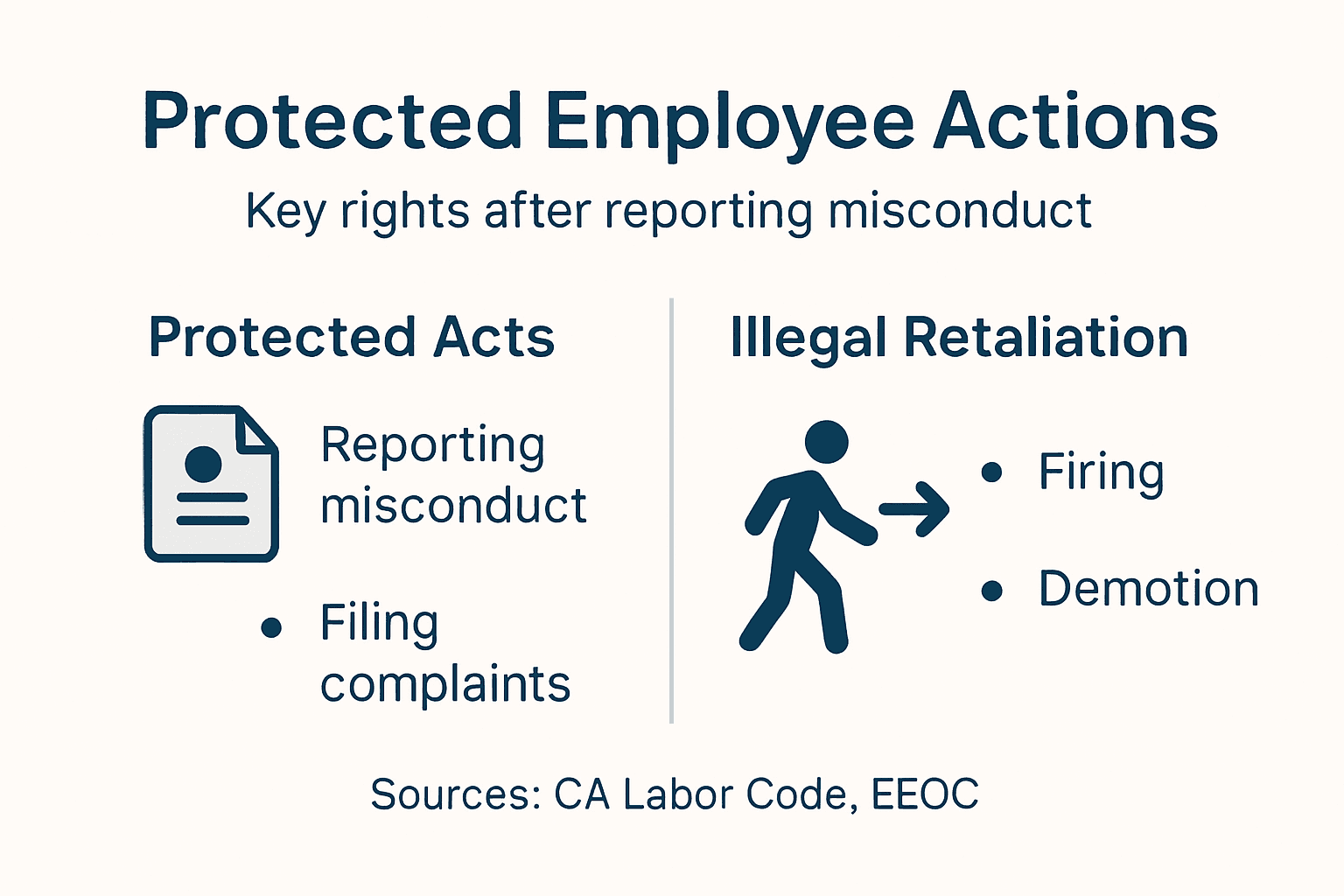
California labor laws protect employees who report violations through internal channels or to outside authorities. Your employer cannot fire you, cut your hours, demote you, or threaten you for engaging in whistleblowing.
Whistleblowers are essential to enforcing workplace compliance and protecting fellow employees from ongoing harm.
Protected Whistleblowing Activities
You’re protected when reporting:
- Safety violations or hazardous conditions
- Discrimination or harassment
- Wage theft or labor law violations
- Fraud or illegal business practices
- Environmental violations
- Violations of health codes or regulatory standards
Protection applies whether you report internally to your company or externally to government agencies. Employees who report workplace violations face federal protection against retaliation like firing, demotion, or pay cuts.
Internal vs. External Reporting
You have options for where and how to report misconduct.
Internal reporting means telling your supervisor, HR department, compliance officer, or management about the misconduct. This gives your employer a chance to address the issue internally.
External reporting involves contacting government agencies, law enforcement, or other authorities outside your company. Examples include the California Department of Industrial Relations, OSHA, the EEOC, or local police.
You’re not required to report internally first. You can go directly to external authorities if you believe your company won’t address the problem or if you fear retaliation.
Here is a summary of when different reporting channels offer legal protection for California employees:
| Reporting Channel | Legal Protection Begins | Who Can Receive Report |
|---|---|---|
| Internal (within company) | Upon reporting misconduct | Supervisor, HR, Compliance Officer, Management |
| External (outside company) | Immediately upon filing with outside agency | Labor Commissioner, OSHA, EEOC, Police |
| Both (simultaneous) | From first protected activity | Any of the above channels |
Why Whistleblowing Matters
Whistleblowers stop ongoing harm to coworkers and hold employers accountable. Without employees willing to report misconduct, violations continue unchecked.
Your decision to report takes courage. California recognizes this and provides legal protections to support you.
Pro tip: Document the misconduct you observe before reporting—dates, times, what happened, and who was involved. This record strengthens your credibility and protects you if retaliation occurs.
Protected activities under California law
California provides broad protection for employees who engage in legally protected activities. These protections apply to virtually all workers, regardless of company size or industry.
Protected activities are actions you take to oppose illegal workplace practices or report violations. You’re shielded from retaliation when you do these things.
Activities California law protects include:
- Reporting discrimination, harassment, or safety violations to your employer
- Filing complaints with government agencies like the California Civil Rights Department
- Participating in investigations or hearings related to workplace violations
- Refusing to perform unsafe or illegal work
- Seeking legal advice about your rights
- Encouraging coworkers to file complaints
- Giving testimony in proceedings about workplace violations
- Opposing illegal practices through internal or external channels
California protects employees engaging in reporting discrimination and related activities from retaliation. This protection is fundamental under California law – your employer cannot lawfully penalize you for speaking up about protected activities.
What Counts as Retaliation
Retaliation means any adverse action your employer takes because you engaged in protected activity. The action doesn’t need to be severe to be illegal.
Retaliation includes:
- Firing or terminating your employment
- Demoting you or reducing your responsibilities
- Cutting your pay or reducing your hours
- Transferring you to an undesirable position
- Changing your work schedule unfavorably
- Verbal threats or intimidation
- Exclusion from meetings or work opportunities
- Negative performance reviews without basis
Your employer cannot take adverse action against you simply because you reported misconduct, even if their investigation finds the complaint unfounded.
Timing and Scope of Protection
Protection applies regardless of when the violation occurred. You can report misconduct immediately or years later.

Employees who file complaints or participate in hearings receive protection under California law. This covers internal complaints and external reports to agencies.
Your position or status doesn’t matter. Full-time employees, part-time workers, temporary staff, and even job applicants receive protection. Your employer’s size doesn’t limit your rights either.
Internal vs. External Reports
You’re protected when reporting through internal channels—your supervisor, HR, compliance officer, or management.
You’re also protected when reporting externally to government agencies, law enforcement, or other authorities outside your company. This includes agencies like OSHA, the California Department of Industrial Relations, and local police.
You don’t need to report internally first. Going directly to external authorities still provides full protection.
Key Protections Apply Immediately
Protection begins the moment you engage in protected activity. Your employer cannot retaliate before, during, or after investigations.
If retaliation occurs, document everything. Record dates, times, what happened, who was involved, and any witnesses. This evidence becomes critical if you need to pursue legal action.
Pro tip: Keep detailed records of your protected activity—emails, complaints, dates of conversations, and names of people you reported to. This documentation proves you engaged in protected activity and helps establish a retaliation claim if adverse actions follow.
Legal framework for whistleblower retaliation
California has built a comprehensive legal framework protecting whistleblowers from retaliation. Multiple statutes work together to shield employees who report misconduct.
The foundation rests on the Fair Employment and Housing Act (FEHA) (Government Code section 12940(h)), which prohibits retaliation against employees for opposing unlawful practices or filing complaints. California also enforces numerous additional labor laws protecting whistleblowers from retaliation in specific areas.
These laws cover:
- Discrimination and harassment complaints
- Safety violations and health code breaches
- Wage and hour violations
- Environmental or regulatory violations
- Fraud or illegal business practices
- Workers’ compensation claims
- Family and medical leave requests
California courts have broadly interpreted whistleblower protections. In People ex rel. Garcia-Brower v. Kolla’s, Inc. (2023) 14 Cal.5th 719, the California Supreme Court held that employees are protected when disclosing unlawful activity even if the employer already knows about the violation, emphasizing that the term ‘disclose’ should be read broadly to protect workers. Additionally, the California Court of Appeal in Hager v. County of Los Angeles (2014) 228 Cal.App.4th 1538 confirmed that whistleblower protection (California Labor Code section 1102.5) extends beyond the first employee who reports a violation.
The Three-Part Retaliation Test
To establish retaliation, you must demonstrate three elements working together. Courts apply this test consistently across cases.
You must show:
- You engaged in protected activity (reported misconduct, filed a complaint, refused unsafe work, or participated in an investigation)
- Your employer took adverse employment action (firing, demotion, pay cut, schedule change, or other negative consequence)
- A causal connection exists between the protected activity and adverse action (the employer retaliated because of your report)
This three-part framework has been consistently applied by California courts. In Yanowitz v. L’Oreal USA, Inc. (2005) 36 Cal.4th 1028, the California Supreme Court clarified that adverse employment actions under FEHA are limited to actions affecting ‘compensation or in terms, conditions, or privileges of employment.’ The court also recognized that a series of separate retaliatory acts may collectively constitute an adverse employment action, even if none of the individual acts would be actionable on its own.
California’s legal framework requires proving engagement in protected activity and showing a direct link to adverse employment action. This standard applies statewide regardless of company size.
Your employer cannot take any action that would discourage a reasonable employee from reporting misconduct or filing complaints.
Temporal Connection Matters
Timing strengthens retaliation claims significantly. If adverse action follows protected activity closely, it suggests retaliation.
Action taken within days or weeks of reporting is particularly suspicious. Even action taken months later can establish retaliation if circumstances suggest a connection.
“California courts have recognized temporal proximity as significant evidence of retaliation. In McRae v. Department of Corrections & Rehabilitation (2006) 142 Cal.App.4th 377, the court held that while proximity in time satisfies a plaintiff’s initial burden of establishing a prima facie case, it may not alone prove the employer’s stated reason is pretextual if the employer offers a legitimate, nonretaliatory explanation. More recently, in Moore v. Regents of University of California (2016) 248 Cal.App.4th 216, the court found that termination occurring two months after an employee disclosed a medical condition raised sufficient questions about retaliation, particularly where the employer failed to follow its own policies and procedures.
Enforcement and Remedies
The Labor Commissioner enforces whistleblower protections across California, covering wrongful termination, blacklisting, pay reduction, and suspension. Employees who experience retaliation can file complaints seeking compensation.
Depending on the specific facts and legal claims in each case, available remedies may include:
- Back pay and lost wages
- Reinstatement to your former position
- Front pay for future lost earnings
- Compensatory damages for emotional distress
- Punitive damages in cases of intentional misconduct
- Attorney’s fees and court costs
In Mathews v. Happy Valley Conference Center, Inc. (2019) 43 Cal.App.5th 236, the court affirmed that punitive damages are available in whistleblower retaliation cases where the employer’s conduct demonstrates malice, fraud, or oppression. The case also confirmed that employees may recover their reasonable attorney’s fees under Labor Code section 1102.5(j).
Burden of Proof
You don’t need absolute certainty about your employer’s motivation. However, you must still present sufficient evidence to meet your burden of proof for each element of your claim. Once you prove the three elements, the burden shifts to your employer to show the adverse action would have occurred regardless of protected activity.
This means your employer must prove they would have made the same decision anyway—a difficult standard to meet.
Pro tip: Build your retaliation case immediately by documenting when you reported misconduct, what you reported, to whom you reported it, and any adverse actions that followed. This contemporaneous documentation is far more credible than recollection months or years later.
How retaliation is disguised by employers
Not all retaliation looks like a sudden firing. Savvy employers mask their retaliation using subtle tactics that are harder to recognize and prove.
Disguised retaliation is just as illegal as direct firing. California law recognizes these covert methods and protects you from them.
Common disguised retaliation tactics include:
- Exclusion from meetings, projects, or professional development
- Schedule changes or shift reassignments without business justification
- Denial of promotions or raises you would normally receive
- Increased scrutiny, monitoring, or performance audits
- Reassignment to less desirable positions or departments
- Withholding bonuses, benefits, or overtime opportunities
- Spreading false rumors or damaging your professional reputation
- Unjustified disciplinary actions or written warnings
- Reducing responsibilities or meaningful work assignments
Why Employers Use Disguised Tactics
Employers use subtle retaliation because it’s harder to prove. A schedule change looks innocent. A denied promotion seems like normal business. But when these actions cluster around your protected activity, they reveal a pattern.
Employers often disguise retaliation through exclusion and schedule changes rather than outright termination. This strategy discourages employees from reporting while creating plausible deniability.
The following table highlights the difference between direct and disguised employer retaliation tactics:
| Retaliation Type | Common Forms | Why It Matters |
|---|---|---|
| Direct | Firing, Demotion, Pay cut | Easier to prove and recognize |
| Disguised | Exclusion, Schedule change, Withheld bonuses | Harder to detect, but equally unlawful |
Subtle retaliation can be just as damaging as firing—it erodes your career, income, and workplace standing.
Pattern Recognition Is Key
No single action proves retaliation. But a series of actions following your report tells the story.
Look for changes in how you’re treated after reporting misconduct. Are you suddenly excluded from meetings you previously attended? Did your schedule change right after you filed a complaint? Are performance expectations now unreasonably high?
Employers rarely admit retaliation openly. They rely on you missing the connection between your protected activity and the adverse actions.
Indirect Retaliation Methods
Retaliation may take indirect forms like unjustified discipline or benefit withholding, creating hostile environments that discourage future reporting. These tactics harm morale while maintaining surface plausibility.
Examples of indirect methods:
- Creating impossible performance standards only for you
- Suddenly enforcing rules that were previously ignored
- Assigning you work outside your job description
- Isolating you from team communications or social events
- Criticizing work quality without documentation
- Removing autonomy or decision-making authority
Documentation Defeats Disguise
Disguised retaliation unravels when you have detailed records. Document every adverse action after reporting, including dates, what happened, and any witnesses.
Keep copies of emails, performance reviews, and schedule changes. Note when you were excluded from meetings or assignments. This documentation creates the pattern that exposes retaliation.
Pro tip: Track all adverse employment actions after reporting misconduct, no matter how minor they seem. Calendar entries, email forwards, or written notes create the timeline that proves retaliation, even when individual actions appear innocent on their own.
Steps for employees facing wrongful termination
Being fired after reporting misconduct feels devastating and unfair. You have legal options, and taking the right steps immediately protects your rights and strengthens your case.
Wrongful termination claims require evidence and proper documentation. Acting quickly gives you the best chance at a favorable outcome.
Step 1: Preserve All Evidence
Stop and gather everything related to your termination immediately. Your memory fades, documents get deleted, and witnesses become harder to locate.
Collect and preserve:
- All emails, text messages, and communications about your report or termination
- Performance reviews and disciplinary records
- Your job description and any policy handbooks
- Witness contact information and their account of events
- Medical records if retaliation caused health issues
- Pay stubs and employment contracts
- Calendar entries documenting key dates and conversations
Make copies and store them safely outside your work devices. Back up digital files to personal cloud storage or external drives your employer cannot access.
Step 2: Document the Termination Details
Write down everything about your termination while it’s fresh. Include the date you were fired, who terminated you, what they said, and any written termination notice.
Record the timing relative to your protected activity. How many days or weeks after you reported misconduct were you terminated? This timeline is critical.
Document your termination immediately—your contemporaneous written account becomes powerful evidence in any legal proceeding.
Step 3: Understand Wrongful Termination
Wrongful termination involves firing in violation of California law, including retaliation for whistleblowing, discrimination, or exercising legal rights. Your termination may violate public policy or contractual agreements.
You were wrongfully terminated if you were fired for:
- Reporting safety violations or discrimination
- Refusing to perform illegal acts
- Exercising legal rights like jury duty or medical leave
- Filing workers’ compensation claims
- Joining labor organizations
- Discriminatory reasons (race, gender, age, disability, religion)
Step 4: File Administrative Complaints
In California, file complaints with the Labor Commissioner or Civil Rights Department if you believe retaliation led to your termination. These agencies investigate your claim and can impose remedies.
You’ll need to provide:
- Specific dates of protected activity and termination
- Detailed description of misconduct you reported
- Names of witnesses
- Copies of supporting documents
- Explanation of how your protected activity caused termination
Step 5: Consult an Employment Lawyer
Don’t delay seeking legal counsel. Employment lawyers understand the nuances of California wrongful termination law and can evaluate your specific situation.
A lawyer will review your evidence, assess the strength of your claim, and advise on next steps. They can represent you in administrative proceedings and litigation if necessary.
Pro tip: Act within weeks of your termination, not months or years later. File administrative complaints promptly, gather evidence before it disappears, and consult a lawyer while your case is strongest and memories are sharpest.
Protect Your Rights After Reporting Workplace Misconduct
Reporting workplace misconduct takes courage but can lead to challenging retaliation like wrongful termination, demotion, or pay cuts. If you are facing retaliation after raising concerns about harassment, discrimination, or safety violations, you do not have to face it alone. Understanding your rights under California law is critical to stopping ongoing harm and holding your employer accountable.
At California United Law Group, P.C., our experienced team represents employees in all forms of retaliation and wrongful termination claims. Whether you reported misconduct internally or to outside agencies, we provide strong legal support through every stage of your dispute. Learn more about how we fight for employees against retaliation and wrongful termination at Wrongful Termination & Retaliation – Los Angeles Employment Lawyers | California United Law Group, P.C. and explore related issues like Discrimination & Harassment – Los Angeles Employment Lawyers | California United Law Group, P.C..
If you believe you have experienced retaliation after reporting workplace misconduct, consulting with an employment attorney can help you understand your options. California United Law Group, P.C. represents employees in retaliation and wrongful termination matters. Visit our website to learn more about our services or to schedule a consultation.
Frequently Asked Questions
What should I do if I experience retaliation after reporting workplace misconduct?
If you experience retaliation, document everything, including dates, times, and details of the adverse actions. You should report the retaliation to your HR department or a legal authority and consider consulting an employment lawyer to explore your options.
What qualifies as workplace misconduct?
Workplace misconduct includes harassment, discrimination, wage and hour violations, unsafe working conditions, and retaliation for reporting such violations. It encompasses any illegal or unethical behavior in the workplace.
Are whistleblowers protected from retaliation when reporting misconduct?
Yes, both California and federal laws protect whistleblowers from retaliation. Employees cannot be fired, demoted, or face other adverse actions for reporting violations, whether they report internally or to external authorities.
How can I document misconduct effectively before reporting it?
To document misconduct effectively, keep a detailed record of dates, times, specific incidents, who was involved, and any witnesses. This information strengthens your credibility and supports your claims if retaliation occurs.
Does consulting with an attorney guarantee I will win my case?
No attorney can guarantee the outcome of any legal matter. Each case depends on its unique facts, the available evidence, applicable law, and many other factors. An experienced employment attorney can evaluate your specific situation and advise you on the strength of your potential claims and your legal options.
Recommended
- Retaliation in the Workplace: Your Rights and Legal Options in California – Los Angeles Employment Lawyers | California United Law Group, P.C.
- Long Beach Workers Reporting Safety Violations: Your Rights – California United Law Group
- Employment Lawyer Los Angeles County – Los Angeles Employment Lawyers | California United Law Group, P.C.
- Medical Leave Retaliation in El Monte Workplaces – California United Law Group
- Workplace Retaliation in LA | Los Angeles Employment Lawyer