
TL;DR:
- Many California workers suspect their pay may be underestimated due to time rounding practices. California law requires employers to pay for all actual hours worked, and systematic rounding that shortchanges employees is illegal. If you notice discrepancies, documenting your exact times and consulting an employment lawyer can help protect your rights.
Many California employees believe their paychecks reflect exactly what they worked. That belief may not hold up. A significant legal debate is unfolding in California courts right now, one that directly affects whether your employer can legally round your clock-in and clock-out times rather than paying you for every exact minute you worked. If you work in Alhambra or anywhere in California, this is not a minor technical issue. It can mean real money missing from your paycheck, and in some cases, missed overtime pay you were legally entitled to receive.
Table Of Contents
- How California law views time entry rounding
- What ‘neutral’ rounding means and when it’s not legal
- How employers in Alhambra must ensure compliance
- Protecting your rights: What to do if your hours are rounded
- The uncomfortable truth: Why employees must question ‘neutral’ rounding
- Get help protecting your wage rights
- Frequently asked questions
Key Takeaways
| Point | Details |
|---|---|
| Legal scrutiny ongoing | California Supreme Court is reviewing whether employers can round time entries, especially when exact time is tracked. |
| ‘Neutral’ rounding isn’t always fair | Even so-called fair rounding can result in lost wages, violating employees’ rights. |
| Compliance applies statewide | Alhambra employers must follow California wage laws for all time worked, not just local standards. |
| Practical steps for employees | Document any rounding, compare records to paystubs, and seek legal advice if you notice discrepancies. |
| Expert legal help available | Consulting an employment lawyer can clarify your rights and support compensation claims. |
How California Law Views Time Entry Rounding
California’s wage laws are among the strongest in the country. Under the California Labor Code, employers are required to pay workers for all time worked, not an approximation of it. That principle sounds simple, but the practice of time rounding has long complicated matters.
Time rounding is when an employer’s payroll system automatically adjusts your clock-in or clock-out time to the nearest increment, usually five, ten, or fifteen minutes. For example, if you clock in at 8:07 a.m., the system might record your start time as 8:00 a.m. or 8:15 a.m., depending on how it’s set up. Employers have argued this practice is convenient for payroll processing and, when applied evenly, does not systematically shortchange employees.
The legal tension around this practice came sharply into focus with the California Court of Appeal’s decision in Camp v. Home Depot U.S.A., Inc., 84 Cal.App.5th 638 (2022). In that case, the Court of Appeal reversed summary judgment in favor of Home Depot, holding that where an employer’s electronic timekeeping system captures the exact minutes an employee works each shift, the employer cannot apply a quarter-hour rounding policy that results in the employee being paid for less time than actually worked. The California Supreme Court’s pending review of whether neutral time-rounding is permitted when an employer’s system tracks exact minutes signals that the law in this area is actively evolving.
California courts have developed the framework for evaluating rounding practices over the last decade. In See’s Candy Shops, Inc. v. Superior Court, 210 Cal.App.4th 889 (2012), the Court of Appeal established the foundational standard that time rounding is only lawful if it is ‘neutral’ — meaning it must not, over time, result in employees being systematically underpaid. In Donohue v. AMN Services, LLC, 11 Cal.5th 58 (2021), the California Supreme Court held that rounding is impermissible during meal periods when an employer’s timekeeping system captures exact times, signaling the court’s increasing skepticism of rounding as a general payroll practice. The Court of Appeal’s decision in Camp v. Home Depot then extended that reasoning to all hours worked, and the California Supreme Court’s forthcoming ruling in that case — docketed as Case No. S277518 — is expected to resolve definitively whether time rounding remains a lawful practice in California.
Key legal principle: Under California law, time rounding is only acceptable if it does not, over time, result in employees being paid less than they actually earned. If rounding consistently benefits the employer, it is unlawful.
Here is what the current legal framework generally requires:
- Employers must compensate employees for every minute worked, including time spent preparing for work duties or wrapping up after a shift
- Rounding policies must be truly neutral, meaning they must not systematically cut employee hours
- If your employer’s system can track exact minutes and chooses to round instead, that practice has already been held unlawful by the Court of Appeal in Camp v. Home Depot U.S.A., Inc., 84 Cal.App.5th 638 (2022), and the California Supreme Court is currently reviewing the issue statewide
- Workers in industries with strict workplace safety compliance obligations, such as warehousing or food service, are particularly vulnerable to these discrepancies
- If rounding affects your hours calculation, it may also affect your eligibility for overtime pay under California’s daily and weekly overtime rules
Understanding these rules is the first step to recognizing whether something is wrong with your paycheck.

What ‘Neutral’ Rounding Means And When It’s Not Legal
Now that you know the legal context, let’s get specific about the meaning and risks of neutral rounding.
A “neutral” rounding policy is one that, in theory, balances out over time. Employees who clock in early get credited for a few extra minutes. Employees who clock in late lose a few minutes. The employer’s argument is that these differences average out, so no one is truly shorted. That reasoning sounds fair on paper, but in practice, the results often tell a different story.
California wage and hour principles make clear that for Alhambra employers, time rounding is not a local policy choice: the legal question is whether the timekeeping and pay practice complies with California’s requirement to pay for all time worked, including overtime calculations. If rounding consistently trims minutes from employees at the start or end of shifts, the employer cannot simply call it “neutral” and walk away.
Here is a practical breakdown of how rounding can cross the legal line:
| Scenario | Legal Status | Why It Matters |
|---|---|---|
| Rounds up and down evenly over time | Potentially lawful | Must be proven through actual pay data |
| Always rounds down employee start times | Likely unlawful | Employees consistently lose minutes |
| Rounds time in ways that push hours below overtime thresholds | Unlawful | Denied overtime compensation |
| System tracks exact time but still rounds | Under court scrutiny | Court of Appeal has held this unlawful (84 Cal.App.5th 638); California Supreme Court review pending (S277518) |
| Rounding causes missed meal or rest break pay | Unlawful | Separate violation under California law |
Here are three concrete examples of when rounding goes too far:
Pattern rounding: Your shift starts at 8:00 a.m. You clock in at 7:58 a.m. every day. Your employer’s system rounds you forward to 8:00 a.m. each time. You never get credit for those two minutes. Over a year, that adds up to more than eight hours of unpaid work.
Overtime threshold rounding: You work 9 hours and 52 minutes on a Tuesday. California law requires overtime pay after 8 hours in a day. Your employer’s rounding system cuts your recorded time to 9 hours and 45 minutes. That’s still over 8 hours, but rounding may also affect how the system calculates the exact premium owed.
Shift end rounding: You consistently stay two or three minutes past your scheduled end time to finish tasks. The system always rounds your clock-out down to the scheduled end time. You never see pay for that time. In healthcare and retail settings, this kind of unpaid overtime dispute is surprisingly common.
Pro Tip: Request a copy of your employer’s written timekeeping policy. If it does not clearly explain how rounding works, or if the explanation does not match what you see on your paystubs, that gap is worth documenting and potentially discussing with an attorney.
Also check whether your paystub accurately reflects your hours. Errors in how hours are reported can sometimes be a sign of paystub law violations, which carry their own legal consequences for employers in California.
How Employers In Alhambra Must Ensure Compliance
Understanding legal compliance means looking at practical steps employers in Alhambra must follow.
Alhambra is governed by California state labor law, not a separate local wage system. This matters because some employees and even some employers mistakenly believe that local customs or informal arrangements can override state requirements. They cannot. The same California wage and hour compliance standards that apply in San Francisco and Los Angeles apply equally to every Alhambra employer.
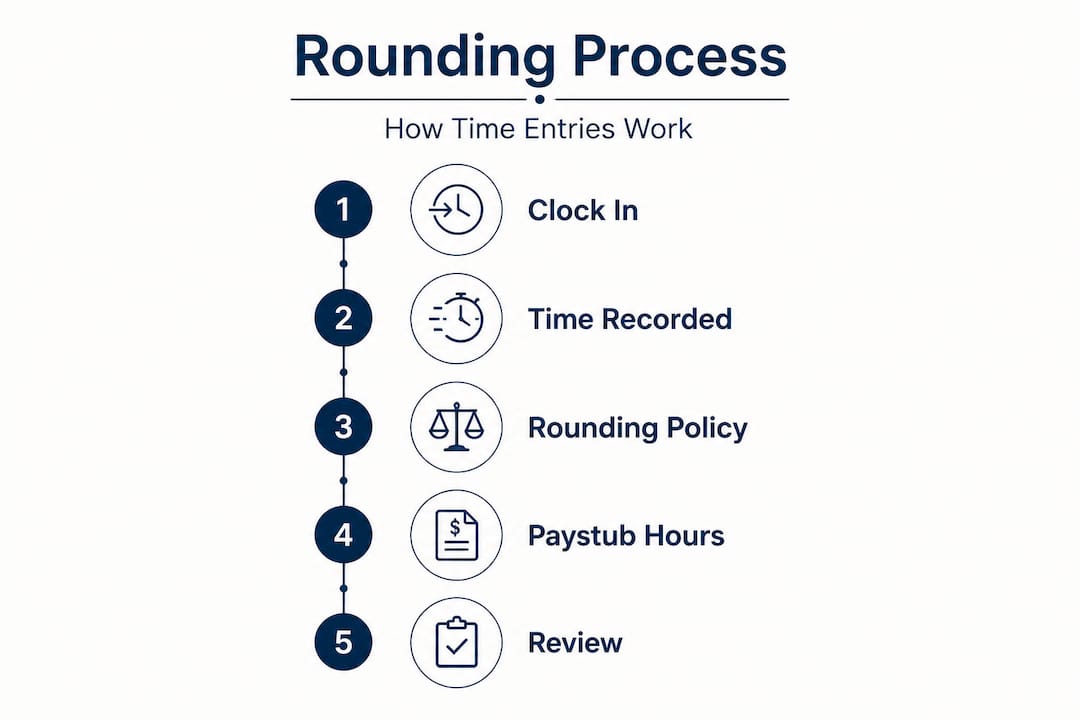
Here is a comparison of compliant versus non-compliant timekeeping practices:
| Compliant Practice | Non-Compliant Practice |
|---|---|
| Records and pays for all exact minutes worked | Rounds time entries in ways that reduce total pay |
| Provides itemized paystubs showing exact hours | Paystub shows rounded or incorrect hours |
| Adjusts payroll if rounding creates a shortfall | Ignores evidence that rounding consistently underpays |
| Uses rounding only in ways that can be shown to be neutral | Applies rounding without reviewing its actual financial impact on employees |
| Tracks exact time even when using rounding for convenience | Destroys or does not retain original time records |
As an employee in Alhambra, here is what you should look for on your paystubs and in your records:
- Exact start and end times should be accessible to you, either through a timekeeping portal, time cards, or upon request from HR
- Total hours worked on your paystub should match what your own records show
- Overtime line items should appear if you worked more than 8 hours in a day or more than 40 hours in a week
- Any deductions related to break penalties or time corrections should be clearly labeled
- If your employer uses an app or digital timekeeping system, request your raw data. California law gives employees the right to access their payroll and time records
If you spot discrepancies and your employer refuses to explain them clearly or provide records, consulting an Alhambra employment lawyer is a reasonable and important next step. A lawyer can help you understand whether what you see rises to the level of a legal violation and what remedies may be available to you.
You should also be aware that paystub law violations can result in civil penalties separate from any unpaid wage recovery. Employers who fail to provide accurate, itemized pay statements face up to $4,000 in penalties per employee under California Labor Code Section 226.
Protecting Your Rights: What To Do If Your Hours Are Rounded
If time rounding affects your pay, here is how you can protect yourself and act.
Taking action does not have to mean filing a lawsuit immediately. It starts with careful observation and documentation. Here is a clear, step-by-step approach:
Compare your records to your paystubs. If you have access to a time clock app, a physical time card, or any record of your exact clock-in and clock-out times, line those up against what your paystub shows. Write down every discrepancy you find.
Track a pattern over time. A single rounding incident might be a clerical error. A consistent pattern over weeks or months is stronger evidence of a systemic policy problem. Keep a personal log with dates, exact times you worked, and what your paystub recorded.
Request your time records from your employer. Under California law, you have the right to inspect your payroll and time records within 21 days of your request. If your employer delays or refuses, that refusal itself can be a violation.
Calculate any shortfalls yourself. Using your own records, estimate how many minutes per day or week are being lost to rounding. Multiply that by your hourly rate and count the days. Even small amounts per day can become significant claims over several months.
Review whether missed time pushed you below overtime thresholds. If rounded hours kept you just under 8 hours per day or 40 hours per week when you actually worked more, you may be owed overtime premium pay in addition to your base wages.
Consult an employment attorney before filing any complaint. An attorney can help you understand whether you have a strong claim, what agencies or courts to approach, and how to preserve your evidence. Time limits (called statutes of limitations) apply to wage claims in California, so waiting too long can cost you the ability to recover.
Pro Tip: If you suspect rounding is affecting your pay, avoid confronting your employer directly in ways that could be seen as insubordination before speaking with a lawyer. Document first, then act strategically.
Given the active California Supreme Court review of whether rounding is permitted when employers track exact time, the legal landscape may shift in employees’ favor. That means claims you file now, or evidence you preserve now, could become very valuable in the near future.
Many employees don’t realize that off-the-clock work claims and rounding claims can overlap. If your employer rounds your time and also asks you to perform tasks before clocking in or after clocking out, both violations can be addressed together. California courts have recognized off-the-clock work claims where employers used rounding policies to obscure total hours worked, and such claims can be pursued alongside rounding violations.
The Uncomfortable Truth: Why Employees Must Question ‘Neutral’ Rounding
Stepping back, here is the hard truth most employees need to consider when faced with “neutral” rounding.
The word “neutral” does a lot of heavy lifting in how employers defend rounding policies. It sounds mathematical. Objective. Fair. But neutrality is only meaningful if someone is actually checking the math, and in most workplaces, that someone is not you.
Employers design their own timekeeping systems. They choose the rounding intervals. They set the thresholds. And unless an employee or their attorney pulls the raw data and runs the numbers, no one is verifying that the rounding truly balances out. In many of the wage and hour cases we have seen, the data tells a starkly different story than the employer’s stated policy.
The Court of Appeal’s decision in Camp v. Home Depot U.S.A., Inc., 84 Cal.App.5th 638 (2022) is instructive here. The central question was not whether Home Depot intended to shortchange workers. It was whether the actual outcome of the rounding policy resulted in a systematic loss of pay. Intent does not determine legality under California wage law. Results do.
This is why we advise employees not to assume fairness because a policy has a fair-sounding name. Neutral rounding, by definition, should produce zero net loss over time. If you run the numbers yourself and find a consistent deficit, you do not have neutral rounding. You have a wage violation with a friendly label.
The legal record from California courts over the last several years consistently shows one thing: employees who question, document, and act on discrepancies are in a far stronger position to pursue the wages they may be owed. Trusting a rounding policy without verifying its actual impact on your paycheck can mean losing compensation you have a legal right to recover.
Get Help Protecting Your Wage Rights
👉 If you believe your pay has been affected by time rounding, you deserve clear answers and strong legal support.
At California United Law Group, P.C., we represent California employees in wage and hour claims involving time entry errors, unpaid overtime, and unlawful rounding policies. We know how to analyze pay records, identify patterns of underpayment, and build strong cases for compensation recovery. Whether you are dealing with a single employer error or a widespread workplace policy, our employment law team is here to help you understand your rights and your options. To learn more about how the legal process works if you decide to take action, review our California employment lawsuit overview. We are ready to listen and help you move forward.
Frequently Asked Questions
Can my Alhambra employer round time entries even if their system tracks exact minutes?
This is the exact question the California Supreme Court is currently deciding in Camp v. Home Depot U.S.A., Inc. (Case No. S277518). The Court of Appeal has already ruled that when an employer’s system captures exact minutes, a rounding policy that results in an employee being paid for less time than actually worked is unlawful. Camp v. Home Depot U.S.A., Inc., 84 Cal.App.5th 638 (2022). The Supreme Court’s ruling will set the final statewide standard. Given the direction of California wage law, if your employer rounds your time despite having an exact-tracking system, consulting an employment attorney now to understand your rights and preserve your evidence is strongly advisable.
Does rounding affect my overtime pay or wage rights?
Yes. If rounding reduces your recorded hours in ways that lower your total pay or push you below overtime thresholds, it can violate your rights because California wage and hour rules require payment for all time worked, including overtime.
How can I tell if my pay was affected by time entry rounding?
Compare your actual clock-in and clock-out records to your paystub totals because any gap between exact recorded time and reported hours may indicate unlawful rounding practices affecting wages.
What should I do if I think rounding cost me overtime?
Document your exact hours, calculate the difference, and consult an employment attorney right away, especially given the active legal review of rounding practices in California, which may strengthen your claim.
The information provided in this article is for general informational purposes only and does not constitute legal advice. Reading this article does not create an attorney-client relationship with California United Law Group, P.C. Wage and hour laws are complex, and outcomes in any legal matter depend on the specific facts involved. If you believe your pay rights have been violated, consult a qualified California employment attorney to evaluate your individual circumstances.