
In many cases, yes. If you work in Alhambra and your employer required or allowed you to work, California law generally treats that time as hours worked, and unpaid wages for those hours can often be recovered through the Labor Commissioner or a civil lawsuit. Whether you can recover a specific amount depends on your facts, including your job, your pay records and how much time has passed. This article is general education, not legal advice.
Below, we explain which kinds of unpaid time California law recognizes, what can be recovered besides the base wages, the deadlines that apply, and the records that tend to matter.
TL;DR
- Under California law, hours worked generally include time you are under your employer’s control and time your employer suffers or permits you to work, even if no one formally asked for it.
- Unpaid overtime, missed meal or rest breaks, off-the-clock work and unpaid expenses are all recognized forms of wage and hour violation in California.
- Most minimum wage and overtime claims generally must be brought within three years, though some claims have shorter limits and certain related claims can reach back four years.
- You can generally pursue unpaid wages through a Labor Commissioner claim or a civil lawsuit, and California law protects you from retaliation for asserting your rights.
- Daily records of start times, end times and breaks, along with your pay stubs, are among the most useful evidence.
Table of Contents
- What counts as “hours worked” for an Alhambra employee
- Types of unpaid time and pay that can lead to recovery
- What you may be able to recover
- Where an Alhambra employee can pursue unpaid wages
- How long you have to bring a claim
- Records that can support a claim for all hours worked
- Can your employer retaliate if you ask to be paid?
- Our perspective
- Talk with a wage and hour attorney serving Alhambra
- FAQ
- Sources
What counts as “hours worked” for an Alhambra employee
Most people think of hours worked as the time between clocking in and clocking out. The law is broader than that. The U.S. Department of Labor explains that work an employer requires or allows is generally compensable, including work the employer did not specifically request but knows, or has reason to believe, is being performed and benefits from. You can read that guidance in the FLSA Hours Worked Advisor.
California law often goes further. In Morillion v. Royal Packing Co. (2000) 22 Cal.4th 575, the California Supreme Court recognized that employers must compensate nonexempt employees for off-the-clock work if the employer knows or should have known the employees were working those hours. The court also explained that federal authorities are of little help in interpreting California regulations that give workers greater protection. In Troester v. Starbucks Corp. (2018) 5 Cal.5th 829, the court held that the federal “de minimis” doctrine, which can excuse employers from paying for small amounts of time, does not apply to wage claims under California law. The court left open whether some activities may be so irregular or brief that employers cannot reasonably be required to pay for them.
The same federal guidance says that simply having a policy against off-the-clock work does not settle the question. Management must actually exercise control and make every effort to prevent the work, and an employer cannot accept the benefit of work without counting the time.
In practice, this can matter for Alhambra employees in several settings:
- A retail or restaurant employee who is asked to finish closing tasks after clocking out.
- An office worker who answers work calls or messages from home in the evening at a supervisor’s request.
- A warehouse or delivery worker who spends time loading, unloading or waiting for assignments before the recorded shift begins.
- A caregiver or clinic worker who completes charting after the scheduled end of a shift.
Whether any of these situations is compensable depends on the details: who directed the work, whether the employer knew about it, and how the time was recorded. Because those facts differ from job to job, an attorney can only evaluate them after reviewing your specific circumstances.
Federal law is only one layer. California’s wage laws are often more protective than the federal rules, and California employees can bring claims under the state Labor Code. California’s wage laws are often more protective than the federal rules, and California employees can bring claims under the state Labor Code and the Industrial Welfare Commission wage orders.
Types of unpaid time and pay that can lead to recovery
The California Division of Labor Standards Enforcement (DLSE), part of the Labor Commissioner’s Office, publishes examples of wage theft. They include:
- Paying less than minimum wage
- Missed meal or rest breaks
- Not paying agreed wages, including overtime on commissions, piece rate and regular wages
- Unauthorized deductions from pay
- Unreimbursed business expenses
- Promised bonuses that are not paid
- Final wages that are not paid on time
That list is useful because “all hours worked” is rarely one problem. A single job can involve several of these at once, such as an unrecorded half hour at the end of each shift that also pushes the workday into overtime.
Overtime
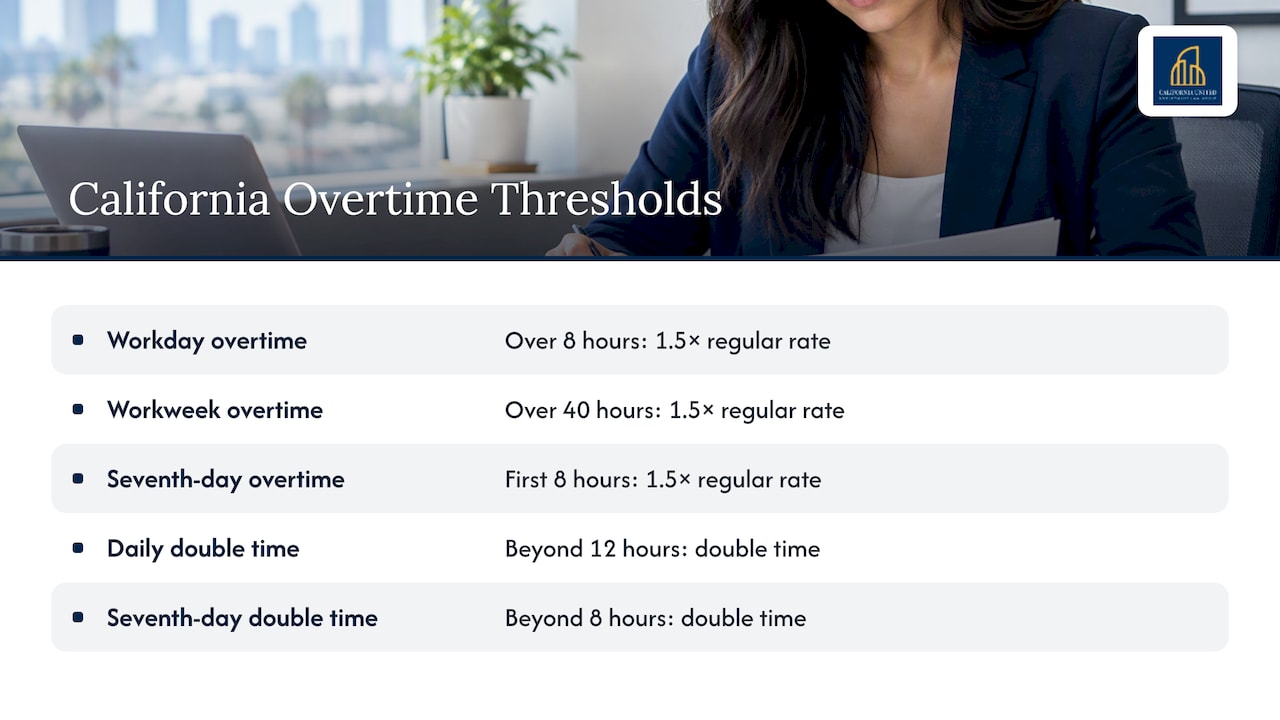
California Labor Code section 510, as published by the California Legislature, treats eight hours as a day’s work. It generally requires pay at 1.5 times the regular rate for work over eight hours in a workday, over 40 hours in a workweek, and for the first eight hours on the seventh consecutive day of work in a workweek. Work beyond 12 hours in a day, and beyond eight hours on the seventh day, generally requires double time. The statute contains exceptions, and whether an exception applies to you depends on your job duties and pay arrangement.
If you are paid a salary, you may still be owed overtime. Whether you are exempt turns on duties and pay level, not on the word “salaried.” Our article on salaried employees and overtime pay in Alhambra explains how that question is usually approached.
Meal and rest breaks
Missed breaks are a common source of unpaid compensation. In Naranjo v. Spectrum Security Services, Inc. (2022) 13 Cal.5th 93, the California Supreme Court held that meal and rest break premium pay counts as wages, which means waiting time and wage statement penalties may also be available when premiums go unpaid. That means it is subject to the same timing and reporting requirements as other wages. You can read the court’s opinion for the full reasoning. When a compliant rest period is not provided, the employer generally owes one additional hour of pay at the employee’s regular rate for each workday the violation occurs, and the same premium applies for each workday a required meal period is not provided. In Brinker Restaurant Corp. v. Superior Court (2012) 53 Cal.4th 1004, the court held that employers must provide a work-free meal period but are not required to ensure that no work is performed during it.
Expenses, deductions and final pay
Unpaid work-related expenses, improper deductions and late final paychecks are also on the DLSE’s list. If you left a job in the Alhambra area and your last check was short or late, that can be a separate issue from the hours themselves.
What you may be able to recover
Recovery is not limited to the hourly rate for the missing time. Depending on the facts, an employee may be able to seek:
| Type of recovery | What it generally covers |
|---|---|
| Unpaid wages | Straight time or minimum wage for hours that were not paid |
| Overtime premiums | The higher rate for qualifying overtime or double-time hours |
| Break premium pay | Pay owed for missed meal or rest breaks, which counts as wages under Naranjo |
| Unreimbursed expenses and deductions | Business costs you paid and pay that was improperly withheld |
| Waiting time penalties | Additional pay that may be owed when final wages are not paid on time after employment ends |
| Wage statement penalties | For knowing and intentional pay stub violations, the greater of actual damages or $50 for the initial pay period and $100 for each later pay period, up to $4,000 |
| Attorney fees and costs | Fees available to a prevailing employee in an action for nonpayment of wages under Labor Code section 218.5. |
| Civil penalties | In a representative action under PAGA, penalties that may apply across aggrieved employees, with a portion paid to the state |
On that last point, the California Labor and Workforce Development Agency explains in its PAGA FAQs that employees may bring representative actions for Labor Code violations, with civil penalties of $100 per aggrieved employee per pay period for initial violations and $200 for malicious or repeat violations. Penalties recovered under PAGA are shared between the state and the aggrieved employees. The 2024 amendments to PAGA also changed how penalties are calculated and allow reductions in some circumstances, such as where the employer took steps to comply. PAGA claims follow their own procedural requirements, so they are a topic for a conversation with an attorney rather than something to assume applies to your situation.
Remedies for the same underlying problem cannot always be stacked. Courts have addressed when certain recoveries overlap, and the answer depends on which law and which facts are involved. That is another reason the amount you could recover cannot be estimated from a general article.
Where an Alhambra employee can pursue unpaid wages
There are two main paths, and the California Supreme Court described them in Cuadra v. Millan (1998) 17 Cal.4th 855. An employee may file an ordinary civil action in court for contract or statutory wages, or use an administrative wage claim under the Labor Commissioner’s hearing procedure. The court described the Labor Commissioner route as a speedy, informal and affordable alternative to ordinary litigation, while the court option remains available for judicial relief. The opinion is available here.
The Labor Commissioner route
According to the DLSE’s wage claim page, workers may file a wage claim when an employer does not pay wages or benefits owed. Claims may be filed online, by email, by mail or in person, and California labor-law protections apply regardless of immigration status.
The Labor Commissioner’s wage recovery brochure describes the general process. A worker files an Initial Report or Claim with supporting documents, attends a settlement conference, and, if the claim does not settle, goes to a hearing. At the hearing, the worker must present evidence and prove the employer owes wages. The brochure states that an unappealed award becomes final and enforceable as a court judgment after 10 days. That brochure was published in 2014, so check the Labor Commissioner’s current materials for any updates.
The civil court route
The California Courts’ employment self-help guide identifies the DLSE as a resource for unpaid wages, including overtime, and explains that an employee may also pursue an employment-related civil lawsuit. A lawsuit can make sense when the claim is larger, involves several kinds of violations, or may affect other employees at the same workplace. In some situations, a group of employees with the same problem may be able to proceed together. You can learn more about our approach on our class action page.
For a broader look at how these options compare for people who work in the city, see our guide on DLSE wage claims, civil lawsuits and waiting-time penalties for Alhambra employees.
How long you have to bring a claim
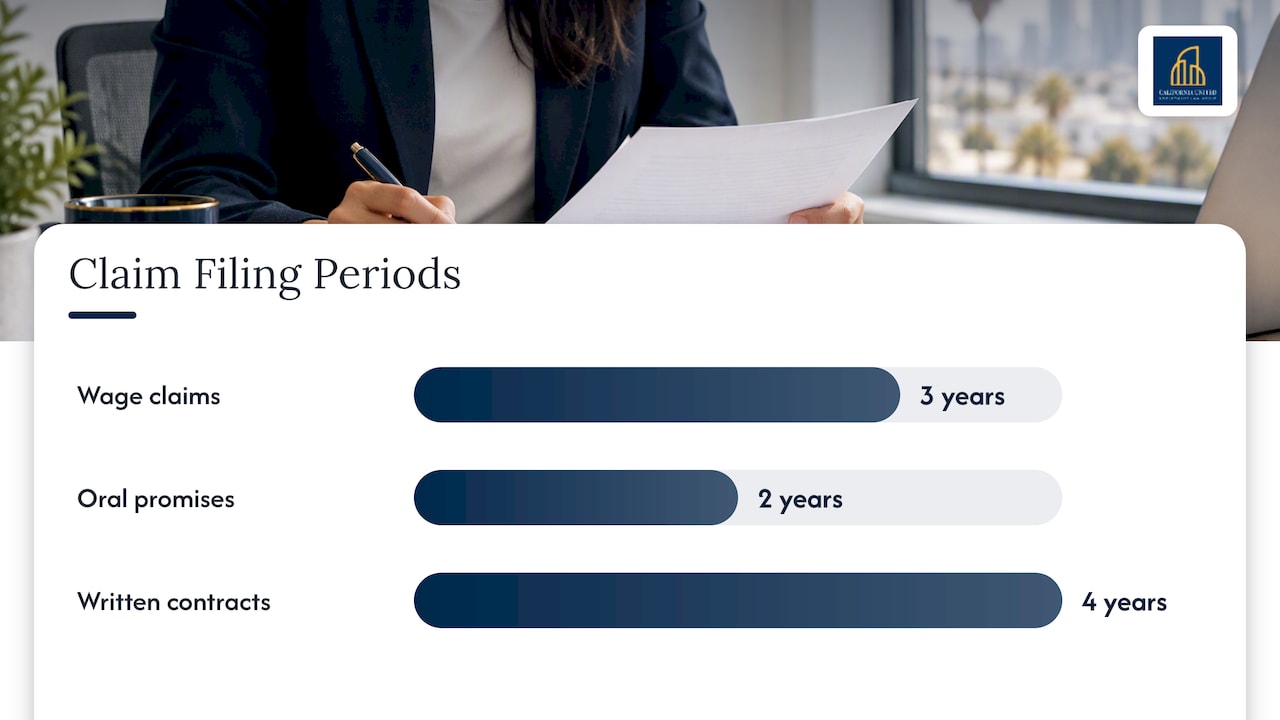
Time limits can reduce or eliminate what you can recover, so they deserve attention early. According to the DLSE, claims for minimum wage, overtime, illegal deductions and unpaid reimbursements generally must be brought within three years. Claims based on oral promises are limited to two years, and claims based on written contracts to four years. The agency sets this out on its wage claim page.
A few cautions apply:
- These are general periods. Some claims have different limits. For example, a claim under California’s Unfair Competition Law may seek restitution of unpaid wages going back four years.
- The clock can depend on when each underpaid pay period occurred, so older pay periods may fall outside the window while recent ones remain open. In Cuadra v. Millan, the California Supreme Court explained that a separate claim accrues on each payday when wages are paid periodically.
- Claims about discrimination, retaliation or termination follow separate deadlines from wage claims.
If you are unsure whether your claim is still timely, speaking with an employment attorney or contacting the DLSE promptly is a reasonable way to find out.
Records that can support a claim for all hours worked
In a wage dispute, the question is often not whether you worked, but how much and when. The DLSE advises workers to record daily start and end times, meal and rest breaks and total hours, keep their pay stubs, and gather supporting documents. The agency also states that employers must keep accurate records of actual time worked and provide itemized wage statements. This is all on the DLSE wage claim page.
Useful records commonly include:
- Pay stubs and wage statements
- Schedules, shift swaps and work-related texts or emails that show when you were working
- Your own daily notes of start times, end times and breaks
- Offer letters, handbooks or pay policies
- Photos or messages that show work done outside recorded hours
If your pay stubs seem incomplete or confusing, that may itself be significant. Our articles on Alhambra paystub law questions and on saving records before a wage claim cover what wage statements should show and how timesheet problems are commonly handled.
Keep copies of records in a place you control, such as a personal device or notebook. Be careful about removing confidential employer materials, since that can create separate problems. If you are unsure what you may keep, ask an attorney before taking anything.
Can your employer retaliate if you ask to be paid?
California law prohibits it. According to CalChamber’s guidance on protection for reporting Labor Code violations, an employer cannot legally retaliate against an employee for asserting the right to be paid for all hours worked, and doing so violates California Labor Code section 98.6.
If you have been disciplined, demoted, had your hours cut or been fired after raising a pay concern in Alhambra, that may be a separate legal issue from the wages themselves. Retaliation claims have their own requirements and deadlines. Our employment law page describes the retaliation and wrongful termination matters we handle.
Our perspective
Employees often tell us they feel uneasy about even raising an unpaid-hours question. They worry about being seen as difficult, or they assume small amounts are not worth the trouble. We see it differently. Ten or fifteen unrecorded minutes a day can add up over months and years, and the law does not treat unpaid work as acceptable simply because it was routine.
Our firm practices employment law for employees in California. Our attorneys include lawyers with prior employer-side experience, which helps us understand how a wage dispute may look from the other side of the table. We work on a contingency fee basis. Under our standard fee agreement, clients do not pay attorney fees or case costs unless we recover money through a settlement or award, and all fee and cost terms are set out in a written agreement before representation begins.
Every case depends on its facts, and we do not promise any result. What we can do is review your pay records, explain which California Labor Code provisions may apply, and tell you honestly which options may fit your situation, whether that is an administrative claim, a lawsuit or a conversation with your employer.
California United Law Group
Talk with a wage and hour attorney serving Alhambra
If you think you were not paid for all the hours you worked, we can review, at no charge, your situation. We represent California employees in unpaid overtime, off-the-clock, break and other wage matters, and we handle matters from the early stages through litigation.
👉 Learn about our wage and hour representation
👉 Contact us to discuss your situation
You can also read about our employment lawyer services in Alhambra.
FAQ
Can I recover pay for work I did off the clock in Alhambra?
In many cases, yes, if your employer required or allowed the work. Under California law, employers generally must pay for off-the-clock work they knew or should have known about, and the federal de minimis exception for small amounts of time generally does not apply to California wage claims. Proof is important, so records of when and what you worked can matter a great deal.
Do I need a lawyer to file a wage claim?
No. California allows workers to file a wage claim with the Labor Commissioner directly, and the DLSE accepts claims online, by email, by mail or in person. Some employees choose to consult an attorney first, particularly when the claim involves several violations, large amounts or possible retaliation.
How far back can I claim unpaid overtime?
The DLSE says claims for minimum wage, overtime, illegal deductions and unpaid reimbursements generally must be brought within three years. Other kinds of claims, such as oral promises or written contracts, can have different periods. An attorney can tell you which limit applies to your facts.
Can my employer fire me for asking about unpaid hours?
No. Labor Code section 98.6 prohibits retaliation against employees who assert their right to be paid for all hours worked. If you believe you were treated differently after raising a pay issue, speak with an employment attorney about your options, since retaliation claims have their own requirements.
Does immigration status affect my right to be paid?
The DLSE states that California labor-law protections apply regardless of immigration status. If you have questions about your particular circumstances, an employment attorney can talk them through with you.
Sources
- elaws FLSA Hours Worked Advisor, U.S. Department of Labor
- Examples of Wage Theft, California DLSE
- California Labor Code section 510, California Legislature
- Naranjo v. Spectrum Security Services, Inc.
- PAGA Frequently Asked Questions, California Labor and Workforce Development Agency
- Cuadra v. Millan, 17 Cal.4th 855
- How to File a Wage Claim, California DLSE
- Recover Your Unpaid Wages with the California Labor Commissioner’s Office
- Employment related cases, California Courts Self-Help Guide
- Protection for Reporting Labor Code Violations, CalChamber