
Often, yes. A Culver City employee may be able to bring a breach of employment contract claim when an employer broke a promise about the job, such as a promise to fire only for good cause. That promise can be written, spoken or implied from how the employer behaved. The claim is fact-specific, though, and California’s default rule of at-will employment is the first thing it has to get past.
This article explains how those claims work in California, what a court looks at, how they differ from other workplace claims, and which deadlines and arbitration terms often matter. It is general education, not legal advice, and outcomes depend on the facts of each case.
TL;DR
- California presumes employment is at-will, but an express or implied agreement to terminate only for good cause can overcome that presumption.
- A breach claim generally requires an employment relationship, a promise, your performance, a discharge or other breach, and resulting harm.
- A contract claim is different from wrongful termination, discrimination, retaliation and wage claims, although the facts can overlap.
- Filing deadlines and arbitration clauses can affect where and when a claim is brought, so the paperwork you signed matters.
- Talking with an employment lawyer early helps you understand which claims fit your facts.
Table of Contents
- Why at-will employment is the starting point
- What counts as an employment contract
- What a breach of contract claim usually has to show
- Employer actions that may be breaches
- Evidence that tends to matter
- How a contract claim differs from other workplace claims
- Deadlines, agencies and arbitration
- Severance agreements and releases
- Remedies: what “recovery” can mean
- What Culver City employees can do now
- Our perspective
- Talking with a Culver City employment lawyer
- FAQ
- Sources
Why at-will employment is the starting point
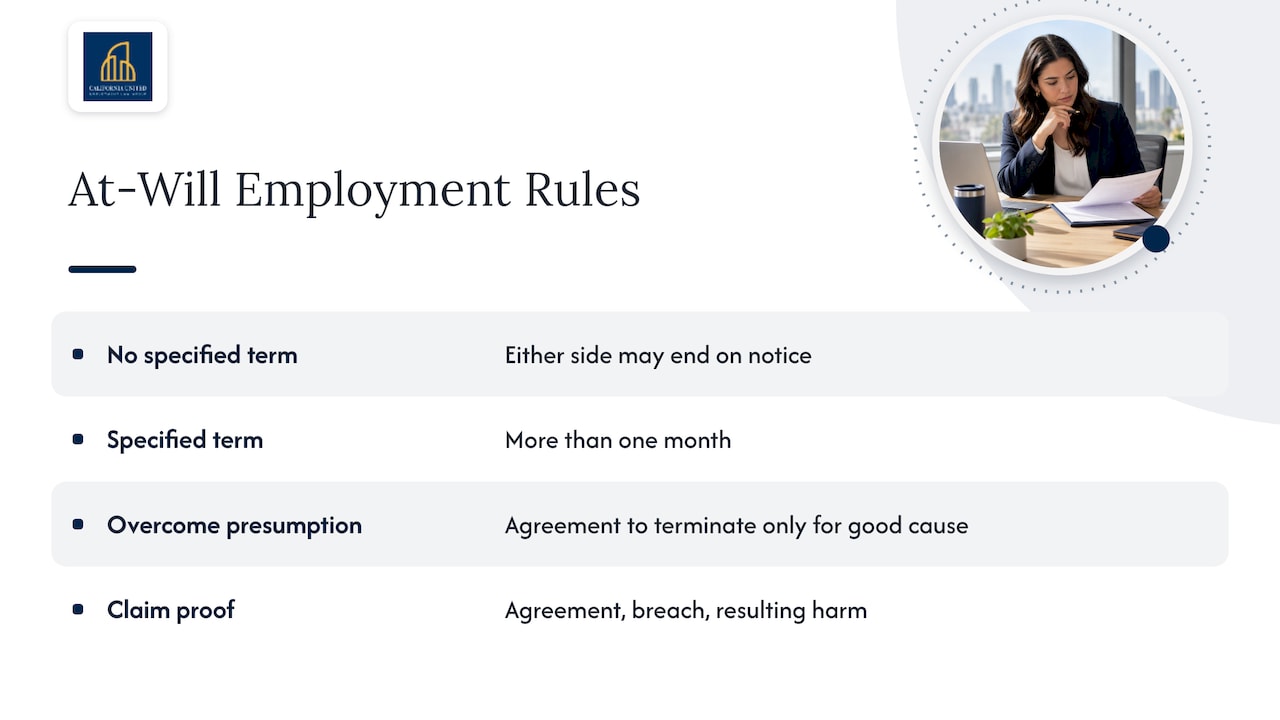
Most Culver City jobs, from studio and media work to retail, healthcare and tech, begin under California’s default rule. Under Labor Code Section 2922, employment with no specified term may be ended by either side on notice to the other. The same section treats employment for a specified term as a period greater than one month.
That is a presumption, not a wall. California courts have recognized that an employee can overcome it by showing an express or implied-in-fact agreement that the employee would be let go only for good cause. In Stillwell v. Salvation Army (2008) 167 Cal.App.4th 360, the court explained that an employer and an employee are free to depart from the at-will presumption by an express or implied agreement that the employee will be terminated only for good cause. Whoever brings the claim still has to prove the agreement, the breach and the resulting harm.
California courts have long recognized these claims. In Foley v. Interactive Data Corp. (1988) 47 Cal.3d 654, the California Supreme Court held that the employer’s personnel policies or practices, the employee’s length of service, actions or communications by the employer reflecting assurances of continued employment, and the practices of the industry may be used to show the existence and content of an employment agreement. In Pugh v. See’s Candies, Inc. (1981) 116 Cal.App.3d 311, the court found evidence of an implied promise not to terminate without cause where an employee had worked 32 years, rising from dishwasher to vice president, had received assurances that his future was secure, and the employer had a policy of not terminating without cause. Parts of Pugh were later disapproved on other grounds in Guz v. Bechtel National, Inc. (2000) 24 Cal.4th 317.
So the real question is rarely “Do I have a contract?” It is usually “What exactly was promised, by whom, and in what form?”
What counts as an employment contract
Many people picture a signed document with a salary and a start date. A contract claim can be broader than that. The California jury instructions on this claim, CACI Nos. 2401 and 2403, recognize that a promise to discharge only for good cause can be created by the parties’ words or conduct. In practice, a court looks at several kinds of agreement.
Written agreements
Offer letters, employment agreements, bonus or commission plans and separation terms can all contain promises. A written agreement may set a term of employment, require cause for termination, or promise specific pay or benefits.
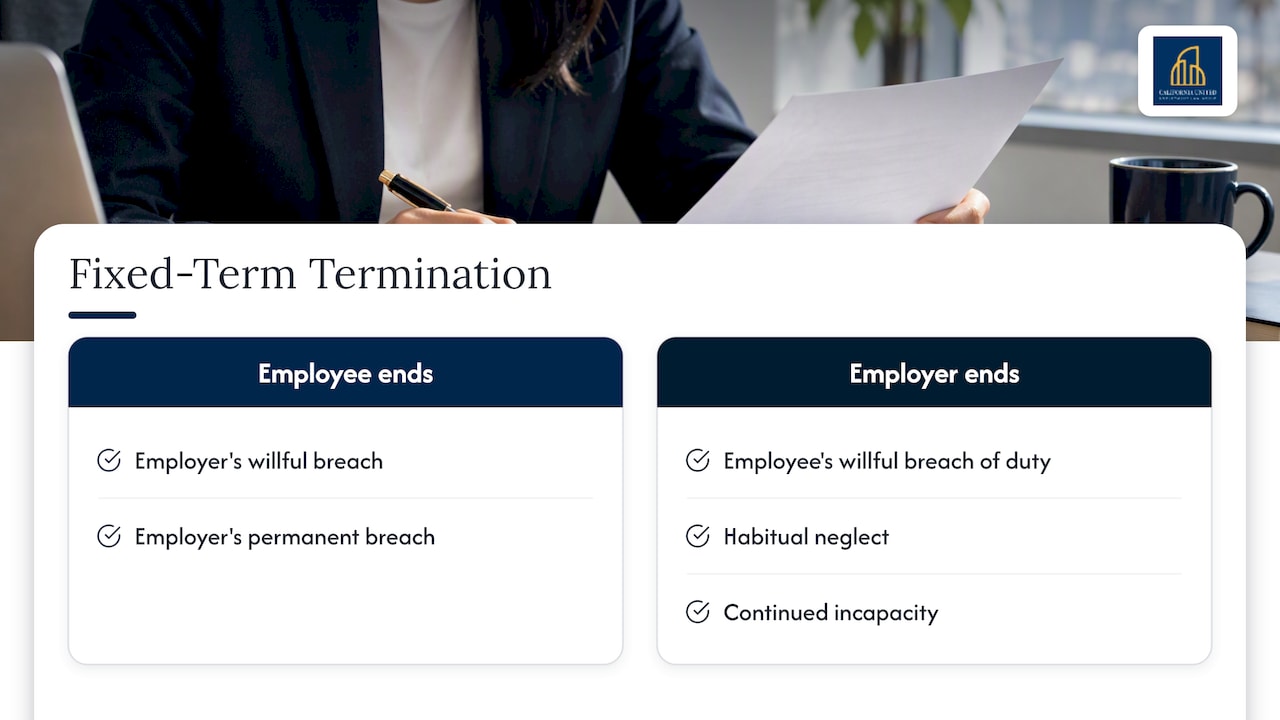
For a fixed-term agreement, the Labor Code speaks to both sides. Section 2925 allows an employee to end a specified-term contract if the employer commits a willful or permanent breach of its obligations. Section 2924 lets an employer end such a contract for the employee’s willful breach of duty, habitual neglect or continued incapacity to perform the work.
Oral promises
A supervisor may have said that you would have the job as long as you performed well, or that a project would be guaranteed for a set period. Spoken promises can matter, but they are harder to prove, which is why dates, witnesses and follow-up messages often come up.
Implied agreements
An implied-in-fact agreement comes from the whole relationship. Courts consider the totality of circumstances, including personnel policies, how long you worked there and what the employer communicated. A handbook that describes a progressive discipline process, years of strong reviews, or assurances of job security are the kinds of facts that can be examined. These factors are weighed together, though. In Guz v. Bechtel National, Inc. (2000) 24 Cal.4th 317, the California Supreme Court held that the mere passage of time in the employer’s service, even when marked by signs that the employer approves of the employee’s work, cannot alone create an implied contract that the employee is no longer at will. By contrast, in Faigin v. Signature Group Holdings, Inc. (2012) 211 Cal.App.4th 726, a board chairman’s statements that the general counsel could expect to be employed there for the rest of his career were treated as evidence of an implied promise to terminate only for cause.
When a written at-will clause changes the picture
This is where claims are most often lost. The California Supreme Court held in Dore v. Arnold Worldwide that a clear, unambiguous at-will provision in a written contract the employee signed cannot be overcome by evidence of an earlier or contemporaneous implied agreement requiring good cause. There are limits to that rule. A later agreement can modify an at-will arrangement, and the Stillwell court recognized that an employee may challenge whether an at-will agreement was properly executed. If you signed something that says your employment is at-will, that language deserves careful review by a lawyer before you assume a good-cause promise exists.
What a breach of contract claim usually has to show
The CACI No. 2401 instruction lists what a plaintiff must prove for a claim where the contract has no specified term. A claim based on a fixed-term contract follows a different instruction, CACI No. 2420. In plain language:
- An employment relationship existed between you and the employer.
- The employer promised, by words or conduct, to discharge you only for good cause.
- You substantially performed your job, unless you were excused or prevented from doing so.
- The employer discharged you.
- You were harmed.
- The breach was a substantial factor in causing that harm.
Each element is a question of evidence. A claim can be strong on the promise and weak on the harm, or the reverse. That is one reason a general article cannot tell you whether your situation qualifies.
Employer actions that may be breaches
The most familiar example is a discharge without good cause under an agreement that required it. Others can arise depending on what the agreement says:
- Ending a fixed-term contract early without the cause the contract requires.
- Failing to pay agreed compensation, such as a promised bonus or commission.
- Changing core terms the agreement fixed, such as the role or pay structure.
- Ignoring a termination procedure the agreement or a binding policy set out.
A resignation does not always end the analysis. CACI No. 2401 notes that an employee may be constructively discharged when an employer intentionally creates or knowingly permits intolerable working conditions that leave a reasonable person with no real choice but to resign. Constructive discharge is a demanding standard, and it turns on specific facts.
Evidence that tends to matter
Without suggesting what any one case needs, these are the kinds of records that commonly come up when a promise and a breach are examined:
- Offer letters, employment agreements and any amendments.
- Employee handbooks, policy acknowledgments and discipline procedures.
- Emails, texts or performance reviews that describe job security or the reasons for termination.
- Termination letters and any stated reason for the decision.
- Pay records tied to promised compensation.
- Anything you signed that mentions at-will status, arbitration or releases.
Keep what you lawfully have access to, and avoid taking confidential materials that are not yours. A lawyer can explain what is appropriate in your situation.
How a contract claim differs from other workplace claims
People often search for a “breach of contract” when what happened could fit several legal categories. The California Courts Self-Help Guide on employment cases notes that employment disputes can involve unpaid wages, wrongful termination, discrimination, harassment and workplace safety, that some issues overlap, and that state or federal agencies may be able to help.
| Type of claim | What it is generally about | Typical starting point |
|---|---|---|
| Breach of employment contract | A broken promise in a written, oral or implied agreement | Court or arbitration, depending on the agreement |
| Wrongful termination | A firing that violates law or public policy | Depends on the legal basis |
| Discrimination or harassment (FEHA) | Treatment based on a protected characteristic | Civil Rights Department complaint |
| Retaliation | Adverse action after a protected complaint or activity | Depends on the underlying law |
| Wage and hour | Unpaid wages, overtime, meal and rest issues | Labor Commissioner (DLSE) or court |
These claims are not mutually exclusive. A single termination might involve a broken good-cause promise and also a retaliation question. If you want to read about related Culver City situations, our pages on workplace retaliation in Culver City and unequal pay cover those topics, and our overview of breach of contract and fraud in employment goes deeper on contract theories.
Deadlines, agencies and arbitration
Time limits for contract lawsuits
The California Courts guide on breach of contract explains that lawsuits generally must be filed within four years for a written contract and two years for a verbal contract, counted from the date the agreement was broken. Those are general periods. Your facts, the type of claim and any related claims can change the calculation, so do not treat them as your personal deadline.
Agency complaints for related claims
If your situation also involves discrimination under the Fair Employment and Housing Act (FEHA), the Civil Rights Department (CRD) is the agency involved. Its published guidance says complaints must be filed within three years of the last act of discrimination. The same guidance describes the CRD as an objective fact-finder that tries to help the parties resolve disputes voluntarily, and that it may file a lawsuit after mandatory mediation if it finds sufficient evidence and settlement efforts fail.
For unpaid wages, the Division of Labor Standards Enforcement handles claims through conferences and hearings, as its wage claim procedures describe, aiming to resolve issues informally before court involvement.
Arbitration and mediation clauses
The Self-Help Guide on breach of contract also points out that a contract may require arbitration or mediation before a lawsuit, or make arbitration the only option. Many employment agreements and onboarding packets include such a clause. It does not necessarily end a claim, but it can change the forum, the process and the timeline. Reading the dispute-resolution paragraph of every document you signed is a sensible habit, and a lawyer can tell you what it means for you.
Severance agreements and releases
A contract question often shows up right at separation. Severance offers usually come with a release, and signing one can affect claims you might otherwise bring. If you are weighing an offer, you may want a lawyer to review it first, since the terms could affect claims related to your job. Our employment practice includes severance and separation agreements for that reason.
Remedies: what “recovery” can mean
In contract law, remedies generally aim to put you where you would have been had the contract been performed, often called the benefit of the bargain. What that means in dollars depends on the agreement, your pay, how the harm is measured and other factors. In Guz, the California Supreme Court confirmed that the remedy for breaching an employment agreement is contractual, and there is no tort of bad faith breach of an employment contract. Damages may also be reduced if a court finds the employee could reasonably have reduced the loss, for example by seeking comparable work. Other employment claims can have different remedies, such as back pay or reinstatement, and we do not predict or promise any outcome for a particular case.
What Culver City employees can do now
This is general information about reasonable next considerations, not a legal strategy:
- Gather the documents you already have, such as agreements, offer letters and policies.
- Note which documents mention arbitration, at-will status or a termination procedure.
- Be cautious about signing a release or severance agreement before you understand it.
- Consider speaking with an employment lawyer. The Self-Help Guide itself says it is a good idea to talk with one before pursuing a case in court, and that an agency may need to be contacted first in some cases.
Our perspective
We represent employees only, across California, and our attorneys include lawyers with prior employer-side experience. From that vantage point, the most common mistake we see is assuming one label fits a whole story. Someone says “my employer broke our contract,” when the documents show an at-will clause, but the facts also raise a wage or retaliation question. Or the reverse: someone assumes they were simply fired at will, when a policy, a promise or a fixed-term agreement says otherwise.
The better approach is to read the paperwork, put the events in order and look at every legal avenue that fits. Contract claims can be valuable where the promise is clear, and they can be difficult where an at-will clause is clear. We would rather tell you that plainly than overstate a claim. Every case is different, and nothing here guarantees a result.
— California United Law Group
Talking with a Culver City employment lawyer
If you think your employer broke an agreement, we offer free consultations and case evaluations. We handle employment cases on a contingency fee basis, which means our attorney’s fees are paid from a settlement or award, and you owe no attorney’s fees unless we recover compensation for you. Your written fee agreement will explain how case costs are handled, including whether you may be responsible for any costs if there is no recovery. Our Culver City employment lawyers page describes how we work, and you can see the full range of matters on our employment law page.
👉 Contact us to discuss your situation
FAQ
Can I sue if I was fired but never signed a contract?
Possibly. California recognizes implied-in-fact agreements that can limit termination to good cause, based on things like policies, length of service and employer statements. Length of service or good reviews alone are generally not enough. Courts look at the full circumstances, and a signed at-will clause can defeat this theory, so the details matter.
Does an at-will clause in my offer letter end my claim?
Not always, but it can. Under the California Supreme Court’s Dore decision, a clear written at-will provision you signed cannot be overcome by an implied agreement requiring good cause. Whether the agreement was properly executed or later modified can still matter. Other claims, such as discrimination, retaliation or unpaid wages, are separate questions.
How long do I have to file a breach of contract lawsuit?
The California Courts guide says generally four years for written contracts and two years for verbal ones, from the date of the breach. Related claims may have different deadlines, and individual facts can change the analysis, so confirm your timeline with a lawyer.
What if my contract requires arbitration?
Some contracts require arbitration or mediation before a lawsuit, or make arbitration the only route. The clause affects where the dispute is decided, not necessarily whether you have a claim. A lawyer can review the exact wording.
Is a breach of contract claim the same as wrongful termination?
No. A contract claim rests on a broken promise in an agreement. Wrongful termination, discrimination and retaliation rest on other legal grounds, though one situation can support more than one claim.
Sources
- Labor Code Section 2922
- Labor Code Sections 2924 and 2925
- Stillwell v. Salvation Army (2008)
- Dore v. Arnold Worldwide (2006)
- CACI No. 2401, Breach of Employment Contract
- California Courts Self-Help Guide: Employment related cases
- California Courts Self-Help Guide: Breach of contract
- California Civil Rights Department guidance on disability discrimination
- DLSE wage claim processing policies