
If you work in Los Angeles and have been labeled an independent contractor, that label may not control your rights. Under California law, many workers classified as contractors may legally qualify as employees, which can open the door to unpaid wages, overtime, meal and rest break premiums, and penalties.
Los Angeles employees generally have three main paths to challenge misclassification: filing a wage claim with the California Labor Commissioner’s Office, requesting review through the Employment Development Department, or pursuing a private lawsuit with an employment attorney. The right option depends on the facts of the work arrangement, the amount owed, and whether the case involves related issues such as retaliation, discrimination, or a broader company-wide classification policy.
TL;DR:
- Los Angeles workers can challenge independent contractor misclassification through a DLSE wage claim, an EDD reclassification review, or a private lawsuit.
- California’s ABC test generally places the burden on the hiring entity to justify contractor status.
- A signed contractor agreement or 1099 form does not automatically make someone an independent contractor.
- Successful claims may recover unpaid wages, overtime, missed meal and rest break premiums, waiting time penalties, and other penalties.
- EDD findings can affect payroll tax liability and unemployment eligibility, but they do not automatically resolve wage claims.
- Workers should gather pay records, schedules, contracts, messages, and other evidence before filing.
- Deadlines matter, so employees should evaluate their options as early as possible.
Table of Contents
- California’s Legal Standard for Worker Classification
- Filing a DLSE Wage Claim for Misclassification
- EDD Reclassification, Audits, and Tax Consequences
- Remedies Available and Penalties Employers Face
- Statutes of Limitations and Why Timing Matters
- Protecting Your Claim: Evidence and Retaliation Safeguards
- Getting Legal Help From California United Law Group
- Employee Versus Contractor Rules Specific to Los Angeles
- Requesting a Hearing or Appeal Through State Agencies
- Private Lawsuits and Class Actions for Misclassification
- Worker Advocacy Resources in Los Angeles
- Finding Legal Counsel or Low-Cost Legal Aid
- A Local Perspective on Misclassification Patterns
- Contact California United Law Group About Your Misclassification Claim
- FAQ
California’s Legal Standard for Worker Classification
California uses the ABC test to determine whether many workers should be classified as employees or independent contractors. Under this standard, the hiring entity must generally prove all three of the following:
- The worker is free from the control and direction of the hiring entity in performing the work.
- The worker performs work outside the usual course of the hiring entity’s business.
- The worker is customarily engaged in an independently established trade, occupation, or business of the same nature as the work performed.
This standard comes from the California Supreme Court’s decision in Dynamex Operations West, Inc. v. Superior Court, which reshaped California worker classification law by adopting the ABC test for certain wage order claims. California later codified the ABC framework through AB 5 and Labor Code section 2775. In some occupations and business relationships, exceptions may apply and courts may instead look to the older multifactor approach from S.G. Borello & Sons, Inc. v. Department of Industrial Relations.
The key point is simple: a job title, 1099 form, or independent contractor agreement does not end the analysis. California agencies and courts look at how the work relationship operates in practice, including who controls the schedule, who directs the work, whether the work is central to the business, and whether the worker truly operates an independent business.
Filing a DLSE Wage Claim for Misclassification
The California Labor Commissioner’s Office, also known as the DLSE, provides an administrative process for workers seeking unpaid wages and related penalties. This path is often less formal and less expensive than filing a lawsuit, and workers can file without an attorney. However, legal guidance can help employees organize evidence, calculate damages, and present the claim clearly.
A DLSE wage claim usually involves these steps:
- Submit a wage claim describing the work performed, the pay arrangement, and why the worker believes they were misclassified.
- Attend a settlement conference or hearing where both sides may present evidence.
- Receive a decision that may award unpaid wages, overtime, meal and rest break premiums, or penalties.
- Take enforcement steps if the employer does not voluntarily pay an award.
The DLSE may also award waiting time penalties when final wages were not paid on time after separation and penalties for inaccurate wage statements. These claims are especially important for misclassified workers because contractors are often denied the wage protections that employees should receive.
Requesting EDD Reclassification Review
The Employment Development Department plays a different but related role. While the DLSE focuses on wages owed to the worker, the EDD focuses on payroll tax compliance, unemployment insurance, and whether the employer should have treated the worker as an employee for tax and benefit purposes.
A worker may come before the EDD in several ways. Filing for unemployment benefits after a job ends can cause the EDD to examine whether the worker was actually an employee, even if the employer issued a 1099. A worker may also request a preliminary employment status assessment through EDD Form DE 230.
An EDD determination can affect unemployment eligibility and may expose the employer to payroll tax assessments, interest, and other consequences. However, an EDD finding does not automatically resolve a wage claim or lawsuit. Workers may still need to pursue unpaid wages through the DLSE or the courts.
Filing a Private Lawsuit
A private lawsuit may be appropriate when the unpaid wages are substantial, when administrative remedies are not enough, or when the case involves related claims such as retaliation or discrimination. A lawsuit may also be the better route when misclassification affected a group of workers under the same company policy.
For example, if an entire delivery fleet, sales team, cleaning crew, or group of gig workers was classified the same way, a class action or representative action may allow workers to challenge the practice collectively. This can be more efficient than requiring each worker to bring an individual claim.
Private litigation usually takes longer than a DLSE claim and involves more formal procedures, but it can address broader harms and systemic violations.
Remedies Available in a Misclassification Claim
When a misclassification claim succeeds, the financial consequences can extend beyond unpaid regular wages. Depending on the facts, workers may be able to recover:
- Unpaid minimum wages.
- Unpaid overtime.
- Meal and rest break premiums.
- Waiting time penalties.
- Wage statement penalties.
- Reimbursement for business expenses.
- Interest and other statutory penalties.
- Additional remedies if retaliation occurred.
For employers, misclassification can also trigger EDD payroll tax assessments, civil penalties, and exposure across multiple workers if the classification practice was widespread.
Why Timing Matters
Deadlines can determine which claims remain available. Many wage claims are subject to a three-year limitations period, though claims involving written contracts or specific statutory penalties may follow different deadlines. A private lawsuit and an administrative claim may also have different timing rules.
Because deadlines depend on the type of claim, the pay arrangement, and when the violations occurred, workers should not wait until records disappear or witnesses become difficult to locate. Early review can help preserve options.
Evidence That Can Strengthen a Misclassification Claim
Strong documentation often determines whether a claim succeeds. Workers should gather and preserve:
- Paystubs, 1099s, invoices, bank deposits, or other payment records.
- Work schedules, shift assignments, dispatch records, or app-based logs.
- Text messages, emails, or app communications showing supervision or control.
- Contracts, onboarding materials, handbooks, or platform terms.
- Records showing required uniforms, tools, training, routes, or procedures.
- Names of coworkers, supervisors, or managers who can confirm how the work relationship functioned.
Workers should keep personal copies of records whenever possible. Employer-held records may become harder to obtain once a dispute begins.

Retaliation Protections
California law prohibits employers from retaliating against workers who assert wage rights, file claims, or cooperate with agency investigations. Retaliation can include termination, reduced hours, demotion, threats, discipline, or other adverse actions connected to the worker’s complaint.
If retaliation occurs after a worker raises classification or wage concerns, that conduct may create additional legal claims. Workers should document what happened, when it happened, who was involved, and any connection to the wage complaint or agency filing.
Employee Versus Contractor Rules in Los Angeles
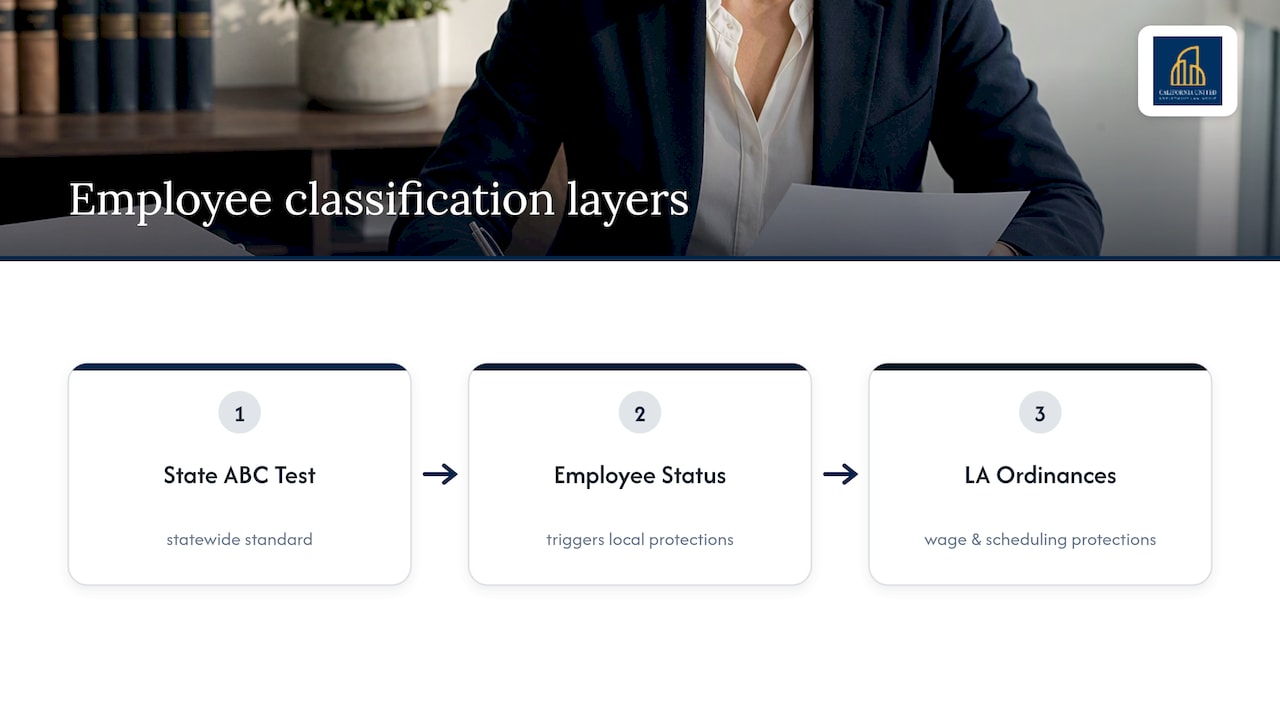
Los Angeles does not use a separate classification test that replaces California’s statewide rules. The ABC test and its exceptions generally control whether a worker should be treated as an employee or independent contractor.
Where Los Angeles matters is in the additional protections that may apply once a worker is properly classified as an employee. Local wage, scheduling, and industry-specific protections may add another layer of rights for certain workers and employers. A misclassified worker may have been denied both statewide wage protections and applicable local protections.
Choosing the Best Path
Each route serves a different purpose:
- A DLSE wage claim can be useful for recovering unpaid wages and penalties through an administrative process.
- An EDD review can help address employment status for unemployment insurance and payroll tax purposes.
- A private lawsuit may be appropriate for larger claims, retaliation, discrimination, or company-wide misclassification practices.
The best approach depends on the amount owed, the available evidence, whether multiple workers were affected, and whether the worker needs remedies beyond unpaid wages.
Getting Legal Help From California United Law Group
Misclassification cases often involve overlapping wage, tax, and retaliation issues. An employment attorney can help evaluate whether the ABC test applies, identify potential exceptions, calculate unpaid wages, and determine whether a DLSE claim, EDD request, private lawsuit, or class action is the strongest path.
California United Law Group represents employees in wage and hour disputes, including misclassification, unpaid overtime, missed meal and rest break premiums, and related class action matters. The firm offers free case evaluations and works on a contingency fee basis, meaning clients pay nothing unless a settlement or award is secured.
If you believe you were misclassified as an independent contractor, understanding your options is the first step. Speaking with an employment attorney can help you determine whether your classification was lawful and what remedies may be available.
This article provides general information, not legal advice. Consult a qualified employment lawyer about your specific circumstances before taking action.
FAQ
How much can you sue an employer for misclassification?
There is no fixed amount. Recovery depends on unpaid wages, unpaid overtime, missed meal and rest break premiums, penalties, business expense reimbursement, and the length of the misclassification period.
How do you correct employee misclassification?
Correcting misclassification may involve filing a DLSE wage claim, requesting EDD review, or pursuing a private lawsuit. The right path depends on the amount owed, the available evidence, and whether the case involves broader legal issues.
Does a 1099 mean I am an independent contractor?
No. A 1099 form does not decide worker status. California looks at the actual working relationship, including control, the nature of the work, and whether the worker operates an independent business.
What penalties can employers face for misclassifying employees in California?
Employers may face liability for unpaid wages, overtime, meal and rest break premiums, wage statement penalties, waiting time penalties, payroll tax assessments, interest, and civil penalties. The exact exposure depends on the facts and the agencies or claims involved.