
Yes. Santa Monica employees, including fathers, can pursue claims when parental leave or workplace treatment is less favorable because of sex or caregiver status. Federal law under Title VII, the Pregnancy Discrimination Act, and the FMLA, California law under FEHA and CFRA, and Santa Monica’s paid parental leave policy for eligible city employees may all play a role. If you believe you were treated unfairly, start by gathering your documents and consider consulting an employment attorney promptly about administrative filing deadlines and your options.
TL;DR:
- Fathers may have discrimination or leave-interference claims if bonding leave or related benefits are less favorable than those offered to similarly situated mothers, while pregnancy-disability leave may lawfully differ because it addresses physical disability related to pregnancy or childbirth.
- Employers may defend different treatment by pointing to legitimate, nondiscriminatory reasons or to medical differences related to pregnancy disability, but those reasons must be evaluated against the policy language, timeline, and evidence.
- Building a claim requires collecting policies, communications, pay records, and a clear timeline connecting leave requests with adverse actions to challenge unjust treatment effectively.
- Eligible City of Santa Monica employees may have a defined paid parental leave benefit, while private sector employees generally must evaluate employer policies, CFRA/FMLA rights, California Paid Family Leave wage replacement, and comparisons with similarly situated coworkers.
- Intersectional factors, such as race or disability, can compound paternity discrimination claims, with California law supporting broader protections beyond sex-based treatment alone.
Table of Contents
- Federal and California law that supports paternity discrimination claims
- Santa Monica Paid Parental Leave and employer policies: what to check in your handbook
- When unequal treatment is unlawful: claim patterns, evidence, and common defenses
- Documenting, filing, and timelines: CRD, EEOC, and Right-to-Sue basics
- How California United Law Group supports Santa Monica employees with paternity discrimination claims
- Differences in protections for public sector vs private sector employees in Santa Monica
- Potential intersection of paternity discrimination with other protected categories
- Examples of paternity-discrimination and parental-leave authorities
- How Santa Monica local ordinances beyond state law may provide additional protections or resources
- Firm perspective: common misconceptions and practical reassurance
- Contact California United Law Group for a consultation
- Sources
- FAQ
Federal and California law that supports paternity discrimination claims
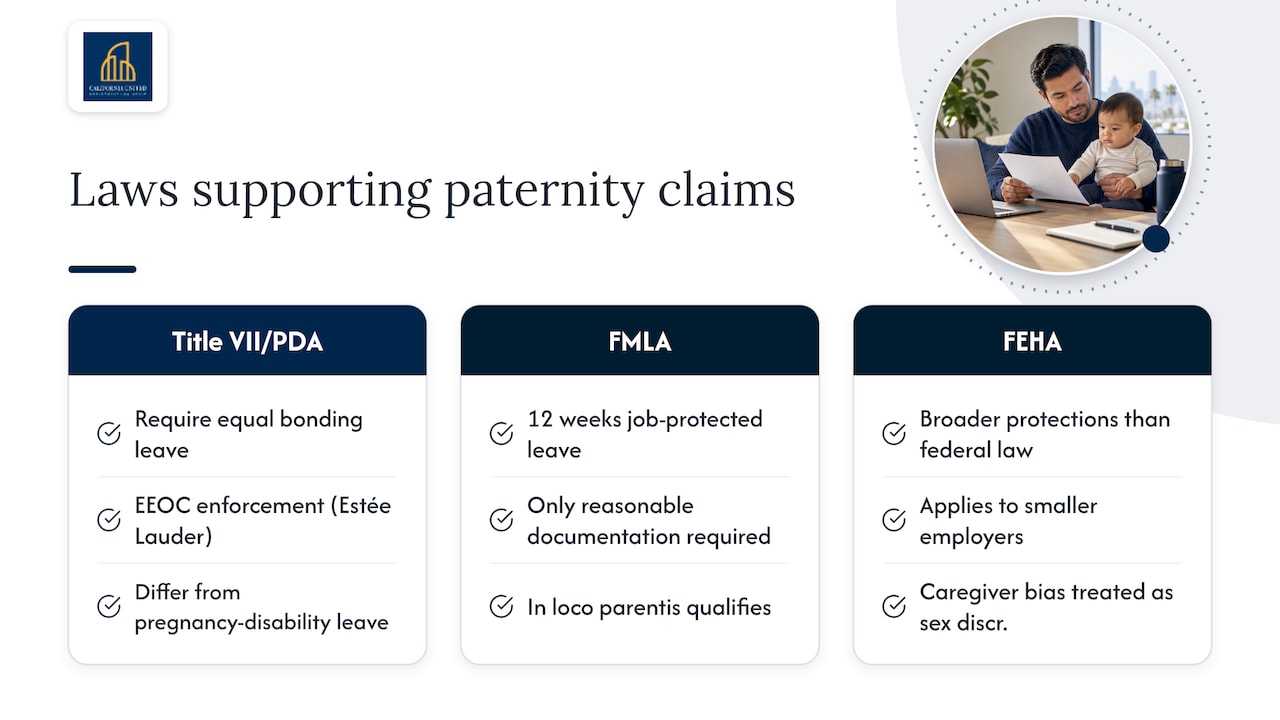
Title VII generally prohibits sex discrimination, and when an employer voluntarily provides parental or childcare leave, that leave should be offered on a nondiscriminatory basis to both men and women; pregnancy-disability leave remains a separate category tied to pregnancy, childbirth, or related medical conditions. The EEOC’s enforcement action against Estée Lauder illustrates this principle in practice: the agency pursued the company after it offered new fathers substantially less paid parental leave than new mothers, along with fewer return-to-work benefits. Courts have also recognized the same nondiscrimination principle in the parenting-leave context. In Schafer v. Board of Public Education of the School District of Pittsburgh, Pennsylvania, the court recognized that voluntarily offered parenting or childcare leave must be provided on a nondiscriminatory basis to both men and women. That case shows regulators will act when a leave program treats fathers as an afterthought.
The Family and Medical Leave Act and California Family Rights Act add separate layers of job-protected leave protection for eligible employees. Eligible employees can generally take up to 12 weeks of job-protected leave to bond with a newborn, adopted child, or foster child, subject to eligibility, notice, documentation, and timing requirements. Documentation requirements depend on the applicable law and the employer’s policy, but bonding leave is not limited to birth mothers. In some circumstances, an employee standing in loco parentis may qualify for protected leave.
California’s Fair Employment and Housing Act (FEHA) generally extends broader protections than federal law and applies to smaller employers than Title VII does. FEHA prohibits discrimination based on sex and other protected characteristics, and caregiver-related unequal treatment may support a sex-discrimination theory when the facts show the employer treated employees differently because of sex or gender-based assumptions.
One distinction matters throughout this area of law. Pregnancy-disability leave, tied to the physical recovery from childbirth, can lawfully differ from parental bonding leave, which must be offered on equal terms to similarly situated mothers and fathers. Employers sometimes blur that line, and the blurring is often where a father’s claim begins.
Santa Monica Paid Parental Leave and employer policies: what to check in your handbook
The City of Santa Monica offers a paid parental leave program for eligible city employees that may provide up to six weeks of fully paid leave to bond with a new child. That city benefit may sit alongside other applicable leave rights, including FMLA, CFRA, and FEHA protections. Private employers in Santa Monica are not covered by the city employee benefit itself, but their own parental leave policies must still comply with applicable state and federal nondiscrimination and leave laws.
Some workplace policies look neutral on paper but produce unequal results. A handbook might provide leave for employees recovering from childbirth, which can be lawful pregnancy-disability leave, but then also reserve bonding leave or flexible return-to-work benefits for mothers without a medical basis or sex-neutral reason. That second piece is where the policy usually crosses from lawful to questionable.
If you suspect a policy treats you differently as a father, look for:
- The total number of paid and unpaid bonding weeks offered to each parent.
- Whether return-to-work flexibility, such as part-time ramp-up schedules, is available to fathers on the same terms as mothers.
- Any language that assumes only birth mothers need bonding time or caregiving flexibility.
When unequal treatment is unlawful: claim patterns, evidence, and common defenses
Certain patterns show up repeatedly in paternity discrimination claims. A few examples:
- An employer grants full bonding leave to mothers but caps bonding leave for fathers at a shorter period, separate from any pregnancy-disability leave.
- A father requests a flexible return-to-work schedule that mothers routinely receive, and the request is denied without explanation.
- An employee faces a demotion, a poor review, or termination shortly after requesting or returning from bonding leave.
Building a claim depends on the evidence you can gather. Useful documentation includes the written leave policy or handbook, emails and text messages discussing your leave request, payroll and benefits records showing what you actually received, contemporaneous notes about conversations with supervisors, the names of witnesses, and performance records from before and after your leave request. A clear timeline connecting the leave request, employer response, and adverse action can strengthen the factual basis for a claim.
Employers may respond with several defenses. They may argue the decision was based on a legitimate, nondiscriminatory reason unrelated to sex, that the challenged benefit was pregnancy-disability leave rather than bonding leave, that the employee was not eligible for protected leave, or that the same decision would have been made regardless of the leave request. An investigator or court weighs whether the employer’s stated reason holds up against the timeline and the paper trail, or whether it looks like a justification created after the fact.
Pro Tip: Save copies of leave policies and related communications as soon as a dispute arises, since employer portals and shared drives can change or become inaccessible later.
Documenting, filing, and timelines: CRD, EEOC, and Right-to-Sue basics
California employees may need to file with the Civil Rights Department, the EEOC, or another agency depending on the legal theory, employer, and facts, and the agencies coordinate on many discrimination claims. Filing deadlines are limited, so acting promptly preserves your options rather than leaving a claim to expire on the calendar.
In some CRD matters, requesting an immediate Right-to-Sue notice may allow the employee to proceed to court without waiting for a full agency investigation. That path can speed access to litigation, but it also means forgoing the agency’s own fact-finding process, a trade-off worth discussing with an attorney before you choose it.
Before filing or consulting counsel, it helps to have:
- A written summary of what happened and when, in chronological order.
- Copies of your employer’s leave and parental-benefit policies.
- Any communications about your leave request or return to work.
- Pay stubs or benefit statements showing what leave or pay you actually received.
How California United Law Group Supports Santa Monica Employees With Paternity Discrimination Claims
Legal representation is available for California employees dealing with FEHA and Labor Code matters, including sex and pregnancy discrimination, retaliation, and wrongful termination, from pre-litigation through administrative filings and litigation. An early case evaluation typically focuses on reviewing documentation, identifying applicable leave laws, and discussing whether an administrative filing or direct claim fits the circumstances. Representation may be available on a contingency-fee basis, depending on the case, with attorney’s fees generally tied to a settlement or award; clients should review the fee agreement for responsibility for litigation costs and expenses.
Differences in protections for public sector vs private sector employees in Santa Monica
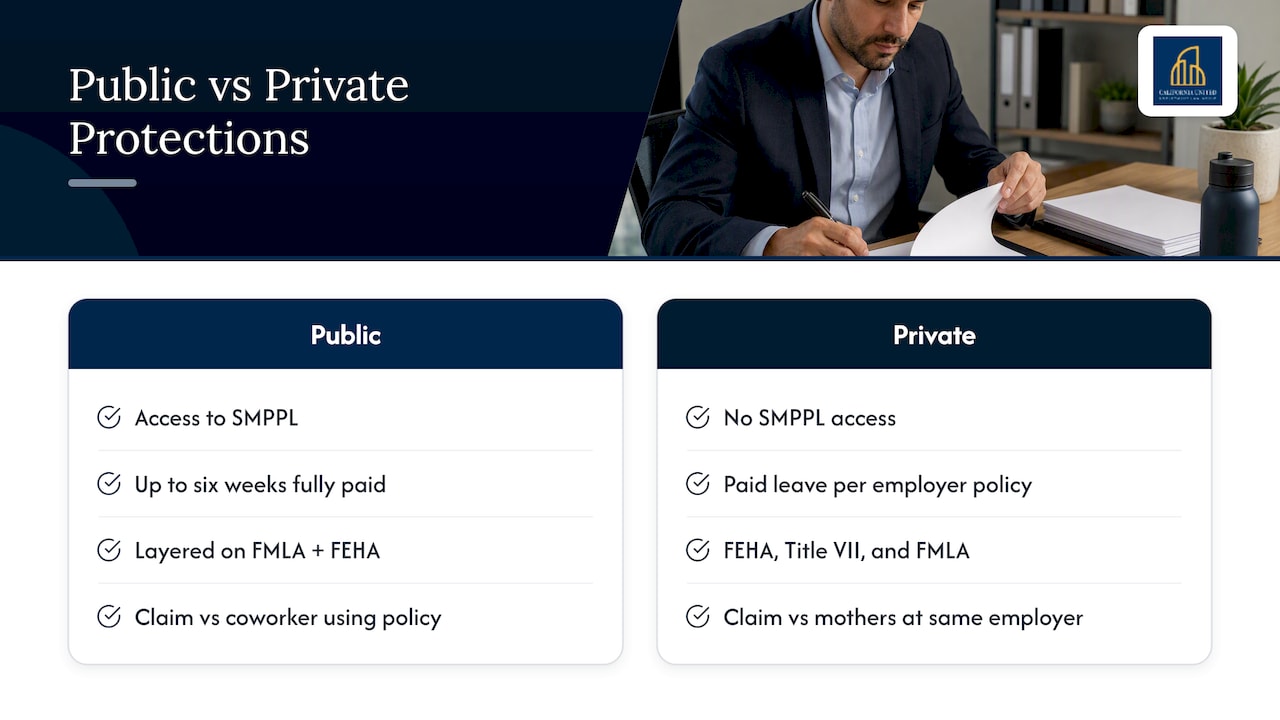
Public and private sector employees in Santa Monica draw on overlapping but distinct sets of protections. City employees who qualify for Santa Monica’s paid parental leave benefit may receive up to six weeks of fully paid parental leave under city policy, potentially alongside FMLA, CFRA, and FEHA rights. That structure gives public employees a clearer baseline to point to when comparing their treatment against a coworker’s.
Private sector employees in Santa Monica do not have access to SMPPL itself, since it is a municipal employee benefit rather than a citywide mandate on private businesses. Their parental leave rights instead may come from FEHA, CFRA, Title VII, the FMLA, California Paid Family Leave wage-replacement benefits, and whatever leave policy their employer has adopted. Because private employer policies vary widely, a private sector father’s claim often turns more heavily on comparing his own leave and return-to-work terms against what the same employer offered similarly situated mothers, rather than on a standardized citywide benchmark.
Both groups share the same basic nondiscrimination principle: bonding leave and related benefits should not be distributed on the basis of sex, whether the employer is a government agency or a private company. The practical difference lies in what documentation is available. Public employees can often point to formal, written city policy, while private sector employees may need to reconstruct their employer’s practice through handbooks, emails, and comparisons with coworkers’ experiences.
Potential intersection of paternity discrimination with other protected categories
Paternity discrimination rarely exists in isolation from an employee’s other protected characteristics. A father who is also a member of another protected class, such as race, disability, religion, age, sexual orientation, gender identity, marital status, military or veteran status, or another protected category, may experience facts that implicate more than one legal theory.
Consider a scenario where a father requesting bonding leave also has a documented disability requiring accommodation. If an employer denies both the leave request and a related accommodation, the resulting claim may draw on FEHA’s disability protections alongside its sex discrimination provisions. Similarly, a father who belongs to a racial or ethnic minority might reasonably ask whether his leave request was treated differently than a colleague’s request due to factors beyond caregiver status alone.
FEHA prohibits discrimination on the basis of several protected characteristics, including sex, race, color, disability, and others, and a single set of facts can sometimes implicate more than one of these categories. When evidence suggests overlapping motives, an employment attorney can help evaluate which legal theories the facts support and how they interact, since overlapping facts may affect which claims are available, what evidence matters, and how the case should be evaluated.
Examples of paternity-discrimination and parental-leave authorities
Court and agency records show how these principles may apply, although outcomes depend on the facts and the specific legal claims. The EEOC’s action against Estée Lauder remains one of the most cited examples nationally: the agency alleged the company’s parental leave program gave new mothers significantly more paid bonding time and better return-to-work support than new fathers received, and the matter proceeded toward resolution under Title VII. The case illustrates that regulators may challenge parental-leave policies that appear to give fathers less bonding leave or fewer related benefits than similarly situated mothers.
California and federal authorities support the principle that parenting or bonding leave, when offered apart from pregnancy-disability leave, should be administered without sex-based distinctions. The California Supreme Court has also recognized that California may provide pregnancy-disability protections that go beyond federal minimum requirements, as in California Federal Savings & Loan Association v. Guerra. While outcomes in any individual case depend heavily on the specific facts, the underlying legal theory, that parental leave benefits must be administered without regard to the employee’s sex, has held up in both federal enforcement and California employment litigation.
These examples do not guarantee a particular outcome in any new matter. Employment discrimination cases are fact-specific, and the strength of a claim depends on the specific policy language, the documentation available, and the timeline of events. They do, however, show that sex-neutral administration of bonding leave is a recognized issue in employment discrimination and leave law.
How Santa Monica Local Resources May Help Employees Evaluate Leave Rights
Beyond FEHA, CFRA, and federal law, Santa Monica maintains employee resources that may matter to a parental-leave dispute, particularly for those who work for the city itself. The City of Santa Monica’s employee leave resources lay out SMPPL eligibility and how it fits alongside other leave entitlements, giving city employees a documented local policy to reference if their actual treatment departs from what the policy promises.
For private sector employees, Santa Monica’s broader municipal employment ordinances, such as local minimum wage and paid sick leave rules, generally do not create a separate city parental-bonding leave claim. A private sector employee may review the city policy for context, but private employers are not required to match the city employee paid parental leave benefit unless another law, contract, or policy requires it.
Local resources can also matter procedurally. Employees working in Santa Monica generally have access to the same state and federal filing agencies as employees elsewhere in California, and the article should not imply that Santa Monica has a separate local paternity-discrimination filing process unless a specific local process is identified. The city’s value here lies mainly in the documented SMPPL standard and its published leave resources, which can serve as a point of comparison when an employee is evaluating whether their employer’s treatment was consistent with the norms established in Santa Monica’s own workforce.
Firm perspective: common misconceptions and practical reassurance
A common misunderstanding is that only mothers have standing to raise a parental leave claim. Fathers may have legal protection when a policy or decision treats bonding leave, rather than medical recovery from childbirth, less favorably because of sex. Documentation built early, even before you are certain a claim exists, tends to preserve options that otherwise fade with time. This section offers general information only, not legal advice, since employment facts vary case by case.
— California United Law Group
Contact California United Law Group for a consultation
If your employer denied you equal bonding leave or treated you differently after a leave request, California United Law Group offers a free consultation to review what happened and discuss potential options. Representation may be available on a contingency-fee basis, depending on the case; attorney’s fees and responsibility for costs are governed by the written fee agreement.
Before your consultation, gather your leave policy documents, any emails or texts about your request, pay records showing the leave you actually received, and a written timeline of events. You can review the firm’s employment law services or contact the firm to request a case evaluation.
This article provides general information for California employees and is not legal advice, does not create an attorney-client relationship, and is not a guarantee of any result. Consult a qualified legal professional about your own circumstances before acting on anything here.
Sources
- Fact Sheet #28B: FMLA leave for birth, placement, bonding, or to care for a child (in loco parentis) | U.S. Department of Labor
- EEOC sues Estée Lauder for sex discrimination | U.S. Equal Employment Opportunity Commission
- Employee leaves | City of Santa Monica
- California Family Rights Act resources from the California Civil Rights Department
- California Paid Family Leave resources from the California Employment Development Department
- Schafer v. Board of Public Education of the School District of Pittsburgh, Pennsylvania
- California Federal Savings & Loan Association v. Guerra
- California Rules of Professional Conduct, Rules 7.1, 7.2, 7.4, and 7.5
FAQ
Can I sue my employer for laying me off while pregnant?
California and federal law generally prohibit terminating an employee because of pregnancy, childbirth, or related medical conditions, but a layoff may still be lawful if it is based on legitimate reasons unrelated to pregnancy or protected leave. Whether a specific layoff was lawful depends on the employer’s stated reason and the surrounding evidence, so a documented timeline and any related communications matter for evaluating a claim.
Do fathers get paid for paternity leave in California?
Pay during paternity or bonding leave depends on the specific leave program an employer offers, since FMLA itself provides job protection rather than pay. City of Santa Monica employees may qualify for up to six weeks of fully paid parental leave under the city policy, while private sector pay during bonding leave depends on the employer’s policy, any applicable wage-replacement benefits such as California Paid Family Leave, and the employee’s eligibility.
Can a job fire you for taking paternity leave?
An employer generally cannot lawfully terminate an eligible employee because the employee took protected bonding leave under applicable law or exercised protected rights under FEHA, CFRA, or the FMLA. Retaliation following a leave request, including termination, demotion, or a sudden negative review, can support a separate legal claim when the timeline and evidence point to the leave request as the cause.
How much paternity leave will California employees have in 2026?
Eligible employees may generally take up to 12 workweeks of job-protected bonding leave under the FMLA and/or CFRA, subject to eligibility, notice, documentation, employer coverage, and timing rules. Eligible City of Santa Monica employees may separately have access to the city’s paid parental leave benefit, subject to the program’s eligibility rules and coordination with other leave rights.