
Yes. West Hollywood employees may have claims under the California Equal Pay Act when they are paid less than employees of another sex, race, or ethnicity for substantially similar work. Depending on the facts, pay discrimination may also support a claim under California’s Fair Employment and Housing Act. Remedies can include unpaid wages, interest, liquidated damages, and sometimes compensatory damages. Your first move: gather your pay stubs and comparator information now, then get a confidential legal read on your situation before any filing deadlines apply.
TL;DR:
- Employees should document their work duties, pay history, and communications thoroughly. Several consecutive pay periods can help show whether a disparity is persistent, but there is no fixed six-month evidence requirement.
- The employer must prove any wage difference is based solely on lawful factors like seniority or merit, not on gender, race, or ethnicity, for the claim to fail.
- Filing options include the Labor Commissioner, the Civil Rights Department, or a private lawsuit, with deadlines typically two years but extended to three in cases of willful violations.
- Evidence such as pay stubs, job descriptions, and performance reviews are crucial, and choosing a comparator with closely overlapping duties improves claim strength.
- Employers cannot lawfully retaliate against employees for exercising Equal Pay Act rights. If an employer takes adverse action within 90 days, California law creates a rebuttable presumption in favor of the employee’s retaliation claim. Keep personal copies of lawful, non-confidential evidence off employer-owned devices to avoid access issues.
Table of Contents
- What laws protect you and what they require
- How to identify whether you have a claim
- Where to file, how the routes differ, and your deadlines
- What you can recover and how cases commonly progress
- Your document checklist and early timeline
- Why specialized California employment counsel helps
- When your claim is strongest, and where it gets harder
- How California United Law Group can help West Hollywood employees
- Sources
- FAQ
What laws protect you and what they require
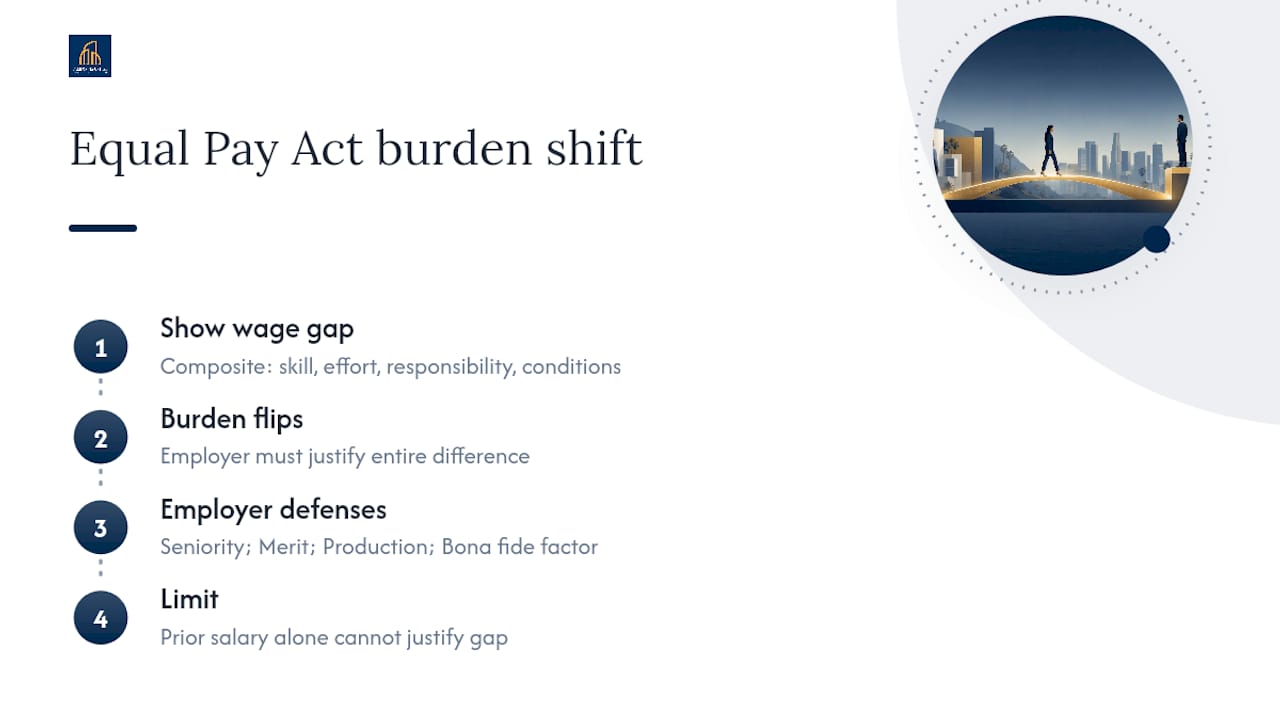
Labor Code §1197.5 bars employers from paying you less than a coworker of another sex, race, or ethnicity for “substantially similar work,” measured as a composite of skill, effort, responsibility, and working conditions. You don’t need an identical job title. You need comparable job content. California jury instructions frame the claim around substantially similar work, considering the overall combination of skill, effort, responsibility, and similar working conditions. Courts also scrutinize whether the employee has selected a proper comparator; in Allen v. Staples, Inc., the court emphasized that the Equal Pay Act does not prohibit all wage variations, only discriminatory wage variations.
Once you establish the required pay disparity for substantially similar work under similar working conditions, the burden shifts to the employer to prove a statutory defense. Your employer must prove the disparity comes entirely from one of four defenses: a seniority system, a merit system, a system that measures production quantity or quality, or a bona fide factor other than sex, race, or ethnicity, such as education or specific experience tied to the role. Critically, the factor must account for the entire wage difference, not just part of it. Prior salary does not justify any disparity in current compensation.
The statute also protects your right to disclose your own wages, discuss wages, ask about another employee’s wages, and encourage another employee to exercise equal pay rights, while no coworker is required to disclose their own pay. West Hollywood employers cannot lawfully retaliate against you for asking a coworker what they earn, and they cannot maintain a policy that forbids the conversation.
How to identify whether you have a claim
Start by comparing job content, not job titles. Two employees with different titles but overlapping duties, similar skill demands, and comparable responsibility can still count as doing substantially similar work under Labor Code §1197.5. If your pay lags behind a coworker who shares that profile and is of another sex, race, or ethnicity, you may have reason to investigate whether the disparity is legally justified.
The evidence that carries the most weight, in rough order of priority:
- Pay stubs covering consecutive pay periods, if available, to help show whether the disparity persisted over time
- Job descriptions for you and your comparator, ideally in the employer’s own language
- Offer letters and any documented starting salary or raise history
- Performance reviews that show comparable output or ratings
- Emails or texts where pay, raises, or comparator duties come up
- Org charts showing reporting lines and role scope
Remember, the 2016 amendments to the Equal Pay Act shifted the burden squarely onto the employer once you establish the pay gap. Your employer must then prove seniority, merit, production, or a bona fide factor accounts for the entire difference.
Pro Tip: When choosing a comparator, resist the urge to pick the coworker with the biggest salary gap. Pick the one whose actual day-to-day duties overlap most closely with yours. A weaker pay gap with a strong, well-documented match beats a dramatic gap with a shaky comparison. Courts may closely examine whether the chosen comparator is appropriate, so the best comparator is usually the employee whose actual work most closely matches yours, not necessarily the highest-paid coworker.
Where to file, how the routes differ, and your deadlines
Depending on the claim, you may have more than one procedural path:
- File with the Labor Commissioner’s Office (DLSE). The agency can investigate, issue a citation, or pursue civil enforcement on your behalf.
- File with the Civil Rights Department (CRD), if your facts support a FEHA discrimination claim. This route can lead to conciliation, a right-to-sue letter, or further civil enforcement depending on the agency process and facts.
- File a private lawsuit. Equal Pay Act claims generally can proceed in court without first exhausting an administrative process, although FEHA claims have separate administrative requirements.
Deadlines matter. Equal Pay Act claims generally have a limited filing period, with a longer period for willful violations. FEHA claims follow a separate administrative deadline process, so employees should confirm which deadline applies before choosing a filing route. One detail that changes the math for a lot of West Hollywood employees: each unequal paycheck counts as its own separate violation, which can extend your recoverable period even for a long-running disparity.
What you can recover and how cases commonly progress
If your claim succeeds, you may recover unpaid wages, interest, and an amount equal to the unpaid wages as liquidated damages under the Equal Pay Act. If your Equal Pay Act claim succeeds, you may recover the unpaid wage balance, interest, an equal amount as liquidated damages, and potentially costs and attorney fees. If the facts also support a FEHA claim, additional remedies may be available on proper proof.
Many cases involve an agency intake, investigation, citation, conciliation, or litigation, but the sequence depends on the claim, filing route, and facts. Potential fee recovery is one factor an attorney may consider when evaluating whether a smaller pay gap is practical to pursue.
One protection worth knowing: if your employer takes an adverse action against you within 90 days of you raising a pay concern or filing a complaint, California law presumes that action was unlawful retaliation. Your employer bears the burden of proving otherwise.
Your document checklist and early timeline
Before you do anything else, protect your evidence. Only preserve documents you can lawfully access and keep. Do not take confidential, privileged, trade secret, or proprietary employer materials without legal advice. Here’s what to collect:
- Consecutive pay stubs covering at least six months, ideally longer
- Your offer letter and any promotion or raise documentation
- Written job descriptions, both yours and your comparator’s
- Dates of every pay change you’ve had
- Emails or texts touching on compensation, workload, or comparator duties
- Names and role details for coworkers you believe are paid more
A realistic timeline for the first four to eight weeks: preserve your records, make a cautious informal inquiry about pay if it feels safe to do so, schedule a confidential attorney intake or a DLSE/CRD intake session, then file your complaint or request a right-to-sue letter. Clear documentation at the intake stage can make it easier for an agency or attorney to understand the claim and identify the key facts.
Pro Tip: Keep personal copies of documents you can lawfully access, such as your own pay stubs, offer letters, job descriptions, performance reviews, and communications, off your work email and off any employer-owned device. If things escalate, you don’t want your evidence trapped behind a login you no longer have.
If your employer retaliates during this window, write down the date, the action, and who was involved immediately. You may have protected rights to discuss wages, but keep communications factual and professional. Document what happened before escalating the issue.
Why specialized California employment counsel helps
California United Law Group handles Labor Code and FEHA claims for California employees, including unequal pay matters, from early case evaluation through litigation when appropriate. The firm may handle qualifying cases on a contingency-fee basis, subject to a written fee agreement. An attorney can help evaluate comparators, prepare administrative filings when appropriate, and analyze the recoverable period for affected paychecks.
That matters because comparator selection and documentation quality can significantly affect how an unequal pay claim is evaluated.
When your claim is strongest, and where it gets harder
The strongest claims often involve a pay gap persisting over time, a comparator with genuinely overlapping job content, and clear documented evidence. Cases get harder when the gap is a one-time anomaly, when your employer has documented, job-related reasons for the difference, or when you can’t identify a clean comparator. If your situation looks close to either extreme, preserve your records today and get a confidential read before deciding your next move.
— California United Law Group
How California United Law Group can help West Hollywood employees
California United Law Group represents West Hollywood employees in unequal pay and FEHA claims and may offer contingency-fee arrangements in qualifying cases. Under a contingency-fee arrangement, attorney fees are typically paid from a settlement or award, but clients should review the written fee agreement to understand whether they may be responsible for litigation costs or expenses. Free consultations may be available for prospective clients who want an initial evaluation before deciding whether to move forward.
If you’re ready to talk, bring what you’ve already collected: consecutive pay stubs, your offer letter, job descriptions, and any communication touching on your pay or your comparator’s role. Read more about unequal pay discrimination specific to West Hollywood, or if you’re weighing an administrative filing against a private lawsuit, our overview of the employment lawsuit process in California walks through both paths. Reach out to schedule a free case evaluation and discuss whether your pay gap may support a legal claim.
Sources
Start with the DLSE’s Equal Pay Act overview for the statute itself, the CRD complaint process page when discrimination beyond pay is involved, and California’s civil jury instructions on Equal Pay Act claims. Helpful case authority includes Allen v. Staples, Inc., which discusses comparator selection and discriminatory wage variations, and Green v. Par Pools, Inc., which CACI cites for the principle that discriminatory intent is not an element of an Equal Pay Act claim.
This article is general information, not a substitute for advice from a qualified lawyer. Consult a qualified legal professional about your own circumstances before acting on anything here. Reading this article or contacting the firm through this website does not create an attorney-client relationship unless and until a written engagement agreement is signed.
FAQ
How do you prove unequal pay?
You show that a coworker of a different sex, race, or ethnicity earns more for substantially similar work, using pay stubs, job descriptions, and communication records. Once you establish that gap, your employer must prove a lawful defense accounts for the entire difference.
What is West Hollywood’s minimum wage?
West Hollywood sets its own minimum wage, which is separate from unequal pay claims and adjusts periodically. Check the City of West Hollywood’s current wage ordinance directly, since minimum wage figures change and aren’t part of the Equal Pay Act analysis.
Can two employees doing the same job be paid differently?
Yes. Employees performing substantially similar work may be paid differently if the employer proves the difference is based on a lawful factor, such as a seniority system, merit system, production-based system, or bona fide job-related factor, and that the factor reasonably accounts for the entire wage differential. If none of those fully explain the gap, the pay difference is unlawful.
Is unequal pay illegal?
Unequal pay based on sex, race, or ethnicity for substantially similar work may violate California’s Equal Pay Act. Depending on the facts, pay discrimination may also support a FEHA claim. Pay differences based on legitimate, job-related factors like seniority or merit are not automatically unlawful.
How long do I have to file an unequal pay claim in West Hollywood?
Equal Pay Act deadlines are generally measured from the violation, with a longer period for willful violations. Because each allegedly unequal paycheck may be treated as a separate violation, employees should act promptly to preserve the largest possible recovery period. Filing sooner preserves more of your recoverable back pay.