
Alhambra employees may be able to pursue religious discrimination and accommodation claims under both Title VII and California’s Fair Employment and Housing Act (FEHA). California law generally provides broader employee protections in this area, including a demanding undue-hardship standard for employers denying religious accommodations. You can file with the EEOC or California’s Civil Rights Department, but strict deadlines apply, so acting promptly matters. Legal counsel often advises employees on exactly these claims.
TL;DR:
- Many Alhambra employers with five or more employees are covered by FEHA and may have to reasonably accommodate an employee’s sincerely held religious belief or practice unless doing so would cause undue hardship.
- Protected religious practices may include dress, grooming, holy day observance, prayer, dietary restrictions, and religious expression, but the law does not require accommodation of conduct that would create unlawful harassment, violate civil-rights laws, or impose undue hardship.
- Employers should engage in a good-faith process to identify feasible accommodations, and employees should try to document that process in writing whenever possible.
- Filing deadlines are strict: employees should report discrimination or accommodation denials promptly to the EEOC or California Civil Rights Department within specified timeframes.
- Many employment law firms offer free consultations and may handle qualifying cases on a contingency-fee basis, though clients should ask whether they may remain responsible for litigation costs.
Table of Contents
- Legal Overview: Title VII and California FEHA Protections
- What Counts as a Protected Religious Practice at Work?
- Reasonable Accommodation and Undue Hardship in California
- How to Report Religious Discrimination and Filing Deadlines
- Remedies Available in a Religious Discrimination Claim
- Practical Steps for Alhambra Employees Facing This Issue
- How California United Law Group Can Help Alhambra Employees
- Examples of Protected Conduct and Common Employer Responses
- Common Types of Religious Discrimination Claims in Alhambra
- Employer Duties Beyond Accommodation: Preventing Harassment
- California Case Law Shaping Religious Discrimination Claims
- Do All Religious Beliefs Get the Same Legal Protection?
- Why California Law Often Favors Accommodation
- Talk to California United Law Group About Your Situation
- Sources
- FAQ
Legal Overview: Title VII and California FEHA Protections
Two separate laws protect Alhambra workers from religious bias on the job, and understanding how they overlap helps you know where you stand.
Title VII of the Civil Rights Act applies to employers with 15 or more employees and prohibits discrimination based on religion, including a duty to reasonably accommodate religious practices. The EEOC enforces Title VII and requires employers to accommodate sincerely held beliefs unless doing so creates an undue hardship on the business.
FEHA covers far more workplaces. California’s law applies to employers with five or more employees, and its protections often run broader than federal law. FEHA explicitly bars religious discrimination in hiring, promotion, discipline, and termination, and it requires accommodation for religious creed, including dress and grooming practices, according to guidance from the California Civil Rights Department.
For Alhambra employees, the practical takeaway comes down to a few things:
- Many local public and private employers fall under FEHA’s five-employee threshold, but coverage depends on the employer and the facts.
- You do not need to choose one law over the other. Many claims proceed under both simultaneously.
- Public-sector employees have additional constitutional considerations layered on top of statutory protections.
- Small employers with fewer than five workers may fall outside some FEHA provisions, but other legal duties may still apply depending on the facts.
What Counts as a Protected Religious Practice at Work?
FEHA and Title VII both define “religion” broadly. It covers organized faiths, but it also covers sincerely held moral or ethical beliefs that function like religion in a person’s life. Under California law, the key question is not whether the belief belongs to a major organized religion, but whether it is sincerely held and occupies a role comparable to traditional religious belief in the employee’s life. Courts don’t require you to belong to a recognized denomination. They ask whether the belief is genuine and religious in nature to the person holding it.
Protected practices typically include:
- Religious dress and grooming, such as head coverings, beards, or specific garments.
- Observance of holy days, Sabbath restrictions, or prayer breaks during a shift.
- Dietary practices tied to faith, including fasting periods.
- Religious speech or expression, up to the point it becomes harassment of coworkers.
- Declining tasks that conflict with a genuinely held belief, when accommodation is feasible.
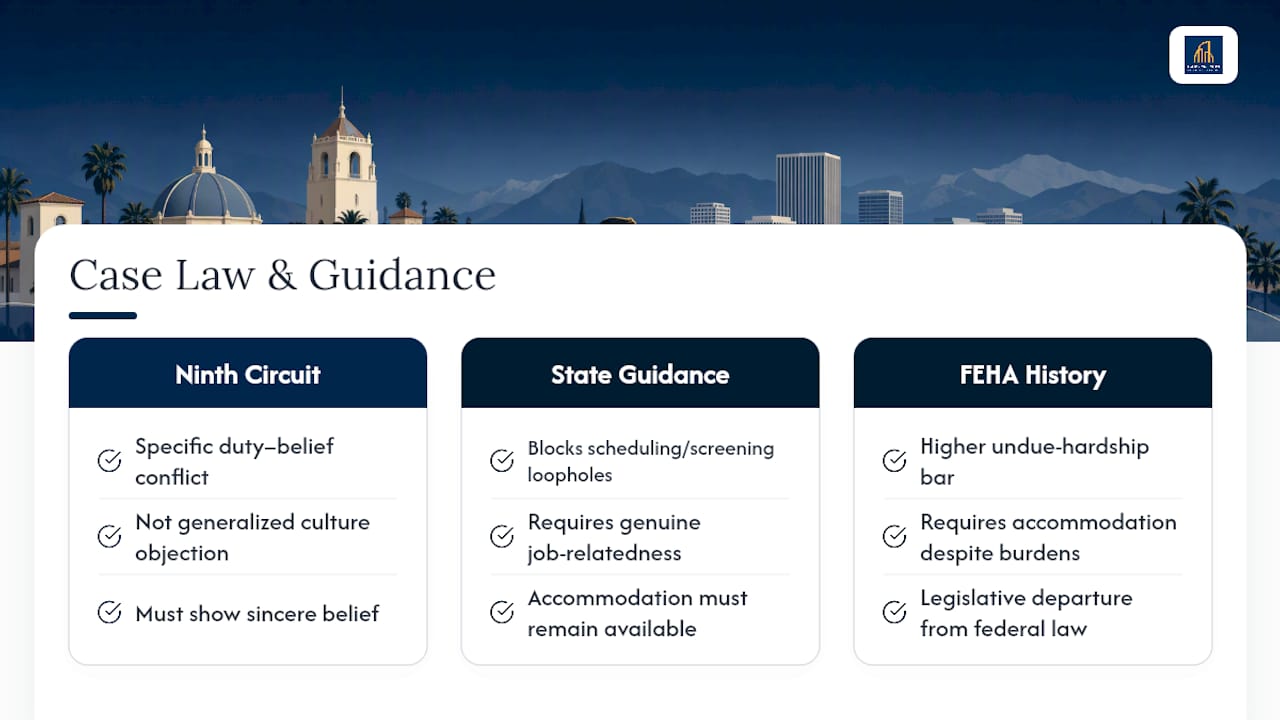
Borderline cases come up often. A worker who asks to swap shifts for a holy day is on solid ground. A worker who repeatedly proselytizes to unwilling colleagues after being asked to stop is not protected in that specific conduct. Courts often look for a concrete conflict between the employee’s religious belief or practice and a job requirement. For example, Rutter cites Tiano v. Dillard Department Stores, Inc., where the Ninth Circuit rejected a religious-accommodation claim because the employee did not show that the timing of her pilgrimage was itself required by her religious beliefs. Rutter discusses Tiano v. Dillard Department Stores, Inc. as an example requiring a conflict between religious belief and job duties. That distinction shapes how agencies and courts evaluate close cases.
Reasonable Accommodation and Undue Hardship in California
Once you make a religious accommodation request, your employer has to engage with it seriously. California law requires the employer to seriously consider available reasonable alternatives for accommodating the religious belief or practice.
Common accommodations include:
- Adjusting schedules to allow for Sabbath observance or holy day attendance.
- Granting exceptions to dress or grooming policies.
- Allowing brief prayer breaks during a shift.
- Reassigning an employee to a different role or location when that genuinely resolves the conflict, does not punish the employee, and does not unlawfully segregate the employee from coworkers or the public.
- Restructuring job duties to remove a task that conflicts with a sincere belief.
The undue-hardship question is where California really separates itself from federal law. Older federal cases were often described as allowing denial of religious accommodations based on more than a minimal burden, but the U.S. Supreme Court later clarified the federal standard in Groff v. DeJoy. California law remains especially protective because FEHA defines undue hardship in terms of significant difficulty or expense. California regulations reject that low bar. Under 2 CCR § 11062, California’s undue-hardship analysis focuses on whether the accommodation would cause significant difficulty or expense, considering the employer’s resources, operations, and the impact of the accommodation. Legal commentary has described this gap as one of the more significant departures California made from federal law specifically to protect religious observance.
That means a vague statement that an accommodation is inconvenient for scheduling may not be enough by itself; the employer generally needs specific facts showing undue hardship. Coworker grumbling about a shift swap, or a manager’s preference for uniformity, rarely rises to the level California law requires.
Pro Tip: Ask your employer to explain, in writing, exactly what specific cost or operational difficulty the accommodation would cause. Vague objections may not satisfy California’s standard, and a written response creates a clearer record either way.
How to Report Religious Discrimination and Filing Deadlines
If informal requests to your employer go nowhere, or if you experience discrimination rather than just a denied accommodation, you may have administrative options through the EEOC, California’s Civil Rights Department, or both, depending on the claim and timing.
- File with the EEOC, the federal agency enforcing Title VII, or with California’s Civil Rights Department, which investigates FEHA violations and can issue a right-to-sue letter.
- Dual filing is common. Because the agencies have work-sharing arrangements, filing with one agency may help preserve related claims, but employees should confirm deadlines and filing requirements for their specific situation.
- Deadlines matter enormously. Administrative deadlines are strict and may run from the date of the discriminatory act, denial, termination, or retaliation, so employees should confirm the applicable EEOC and CRD deadlines as soon as possible.
- Waiting to see if things improve is a common mistake. Evidence fades, witnesses move on, and deadlines don’t pause for a wait-and-see approach.
- Consider legal counsel before filing, particularly if your case involves termination, retaliation, or a denied accommodation with financial consequences. An agency charge and a well-documented legal claim are not always the same thing.
Remedies Available in a Religious Discrimination Claim
Employees who successfully prove religious discrimination or an unlawful denial of accommodation can recover several forms of relief, depending on the facts and forum.
- Back pay for lost wages tied to a wrongful termination or demotion.
- Reinstatement to a former position, in some cases.
- Compensatory damages for emotional distress caused by the discrimination.
- Punitive damages may be available in some cases involving especially wrongful conduct, depending on the defendant and the facts.
- Injunctive relief, such as an order requiring a policy change.
- Attorney’s fees and costs, which can shift the financial calculus of pursuing a claim.
Most claims resolve before trial. Agencies frequently mediate accommodation disputes, and many cases settle once an employer sees the documented denial in writing. Settlement value often depends on many factors, including the strength of the documentation, the harm suffered, the employer’s stated reason, witness support, and any pattern of similar denials toward other employees.
Practical Steps for Alhambra Employees Facing This Issue
Before things escalate, a few concrete steps protect your position and often resolve the issue faster.
- Submit your accommodation request in writing, describing the specific practice or belief and the exact change you need.
- Reference your company’s handbook or policy on religious accommodation, if one exists.
- Keep copies of every email, memo, or text related to the request and your employer’s response.
- Note dates, names of anyone present at relevant conversations, and any witnesses to denials or retaliation.
- Ask HR directly whether the request was denied, delayed, or is still under review, and get the answer in writing.
Watch for red flags: unexplained delays, sudden schedule changes after you raise the issue, or a shift in how you’re treated by supervisors. Those patterns may raise retaliation concerns, which should be evaluated separately from the accommodation issue.
Pro Tip: Save your documentation somewhere outside your work email or work devices. If your access gets cut off during a dispute, you don’t want your evidence locked away with it.
How California United Law Group Can Help Alhambra Employees
Some law firms represent employees in FEHA and Title VII disputes across California, including religious discrimination and accommodation matters. Many work on a contingency-fee basis, meaning attorney’s fees may depend on the case resulting in a settlement or award. Clients should ask whether they may still be responsible for case costs or expenses.
A free initial consultation typically covers the facts of your accommodation request or discrimination experience, the documentation you already have, and a realistic assessment of next steps. There are no guarantees of outcome. Every case turns on its own facts. If you’re facing a denied accommodation, retaliation, or termination tied to your religious beliefs, an employment lawyer serving Alhambra can help you understand your options before deadlines pass.
Examples of Protected Conduct and Common Employer Responses
Protected conduct covers a wide range of everyday workplace moments. A retail employee asking to wear a hijab despite a “no headwear” dress code. A warehouse worker requesting Friday afternoons off for religious observance. An office employee asking for a quiet space to pray during a break.
Employer responses fall into recognizable patterns, and some of them cross legal lines even when they seem like compromises. Outright denial is the most obvious violation: refusing a request without exploring alternatives. Reassignment can be lawful when it genuinely resolves the conflict and doesn’t demote or disadvantage the employee, but it becomes problematic when used punitively.
Segregation is the pattern California regulators scrutinize most closely. That’s when an employer moves an accommodated employee away from customers or coworkers rather than adjusting the actual conflict. For religious dress and grooming practices, California law does not treat segregation from coworkers or the public as a reasonable accommodation. In practice, employers sometimes reach for a minor schedule tweak or a quiet reassignment first, and courts look closely at whether that response actually solved the conflict or just hid it from view.
Common Types of Religious Discrimination Claims in Alhambra
Alhambra’s workforce spans retail, healthcare, logistics, and small business sectors, and religious discrimination claims tend to cluster around a few recurring scenarios in workplaces like these.
Dress and grooming disputes are among the most frequent, particularly in customer-facing retail and food service roles where uniform policies clash with religious garments or facial hair requirements. Scheduling conflicts come up constantly in shift-based industries, where an employee’s request for Sabbath or holy day observance runs into staffing pressures.
Harassment claims form another category entirely, separate from accommodation denials. This includes coworkers or supervisors making derogatory comments about an employee’s faith, mocking religious practices, or excluding someone from workplace opportunities because of their beliefs. Hiring discrimination also appears, sometimes subtly, when a candidate’s religious identity or visible practice becomes a factor in whether they’re hired at all. Each of these fits the same underlying framework: FEHA and Title VII overlap, but they differ in coverage, standards, and procedures. The analysis often starts with whether the employee had a sincerely held religious belief or practice, whether it conflicted with a job requirement, and how the employer responded.
Employer Duties Beyond Accommodation: Preventing Harassment
Accommodation is only part of an employer’s legal obligation. California employers also carry an affirmative duty to prevent religious harassment and discrimination before it starts, not just respond to it after a complaint.
Depending on employer size and applicable rules, prevention efforts may include written anti-harassment policies, distribution of those policies to employees, and supervisor training on recognizing and responding to religious discrimination complaints. Employers are expected to take complaints seriously, investigate promptly, and take corrective action when harassment is substantiated.
A workplace culture that tolerates repeated or serious jokes about an employee’s faith, or allows supervisors to make derogatory comments about religious dress, may create liability even without a formal termination or demotion. Employees experiencing this kind of ongoing harassment don’t need to wait for a single dramatic incident. A pattern of smaller comments or exclusionary behavior may support a claim depending on severity, frequency, context, and whether the employer knew or should have known and failed to act. Documentation matters here just as much as it does in accommodation disputes: dates, specific comments, and who was present all strengthen a potential complaint.
California Case Law Shaping Religious Discrimination Claims
California and federal courts applying California workplace law have emphasized that religious accommodation claims are fact-specific. In California Fair Employment & Housing Commission v. Gemini Aluminum Corp., the employer violated FEHA by refusing time off for a Jehovah’s Witness convention without making a good-faith effort to accommodate the employee. Rutter cites California Fair Employment & Housing Commission v. Gemini Aluminum Corp. for the rule that an employer violated FEHA by refusing time off without initiating a good-faith accommodation effort. By contrast, in Peterson v. Hewlett-Packard Co., the Ninth Circuit held that an employer was not required to allow workplace postings that violated its harassment policy. Rutter discusses Peterson v. Hewlett-Packard Co. as rejecting a claim based on anti-gay workplace postings that violated the employer’s harassment policy. These cases show why employees should identify the specific religious practice, the specific job conflict, the requested accommodation, and the employer’s response.
Do All Religious Beliefs Get the Same Legal Protection?
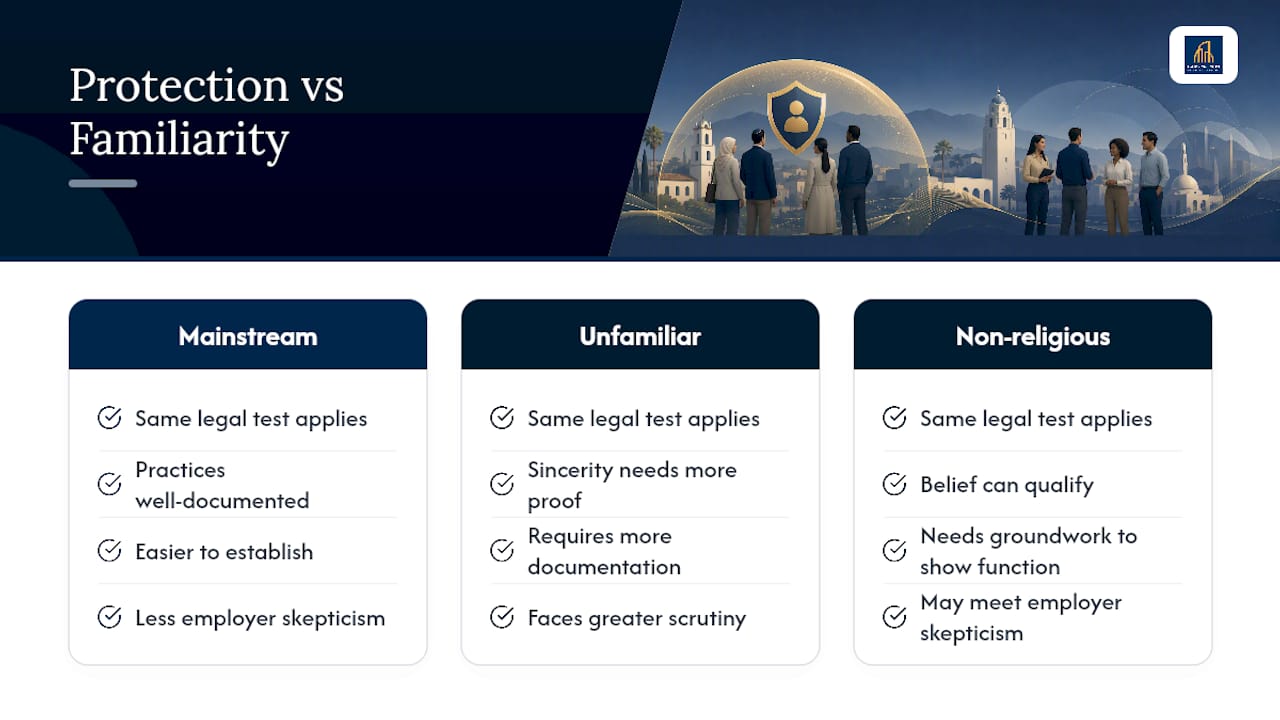
The legal test does not favor major religions over less familiar belief systems, but unfamiliar practices may require more explanation to show sincerity and religious significance. The law protects sincerely held beliefs regardless of whether they belong to a major world religion, a smaller denomination, or a personal moral framework functioning like religion in someone’s life.
Mainstream, well-documented practices, such as Sabbath observance in Judaism or daily prayer in Islam, tend to be easier to establish because courts and agencies have handled similar cases before and understand the practice’s religious basis. Less familiar or newer belief systems sometimes face more scrutiny, not because the law protects them less, but because the sincerity and religious nature of the belief may require more explanation or documentation to establish.
Moral or ethical beliefs may qualify when they are sincerely held with the strength of traditional religious views and function like religion in the person’s life. Employees whose practices sit outside familiar categories, such as unconventional dress requirements or unfamiliar dietary restrictions, sometimes encounter employer skepticism that has nothing to do with the legal merits of the claim. Documenting the sincerity and consistency of the practice becomes especially valuable in these situations.
Why California Law Often Favors Accommodation
Employer inconvenience alone rarely satisfies FEHA’s “significant difficulty or expense” standard, and that gap between federal and California law is easy to underestimate. Employees are often better positioned when they document requests early and escalate in measured steps rather than assuming an initial denial is final. Every case still depends on its specific facts, and outcomes are never guaranteed.
Talk to California United Law Group About Your Situation
Employment law firms represent employees across FEHA and Title VII disputes, including religious discrimination and accommodation denials. Working with an employment lawyer who handles employee-side claims can help ensure the facts are evaluated under California’s specific religious-accommodation standards. Many firms operate on a contingency-fee model, meaning attorney’s fees may depend on the case resulting in a settlement or award. Clients should ask whether they may still be responsible for costs or expenses.
If your employer denied a religious accommodation, reassigned you without explanation, or retaliated after you raised a concern, gather your written requests and any employer responses before reaching out. Then contact California United Law Group to schedule a free consultation and discuss the facts, deadlines, and possible next steps.
This article is general information, not a substitute for advice from a qualified lawyer. Consult a qualified legal professional about your own circumstances before acting on anything here.
Sources
- Religious Discrimination (EEOC)
- Religious Discrimination and Accommodations at Work (California Civil Rights Department)
- California Code of Regulations §11062 — Reasonable Accommodation
- Ninth Circuit opinion (2025)
FAQ
Can I Sue My Employer for Religious Discrimination?
Yes, in many cases, an employee may pursue a lawsuit after satisfying applicable administrative filing requirements and obtaining a right-to-sue notice. The process and deadlines vary by claim type and agency.
Can an Employer Deny a Day Off for Religious Reasons?
An employer may deny a specific schedule request if another reasonable accommodation is available or if granting the request would cause undue hardship under California’s standard. Ordinary staffing inconvenience, without more, may not be enough.
How Do You Prove Religious Discrimination in the Workplace?
Proof often includes the employee’s sincerely held religious belief or practice, the specific job requirement or workplace conduct at issue, the accommodation requested, the employer’s response, and any documents or witnesses showing denial, harassment, or retaliation.
What Qualifies as Religious Discrimination?
Religious discrimination may include unlawfully denying a reasonable accommodation for a sincerely held religious belief or practice, harassing an employee because of religion, or making employment decisions based on religion rather than job-related reasons.
Does FEHA Apply to Small Employers in Alhambra?
FEHA generally covers California employers with five or more employees, a lower threshold than Title VII’s 15-employee minimum. Whether a specific Alhambra workplace is covered depends on the employer and the facts.