
Yes. If you are 40 or older and work in Long Beach, California law may protect you from age-based treatment on the job, and federal law may also apply depending on the size and nature of the employer. FEHA and the ADEA cover hiring, firing, pay, and promotion decisions. File promptly with the CRD or EEOC, preserve every relevant document now, and talk to an employment attorney early, since deadlines and evidence gaps can quietly close doors on a strong claim.
TL;DR:
- California’s FEHA protections apply to employers with five or more employees, offering broader remedies than federal law for age discrimination claims.
- Discrimination can be subtle, such as biased performance reviews, exclusion from opportunities, derogatory comments, or disguised layoffs targeting older workers.
- Preserving documents like performance reviews, pay records, emails, and witness accounts is crucial, as they form the backbone of a strong case.
- Filing deadlines are strict: California FEHA claims generally require filing with the CRD within three years of the last harmful act, while federal ADEA charge deadlines can be shorter and should be evaluated promptly.
- Employers typically defend with performance-based justifications or neutral policies, making consistent documentation key in disproving pretextual reasons.
Table of Contents
- What Are Long Beach Employees’ Rights Against Age Discrimination Under State and Federal Law?
- What Counts as Age Discrimination? Clear Examples and Subtle Forms
- What Evidence to Preserve, and Why It Matters
- Where to File: CRD, EEOC, and the Right-to-Sue Requirement
- What Remedies Are Available in an Age Discrimination Case?
- How California United Law Group Helps Long Beach Employees
- Recognizing the Common Forms of Age Discrimination at Work
- Building a Claim: What Evidence Actually Supports It
- What Legally Constitutes Age Discrimination in California
- Lawful vs. Unlawful Age-Based Employment Decisions
- How Employers Defend Against Age Discrimination Claims
- The Interactive Process and Accommodations for Older Workers
- Who Has to Prove What: Burden of Proof in Age Discrimination Cases
- A Note From California United Law Group
- Talk to California United Law Group About Your Situation
- Official Resources for Long Beach Employees
- Sources
What Are Long Beach Employees’ Rights Against Age Discrimination Under State and Federal Law?
Two separate laws give you protection, and they don’t always cover the same ground. Knowing which one applies to your job matters, because the gaps between them can decide whether you have a claim at all.
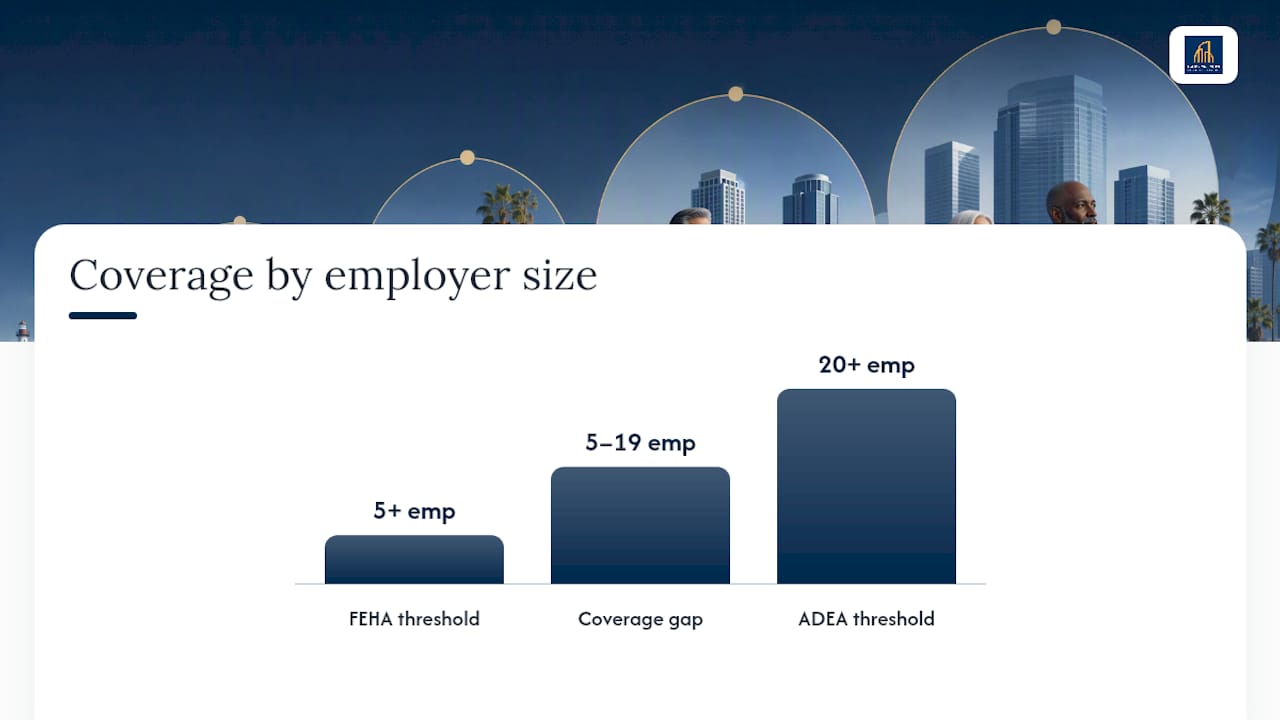
California’s Fair Employment and Housing Act protects job applicants and employees aged 40 and older, and it applies to nearly every private and public employer in the state with five or more employees. The CRD’s fact sheet on age discrimination lists specific prohibited actions, including pay disparities tied to age, denial of promotion, and forced retirement.
The federal Age Discrimination in Employment Act applies to workers age 40 and older and generally covers employers with 20 or more employees. That threshold leaves a real gap for people working at small Long Beach businesses, warehouses, or local shops.
- FEHA: covers employers with 5+ employees; enforced by California’s Civil Rights Department.
- ADEA: covers employers with 20+ employees; enforced by the EEOC; includes protections for OWBPA waiver rules in severance and exit agreements.
- Overlap: many Long Beach employees can pursue claims under both laws simultaneously, since state law frequently offers broader remedies than federal law.
Because FEHA has a lower employer-size threshold and often provides broader remedies, it is frequently a stronger avenue for California employees than an ADEA claim alone.
What Counts as Age Discrimination? Clear Examples and Subtle Forms
Age discrimination isn’t always a manager saying “you’re too old for this.” It shows up in decisions that look neutral on paper but track age underneath.
- Overt discrimination. Getting fired, passed over for hiring, demoted, or denied a promotion where age is identified as the reason, or where the surrounding facts support an inference that age substantially motivated the decision.
- Biased performance reviews. Sudden negative evaluations after years of solid ratings, especially right before a layoff or restructuring.
- Exclusion and marginalization. Being left out of meetings, training, or new projects while younger colleagues get those opportunities.
- Derogatory comments. Jokes about being “out of touch,” “old school,” or “not a culture fit,” particularly from decision-makers.
- Disguised layoffs. A “reduction in force” or reorganization that disproportionately targets older workers while retaining younger employees in similar roles.
Each of these can be lawful in isolation. A single negative review or one skipped promotion doesn’t prove discrimination. The pattern, timing, and comparison to how younger employees were treated is usually what turns a workplace decision into an unlawful one.
What Evidence to Preserve, and Why It Matters
Strong claims are built on paper trails, not memory. What you save now often determines whether a claim can move forward later.
- Personnel files: performance reviews, disciplinary notices, and any documentation of your work history.
- Emails and messages: anything referencing age, retirement, “fresh perspectives,” or comparisons to younger staff.
- Comparative data: pay records, job titles, and promotion timelines for younger coworkers doing similar work.
- Witness accounts: names of coworkers who observed relevant comments or treatment, even if they haven’t agreed to speak yet.
- Contemporaneous notes: a dated, private log of incidents written close to when they happened tends to carry more weight than a reconstructed timeline months later.
Save digital copies outside your work account, since access can be cut off the moment employment ends. Avoid confronting your employer publicly or on social media before speaking with counsel; that can complicate a claim rather than strengthen it.
Pro Tip: Keep a simple dated log, even a few lines per entry, of anything that feels off, whether it’s a comment, a skipped meeting invite, or a change in how you’re treated. Small entries add up to a pattern that’s hard to dismiss later.
Where to File: CRD, EEOC, and the Right-to-Sue Requirement
Employment discrimination claims often require an administrative filing before a lawsuit, and the state and federal paths run on different clocks.
- CRD (California): file an intake with the Civil Rights Department within three years of the last harmful act. CRD investigates and can issue a right-to-sue notice, which you typically need before filing a private lawsuit under FEHA.
- EEOC (federal): ADEA claims require filing an administrative charge before suit, but the deadline and lawsuit timing rules differ from FEHA and should be reviewed immediately.
- Dual filing: many employees try to coordinate CRD and EEOC filings because state and federal claims can overlap, but employees should confirm that the filing actually preserves both FEHA and ADEA rights.
- Timing: CRD’s complaint process requires the intake within three years of the date you were last harmed, and missing that window can end an otherwise valid claim.
An employee can request a right-to-sue notice directly through CRD, but the paperwork and timing decisions around it are exactly where an attorney’s guidance tends to matter most.
What Remedies Are Available in an Age Discrimination Case?
Remedies depend entirely on the facts, evidence, and how the case resolves, whether through settlement, agency action, or litigation. No two outcomes look alike.
- Back pay: wages and benefits lost between the discriminatory act and resolution.
- Front pay: compensation for future lost earnings in some cases.
- Reinstatement: returning to the position, where appropriate and feasible.
- Compensatory and, in limited circumstances, punitive damages: available under FEHA depending on the conduct involved.
- Attorney’s fees and costs: may be recoverable for a prevailing employee, depending on the claim, statute, and outcome.
Courts and agencies weigh the strength of the evidence, the employer’s conduct, and the financial impact on the employee when calculating any award. There’s no fixed “average” payout. Two employees with similar job titles and similar treatment can see very different outcomes based on documentation and how clearly the pattern of discrimination comes through.
How California United Law Group Helps Long Beach Employees
California United Law Group handles FEHA and California Labor Code claims, representing employees from the first consultation through litigation when appropriate.
A consultation typically covers:
- A review of what happened, including dates, communications, and any evidence you’ve already gathered.
- A check of your filing deadlines with the CRD or EEOC so nothing lapses while you’re deciding next steps.
- An honest overview of your options, including whether an administrative filing, negotiation, or litigation fits your situation.
The firm represents employees at every stage of a dispute, not just once a lawsuit is filed, which means Long Beach workers can get guidance early, when preserving evidence and meeting deadlines still matters most.
Recognizing the Common Forms of Age Discrimination at Work
Age discrimination tends to cluster around a handful of decision points: who gets hired, who gets let go, who gets promoted, who gets paid what, and what gets said out loud in the office.
Hiring discrimination often hides behind phrases like “looking for someone with fresh energy” or requirements that seem to screen for youth rather than skill. Firing and layoffs raise flags when older employees are let go in disproportionate numbers during a “restructuring,” especially if younger workers in comparable roles keep their jobs. Promotion decisions become suspect when a consistently strong performer is repeatedly passed over for less experienced, younger colleagues without a documented performance reason.
Pay discrimination shows up when older workers earn less than younger employees doing the same job with similar or less experience. Comments matter too. Remarks about someone being “set in their ways,” jokes about retirement, or references to needing “new blood” can serve as direct evidence of discriminatory intent, especially when they come from a supervisor involved in an adverse decision.
None of these signs alone guarantees a violation occurred. Together, especially when documented and compared against how younger employees were treated, they can form the backbone of a claim.
Building a Claim: What Evidence Actually Supports It
The strongest age discrimination claims rest on comparison. Investigators and courts want to know how you were treated relative to younger coworkers doing similar work.
Comparative treatment evidence can carry significant weight: if a 45-year-old employee is disciplined for conduct that a similarly situated 28-year-old coworker committed without consequence, that difference may support an inference of discrimination. Emails and written communications matter just as much, particularly anything referencing age, retirement plans, or comments about wanting a “younger” team. Performance reviews are another critical piece. A sudden drop in ratings after years of positive feedback, especially timed close to a layoff or demotion, often raises questions worth investigating.
Witness statements from coworkers who observed comments or disparate treatment can corroborate your account, even when those coworkers aren’t ready to come forward immediately. Personnel records, including promotion history and pay data, help establish whether the pattern you experienced was isolated or part of a broader trend affecting other older workers.
None of this needs to be assembled into a legal argument on your own. What matters right now is preserving it before access disappears.
What Legally Constitutes Age Discrimination in California
Age discrimination under FEHA generally requires proof that the employee or applicant was age 40 or older, suffered an adverse employment action, and that age was a substantial motivating reason for the employer’s decision or conduct. FEHA and the ADEA both protect workers age 40 and older, but they use different coverage and proof rules, so the available claim depends on the employer, the facts, and the evidence.
The legal standard doesn’t require an employer to say “your age” out loud. Age can be a substantial motivating factor even when mixed with other stated reasons, such as “cost cutting” or “restructuring,” if the pattern of who was actually affected skews heavily toward older workers.
FEHA and the ADEA both prohibit discrimination in hiring, firing, compensation, promotion, and other terms of employment. The ADEA’s statutory text also permits certain exceptions, such as bona fide occupational qualifications and legitimate seniority systems, which employers sometimes invoke as defenses.
Understanding this distinction, between an employer’s stated reason and the real motivating factor, is often what separates a lawful business decision from an unlawful one. It’s also why comparative evidence and documentation carry so much weight in these cases.
California courts have recognized these proof issues in age discrimination cases. In Harris v. City of Santa Monica, the California Supreme Court explained that FEHA liability requires discrimination to be a substantial motivating factor, not merely a passing or unrelated thought. In Guz v. Bechtel National, Inc., the court recognized that downsizing does not automatically justify the dismissal of an age-protected worker if the employer uses the restructuring as an opportunity to remove older employees. These cases are a reminder that the stated business reason, the timing, and the surrounding evidence all matter.
Lawful vs. Unlawful Age-Based Employment Decisions
Not every decision affecting an older worker is illegal, and not every seemingly neutral policy is safe. The line comes down to motive and consistent application.
Lawful practices include performance-based terminations backed by documented, consistent history; legitimate seniority systems applied equally regardless of age; and bona fide occupational qualifications in rare cases where age genuinely relates to job requirements (certain safety-sensitive positions, for example). A company-wide layoff based on objective criteria, such as department elimination, may be lawful if applied without regard to age and not used as a pretext for removing older workers.
Unlawful practices include job postings or interview questions that signal an age preference, layoffs that disproportionately target older employees without a neutral, documented rationale, denying training or promotion opportunities specifically because someone is “close to retirement,” and pressuring older employees into early retirement through hostile treatment.
The core question employers get tested on is consistency. If an employer applies a policy evenly across all ages, it’s likely defensible. If a policy’s real-world impact falls heavily on workers 40 and older and the employer lacks a neutral, evidence-based explanation, that pattern may become important evidence in a discrimination claim.
How Employers Defend Against Age Discrimination Claims
Employers rarely admit that age motivated a decision. Instead, they typically offer an alternative, legitimate explanation and argue the real reason was performance, cost, or restructuring.
Common defenses include claiming the decision was based on documented performance issues unrelated to age, arguing a layoff was part of a broader, age-neutral restructuring, or asserting that a bona fide occupational qualification justified the age-related requirement. Employers also frequently point to seniority systems, arguing that pay or role differences stem from tenure-based structures rather than discriminatory intent.
Another defense sometimes raised is the same-actor argument, where an employer notes that the person who hired an older employee later made the challenged termination decision, suggesting bias may be less likely. Courts don’t treat this as automatically conclusive, but it can carry weight depending on the timeline and other facts.
The strength of any employer defense depends heavily on documentation. An employer with clear, consistent performance records built over time has a stronger position than one that suddenly produces negative reviews shortly before termination. This is precisely why the evidence an employee preserves, emails, review histories, and comparative treatment data, matters so much in countering these defenses.
The Interactive Process and Accommodations for Older Workers
Age itself doesn’t create a right to workplace accommodations the way a disability does. But age and disability frequently intersect, since many older workers develop medical conditions that qualify for protection under FEHA’s disability provisions.
When a medical condition or disability affects an employee’s ability to perform job functions, California law may require the employer to engage in a good-faith interactive process to identify reasonable accommodations, such as modified duties, adjusted schedules, or equipment changes. Refusing to engage in that process, or refusing reasonable accommodations without a legitimate business reason, can itself become a separate legal claim running alongside an age discrimination complaint.
Employers sometimes use accommodation requests as a pretext to push older employees out, treating a request for flexibility as evidence someone can no longer do the job. That approach carries legal risk for the employer and can strengthen an employee’s case if the timing lines up with other adverse treatment.
If you’re navigating both an age-related and a health-related workplace issue, it’s worth flagging both to whoever reviews your situation, since the two often overlap in ways that affect the strength and framing of a claim.
Who Has to Prove What: Burden of Proof in Age Discrimination Cases
Age discrimination cases generally follow a shifting framework. At the early stage, an employee generally must show facts supporting a prima facie case: that the employee is over 40, suffered an adverse employment action, was performing satisfactorily, and experienced the adverse action under circumstances suggesting unlawful age discrimination.
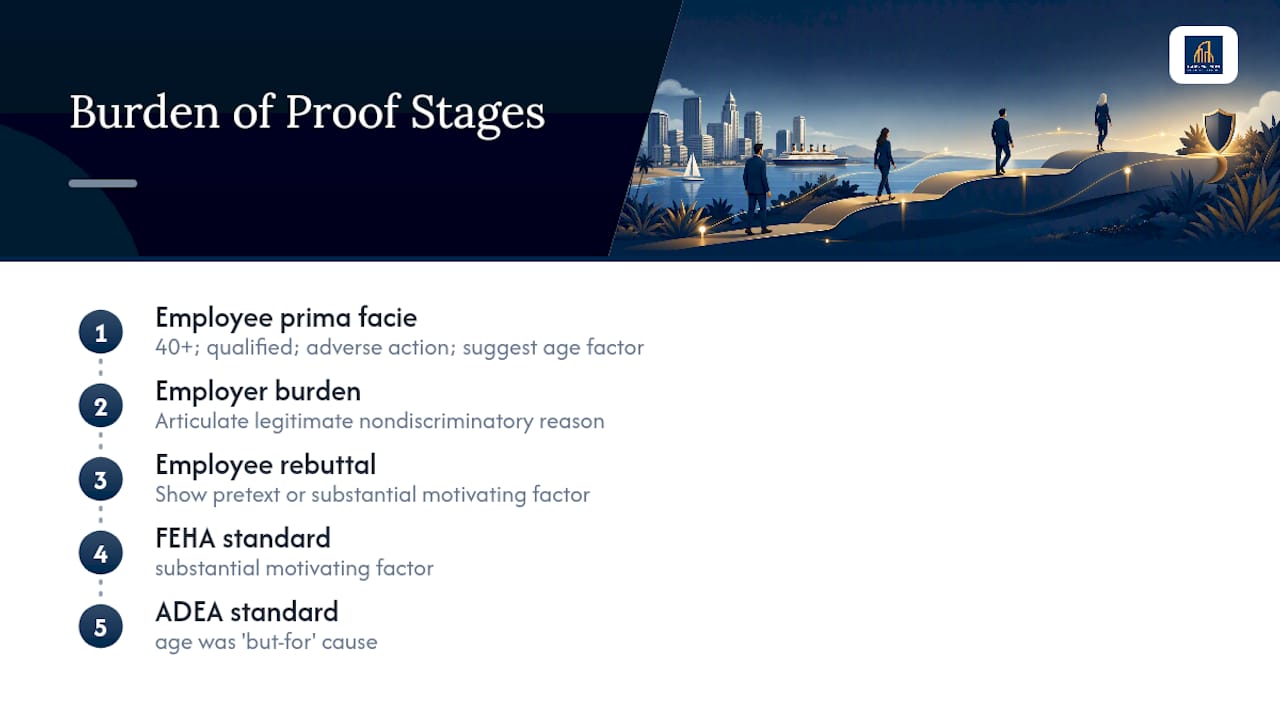
Once that threshold is met, the burden shifts to the employer to articulate a legitimate, nondiscriminatory reason for the decision. This isn’t a high bar. Employers usually clear it by pointing to performance records or a restructuring rationale.
The burden then shifts back to the employee, who must show that the employer’s stated reason is pretextual, meaning it’s not the real reason, or that age was a substantial motivating factor even if other reasons played a role. This is typically where the case is won or lost, and it’s exactly why comparative evidence, written communications, and consistent documentation carry so much weight throughout the process.
Federal ADEA claims require a slightly higher standard, generally requiring proof that age was the “but for” cause of the adverse action, while FEHA allows a claim to proceed even if age was only a substantial motivating factor among several reasons. That difference is one more reason FEHA claims are often more accessible for California employees than ADEA claims alone.
A Note From California United Law Group
This article is written for general education, not as legal advice. Age discrimination cases turn on specific facts, timelines, and evidence, and outcomes vary case by case. If you work in Long Beach and believe age influenced a decision affecting your job, don’t wait to explore your options. Filing deadlines with the CRD and EEOC can move faster than people expect, and early conversations with counsel may help preserve options that can disappear with time.
— California United Law Group
Talk to California United Law Group About Your Situation
California United Law Group offers legal services for many California employee matters on a contingency fee basis, where attorney’s fees are typically paid from a settlement or award if there is a recovery. Clients should review the fee agreement to understand whether they may be responsible for any costs or expenses. That structure may make it easier for Long Beach workers to explore potential age discrimination claims without paying hourly attorney’s fees upfront.
The firm provides legal representation for employment discrimination matters under FEHA and the ADEA, as well as wrongful termination, retaliation, and wage and hour claims, supporting employees through various stages of disputes. Consultations generally cover a review of the situation, assessment of filing deadlines, and explanation of possible legal options.
If you believe age may have played a role in a hiring decision, layoff, demotion, promotion denial, pay decision, or other workplace treatment, reach out through California United Law Group’s contact page to request a consultation about your situation.
Official Resources for Long Beach Employees
- CRD age discrimination fact sheet — FEHA protections explained
- EEOC facts about age discrimination — federal ADEA overview
- CRD complaint process — filing steps and deadlines
- Long Beach workplace safety rights — related local resource
This article is general information, not a substitute for advice from a qualified lawyer. Consult a qualified legal professional about your own circumstances before acting on anything here.
Sources
- CALIFORNIA LAW PROTECTS WORKERS FROM AGE DISCRIMINATION (CRD fact sheet, 2025)
- EEOC — Facts about age discrimination
- Complaint Process | CRD
- EEOC — Filing a charge of discrimination