
Facing unsafe conditions at work can feel overwhelming, especially when speaking up leads to retaliation from your employer. Many California workers in retail and hospitality fear risking their jobs just to protect their health. The California Labor Commissioner’s Office and OSHA both offer options for reporting workplace safety violations, with OSHA allowing anonymous complaints in certain circumstances, helping workers report hazards while protecting their rights. Understanding these reporting channels and retaliation safeguards empowers you to take decisive action.
Table of Contents
- Workplace Safety Reporting in Long Beach
- Types of Safety Concerns Workers Face
- California Laws Protecting Whistleblowers
- What Counts as Employer Retaliation?
- Steps to Take If Retaliation Occurs
Key Takeaways
| Point | Details |
|---|---|
| Worker Protections | Long Beach workers can report unsafe conditions with legal protections against retaliation under state and federal laws. |
| Reporting Mechanisms | Employees can confidentially report safety violations through multiple channels, ensuring professional protection. |
| Whistleblower Rights | California laws provide protections for whistleblowers against adverse employment actions when reporting workplace safety violations. |
| Steps After Retaliation | If retaliation occurs, prompt documentation and legal guidance are critical for protecting rights and pursuing justice. |
Workplace Safety Reporting in Long Beach
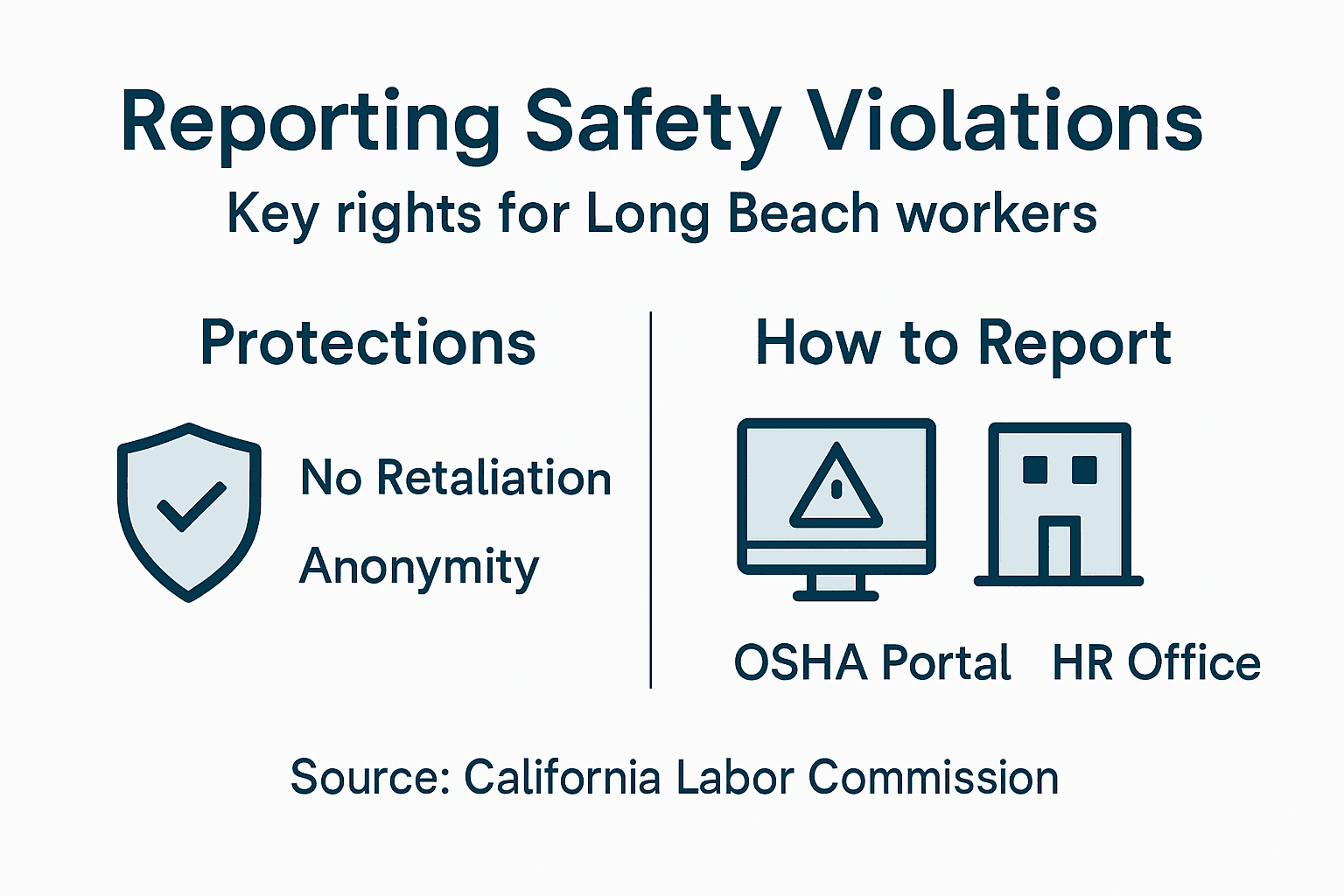
Workplace safety is a critical concern for employees in Long Beach, with legal protections designed to safeguard workers who report hazardous conditions. Workers have specific rights when identifying and addressing potential safety violations, ensuring their ability to speak up without fear of retaliation.
The California Labor Commissioner’s Office provides crucial support for employees seeking to report workplace safety issues. Workers can confidentially file safety complaints through multiple channels, protecting their professional standing while addressing potential hazards. These reporting mechanisms are essential for maintaining safe working environments across different industries in Long Beach.
Key safety reporting rights for Long Beach workers include:
- The right to report unsafe working conditions with legal protections against employer retaliation
- Protection under state and federal workplace safety regulations
- Confidential complaint filing options
- Access to investigation processes through state labor authorities
Federal OSHA guidelines reinforce worker protections. While California has its own Cal/OSHA program that governs most workplaces in the state, workers may file complaints about safety hazards through various reporting channels. However, employees should be aware that ensuring complete anonymity while maintaining effective investigation can present practical challenges.
In Freund v. Nycomed Amersham (9th Cir. 2003) 347 F.3d 752, the court clarified that the public policy behind Labor Code section 6310 is not merely to aid the reporting of actual safety violations, but also to prevent retaliation against those who in good faith report working conditions they believe to be unsafe, even if those conditions do not ultimately constitute formal violations.
Pro tip: Document every safety concern in writing and keep copies of all communication to create a clear record of your reporting efforts.
Types of Safety Concerns Workers Face
Workplace safety encompasses a complex landscape of potential hazards that can significantly impact employee health and well-being. Workplace injuries stem from multiple risk categories that span physical, chemical, biological, and ergonomic threats across different industries.
Physical safety hazards represent one of the most immediate risks for workers. These include dangerous conditions such as:
- Wet or slippery floors
- Malfunctioning machinery
- Inadequate safety guards on equipment
- Poorly maintained work areas
- Insufficient protective gear
Ergonomic hazards are particularly challenging, involving repetitive motions, awkward postures, and prolonged physical strain that can lead to long-term musculoskeletal disorders. Workplace hazards encompass multiple complex risk factors that require comprehensive understanding and proactive management.
Chemical and biological hazards present additional layers of workplace risk. Exposure to toxic substances, infectious agents, and harmful environmental conditions can create serious health challenges for workers across various sectors. Transportation, healthcare, and manufacturing industries often face the most significant exposure risks.

Here’s a quick overview of common workplace hazard types and the industries most affected:
| Hazard Type | Primary Risks | Most Affected Industries |
|---|---|---|
| Physical | Slips, equipment failures | Warehousing, manufacturing |
| Chemical | Toxic exposure, burns | Manufacturing, healthcare |
| Biological | Infectious agents | Healthcare, food services |
| Ergonomic | Strain, repetitive motions | Office, retail, manufacturing |
Pro tip: Regularly document and photograph potential workplace hazards to create a clear record of safety concerns for potential future investigations.
California Laws Protecting Whistleblowers
California has robust legal protections designed to shield employees who report workplace safety violations and unethical practices. California Labor Code protects whistleblowers from potential retaliation across both public and private employment sectors.
The legal framework provides comprehensive safeguards for workers reporting misconduct, including protection against adverse employment actions such as:
- Termination
- Demotion
- Reduction in work hours
- Harassment
- Pay cuts
- Negative performance reviews
Whistleblower protections extend to employees who disclose information about illegal activities, safety violations, or unethical conduct both internally within their organization and externally to governmental authorities. California Labor Code Section 1102.5 protects workers who disclose information about illegal activities, safety violations, or violations of law both internally within their organization and externally to governmental authorities.
California courts have affirmed broad protections for whistleblowers. For example, in People ex rel. Garcia-Brower v. Kolla’s, Inc. (2023) 14 Cal.5th 719, the California Supreme Court held that Labor Code section 1102.5(b) protects employees from retaliation even when they disclose unlawful activity to employers or agencies that already know about the violation, interpreting the statute’s protection broadly to advance worker safety.
Understanding these legal protections is crucial for employees who witness workplace misconduct. The laws are designed to encourage ethical reporting and provide meaningful legal recourse for workers who face retaliation after raising legitimate safety or compliance concerns.
Pro tip: Keep detailed documentation of any safety concerns and potential retaliatory actions to strengthen your legal position if disputes arise.
What Counts as Employer Retaliation?
Workplace retaliation encompasses a wide range of adverse actions designed to punish employees who report safety violations or engage in protected workplace activities. These actions go beyond simple workplace disagreements, representing intentional efforts to discourage workers from speaking up about critical safety concerns.
California courts have established that to prove retaliation, an employee must show they engaged in protected activity, suffered an adverse employment action, and that a causal link existed between the protected activity and the employer’s action. The employee need only prove that retaliatory animus was a substantial or motivating factor in the adverse employment decision.
Specifically, employer retaliation can take multiple forms, including:
- Terminating employment
- Reducing work hours or pay
- Demoting an employee
- Passing over for promotions
- Creating a hostile work environment
- Increasing workplace surveillance
- Changing job responsibilities unfairly
Subtle forms of retaliation can be equally damaging. Prohibited workplace actions might include strategic exclusion from meetings, negative performance evaluations, or creating impossible working conditions that force an employee to quit.
The legal standard for retaliation focuses on actions that would deter a reasonable employee from reporting workplace safety issues. Not every minor workplace tension constitutes retaliation, but significant negative consequences motivated by an employee’s protected activities are legally actionable. Workers should carefully document any suspected retaliatory behaviors to build a strong potential legal case.
Pro tip: Maintain a contemporaneous written record of all interactions and potential retaliatory actions, including dates, witnesses, and specific details of each incident.
Steps to Take If Retaliation Occurs
When workplace retaliation occurs, swift and strategic action is critical to protecting your legal rights. Workers should promptly document retaliation incidents to build a strong foundation for potential legal challenges against employers who violate worker protection laws.
Important initial steps for addressing workplace retaliation include:
- Collect and preserve all evidence of retaliatory actions
- Write detailed accounts of incidents, including dates and witnesses
- Save email communications, performance reviews, and workplace correspondence
- Maintain a chronological record of events
- Photograph or screenshot relevant documentation
- Avoid confrontational interactions with the retaliating supervisor
Legal reporting channels provide critical support for workers experiencing retaliation. California Labor Commissioner’s Office investigates workplace complaints and offers formal mechanisms for workers to file official reports about safety violations and subsequent retaliatory actions.
Seeking professional legal guidance early can significantly strengthen your position. Employment law specialists can help evaluate the strength of your case, advise on documentation strategies, and determine the most appropriate course of action for addressing workplace retaliation.
The following table summarizes key legal options for workers facing retaliation:
| Legal Action | Who Can Help | Typical Outcome |
|---|---|---|
| File formal complaint | Labor Commissioner’s Office | Investigation, corrective action |
| Seek legal counsel | Employment law specialists | Settlement or legal recourse |
| Internal reporting | HR or compliance department | Policy review, potential mediation |
Pro tip: Create a secure, separate digital and physical file to store all evidence of workplace retaliation, ensuring these documents remain protected and organized.
Protect Your Rights When Reporting Workplace Safety Issues in Long Beach
If you have faced retaliation or unsafe conditions after reporting workplace safety violations you are not alone. The challenge of speaking up without fear of repercussions is real and the legal protections described here are essential but complex. At California Employment Law – Los Angeles Employment Lawyers | California United Law Group, P.C. we understand the emotional toll retaliation can take when you try to stand up for your safety and your rights.
Our experienced team assists Long Beach workers in navigating claims involving retaliation, wrongful termination, and other workplace violations covered under California Labor Code and FEHA. We work to protect clients facing unfair employer practices while advocating for their rights. If you notice signs of workplace retaliation or have safety concerns that have led to adverse actions, we encourage you to seek guidance promptly.
Contact California United Law Group, P.C. to discuss your situation. Whether you need support filing a complaint or exploring legal options, our attorneys are prepared to represent workers facing workplace safety and retaliation issues.
Disclaimer: This blog post is for informational purposes only and does not constitute legal advice. The information provided does not create an attorney-client relationship. Workplace safety and retaliation claims are highly fact-specific, and outcomes depend on individual circumstances. Past results do not guarantee similar outcomes in future cases. For advice about your specific situation, consult with a qualified employment attorney.
Frequently Asked Questions
What rights do workers have when reporting safety violations?
Workers have the right to report unsafe working conditions and are protected under state and federal workplace safety regulations from employer retaliation. These protections include options for filing complaints through various channels.
How can I report a workplace safety issue confidentially?
You can confidentially report safety complaints through multiple channels provided by the California Labor Commissioner’s Office. This ensures your professional standing is protected while addressing potential hazards.
What constitutes employer retaliation?
Employer retaliation can include actions such as termination, demotion, reductions in work hours, harassment, pay cuts, and negative performance reviews aimed at punishing employees for reporting safety violations or other protected activities.
What steps should I take if I experience retaliation for reporting safety issues?
If you experience retaliation, it’s important to document the incidents in detail, including dates, witnesses, and evidence of the retaliatory actions. Consider filing a complaint with the Labor Commissioner’s Office and seek legal guidance to strengthen your position.
Recommended
- Employment Lawyer Long Beach – Los Angeles Employment Lawyers | California United Law Group, P.C.
- Retaliation in the Workplace: Your Rights and Legal Options in California – Los Angeles Employment Lawyers | California United Law Group, P.C.
- Employment Lawsuit Process Overview for California Workers – Los Angeles Employment Lawyers | California United Law Group, P.C.
- Employment Law – Los Angeles Employment Lawyers | California United Law Group, P.C.
- Safety Complaints and Retaliation in Huntington Beach | Serendib Law Firm