
Under California law, sexual harassment claims commonly involve either quid pro quo conduct or a hostile work environment. Evidence such as messages, witness names, and a contemporaneous incident log can help support the facts an employee may later present to an employer, the Civil Rights Department (CRD), or a court. The three priorities are digital communications with intact metadata, a contemporaneous log you keep yourself, and named witnesses. Culver City employees generally have three years from the last alleged unlawful practice to file a CRD complaint, but deadlines can depend on the facts and any related federal or court claims.
TL;DR:
- Digital communications like emails, Slack messages, and screenshots with metadata are crucial evidence, especially if preserved without editing.
- A contemporaneous, private, dated log of incidents and witness observations strengthens claims by capturing details that are hard to verify later.
- Filing with the CRD within the applicable deadline preserves important rights, and the employer’s response may become relevant evidence in evaluating the claim.
- Evidence of retaliation may provide additional support for a claim, especially when adverse action closely follows a complaint or participation in an investigation.
- Consulting a qualified attorney can enhance case strength, particularly when evidence collection is complex or employer records need legal safeguarding.
Table of Contents
- What Evidence Proves Sexual Harassment in Culver City Workplaces?
- How Should You Preserve Evidence Without Compromising Your Case?
- How Do You Report Harassment and File a Formal Complaint?
- What Evidence Supports a Retaliation Claim?
- What Happens After You File: A Realistic Timeline
- How California United Law Group Supports Culver City Employees
- What Confidentiality Protections Apply During a Harassment Complaint?
- What Happens During a Workplace Harassment Investigation?
- Where Can Culver City Employees Find Support During This Process?
- Why Most Guidance on This Topic Misses the Point
- Talk to an Attorney About Your Harassment Claim
- Official Forms and Agency Guidance
- Sources
What Evidence Proves Sexual Harassment in Culver City Workplaces?
California’s Fair Employment and Housing Act (FEHA) recognizes two harassment categories, and knowing which one applies shapes what you collect. Quid pro quo harassment involves a tangible employment action, like a denied promotion or a threatened termination, tied to a sexual demand. Hostile work environment claims focus on whether the conduct was severe or pervasive under the circumstances. California jury guidance allows jurors to consider factors such as the nature of the conduct, how often and over what period it occurred, the circumstances, and whether it was physically threatening or humiliating.
Every piece of evidence you gather should help show what happened, whether the conduct was unwelcome, how severe or frequent it was, who was involved, who witnessed it, and when the employer learned about it or had an opportunity to respond.
- Digital communications: Emails with full headers, Slack or Teams messages including edit history, text threads, voicemails, and screenshots that show timestamps.
- Contemporaneous logs: A private, dated record you write shortly after each incident, noting who was present, what was said, and how you responded.
- Witnesses: Coworkers who directly observed conduct, plus those who can describe a broader pattern, such as noticing the same manager isolating multiple employees.
- Employment records: Pay stubs, performance reviews, and promotion or scheduling records that show changes before and after you reported the conduct. California courts and jury instructions evaluate harassment and retaliation claims in context. In hostile work environment cases, jurors may consider the nature of the conduct, its frequency, the period over which it occurred, the surrounding circumstances, and whether it was physically threatening or humiliating. Retaliation claims similarly depend on facts showing protected activity, an adverse employment action, and a causal link between the two.
- Physical or visual items: Photos of offensive materials left in shared spaces, with device metadata intact whenever possible.
HR complaint records matter for a second reason: an employer’s response after notice may become relevant to whether it took reasonable steps to prevent and correct harassment.
Pro Tip: Save your incident log outside any work device. A personal notes app or a private email to yourself, timestamped the same day, may be more persuasive than a memory reconstructed months later.
How Should You Preserve Evidence Without Compromising Your Case?
Evidence loses value if its origin or timing becomes disputable. A few careful habits now protect the record you build for a CRD intake or later litigation.
- Export, don’t just screenshot. Where possible, export emails and messages in their native format so headers and timestamps travel with the file; a screenshot alone can be challenged as edited.
- Capture disappearing messages immediately. For apps that auto-delete messages, preserve what you can without violating privacy, recording, computer-access, or workplace policies. If you are unsure whether a method is lawful, ask an attorney before using screen recording or another device.
- Back up to encrypted personal storage. Keep copies on a personal cloud account or external drive, not solely on an employer-owned device you could lose access to.
- Avoid employer systems for storage. Copying company files you’re not authorized to access can create separate legal problems, even when your intent is protective.
- Never alter timestamps or metadata. Editing dates to “clean up” a record, even innocently, can undermine the record’s credibility later.
If litigation, a CRD complaint, or a formal dispute is reasonably possible, consider speaking with an attorney about whether a preservation letter is appropriate before evidence disappears.
Pro Tip: Contemporaneous logs can be useful because they preserve details, dates, witnesses, and the employee’s response while events are still fresh.
How Do You Report Harassment and File a Formal Complaint?
Reporting internally can help build a record, but employees do not always have to wait for an internal process to finish before seeking legal advice or filing with the CRD.
- Report through your employer’s HR channel and keep a copy of what you submitted and when. Note who responded, what they said they’d do, and whether they followed through. How an employer responds, or fails to respond, may become important evidence.
- File an intake with the CRD. Employees generally have three years from the last incident to submit a complaint. CRD staff review the intake and can open a formal investigation.
- Understand CRD’s investigative power. CRD may investigate the complaint, request information, take sworn testimony, and issue subpoenas when authorized.
- A Right-to-Sue letter may allow you to proceed to court without waiting for a full CRD investigation, but that choice can affect strategy and timing, so consider getting legal advice first.
- Check for coordination with federal claims. The EEOC handles parallel federal retaliation and harassment protections and often works alongside CRD on overlapping cases.
What Evidence Supports a Retaliation Claim?
Retaliation claims focus on whether the employee engaged in protected activity, whether the employer took an adverse employment action, and whether there is a causal link between the two. Common examples may include termination, demotion, material schedule cuts, or exclusion from important work opportunities, depending on the workplace context.
Three categories of evidence often help support retaliation claims:
- Timing. Close timing between a complaint and an adverse action may support an inference of retaliation, especially when combined with other evidence.
- Pattern evidence. A shift from positive reviews to sudden discipline shortly after a report may be relevant pattern evidence.
- Pretext. Emails, messages, or inconsistent explanations may help show pretext if they undermine the employer’s stated reason for the adverse action.
Federal guidance from the EEOC outlines these categories in detail, and California’s own retaliation factsheet describes similar investigative considerations for state claims.
What Happens After You File: A Realistic Timeline
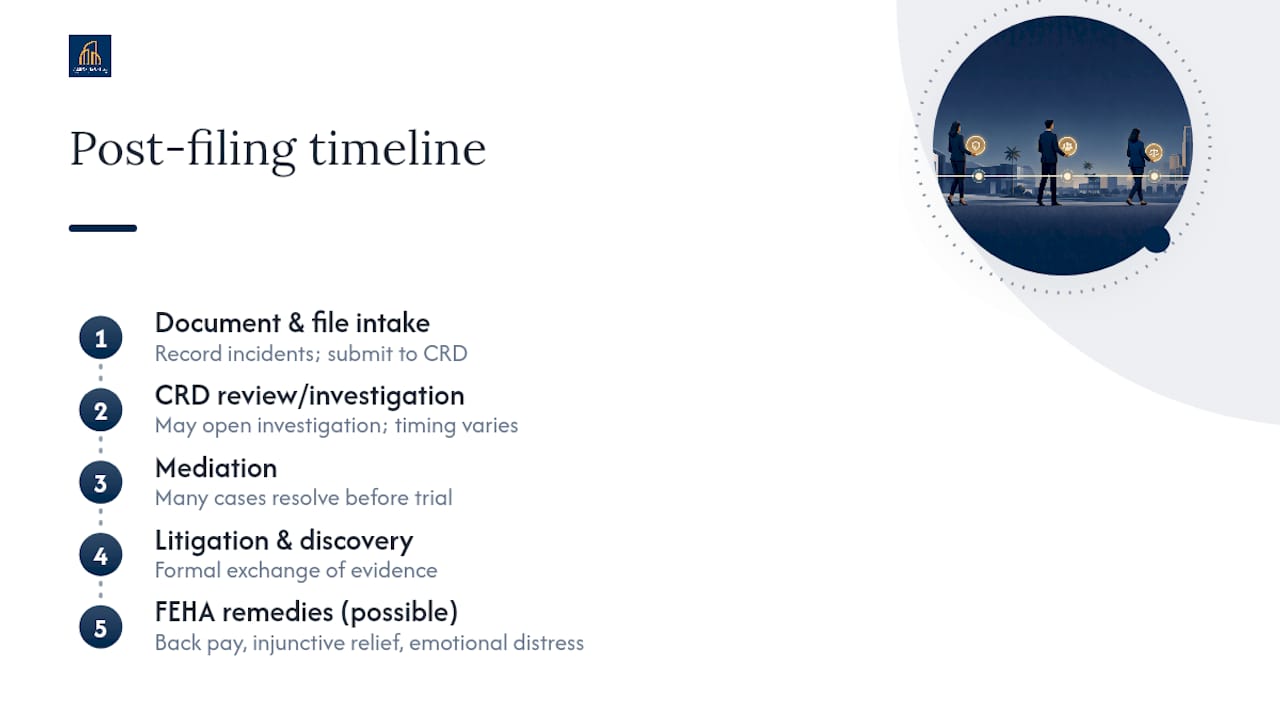
Expect a sequence, not a single event. After you document incidents and file an intake, CRD reviews the complaint and may open an investigation, a phase that varies in length depending on complexity and evidence volume. Some cases resolve through mediation before trial. If a case proceeds to litigation, discovery, the formal exchange of evidence, becomes a significant phase, as outlined in this overview of the California employment lawsuit process. Potential remedies after a successful FEHA claim may include back pay, injunctive relief, emotional distress damages, and other relief depending on the claims, proof, and applicable law. No outcome is guaranteed.
How California United Law Group Supports Culver City Employees
California United Law Group works with Culver City employees on evidence review, CRD filing assistance, Right-to-Sue requests, and representation in mediation or litigation for harassment and retaliation claims under FEHA. The firm evaluates each matter based on its specific facts, available evidence, deadlines, and procedural posture.
When an employer refuses to provide records, when timelines conflict, or when formal discovery or agency procedures may be needed, a consultation may help identify lawful next steps.
A conversation with counsel can help when retaliation is complex, when an employer resists producing records, or when the case may require formal legal procedures.
What Confidentiality Protections Apply During a Harassment Complaint?
California harassment complaints may involve privacy protections, but employees should not assume complete confidentiality during an internal investigation, CRD investigation, or lawsuit. Internally, HR investigations are often handled on a need-to-know basis, but complete secrecy is rarely realistic once witnesses are interviewed or decision-makers become involved.
At the CRD level, complaint information may receive agency confidentiality protections during an active investigation, but the scope of confidentiality can change if the matter proceeds to litigation or public filings. That said, if a case proceeds to litigation, some information may become part of the public record, since court filings are generally accessible unless a judge seals specific documents.
Retaliation protections exist specifically to prevent an employer from punishing you for filing or participating in a complaint, and evidence of retaliation after a report is treated seriously precisely because confidentiality breaches or punitive responses undermine the entire complaint system. If you believe your identity was improperly disclosed, or that confidentiality was used as a pretext to isolate you, document the incident the same way you’d document harassment itself: dates, witnesses, and any written communication involved.
What Happens During a Workplace Harassment Investigation?
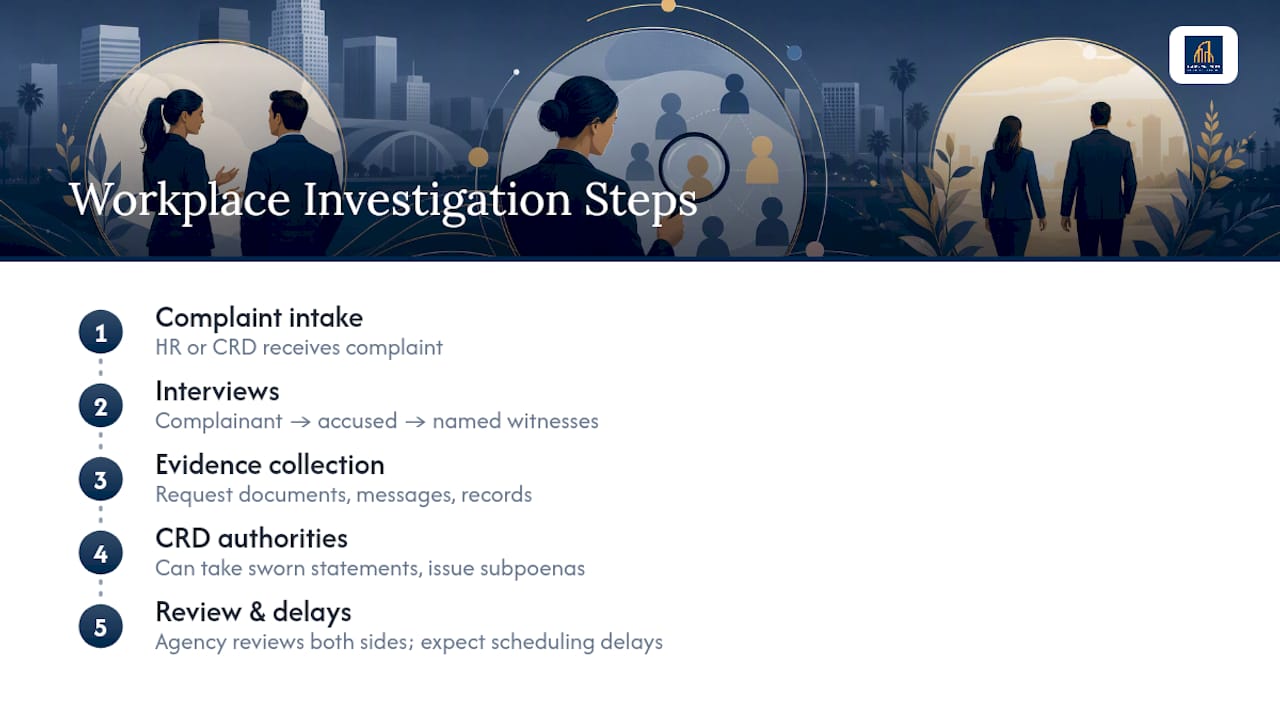
Once a complaint reaches HR or the CRD, expect a structured, if not always fast, process. An internal HR investigation typically starts with interviews, first with the complainant, then the accused, then any named witnesses. Investigators may request documents, messages, or records that corroborate the timeline you’ve provided.
A CRD investigation follows a similar shape but with formal legal authority behind it. Investigators can take sworn statements and issue subpoenas for records an employer might otherwise withhold. The agency reviews evidence from both sides before determining whether reasonable cause exists to support the claim.
Throughout either process, expect delays. Investigations rarely move in a straight line, especially when multiple witnesses need scheduling or when an employer requests extensions to respond. Staying responsive, keeping your documentation updated, and avoiding speculation or inconsistent statements can help preserve the accuracy of your account as the process unfolds.
Where Can Culver City Employees Find Support During This Process?
Beyond legal channels, Culver City employees have several avenues for support while a harassment complaint is active. Many employers offer Employee Assistance Programs (EAPs) that provide confidential counseling sessions unrelated to the HR investigation itself, useful for managing the stress a workplace dispute can create.
Community-based advocacy organizations across Los Angeles County offer guidance on workplace rights, some specifically focused on gender-based workplace issues, and can help employees understand their options before or alongside a CRD filing. Local counseling services, including those offered through county mental health resources, provide confidential support that stays entirely separate from any workplace record.
Keeping your support resources separate from your evidence file matters. Counseling notes and EAP conversations may involve privacy protections, but they should generally be kept separate from documents intended for HR, CRD, or litigation unless an attorney advises otherwise. Treat them as parallel tracks: one for your wellbeing, one for your case.
Why Most Guidance on This Topic Misses the Point
Most articles on proving harassment treat evidence collection like a homework assignment: gather everything, sort it later. That advice undersells how much timing matters. A contemporaneous log written the same day may be more useful than a polished narrative written weeks later because it preserves details before memories fade.
The overlooked piece is retaliation. Employees fixate on proving the harassment itself and forget that what happens in the weeks after they report often generates the clearest evidence of all, sudden discipline, exclusion from meetings, a demotion dressed up as a “restructuring.” That pattern may be easier to document than the original harassment, depending on the facts and records available.
Prioritize tonight, not eventually: write down what happened, export what you can, and identify who saw it. Everything else, filing strategy, legal theory, negotiation, can wait for a conversation with someone who handles these cases regularly. The evidence window closes faster than most people expect.
— California United Law Group
Talk to an Attorney About Your Harassment Claim
California United Law Group offers free consultations and may represent Culver City employees on a contingency-fee basis for FEHA harassment and retaliation claims, subject to a written fee agreement. In a contingency-fee arrangement, attorney’s fees are typically paid from a settlement or award if there is a recovery. Attorney Gerardo J. Sosa and the firm’s employment team review evidence, assist with CRD filings, and represent employees through mediation or litigation when a case moves forward.
Before your consultation, gather three things: your contemporaneous incident log, copies of relevant digital communications, and any written HR complaints you’ve filed along with the employer’s response. Having these ready lets the firm evaluate your situation more efficiently.
👉 Ready to discuss your case? Contact California United Law Group to schedule a consultation. This article provides general information only and does not create an attorney-client relationship.
Official Forms and Agency Guidance
- CRD complaint intake process
- CRD employment guidance and FEHA standards
- EEOC retaliation guidance
- DLSE retaliation complaint procedure
This article is general information only, not legal advice, and does not create an attorney-client relationship. Consult a qualified legal professional about your own circumstances before acting on anything discussed here.
Sources
- California Civil Rights Department — How to file a complaint
- CRD — complaint intake details and procedures
- EEOC — Retaliation guidance
- CRD — Employment guidance (training requirements)