
Race or color discrimination at work is defined under California law as any adverse employment action taken against an employee because of their racial group membership or skin tone. Inglewood employees are legally protected against both forms of discrimination under the California Fair Employment and Housing Act (FEHA) and federal Title VII of the Civil Rights Act of 1964. These are not the same protection. FEHA treats race and color as separate, distinct categories, which means an Inglewood worker can face a valid color discrimination claim even when the discriminating party belongs to the same racial group. Understanding this distinction is the first step toward knowing whether your rights have been violated.
What legal protections cover race and color discrimination in Inglewood workplaces?
California FEHA and federal Title VII both prohibit discrimination based on race and color, but FEHA provides broader protections for California workers. The key difference is that FEHA treats race, color, and ancestry as separate protected categories, not a single combined classification. This matters because it expands the range of actionable claims for Inglewood employees.
Here is what each category covers in practice:
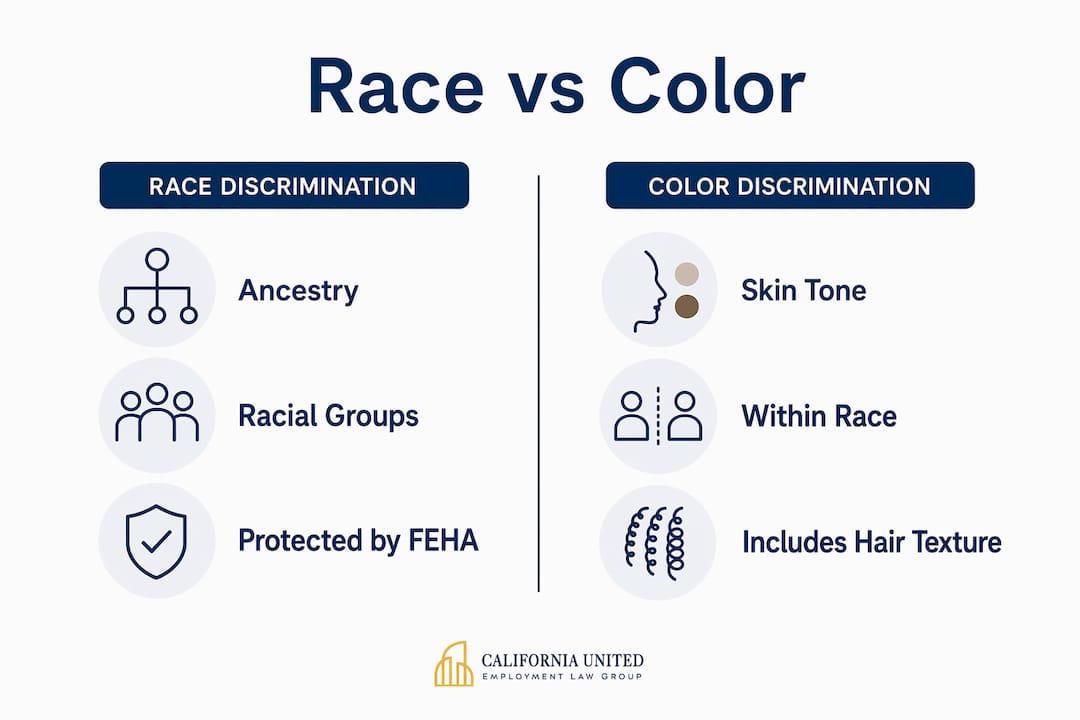
- Race discrimination targets adverse treatment based on biological ancestry, ethnic background, or membership in a recognized racial group. This includes discrimination against Black, Latino, Asian, Native American, and white employees, among others.
- Color discrimination targets adverse treatment based on skin tone or complexion. Under both FEHA and Title VII, color bias in employment claims can succeed even when the employee and the decision-maker share the same racial background.
- Ancestry discrimination covers national origin and lineage, which often overlaps with race claims but is legally distinct under FEHA.
Federal Title VII applies to employers with 15 or more employees. California FEHA applies to employers with five or more employees, which means significantly more Inglewood workers are covered under state law. Both laws prohibit discrimination in hiring, firing, promotions, pay, job assignments, training opportunities, and any other term or condition of employment.
The CROWN Act, signed into California law in 2019, extended race discrimination protections to include hair texture and protective hairstyles historically associated with race. This is another area where California law goes further than federal law, and it directly affects Inglewood workers in industries with appearance-based policies. These protections are now codified directly in FEHA under Government Code sections 12926(w) and (x), making them enforceable alongside all other FEHA claims.

How does race or color discrimination typically show up at work?
Workplace discrimination in Inglewood rarely arrives with an explicit statement. More often, it surfaces through patterns of treatment that, taken individually, might seem minor but collectively reflect a discriminatory motive. Adverse actions can be subtle and cumulative, and even repeated minor discriminatory acts are legally actionable.
Common forms of race inequality at work include:
- Hiring and promotion denials where equally or better-qualified candidates of a different race or skin tone are selected without a documented, legitimate reason.
- Wrongful termination tied to race or color, including situations where employees of one group are disciplined or fired for conduct that is overlooked in employees of another group.
- Disparate pay where employees performing the same work receive different compensation based on race or color.
- Hostile work environment created through racial slurs, derogatory comments, racially offensive imagery, or persistent exclusion based on race or skin tone.
- Racially biased job assignments such as consistently assigning employees of a particular race to less desirable shifts, locations, or roles.
- Retaliation after an employee reports discrimination. Retaliation following complaints is illegal under both FEHA and Title VII, but it remains one of the most common responses employers use.
Color discrimination within the same racial group is a particularly underrecognized form of bias. For example, a darker-skinned Black employee being passed over for promotion in favor of a lighter-skinned Black colleague can constitute a valid color discrimination claim under FEHA. This nuance is one reason California law is considered among the most protective in the country.
Pro Tip: If you are experiencing what feels like unfair treatment at work, write down what happened immediately after each incident. Your memory of specific details fades quickly, and precise records are far more useful than general impressions.
What is the burden of proof for a discrimination claim in California?
California courts apply a structured burden-shifting framework to race and color discrimination claims. Understanding how this process works helps you recognize what evidence matters most. The burden-shifting framework requires the following sequence:
- You establish a prima facie case. You must show that you belong to a protected class, that you were performing your job competently, that you suffered an adverse employment action, and that there is some connection between the adverse action and your protected characteristic.
- The employer provides a legitimate reason. Once you establish a prima facie case, the burden shifts to your employer to articulate a non-discriminatory reason for the action taken.
- You prove pretext. The burden then returns to you to show that the employer’s stated reason is false and that race or color was a substantial motivating factor in the decision.
California’s “substantial motivating factor” standard is more favorable to employees than the federal “but-for” causation standard used under Title VII. Under California law, you do not need to prove that discrimination was the only reason for the adverse action. You need to show it was a substantial motivating factor — one that meaningfully contributed to the employer’s decision, even if other lawful factors also played a role.
The California Supreme Court addressed this standard directly in Harris v. City of Santa Monica (2013) 56 Cal.4th 203. The Court held that where a jury finds unlawful discrimination was a substantial motivating factor in a termination, the employer does not escape liability even if it proves it would have made the same decision absent discrimination — though in that scenario, reinstatement, backpay, and damages may not be available, while declaratory or injunctive relief and attorney’s fees may still be awarded. This means that proving the substantial motivating factor standard has real, concrete consequences for employers even in mixed-motive cases.
| Standard | Jurisdiction | What you must prove |
|---|---|---|
| Substantial motivating factor | California FEHA | Race or color meaningfully contributed to the decision |
| But-for causation | Federal Title VII | Discrimination was the decisive reason for the action |
California also recognizes disparate impact claims, where a neutral workplace policy disproportionately harms employees of a particular race or color. These claims do not require proof of discriminatory intent, only proof of discriminatory effect.
You generally have three years from the date of the discriminatory act to file a complaint with the California Civil Rights Department (CRD). Missing this administrative deadline will bar you from filing a civil lawsuit under FEHA. Once the CRD issues a right-to-sue notice, you then have one year from that notice to file your civil court action — making it essential to act promptly at every stage. Missing this deadline can eliminate your right to pursue a legal claim, so timing matters.
Pro Tip: Filing a timely complaint with sufficient facts is more important than submitting a perfect document. Meeting filing deadlines is critical, but the complaint must also include sufficient particulars — the date, nature, and circumstances of the discrimination — to satisfy the administrative requirement. When in doubt, consult an attorney before filing.
How can Inglewood employees document and report discrimination effectively?
Effective documentation is your strongest defense in any discrimination claim. Factual, structured incident logs are more persuasive to investigators and attorneys than emotional narrative accounts. Each entry should include the date, time, location, the names of everyone involved, exactly what was said or done, and the names of any witnesses present.
Beyond personal documentation, here is how to approach reporting:
- Follow your employer’s internal complaint procedure. Most Inglewood employers are required to have a written anti-discrimination policy. Filing an internal complaint places your employer on legal notice and creates a timestamped record that becomes important if you later pursue a formal claim.
- File with the California Civil Rights Department (CRD) or the EEOC. You must file an administrative charge before you can sue in court. The CRD handles FEHA claims; the Equal Employment Opportunity Commission (EEOC) handles federal Title VII claims. Filing with one agency typically cross-files with the other.
- Preserve all relevant communications. Save emails, text messages, performance reviews, and any written documentation that reflects your work performance or the treatment you received. Do not take company property or confidential documents, as this can undermine your credibility.
- Avoid resigning prematurely. Quitting before filing a complaint can complicate your legal position. If conditions become intolerable, speak with an attorney before making any decisions about your employment status.
- Consult an employment attorney early. An attorney familiar with California employee rights can help you identify deadlines, evaluate your evidence, and avoid procedural errors that could weaken your claim.
Comprehensive internal reporting followed by external filing creates a stronger foundation for any legal claim you may later pursue. The two steps work together, not as alternatives.
Pro Tip: If your employer retaliates after you file an internal complaint, document that retaliation separately. Retaliation is its own legal claim and can significantly strengthen your overall case. Learn more about recognizing retaliation under California law.
Key Takeaways
Race and color discrimination in Inglewood workplaces are distinct legal claims under California FEHA, each requiring separate proof and offering employees broader protections than federal law alone.
| Point | Details |
|---|---|
| Race and color are separate claims | FEHA treats race and color as distinct categories, enabling claims even within the same racial group. |
| California standard favors employees | The “substantial motivating factor” test is easier to meet than the federal “but-for” causation standard. |
| Filing deadlines are strict | You generally have three years from the discriminatory act to file with the California Civil Rights Department (CRD), and one year from the CRD’s right-to-sue notice to file your civil court action. |
| Documentation quality matters | Structured, factual incident logs are more persuasive than emotional narrative accounts to investigators. |
| Internal complaints create legal notice | Filing internally before going to an agency builds a stronger record and timestamps your employer’s awareness. |
What I’ve Seen Working These Cases In California
I’ve reviewed a lot of discrimination cases over the years, and the pattern that concerns me most is not the obvious misconduct. It’s the cases where employees waited too long to document or report because they were hoping the situation would improve on its own. By the time they sought legal help, critical deadlines had passed or the evidence had faded.
The distinction between race and color discrimination is genuinely underappreciated, even among employees who know their rights in general terms. A worker who is treated differently because of their skin tone, not their racial identity, has a separate and valid claim under FEHA. Most people do not realize this. In Inglewood, where the workforce is diverse and workplaces span industries from entertainment to logistics to healthcare, color bias in employment can surface in ways that are easy to dismiss as personality conflicts or management style.
Courts have recognized intraracial color discrimination claims for decades. In Walker v. Secretary of Treasury, I.R.S., 713 F. Supp. 403 (N.D. Ga. 1989), a federal court held that a claim by a light-skinned Black employee alleging discrimination by a dark-skinned Black supervisor was actionable under Title VII — establishing that color discrimination is legally distinct from race discrimination and can occur entirely within the same racial group. California’s FEHA applies this same principle with equal or greater force.
My honest view is that early consultation with an attorney is not about preparing to sue. It’s about understanding what you are dealing with before you make decisions that could limit your options. Knowing how to prove workplace harassment or discrimination under California law changes how you approach every interaction with your employer going forward. That knowledge is protective, not just reactive.
The observations above reflect general experience and are provided for informational purposes only. Every case is different, and past experience does not guarantee any particular result.
How California United Law Group Can Help With Your Discrimination Claim
If you are facing race or color discrimination at work in Inglewood, you do not have to figure out the legal process alone.
California United Law Group, P.C. represents employees in workplace discrimination disputes across California, including FEHA and Title VII claims involving race, color, and related protected categories. The firm handles matters from initial consultation through litigation, including wrongful termination, hostile work environment, and retaliation claims. If you are unsure whether what you experienced qualifies as discrimination, or if you want to understand your rights before taking any action, speaking with an attorney is a practical first step. Visit California United Law Group’s employment law services page to learn more about how the firm approaches these cases and what the process looks like for California employees.
FAQ
What is the difference between race and color discrimination?
Race discrimination is based on a person’s racial group or ancestry, while color discrimination is based on skin tone or complexion. Under California FEHA, these are separate protected categories, meaning a color discrimination claim can succeed even when both parties belong to the same racial group.
How long do I have to file a discrimination complaint in Inglewood?
You generally have one year from the date of the discriminatory act to file a complaint with the California Civil Rights Department. Missing this deadline typically eliminates your right to pursue a legal claim under FEHA.
Do I need to report discrimination internally before filing with a state agency?
You are not legally required to file an internal complaint first, but doing so creates an important record and places your employer on legal notice. Internal reporting followed by an external filing with the CRD or EEOC generally builds a stronger foundation for your claim.
What counts as a hostile work environment based on race?
A hostile work environment exists when racial slurs, offensive comments, derogatory imagery, or persistent exclusion based on race or color are severe or pervasive enough to alter the conditions of your employment. A single incident can qualify if it is sufficiently serious.
Can I be fired for reporting race discrimination at work?
Terminating or otherwise retaliating against an employee for reporting discrimination is illegal under both FEHA and Title VII. If you experience adverse action after reporting, that retaliation is a separate legal claim that can be filed alongside your original discrimination complaint.