
Sexual harassment in the workplace is defined under California’s Fair Employment and Housing Act (FEHA) as unwelcome conduct based on sex, gender identity, or sexual orientation that is severe or pervasive enough to alter the conditions of employment. Long Beach sexual harassment in the workplace is a serious legal matter, and employees who experience it have enforceable rights under state law. FEHA is California’s primary protection against workplace discrimination and harassment, “covering all employers for harassment claims — regardless of size — and employers with five or more employees for discrimination claims. Understanding this framework is the first step toward protecting yourself and making informed decisions about your situation.
What constitutes sexual harassment in a Long Beach workplace under FEHA?
Sexual harassment under FEHA falls into two recognized legal categories: quid pro quo harassment and hostile work environment harassment. Quid pro quo occurs when a supervisor conditions employment benefits, such as a promotion or continued employment, on the acceptance of unwelcome sexual conduct. Hostile work environment harassment arises when conduct based on sex is severe or pervasive enough to interfere with a reasonable person’s ability to perform their job.
FEHA covers harassment based on several protected characteristics, including:
- Sex and gender identity — including transgender status and gender expression
- Sexual orientation — including perceived orientation
- Pregnancy and related conditions
- Marital status
Examples of conduct that may qualify as sexual harassment include unwelcome sexual advances, explicit or suggestive comments, sexual jokes, sharing explicit images or videos, and unwanted physical contact. A single severe incident, such as a sexual assault, can meet the legal threshold on its own. Repeated lower-level conduct, such as persistent comments about your appearance, may qualify as harassment when it is pervasive enough to change your work experience. You can review what counts as harassment under California law for a more detailed breakdown of conduct categories.
Harassment by a supervisor carries different legal weight than harassment by a coworker. When a supervisor commits quid pro quo harassment while acting in their capacity as a supervisor, the employer is automatically liable. If the harassment arises from a wholly private relationship unconnected to employment, strict liability may not apply. For hostile work environment claims involving coworkers, employer liability typically depends on whether the employer knew or should have known about the conduct and failed to take corrective action.
California courts have long recognized these liability rules. In Fiol v. Doellstedt (1996) 50 Cal.App.4th 1318, the court established three clear rules: a supervisor who personally engages in sexually harassing conduct is personally liable under FEHA; if the supervisor participates in or substantially encourages continued harassment, the supervisor is personally liable as an aider and abettor; and under FEHA, the employer is vicariously and strictly liable for sexual harassment by a supervisor. For coworker harassment, Doe v. Capital Cities (1996) 50 Cal.App.4th 1038 confirmed that the employer is only liable if it knew or should have known of the conduct and failed to take immediate corrective action.

Pro Tip: Document every incident in writing as it happens. Note the date, time, location, what was said or done, and who witnessed it. This record becomes your strongest evidence if you pursue a formal complaint.
How should Long Beach employees report sexual harassment?
Reporting workplace harassment in Long Beach requires a clear, deliberate approach. Acting quickly and in writing protects your rights at every stage of the process.
Submit a formal written complaint to HR or a designated supervisor. A formal written internal complaint triggers the employer’s obligation to investigate and take corrective action under FEHA. Verbal complaints are harder to prove and easier to dismiss.
Keep a copy of everything you submit. Save your written complaint, any email confirmations, and any responses from your employer. This documentation serves as evidence regardless of how the employer responds.
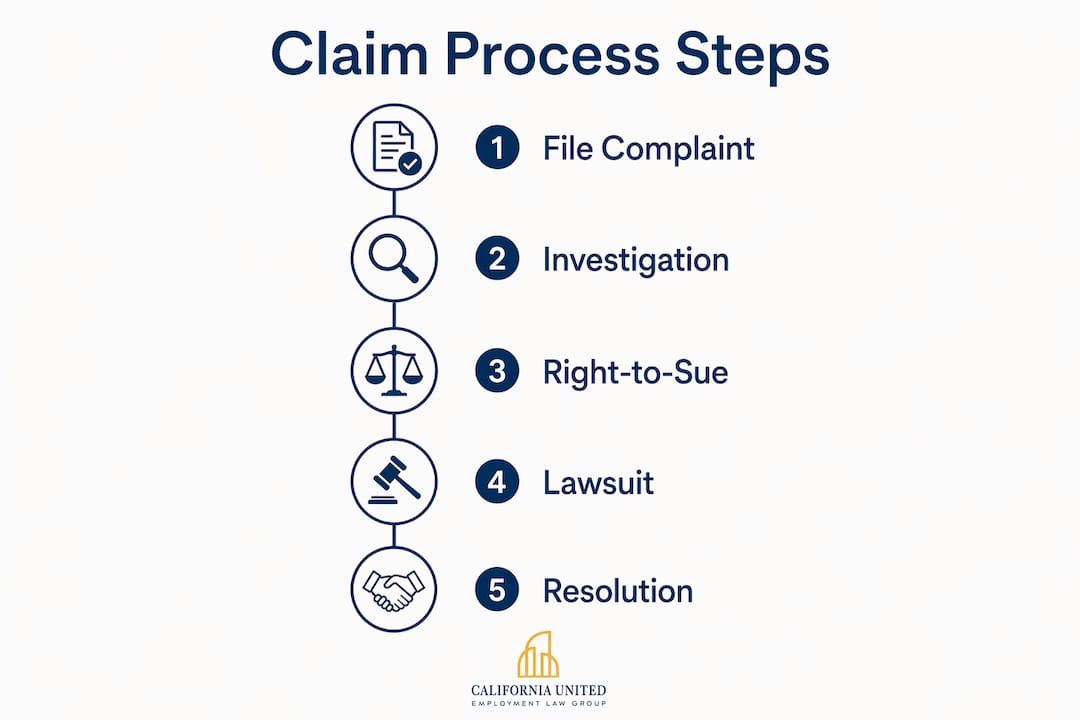
File a complaint with the California Civil Rights Department (CRD). The CRD is the state agency that enforces FEHA. You must file your complaint with the CRD within three years of the last act of harassment to preserve your right to sue. Missing this deadline permanently bars your civil lawsuit.
Choose how to proceed with the CRD. After filing, you can request an immediate right-to-sue notice, which allows you to go directly to court without waiting for the CRD to complete its investigation. Alternatively, you can allow the CRD to investigate, which may include mediation between you and your employer.
Name all potential respondents in your CRD complaint. Claimants who fail to name all potential individual respondents — such as a harassing supervisor — in the CRD complaint may be barred from suing those individuals later in civil court under FEHA’s individual liability provisions. This is a procedural detail with real and lasting consequences.
The CRD investigation process can take months. If your goal is to file a civil lawsuit, requesting immediate right-to-sue at the time of filing gives you control over your litigation timeline and access to broader legal tools, including discovery and jury trials.
Pro Tip: Filing internally with HR does not pause or extend your CRD deadline. Legal deadlines run independently of your employer’s internal process. Do not wait for your employer to resolve the issue before contacting the CRD.
What legal remedies are available for harassment victims in Long Beach?
California law provides some of the strongest remedies available to harassment victims in the country. Unlike federal law, FEHA places no cap on compensatory or punitive damages in harassment cases. This distinction matters significantly for Long Beach employees evaluating their options.
The table below summarizes the primary categories of relief available under FEHA:
| Remedy type | What it covers |
|---|---|
| Compensatory damages | Lost wages, lost benefits, and out-of-pocket losses caused by the harassment |
| Emotional distress damages | Compensation for psychological harm, which does not require medical records to prove |
| Punitive damages | Additional damages awarded to punish employers for malicious or oppressive conduct |
| Injunctive relief | Court orders requiring the employer to stop the harassment and implement corrective policies |
| Attorney’s fees | Fees paid by the employer to your attorney if you prevail in your claim |
FEHA’s uncapped damages create significant leverage for employees seeking compensation beyond emotional distress, including punitive damages and attorneys’ fees. Actual damages depend on the specific facts of each case.
Emotional distress damages are particularly notable because California courts do not require medical records or a formal diagnosis to award them. Your own testimony, supported by corroborating evidence of the harassment, can be sufficient. In Knutson v. Foster (2018) 25 Cal.App.5th 1075, the California Court of Appeal confirmed that “[t]he law in this state is that the testimony of a single person, including the plaintiff, may be sufficient to support an award of emotional distress damages,” where the distress arose from feelings of anxiety, pressure, betrayal, and fear that the plaintiff could testify to directly. Injunctive relief is also a meaningful remedy because it addresses the workplace conditions directly, not just the financial harm to you.
Proving employer liability requires showing that the employer knew or should have known about the harassment and failed to act. When a supervisor is the harasser in a quid pro quo situation, liability is automatic. Understanding how to prove workplace harassment under California law is an important part of building a strong claim.
What are the critical deadlines for Long Beach employees pursuing a harassment claim?
Deadlines are the most common reason employees lose valid harassment claims. Waiting too long, or assuming your employer’s internal process protects your legal rights, can permanently forfeit your ability to sue.
The key deadlines to know are:
- Three years from the last act of harassment to file a complaint with the CRD. This is a strict deadline. Missing it bars your FEHA civil lawsuit entirely.
- One year from the date the CRD issues your right-to-sue notice — not from the date you receive it — to file a civil lawsuit in California Superior Court. Missing this deadline is fatal to your FEHA claim.
- Preserve evidence concurrently with any complaint filing. Do not wait until you have filed to begin collecting emails, texts, witness names, and written records.
One procedural risk that many employees overlook: if you rely solely on your employer’s internal investigation and delay filing with the CRD, you may find that the three-year window has closed before you realize the employer will not resolve the issue. Legal deadlines continue to run regardless of employer internal response or investigation progress.
Retaliation is a separate but closely related risk. If your employer demotes you, changes your schedule, excludes you from meetings, or terminates you after you report harassment, that retaliation is itself a separate FEHA violation with its own legal claims. You can learn more about your protections under California’s workplace retaliation laws if you believe your employer has reacted negatively to your complaint.
Pro Tip: Request your right-to-sue notice at the time you file with the CRD, even if you are not certain you want to litigate. It preserves your options without committing you to a lawsuit.
Key Takeaways
Long Beach employees facing sexual harassment have enforceable rights under FEHA, and the three-year CRD filing deadline is the single most critical factor in preserving those rights.
| Point | Details |
|---|---|
| FEHA is the primary protection | California’s Fair Employment and Housing Act covers harassment based on sex, gender, and related characteristics. |
| Written complaints trigger employer duties | A formal written complaint obligates your employer to investigate and take corrective action under FEHA. |
| CRD deadline is three years | You must file with the California Civil Rights Department within three years of the last act of harassment. |
| Damages are uncapped under FEHA | California law allows compensatory, punitive, and emotional distress damages with no statutory cap. |
| Retaliation is a separate claim | Adverse actions taken after you report harassment constitute an independent FEHA violation. |
What I’ve Learned About Harassment Claims That Most Articles Won’t Tell You
After working closely with California employment law cases, one pattern stands out clearly: employees consistently underestimate how much the internal complaint process matters as a documentation tool, and overestimate how much it functions as a resolution mechanism.
Most people file an HR complaint hoping the employer will fix the problem. That is a reasonable hope. But the more important function of that written complaint is that it creates a dated, documented record that the employer had notice of the harassment. If the employer then fails to investigate or retaliates against you, that record becomes central evidence in your legal claim. Treat every internal step as evidence preservation, not conflict resolution.
The second thing I see employees get wrong is waiting. They wait to see if the situation improves. They wait for HR to finish its investigation. They wait because filing with the CRD feels like an escalation. Meanwhile, the three-year clock runs. Knowing your rights does not mean you have to file a lawsuit. It means you keep your options open while you decide.
California’s FEHA framework is genuinely protective. The uncapped damages, the attorney’s fees provision, and the breadth of covered conduct give Long Beach employees real leverage. But that leverage only exists if you act within the required timeframes and with proper documentation from the start.
How California United Law Group Supports Long Beach Employees Facing Harassment
If you are dealing with sexual harassment at work in Long Beach, you do not have to figure this out alone.
California United Law Group, P.C. represents employees across California in workplace harassment, discrimination, and retaliation claims under FEHA. The firm handles cases at every stage, from pre-litigation through trial, and focuses specifically on California Labor Code and FEHA claims. If you are in Long Beach and need a clear picture of your rights and options, California United Law Group offers case evaluations tailored to your specific situation.
Speak with a Long Beach employment attorney to discuss your harassment claim and understand what remedies may be available to you. You can also explore the firm’s full range of employment law services to learn how California United Law Group can support your case.
FAQ
What is the deadline to file a sexual harassment claim in California?
You must file a complaint with the California Civil Rights Department within three years of the last act of harassment. Missing this deadline permanently bars your right to file a civil lawsuit under FEHA.
Does a single incident count as sexual harassment under California law?
Yes. A single severe incident, such as a sexual assault or an explicit threat tied to employment, can meet the legal threshold for sexual harassment under FEHA without requiring repeated conduct.
What happens after I file a complaint with the CRD?
After filing, you can request an immediate right-to-sue notice to proceed directly to court, or you can allow the CRD to investigate, which may include mediation. Most employees who plan to litigate request the right-to-sue notice immediately.
Can my employer retaliate against me for reporting harassment?
Retaliation for reporting sexual harassment is a separate violation under FEHA. Actions such as demotion, termination, or schedule changes following a complaint can form the basis of an independent legal claim.
Do I need medical records to claim emotional distress damages?
No. California courts do not require medical records or a formal diagnosis to award emotional distress damages in FEHA harassment cases. Your own testimony, supported by evidence of the harassment, can be sufficient.
This article is for general informational purposes only and does not constitute legal advice or create an attorney-client relationship. Every case is different. The outcome of any legal matter depends on the specific facts involved. If you have questions about your situation, speak with a qualified California employment attorney.