
Wage theft is defined as any employer practice that deprives workers of legally earned compensation, and it affects millions of California employees each year. Culver City wage and hour attorneys who handle unpaid overtime and wage theft issues specialize in enforcing California Labor Code protections that most employees never know they have. These attorneys work within a legal framework that includes the Private Attorneys General Act (PAGA), waiting time penalties under Labor Code § 203, and strict overtime calculation rules that go well beyond federal standards. If you work in Culver City and suspect your employer has shorted your paycheck, understanding these protections is the first step toward knowing your options.
What Constitutes Unpaid Overtime And Wage Theft Under California Law
Unpaid overtime is any hours worked beyond eight in a single day or 40 in a workweek for which an employer fails to pay the legally required premium rate. California law requires time-and-a-half for hours worked beyond eight in a single day (up to and including 12 hours), double time for hours beyond 12 in a single day, time-and-a-half for the first eight hours worked on a seventh consecutive workday, and double time for any hours beyond eight on that seventh consecutive day. These rules are stricter than federal Fair Labor Standards Act (FLSA) standards, and many Culver City employers operating under federal assumptions unknowingly violate state law.
Wage theft covers a broader set of violations. Common examples include:
- Misclassification of employees as independent contractors or exempt salaried workers to avoid overtime obligations. California courts have reinforced these protections with landmark decisions. In Dynamex Operations West, Inc. v. Superior Court (2018), the California Supreme Court adopted the ‘ABC test,’ placing the burden squarely on employers to prove that workers classified as independent contractors genuinely are not employees — a ruling that dramatically expanded protections for misclassified workers throughout the state.
- Off-the-clock work, such as requiring employees to set up, clean up, or attend pre-shift meetings without pay
- Illegal deductions from paychecks for uniforms, tools, or cash register shortages
- Meal and rest break violations, where employers deny legally required breaks or fail to pay the one-hour premium owed when breaks are missed
- Manipulated timekeeping, including rounding practices that consistently favor the employer
Overtime pay calculations are more complex than most employees realize. Improper overtime calculations commonly cost employees because employers fail to include nondiscretionary bonuses in the regular rate before computing overtime. The California Supreme Court has addressed how bonuses factor into overtime calculations. In Alvarado v. Dart Container Corp. of California (2018), the court held that flat-sum bonuses must be divided by non-overtime hours only — not total hours — when computing an employee’s regular rate, resulting in higher overtime pay than many employers had been calculating. This means your effective overtime rate should be higher than your base hourly rate alone if you receive production bonuses or shift differentials. Courts have also struck down schemes where employers split wages into a base rate plus untaxed “per diem” payments to artificially lower overtime obligations.
Pro Tip: Keep your own records of hours worked, including screenshots of work-related messages sent outside scheduled hours. This personal log can be critical evidence if your employer’s timekeeping records are incomplete or disputed.

How Do Culver City Wage And Hour Attorneys Help Employees Recover Unpaid Wages?
Culver City labor law attorneys provide structured support at every stage of a wage and hour dispute, from the initial review of your pay stubs through settlement negotiations or litigation. Their role is not simply to file paperwork. It is to build a factual and legal record aimed at pursuing the strongest possible claim on your behalf. Outcomes vary depending on the specific facts, evidence, and legal issues in each case.
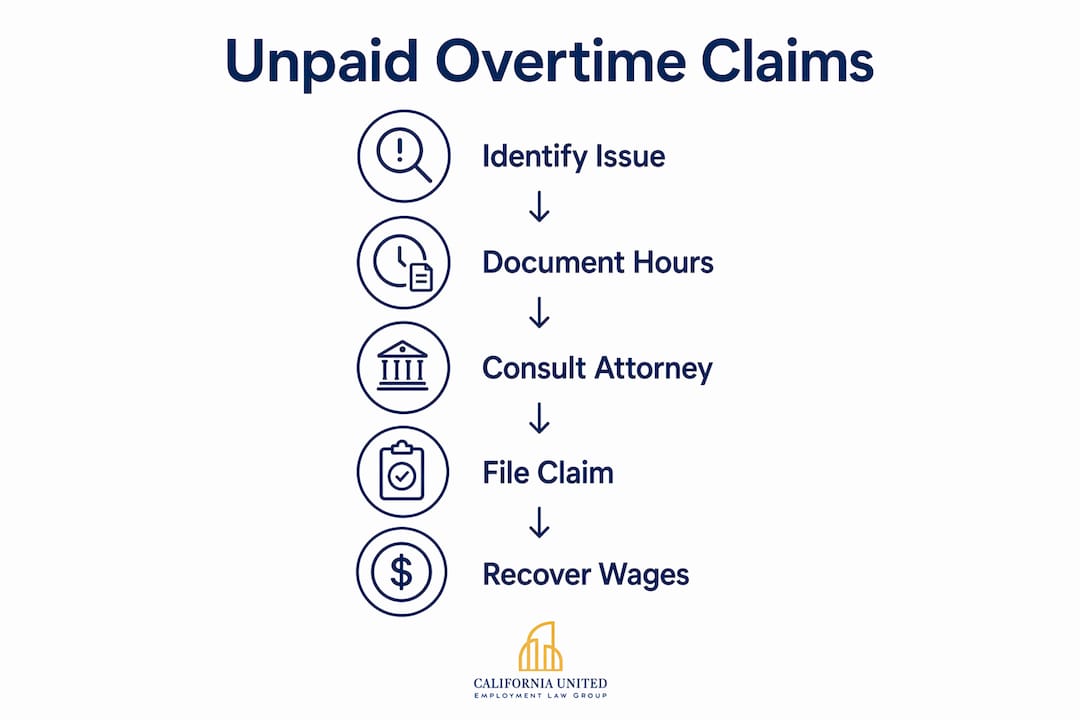
Here is how the process typically unfolds:
- Case evaluation. An attorney reviews your pay records, timesheets, offer letter, and any written policies to identify specific violations. Precise payroll audits help identify erroneous employer practices and strengthen the foundation of your claim.
- Evidence collection. Your attorney gathers documentation including text messages, emails, scheduling records, and witness statements. In contractor-based or gig-style workplaces, factual disputes on data completeness and willfulness can keep claims viable even when records are incomplete.
- Filing the claim. Depending on your situation, your attorney may file a wage claim with the California Labor Commissioner’s Office (also called the Division of Labor Standards Enforcement), pursue a civil lawsuit, or file a PAGA notice with the California Labor and Workforce Development Agency.
- Settlement negotiation. Most wage and hour cases resolve before trial. An attorney with PAGA experience can use the threat of representative action penalties to significantly increase settlement leverage. In Arias v. Superior Court (2009), the California Supreme Court confirmed that PAGA actions do not need to comply with class action requirements, allowing a single aggrieved employee to pursue penalties on behalf of all similarly situated coworkers without seeking class certification. More recently, in Adolph v. Uber Technologies, Inc. (2023), the court held that even where an employer compels an employee’s individual PAGA claim to arbitration, the employee retains standing to pursue the non-individual PAGA action in court — limiting a key employer strategy for defeating representative claims.
- Litigation. If an employer refuses a fair settlement, your attorney can take the case to court, where records, expert analysis, and witness testimony become central.
Deadlines for filing unpaid wage claims run from the date wages were due, and missing them can forfeit your right to recover. Most California wage claims carry a three-year statute of limitations for Labor Code violations, with some claims extending to four years under unfair business practices law. However, PAGA actions carry a separate one-year statute of limitations under Code of Civil Procedure § 340(a) — a deadline that runs from the date of the most recent violation alleged in the PAGA notice. This shorter window makes prompt action especially critical if you intend to pursue representative penalties. Consulting an attorney early protects your ability to recover the full amount owed.
Pro Tip: If you are worried about retaliation after reporting wage violations, California law prohibits employers from firing or punishing workers for asserting their wage rights. You can learn more about retaliation protections specific to Culver City employees.
What penalties and remedies are available for wage theft in California?
California’s penalty structure for wage theft is among the most aggressive in the country. Employees are not limited to recovering only the wages they lost. Multiple layers of penalties can apply simultaneously, and the total exposure for employers can far exceed the original underpayment.
“PAGA’s strength lies in deputizing employees to enforce labor laws where state resources are limited, altering employer compliance incentives.”
Under PAGA, civil penalties start at $100 per employee per pay period for initial violations and $200 per employee per pay period for subsequent violations. Because PAGA penalties are calculated across all affected employees and all pay periods, exposure compounds quickly. Under the 2024 reformed PAGA law (AB 2288, effective June 19, 2024), 65% of the total civil penalty amount goes to the State of California and 35% is distributed to aggrieved employees. This represents an improvement over the prior law, which allocated only 25% to employees.
| Remedy type | How it works |
|---|---|
| Unpaid wages | Full recovery of all wages owed, including overtime premiums |
| Waiting time penalties | Up to 30 days of wages for late final paychecks under Labor Code § 203 |
| PAGA civil penalties | $100 to $200 per employee per pay period, depending on violation history |
| Liquidated damages | Equal to the amount of minimum wage violations in some cases |
| Attorney fees and costs | Recoverable by the employee if they prevail under California law |
Waiting time penalties under Labor Code § 203 apply when an employer willfully fails to pay a terminated employee immediately or a resigning employee within 72 hours. A good faith dispute over whether wages are owed may preclude these penalties, but where no legitimate dispute exists, the penalty accrues each day until paid. These penalties accrue each day wages remain unpaid, up to a maximum of 30 days. For a worker earning $25 per hour on a full-time schedule, that cap represents roughly $6,000 in penalties alone, on top of any unpaid wages.
PAGA penalty exposure depends heavily on how violations are categorized and how payroll periods and employees are counted, which can magnify liability quickly. This is why employers often settle PAGA claims before they reach trial.
Wage claim vs. PAGA action: which path fits your situation?
Culver City employees facing unpaid overtime or wage theft generally have two primary legal paths: an individual wage claim and a PAGA representative action. Understanding the difference helps you and your attorney choose the most effective strategy.
| Factor | Individual wage claim | PAGA representative action |
|---|---|---|
| Who benefits | You alone | You and all similarly affected coworkers |
| Penalties available | Unpaid wages, waiting time penalties, liquidated damages | Civil penalties per pay period per employee |
| Settlement leverage | Moderate | Significantly higher due to penalty scale |
| State involvement | None directly | 65% of penalties go to the State |
| Filing requirement | Labor Commissioner or civil court | PAGA notice to LWDA required first |
| Best suited for | Single, clear violation with documented damages | Systemic employer practices affecting multiple workers |
PAGA acts as a private enforcement mechanism, deputizing employees to seek civil penalties on behalf of the State when government enforcement resources are limited. Many employees file PAGA claims alongside individual wage claims, which combines the direct recovery of unpaid wages with the penalty leverage that PAGA provides. This dual approach is common in Culver City cases involving misclassification or systemic off-the-clock work.
The right path depends on the facts of your case. If your employer underpaid only you for a defined period, an individual claim may be faster and more direct. If the same practice affected your entire team or department, a PAGA action can produce a larger recovery and force broader compliance. An attorney familiar with California Labor Code rights can assess which approach fits your specific situation.
Key Takeaways
California wage and hour law gives Culver City employees powerful tools to recover unpaid overtime and wage theft damages, including PAGA penalties, waiting time penalties, and attorney fee recovery.
| Point | Details |
|---|---|
| Wage theft is broadly defined | It includes misclassification, off-the-clock work, illegal deductions, and improper overtime calculations. |
| PAGA multiplies employer exposure | Penalties of $100 to $200 per employee per pay period compound rapidly across large workforces. |
| Deadlines matter | Most California wage claims must be filed within three to four years of the violation date. |
| Two legal paths exist | Individual wage claims and PAGA actions can be filed together to maximize recovery. |
| Attorney audits strengthen claims | Precise payroll reviews identify violations that employees and employers often overlook. |
What I’ve Seen Working Through Wage And Hour Cases In Culver City
After reviewing wage and hour disputes across Culver City and the broader Los Angeles area, one pattern stands out clearly. Most employees who come forward do so months or even years after the violations began, often because they did not realize what was happening was illegal. Employers rarely announce that they are committing wage theft. The violations are embedded in scheduling software, payroll rounding policies, or job title classifications that sound legitimate on paper.
The employees who recover the most are those who act early and document consistently. A single pay stub showing a miscalculated overtime rate is useful. Twelve months of pay stubs showing the same error is a case. I have seen employers settle quickly once an attorney presents a structured audit showing the full scope of underpayment across a team.
I also want to be direct about PAGA. Some employees hesitate to pursue it because they feel uncomfortable acting on behalf of coworkers. But PAGA exists precisely because individual claims alone do not change employer behavior at scale. When a Culver City employer knows that one employee’s complaint could expose them to penalties covering every worker on the payroll, the compliance incentive shifts dramatically. That is the law working as intended.
If you work in Culver City and something about your paycheck has felt wrong, the right move is a consultation with an attorney who handles employment law in Culver City. Not because litigation is inevitable, but because you deserve to know what you are actually owed.
How California United Law Group supports Culver City Employees With Wage And Hour Claims
California United Law Group, P.C. represents Culver City employees in wage theft and unpaid overtime disputes at every stage, from initial consultation through litigation.
The firm’s attorneys handle the full range of wage and hour violations under the California Labor Code, including overtime underpayment, misclassification, meal and rest break violations, and PAGA representative actions. California United Law Group offers initial case evaluations so you can understand your rights before committing to any legal path. The firm’s focus on California employment law means you work with attorneys who know the specific rules that apply to Culver City workers. If you believe your employer has shorted your wages, reaching out early gives you the best chance of recovering everything you are owed.
FAQ
What is wage theft under California law?
Wage theft is any employer practice that withholds legally earned compensation, including unpaid overtime, illegal deductions, off-the-clock work, and meal break violations. California law defines these violations broadly under the Labor Code.
How long do I have to file an unpaid wage claim in California?
Most California wage claims must be filed within three years of the violation date for Labor Code violations, with some claims extending to four years under Business and Professions Code § 17200. However, PAGA representative actions carry a one-year statute of limitations under Code of Civil Procedure § 340(a), running from the date of the most recent alleged violation. Missing any of these deadlines can forfeit your right to recover. Consulting an attorney promptly protects all available options.
What are PAGA penalties and who receives them?
PAGA penalties start at $100 per employee per pay period for initial violations and $200 for subsequent violations. Of the total amount recovered, 65% goes to the State and 35% is distributed to affected employees.
Can my employer retaliate against me for reporting wage theft?
California law prohibits retaliation against employees who assert their wage rights or file wage claims. If your employer fires, demotes, or threatens you after you report violations, that retaliation is itself a separate legal claim.
Do I need an attorney to file a wage claim in Culver City?
You are not required to have an attorney to file with the Labor Commissioner, but an attorney can identify violations you may have missed, calculate the full value of your claim, and pursue PAGA penalties that are not available through the administrative process alone.