
Many Alhambra employees believe employers only need to respond to workplace safety issues after receiving a government order or inspection. This assumption leaves workers exposed to preventable hazards and unsure about their legal protections. California law actually requires employers to act proactively the moment they become aware of safety concerns, without waiting for regulatory intervention. Understanding these legal duties helps you protect yourself and hold your employer accountable when hazards threaten your wellbeing at work.
Disclaimer: This article provides general information about California workplace safety laws and is not legal advice. Every situation is unique. Consult with a qualified employment attorney about your specific circumstances.
Table of Contents
- Introduction To Workplace Safety Obligations In Alhambra
- Understanding Employer Legal Responsibilities Under Cal/OSHA
- Employee Rights And Whistleblower Protections
- Comparison Of Federal OSHA And Cal/OSHA Requirements
- Process For Reporting And Resolving Workplace Safety Concerns
- Case Studies And Real-World Employer Responses
- Employer Training And Preventative Duties
- Get Expert Help With Workplace Safety Concerns In Alhambra
- Frequently Asked Questions
Key takeaways
| Point | Details |
|---|---|
| Employers must act promptly | Cal/OSHA requires immediate hazard correction once employers know about workplace dangers. |
| Retaliation is illegal | Labor Code Section 6310 protects employees who report safety concerns from termination or punishment. |
| Cal/OSHA governs locally | California operates stricter workplace safety standards than federal OSHA in most industries. |
| Anonymous reporting works | Employees can file complaints with Cal/OSHA without revealing their identity to employers. |
| Document everything | Written records of safety complaints create legal proof of employer notification and response timelines. |
Introduction to workplace safety obligations in Alhambra
California operates one of the most comprehensive workplace safety programs in the United States through the Division of Occupational Safety and Health, commonly known as Cal/OSHA. This state agency has jurisdiction over virtually all private sector workplaces in Alhambra, from restaurants and retail shops to construction sites and manufacturing facilities. Unlike states that rely solely on federal oversight, California maintains its own enforcement system with standards that often exceed minimum federal requirements.
The legal foundation begins with a fundamental principle: every employer must provide a workplace free from recognized hazards that could cause death or serious physical harm. This obligation isn’t optional or discretionary. It applies whether you work for a small family business or a large corporation. The moment an employer becomes aware of a safety concern through any channel, whether an employee complaint, observation, or inspection, the duty to investigate and correct that hazard immediately activates.
Athambra businesses must comply with an extensive body of regulations covering everything from proper machine guarding and chemical storage to heat illness prevention and ergonomic practices. Cal/OSHA publishes detailed standards for different industries, and employers are expected to know which ones apply to their operations. The regulatory framework serves several critical purposes:
- Establishing clear safety standards that employers must meet
- Providing mechanisms for employees to report hazards without fear
- Creating enforcement tools including inspections and penalties
- Ensuring consistent protections across California workplaces
Understanding this framework empowers you to recognize when your employer fails to meet legal obligations. You’re not asking for favors when you report safety concerns. You’re invoking rights that California law explicitly protects.
Understanding employer legal responsibilities under Cal/OSHA
Once you notify your employer about a workplace safety hazard, specific legal duties immediately take effect. Your employer must investigate the reported concern promptly and thoroughly. This isn’t about whether the hazard seems serious to management or fits their schedule. California regulations require timely assessment of all reported conditions that could potentially harm workers.
After investigation confirms a hazard exists, employers face strict deadlines for correction based on severity. Imminent dangers that could cause immediate death or serious harm must be addressed right away, often within hours. Serious hazards typically require correction within days or weeks. Even minor violations need fixes according to reasonable timelines. Employers cannot simply acknowledge the problem and postpone action indefinitely.
The consequences for ignoring these duties are substantial. Cal/OSHA can issue substantial civil penalties for safety violations. Penalty amounts vary based on violation severity, with serious violations carrying significant fines and willful or repeated violations subject to the highest penalties. Penalty amounts are adjusted periodically by regulation. These aren’t just theoretical numbers. The agency actively enforces safety standards through complaint investigations and targeted inspections. Employers who demonstrate a pattern of ignoring hazards face escalating penalties and increased regulatory scrutiny.
Crucially, employers cannot hide behind the excuse that they’re waiting for an official OSHA order or inspection. The duty to correct hazards is proactive and self-executing. Once knowledge exists, action must follow. Many employers mistakenly believe they have discretion about whether and when to address safety issues. California law removes that discretion entirely for recognized hazards.
California courts have consistently held that employers cannot delegate their non-delegable duty to provide a safe workplace. In SeaBright Ins. Co. v. US Airways, Inc. (2011) 52 Cal.4th 590, the California Supreme Court addressed workplace safety obligations, noting that hirers of independent contractors implicitly delegate certain safety duties but retain ultimate responsibility for regulatory compliance. Similarly, in Suarez v. Pacific Northstar Mechanical, Inc. (2009) 180 Cal.App.4th 430, the Court of Appeal held that employers at multi-employer worksites must report hazards to controlling employers even when they did not create those hazards, emphasizing the proactive nature of safety obligations.
If you’re concerned about workplace safety in Alhambra, consulting an employment lawyer in Alhambra helps you understand whether your employer is meeting legal obligations. Proper documentation creates the foundation for both regulatory complaints and potential legal action.
Pro Tip: Always submit safety concerns through written communication like email or a signed letter rather than verbal reports only. Written documentation proves when you notified your employer and creates a clear timeline if you later need to file a Cal/OSHA complaint or pursue legal action for retaliation.
Employee rights and whistleblower protections
California provides robust protections for workers who speak up about unsafe conditions. You have the right to report safety hazards to your employer, Cal/OSHA, or both without risking your job or facing punishment. These protections apply whether you report internally first or go directly to regulators with your concerns.
California Labor Code Section 6310 specifically prohibits employers from discharging or discriminating against any employee for making safety complaints or participating in workplace safety activities. This protection extends beyond just reporting hazards. You’re also protected when you refuse to work in conditions where you reasonably believe imminent danger exists that could cause death or serious injury.
The scope of these whistleblower protections is intentionally broad. They apply whether you file a formal written complaint, mention concerns verbally to a supervisor, participate in a safety committee, or cooperate with a Cal/OSHA inspection. Protection exists even if your complaint turns out to be mistaken, as long as you made it in good faith based on a reasonable belief that a hazard existed.
Courts broadly interpret retaliation protections. In Lujan v. Minagar (2004) 124 Cal.App.4th 1040, the Court of Appeal held that firing an employee whom the employer feared would complain about safety violations constitutes actionable retaliation under Labor Code § 6310(b), establishing that employers cannot engage in preemptive retaliation.
If your employer retaliates against you for asserting safety rights, you have multiple legal remedies available. You can file a retaliation complaint with Cal/OSHA or pursue a civil lawsuit for damages. Understanding your rights after reporting misconduct helps you recognize retaliation and respond effectively. Common forms of illegal retaliation include:
- Termination or demotion following a safety complaint
- Reduced hours or undesirable shift assignments
- Increased scrutiny or disciplinary actions for minor issues
- Hostile treatment or social isolation from supervisors and coworkers
- Threats or intimidation designed to discourage further complaints
Many employees worry about reporting hazards anonymously versus identifying themselves. Cal/OSHA accepts anonymous complaints and will investigate serious allegations even without knowing the complainant’s identity. However, reporting safety violations with your identity allows the agency to gather more detailed information and keeps you informed about investigation progress.
Pro Tip: Maintain a personal file containing copies of all safety complaints, employer responses, and any documentation of changed treatment after reporting. This evidence becomes critical if you need to prove retaliation later. Include dates, times, witnesses, and detailed descriptions of each incident.
Comparison of federal OSHA and Cal/OSHA requirements
Understanding the relationship between federal and California workplace safety programs helps clarify which standards govern your Alhambra workplace. While federal OSHA establishes baseline protections for most U.S. workers, California operates an approved state plan that supersedes federal jurisdiction for most private sector employers within the state.
Cal/OSHA standards must be at least as effective as federal OSHA requirements, but California often adopts more protective rules. This means Alhambra employers face stricter obligations in many areas compared to employers in states covered only by federal OSHA. The practical impact affects your daily workplace protections in significant ways.
| Aspect | Federal OSHA | Cal/OSHA |
|---|---|---|
| Heat illness prevention | Limited specific requirements | Comprehensive program with mandatory water, shade, and training |
| Injury reporting | Hospitalizations and fatalities | Serious injuries, illnesses, and deaths with shorter timeframes |
| Inspection priorities | Reactive to complaints | Proactive targeting of high hazard industries |
| Penalty amounts | Lower maximum fines | Higher penalties for serious violations |
| Employee rights | Basic protections | Enhanced whistleblower protections under state labor code |
Cal/OSHA also enforces requirements in areas where federal OSHA has no comparable standard. For example, California requires detailed aerosol transmissible disease protections, comprehensive workplace violence prevention in healthcare settings, and specific ergonomic guidelines for repetitive motion injuries. These additional protections reflect California’s recognition that worker safety extends beyond the minimum federal baseline.
The enforcement approach differs as well. Cal/OSHA typically conducts more frequent inspections and responds more aggressively to employee complaints compared to federal OSHA’s capacity in other states. This creates practical advantages for California workers seeking to address safety concerns through regulatory channels.
For Alhambra employees, the key takeaway is straightforward: you benefit from more comprehensive protections and more robust enforcement compared to workers in most other states. When asserting your safety rights, California law provides the governing standards and mechanisms for holding employers accountable.
Process for reporting and resolving workplace safety concerns
Navigating the reporting process effectively maximizes your chances of getting hazards corrected while protecting your legal rights. Following these steps creates documentation and escalates concerns appropriately if your employer fails to respond.
Report the hazard to your employer in writing immediately upon discovering or recognizing the danger. Email works well because it creates a timestamp and delivery record. Describe the specific hazard, its location, why it poses danger, and request prompt investigation and correction. Keep a copy for your records.
Allow your employer reasonable time to investigate and address the concern based on hazard severity. Imminent dangers require immediate action, while less serious issues might need several days or weeks for proper correction. Monitor the situation and follow up in writing if nothing happens.
File a formal complaint with Cal/OSHA if your employer ignores the hazard, delays unreasonably, or retaliates against you. You can submit complaints online, by phone, or through mail. Include detailed descriptions, dates, locations, and any documentation supporting your concerns. Cal/OSHA accepts both signed and anonymous complaints.
Cooperate with the Cal/OSHA investigation process, which typically begins within days for serious hazards. Inspectors may contact you for additional information, conduct a workplace inspection, and review employer safety records. Be honest and thorough when providing information to investigators.
Follow up on investigation results and any citations issued. Cal/OSHA will inform you about inspection findings and whether violations were cited. Monitor whether your employer actually implements required corrections within specified deadlines.
Common mistakes undermine the effectiveness of safety complaints and weaken your legal position. Avoid these errors:
- Reporting hazards only verbally without written documentation
- Waiting too long before escalating to Cal/OSHA after employer inaction
- Failing to document retaliation or changed treatment after reporting
- Not keeping personal copies of all complaints and employer responses
- Assuming nothing can be done if your employer dismisses your concerns
Understanding the employment lawsuit process becomes relevant if you face retaliation or your employer’s failure to address hazards causes injury. Legal deadlines apply to different types of claims, so consulting an attorney promptly protects your options.
Case studies and real-world employer responses
Real examples demonstrate how California’s safety enforcement system works in practice and the tangible benefits employees gain when exercising their rights. These scenarios reflect common patterns seen across Alhambra and California workplaces.
DISCLAIMER:
The following examples illustrate common patterns in Cal/OSHA enforcement based on typical scenarios. Individual results vary based on specific circumstances.
Consider a manufacturing facility in Alhambra where workers reported malfunctioning machine guards that left rotating parts exposed. After the employer delayed repairs for several weeks citing budget concerns, employees filed a Cal/OSHA complaint. Inspectors arrived within five days, confirmed the violation, and issued a serious citation with a $15,000 penalty. The employer installed proper guards within 10 days and implemented a regular maintenance schedule to prevent future violations.
In a construction case, workers at an Alhambra building site complained about inadequate fall protection on scaffolding above 10 feet. The contractor initially provided only minimal equipment and no training. Following multiple worker reports and a Cal/OSHA inspection triggered by a complaint, the agency discovered numerous violations beyond the original concern. Citations totaled over $40,000, and the contractor faced mandatory safety training requirements and follow-up inspections.

A restaurant employee reported inadequate ventilation causing excessive heat exposure in the kitchen during summer months. Management dismissed the complaints as workers being overly sensitive. After the employee contacted Cal/OSHA, an inspection revealed violations of California’s heat illness prevention standards. The employer was required to provide adequate cooling, implement scheduled rest breaks, and train all employees on heat illness recognition.
These cases illustrate several important lessons:
- Cal/OSHA investigations often uncover additional violations beyond the original complaint
- Financial penalties provide strong incentives for employers to take safety seriously
- Formal complaints lead to concrete improvements that benefit all workers
- Employees who report concerns ultimately protect themselves and coworkers from harm
The outcomes demonstrate that California’s enforcement system works when employees exercise their rights. Delays in reporting or accepting employer excuses only prolong exposure to preventable hazards.
Employer training and preventative duties
Beyond responding to reported hazards, California law requires employers to maintain ongoing training programs and implement preventative safety measures. These proactive obligations help identify and eliminate risks before injuries occur. Understanding these duties helps you assess whether your employer meets minimum legal standards.
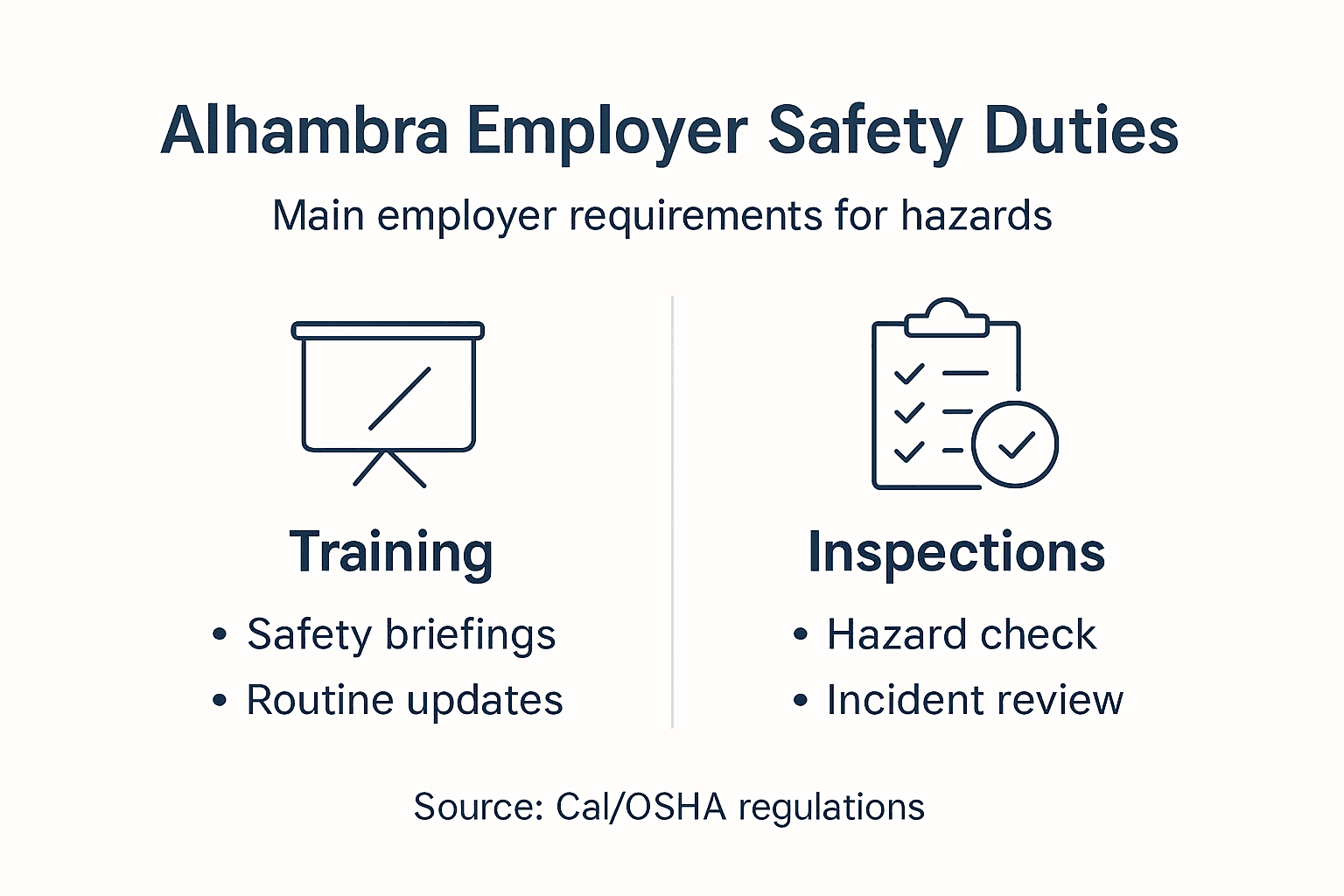
Cal/OSHA mandates that employers provide comprehensive safety training to all employees based on the specific hazards present in their workplace. Training must occur when workers are first hired, whenever new hazards are introduced, and periodically as refresher education. The content must be presented in language and literacy levels workers understand, which often means providing materials in multiple languages for diverse workforces.
Required training topics typically include:
- Recognition of workplace hazards specific to your job duties
- Proper use and maintenance of personal protective equipment
- Emergency procedures including evacuation routes and alarm systems
- Safe operation procedures for equipment and machinery
- Chemical hazards and proper handling of hazardous substances
Employers must also conduct regular workplace inspections to identify hazards before they cause injuries. This proactive hazard assessment represents a core preventative duty under California safety regulations. Simply waiting for employees to report problems doesn’t satisfy legal obligations.
A strong safety culture benefits everyone in the workplace. Employers who invest in comprehensive training, maintain equipment properly, and encourage open communication about hazards experience fewer injuries, lower workers’ compensation costs, and better employee morale. Conversely, workplaces where safety concerns are dismissed or ignored tend to have higher injury rates and face more regulatory enforcement actions.
Awareness of these preventative duties helps you evaluate your employer’s overall approach to safety. If you’ve never received safety training, don’t know how to report hazards, or work with equipment lacking proper guards or warnings, these gaps likely indicate broader compliance failures worth addressing through internal complaints or regulatory channels.
Get expert help with workplace safety concerns in Alhambra
When your employer ignores safety hazards or retaliates against you for speaking up, experienced legal support becomes essential for protecting your rights. California United Law Group, P.C. represents employees throughout Alhambra and Southern California in disputes with employers who violate safety obligations.
Our employment law services include representing workers in retaliation claims, wrongful termination cases involving safety complaints, and related workplace disputes. We work with employees at all stages, from evaluating whether to file formal complaints through litigation when necessary to hold employers accountable.
Prior results do not guarantee a similar outcome. Every case depends on its specific facts and circumstances.
Whether you need guidance on reporting procedures, help documenting retaliation, or representation in a safety-related employment dispute, our experienced team provides the support you need.
Contact California United Law Group, P.C. to discuss your workplace safety concerns and learn how we can help protect your rights while ensuring your employer meets legal obligations.
Frequently asked questions
DISCLAIMER:
These answers provide general information. Consult an attorney for advice about your specific situation.
What are my first steps if my employer ignores a safety hazard?
Document the hazard with photos if possible and submit a written complaint to your supervisor or HR department clearly describing the danger and requesting correction. If your employer doesn’t respond within a reasonable timeframe based on hazard severity, file a complaint with Cal/OSHA while keeping copies of all documentation.
How does Cal/OSHA protect me if I report a safety issue?
Cal/OSHA enforces California Labor Code Section 6310, which prohibits employers from retaliating against workers who report safety concerns. If you face termination, demotion, or other adverse treatment after reporting, you can file a retaliation complaint with Cal/OSHA or pursue a civil lawsuit for damages and reinstatement.
Can I report workplace safety concerns anonymously in Alhambra?
Yes, Cal/OSHA accepts and investigates anonymous complaints about workplace safety violations. However, providing your contact information allows inspectors to gather more detailed information and keeps you informed about investigation progress, which often leads to more thorough enforcement actions.
What should I do if my employer retaliates after I report a hazard?
Document the retaliation immediately with detailed notes about dates, actions, witnesses, and how the treatment differs from before your complaint. Contact an employment attorney right away because legal deadlines apply to retaliation claims, and early legal intervention often prevents escalating retaliation.
Are federal OSHA rules or Cal/OSHA rules applicable in my workplace?
Cal/OSHA standards govern virtually all private sector workplaces in Alhambra and throughout California. These state regulations are generally more protective than federal OSHA requirements, providing stronger employee rights and more comprehensive safety protections for California workers.