
TL;DR:
- California law allows employees at Sony Pictures to sue for workplace harassment based on protected characteristics.
- Filing deadlines require reporting to the CRD within three years and lawsuit filing within one year of notice.
- Employees who prevail can recover a range of remedies under FEHA, including back pay, emotional distress damages, attorney fees, and in certain cases, punitive damages — with no statutory cap on compensatory damages.
If you work at Sony Pictures Entertainment and have experienced harassment on the job, you may assume that a major studio is too big, too powerful, or too well-lawyered to take on. That belief is wrong. California staff can sue for workplace harassment under the Fair Employment and Housing Act (FEHA), one of the strongest employee protection laws in the country. This guide walks you through what legally counts as harassment, how Sony’s own policies apply, the step-by-step process to file a claim, and what compensation you could recover.
Table of Contents
- Understanding workplace harassment under California law
- Recent harassment cases and Sony’s internal policies
- The legal process: Steps to sue Sony Pictures for harassment
- Potential outcomes: What you could win if you prevail
- A legal insider’s take: What most Sony staff miss about harassment claims
- Get support with your workplace harassment claim
- Frequently asked questions
Key Takeaways
| Point | Details |
|---|---|
| Harassment legal rights | Sony staff in California are fully protected under state harassment laws and may sue under FEHA. |
| Filing deadlines matter | There are strict timelines for reporting and suing, so quick action is essential. |
| Evidence is critical | Documenting harassment and following both company and legal steps builds a stronger case. |
| Damages can be significant | If you prevail, you may receive uncapped compensation for back pay, distress, and more. |
| Contractors have rights | Integrated contractors at Sony may also be protected and eligible to file claims. |
Understanding Workplace Harassment Under California Law
Not every uncomfortable moment at work rises to a legal claim. Understanding the legal definition is the first step toward knowing whether you have a case worth pursuing.
Under FEHA, harassment is severe or pervasive conduct based on a protected characteristic that creates a hostile work environment. Under FEHA, employer liability depends on who commits the harassment. An employer is strictly liable for harassment by a supervisor. For harassment by a coworker or non-supervisory employee, the employer is liable only if it knew or should have known about the conduct and failed to take immediate corrective action. That standard applies directly to Sony Pictures.
The California Supreme Court confirmed this framework in State Department of Health Services v. Superior Court (2003) 31 Cal.4th 1026, holding that an employer is strictly liable for a supervisor’s harassment regardless of whether the supervisor was acting as the employer’s agent at the time — except where the harassment results from a completely private relationship unconnected to employment. For coworker harassment, the California Court of Appeal explained in Sheffield v. Los Angeles County Department of Social Services (2003) 109 Cal.App.4th 153, that the key question is whether the employer failed to take reasonable steps to prevent or correct the harassment after receiving notice of it.
Protected characteristics under FEHA include:
- Race and national origin
- Sex and gender identity
- Sexual orientation
- Age (40 and over)
- Disability (physical or mental)
- Religion
- Pregnancy and medical conditions
- Marital status
You can learn more about workplace harassment definitions and how courts interpret each category. The scope is broad intentionally. California lawmakers designed FEHA to cover a wide range of situations.
What counts as harassment in practice?
| Type | Examples |
|---|---|
| Severe single incident | Physical assault, explicit threats, severe racial slurs |
| Pattern of behavior | Repeated offensive jokes, persistent unwanted advances, regular exclusion |
| Quid pro quo | Job benefits tied to sexual favors or compliance |
| Environmental | Offensive posters, degrading comments that permeate the workplace |
Importantly, contractors working on Sony lots or productions may also be protected. Whether a contractor is covered under FEHA’s harassment provisions depends on the specific nature of the working relationship. FEHA extends harassment protections to persons providing services pursuant to a contract in certain circumstances, and workers placed at Sony through staffing arrangements may have additional protections under joint employer theories. An attorney can evaluate whether your specific situation qualifies.
One critical point: Sony’s size does not shield it. The law requires the company to respond when supervisors, coworkers, or even clients engage in prohibited conduct. If you’ve experienced a hostile work environment at Sony Pictures and the company failed to act, that failure itself can form the basis of your legal claim.
Statistic to know: California receives tens of thousands of harassment complaints each year through state administrative agencies, making it one of the most active enforcement environments in the country.
Recent Harassment Cases And Sony’s Internal Policies
Understanding the law is one thing. Seeing how these rules play out at Sony, and what steps the company expects you to follow, gives you a practical roadmap.
Sony Pictures has a documented history of harassment-related litigation. Steib v. Sony Pictures Television involved claims of racial harassment and retaliation.
Steib v. Sony Pictures Television involved claims of racial harassment and retaliation, illustrating that courts and administrative agencies have treated major entertainment studios as accountable under the same legal standards that apply to any California employer. This aligns with the California Supreme Court’s recognition in State Department of Health Services v. Superior Court (2003) 31 Cal.4th 1026, that under FEHA, an employer is strictly liable for all acts of harassment by a supervisor — a rule that applies regardless of the employer’s size or sophistication. In Aguilar v. Avis Rent A Car System, Inc. (1999) 21 Cal.4th 121, the California Supreme Court also confirmed that racial harassment must be sufficiently severe or pervasive to alter the conditions of the victim’s employment, a standard courts apply to claims against any employer, including major studios.
Separately, producers connected to major Sony game shows faced race, gender, and age discrimination complaints. These cases are not just headlines. They show that employees have brought claims against Sony and that the legal system has engaged with those claims seriously.
Every harassment claim is different. What matters most is not the name of the employer but the strength of your documentation and whether the employer responded appropriately once it knew about the problem.
Sony’s internal anti-harassment policy requires employees to report incidents through designated channels. The Sony Pictures policy explicitly prohibits retaliation against anyone who reports in good faith. Contractors are also addressed in certain policy provisions.

How Sony’s stated policy compares to legal requirements:
| Aspect | Sony’s Internal Policy | California Law (FEHA) |
|---|---|---|
| Reporting mechanism | Internal HR or hotline | File with CRD |
| Anti-retaliation protection | Yes, per policy | Yes, enforceable by law |
| Coverage of contractors | Addressed in some provisions | Protected if integrated |
| Consequence for violations | Discipline up to termination | Civil liability, damages |
The gap between policy and practice is where legal claims are born. Reporting internally is an important step, but it does not replace your rights under state law. If Sony’s internal process fails you or results in retaliation, you have legal recourse outside the company. Documentation of your internal report and Sony’s response (or lack of one) becomes critical evidence. Check news on Sony harassment cases to understand how public scrutiny has influenced outcomes at the studio level.
The Legal Process: Steps To Sue Sony Pictures For Harassment
With context from Sony’s policies and past cases, here is your step-by-step legal game plan if harassment happens to you.
Step 1: Document Everything Immediately
Write down dates, times, locations, witnesses, and the exact words or actions involved. Save emails, texts, or any written communications. This contemporaneous record is your strongest defense.
Step 2: Report Through Sony’s Internal Channels
Use the internal HR process or ethics hotline. This creates a formal record. It also gives Sony the opportunity to address the issue, which courts often look for when assessing employer liability.
Step 3: File A Complaint With The California Civil Rights Department (CRD)
You must file with CRD within 3 years of the last harassing act. This administrative step is legally required before you can sue. You cannot skip it.
Step 4: Obtain A Right-To-Sue Notice
After filing, you can request an immediate Right-to-Sue notice from the CRD. Once you receive it, you have 1 year to file your lawsuit in civil court.
Step 5: File Your Civil Lawsuit
With the Right-to-Sue notice in hand, your attorney files the complaint against Sony in California court. Discovery, depositions, and potential settlement negotiations follow.
Review the lawsuit process overview for a detailed breakdown of what each phase involves. You should also familiarize yourself with how to prove workplace harassment before your case moves forward.
Pro Tip: Never wait until you feel ready. The 3-year deadline to file with CRD sounds generous, but evidence fades, witnesses leave companies, and emails get purged. File sooner rather than later.
Missing these deadlines is the number one reason valid claims fail. Not because the conduct was not serious. Because the paperwork was not filed in time.
Potential Outcomes: What You Could Win If You Prevail
If you pursue legal action and win, what can you actually expect beyond headlines and popular misconceptions?
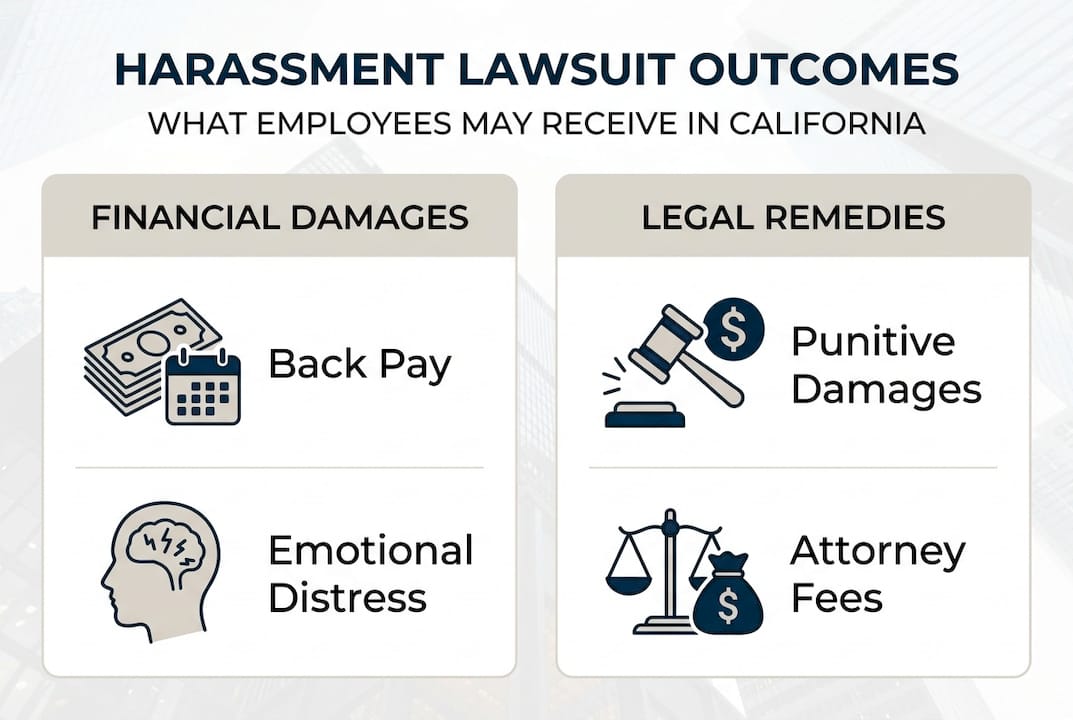
California’s FEHA offers some of the most robust remedies available to workers anywhere in the United States. FEHA allows uncapped damages including back pay, emotional distress, punitive damages, and attorney fees. There is no statutory ceiling on what you can recover, unlike federal law which caps certain damages based on employer size.
Types of compensation available:
- Back pay: Wages and benefits lost due to the harassment or related job action
- Emotional distress damages: Compensation for psychological suffering, anxiety, and trauma
- Punitive damages: Awarded when Sony’s conduct is found to be malicious or oppressive
- Attorney fees: Sony may be required to pay your legal costs if you prevail
- Reinstatement: Return to your former position if you were terminated
- Injunctive relief: Court orders requiring Sony to change its policies or practices
No two cases produce identical outcomes. The strength of your documentation, the severity of the conduct, and how Sony responded all influence the final result. Sony’s size does not automatically mean a larger payout, but it does mean the company has resources to fight aggressively. That is exactly why preparation matters.
You should also understand that pursuing a workplace retaliation claim alongside your harassment claim can increase the scope of your case if Sony took adverse action against you after you reported.
Pro Tip: Punitive damages under California law require proving by clear and convincing evidence that Sony, or a managing agent or officer acting on its behalf, acted with malice, oppression, or fraud. Malice means either intent to cause injury, or despicable conduct done with willful and knowing disregard of your rights. Detailed records showing that the company knew about the harassment and consciously failed to act are critical to meeting that standard.
A Legal Insider’s Take: What Most Sony Staff Miss About Harassment Claims
Here is something we see consistently: employees with genuinely strong cases walk away from claims not because the law failed them, but because they waited too long or kept poor records.
Working at a major employer like Sony can feel intimidating. The legal department is large. The HR team is polished. Many employees assume that reporting harassment will end their career in the industry. That fear is understandable. It is also not a reason to stay silent.
Retaliation for reporting harassment is prohibited under both FEHA and Sony’s own internal policy. In many cases, when an employer takes adverse action against an employee who made a good-faith complaint, that retaliation may give rise to a separate legal claim alongside the underlying harassment claim — potentially expanding the scope of the case.
The practical takeaway: start documenting proof strategies from the moment harassment begins. Write notes in a personal journal outside of work devices. Keep copies of relevant communications in a personal account. Get an attorney involved early, even just for a consultation. Early legal advice shapes the way you document, report, and communicate with HR, which pays dividends later if the case goes to court.
Get Support With Your Workplace Harassment Claim
You do not have to face Sony Pictures’ legal team alone. At California United Law Group, P.C., we represent employees exactly like you. Workers who know something is wrong, are not sure what their rights are, and want to take action without making a costly mistake.
Our team focuses on California employment law, including FEHA harassment claims, retaliation, and wrongful termination. We can guide you from your first consultation through every stage of litigation if needed. 👉 Contact our California employment lawyers today for a free consultation.
Results in any legal matter depend on the specific facts and circumstances of each case. Past results do not guarantee a similar outcome. This article is for general informational purposes only and does not constitute legal advice or create an attorney-client relationship.
You can also review the full lawsuit process details on our site to understand what comes next. Your rights are worth protecting.
Frequently Asked Questions
Do I need to report harassment at Sony internally before filing a lawsuit?
You should report through Sony’s internal policy if it is safe to do so, but state law requires you to file with CRD before you can sue in civil court.
What deadlines should Sony Pictures staff follow to sue for harassment?
You have 3 years to file with the CRD after the last harassing act, and then 1 year from the date of your Right-to-Sue notice to file a lawsuit.
Are Sony contractors protected by California harassment laws?
FEHA covers contractors in some situations, particularly when those contractors are integrated into Sony’s regular workplace operations.
What compensation can I win in a Sony harassment claim?
FEHA provides for a range of remedies with no statutory cap on compensatory damages, including back pay, emotional distress damages, and attorney fees if you prevail. Punitive damages may also be available but require proving by clear and convincing evidence that the employer or a managing agent acted with malice, oppression, or fraud. The damages recoverable in any specific case depend on the facts and evidence.
Is retaliation common after reporting harassment at Sony?
Retaliation is prohibited under both Sony’s own policy and California state law, and any act of retaliation can itself become an additional legal claim against the company.
Legal Disclaimer: The information in this article is for general informational purposes only and does not constitute legal advice. Reading this article does not create an attorney-client relationship. Employment law claims are highly fact-specific, and the outcome of any case depends on the specific circumstances involved. If you believe you have experienced workplace harassment, consult a qualified California employment attorney to evaluate your individual situation. Past results do not guarantee a similar outcome.