
California hostile work environment claims are highly fact-specific. The employee generally must show that the conduct was unwelcome, connected to a protected characteristic, and severe or pervasive enough to alter the conditions of employment and create an abusive work environment. The California Supreme Court has explained that this inquiry depends on all the circumstances, including frequency, severity, whether the conduct was threatening or humiliating, and whether it interfered with work performance. Lyle v. Warner Brothers Television Productions, 38 Cal. 4th 264, 283 (Cal. 2006).
Importantly, the test has both an objective and subjective component. The workplace must be one that a reasonable person would find hostile or abusive, and the employee must actually perceive it that way. Lyle v. Warner Brothers Television Productions, 38 Cal. 4th 264, 284 (Cal. 2006). That is why documentation should focus not only on what was said or done, but also on how the conduct affected the employee’s ability to work.
TL;DR:
- Evidence such as emails, photos, and witness statements that directly document the conduct and its timeline is crucial for strengthening the claim.
- Internal reports, complaint logs, and employer responses, especially if prompt and corrective, can significantly influence employer liability.
- Filing within the specific deadlines set by California or federal agencies is necessary before pursuing litigation, as late submissions can limit remedies.
- Protecting activity, such as reporting harassment, is legally shielded from retaliation, but timing of adverse actions after complaints is key to establishing retaliation.
- Building a detailed, organized record before consulting an attorney ensures a more efficient evaluation of the claim’s strength and potential gaps.
Table of Contents
- What are the legal elements of a hostile work environment claim?
- What kinds of evidence support a hostile work environment claim?
- How do internal complaints and employer responses affect a claim?
- When do you need to file with a state or federal agency?
- How is retaliation different from a hostile work environment claim?
- How should you organize your evidence before speaking with an attorney?
- How does California United Law Group review hostile work environment evidence?
- What health effects can a hostile work environment cause?
- What do hostile work environment claims often look like in West Hollywood workplaces?
- A careful note on documentation and timing
- Get help reviewing your evidence with California United Law Group
- Sources
- FAQ
What are the legal elements of a hostile work environment claim?
California courts and the EEOC’s harassment guidance apply a two-part test. The conduct must be objectively severe or pervasive from the perspective of a reasonable person, and the employee must have actually experienced it as hostile or abusive. Both pieces matter: a single tasteless comment usually will not meet the bar, but a pattern of comments, gestures, or exclusion tied to a protected trait often will.
FEHA and Title VII cover a wide set of protected characteristics, including:
- Race, color, and national origin
- Sex, gender identity, and sexual orientation
- Religion and disability
- Age (40 and older) and pregnancy status
- Genetic information and military or veteran status
The EEOC’s enforcement guidance on Harris v. Forklift Systems confirms that no single incident needs to be extreme. Instead, agencies and courts weigh frequency, severity, whether the conduct was physically threatening or humiliating, and whether it interfered with an employee’s ability to do the job. A supervisor who repeatedly mocks an employee’s accent, for example, can build a stronger claim over weeks than one sharp remark made in isolation.
Employer liability also depends on who did the harassing. Under FEHA, an employer is strictly liable for workplace sexual harassment committed by a supervisor, while harassment by a nonsupervisory coworker is evaluated differently. For coworker harassment, the employer is liable only if it knew or should have known about the conduct and failed to take immediate and appropriate corrective action. State Department of Health Services v. Superior Court, 31 Cal. 4th 1026, 1041-42 (Cal. 2003). That distinction is one reason internal complaints, HR responses, and corrective action records often become central evidence later.
What kinds of evidence support a hostile work environment claim?
Evidence quality often decides whether a claim gets taken seriously by HR, an agency, or an attorney. Several categories consistently carry the most weight.
- Emails, texts, and messaging app records: Metadata, timestamps, and unedited screenshots help confirm authenticity and show when conduct occurred.
- A written incident chronology: Short, dated entries created close to the event tend to be more credible than a memory reconstructed months later.
- Photos, audio, and video: These can capture physical conduct or a hostile tone, though recordings should be preserved in their original file format whenever possible.
- Witness statements: Coworkers who observed the conduct directly, rather than those who only heard about it secondhand, generally provide stronger corroboration.
- HR complaints, performance reviews, and disciplinary memos: These employer-generated records can show both the conduct and how (or whether) the company responded.
- Pattern and timeline evidence: A calendar or spreadsheet showing dates, locations, and witnesses across multiple incidents helps demonstrate pervasiveness rather than an isolated dispute.
The EEOC’s evidence guidance under CM-602 specifically advises evaluating witness bias and pairing testimony with documentary evidence wherever it exists. A witness who is a close friend of the accused, for instance, may be viewed differently than a neutral colleague whose account lines up with dated emails or HR notes. California law also places responsibility on employers to prevent harassment and train staff, which means internal training records and prior complaint logs can sometimes corroborate a pattern that extends beyond one employee’s experience.
California courts do not evaluate workplace conduct in isolation. They consider the surrounding context, including the relationships between the people involved, the workplace setting, and how the conduct was experienced by the employee. Lyle v. Warner Brothers Television Productions, 38 Cal. 4th 264, 283 (Cal. 2006). For that reason, evidence that explains the setting, such as shift schedules, reporting structure, prior complaints, witness locations, and the employee’s role, can be just as important as the offensive message or incident itself.
Pro Tip: Save originals, not just screenshots. A forwarded email or a photo of a text thread is useful, but the original file with intact metadata is far more persuasive if a case moves toward litigation.
How do internal complaints and employer responses affect a claim?
Reporting harassment internally does more than alert the employer. It can shape how liability is assessed and whether the company had a real opportunity to fix the problem.
- Document who you told, when, and what you said. A short written summary sent to yourself right after a conversation with HR or a manager helps establish a timeline.
- Keep copies of any written complaint and the response you received. This includes emails, complaint forms, and any follow-up from HR or management.
- Note whether the employer took corrective action. A prompt investigation, policy change, or separation of the parties involved can factor into how liability is evaluated, while inaction or dismissiveness can work against the employer.
- Remember that reporting is protected activity. Raising a good-faith concern is generally protected even if the underlying conduct has not yet reached the severe-or-pervasive threshold.
A prompt investigation can matter because an employer’s response is part of the liability analysis when the alleged harasser is a coworker rather than a supervisor. If the employer knew or should have known about the harassment but failed to act, that failure can support liability. State Department of Health Services v. Superior Court, 31 Cal. 4th 1026, 1041 (Cal. 2003). Employees should keep copies of complaints, follow-up emails, meeting notes, investigation updates, and any changes in scheduling, duties, discipline, or workplace treatment after reporting.
When do you need to file with a state or federal agency?
Most hostile work environment claims under FEHA or Title VII begin with an administrative charge rather than a lawsuit filed directly in court. California’s Civil Rights Department and the EEOC both handle these charges, and filing promptly preserves options.
- The California Civil Rights Department (CRD) accepts FEHA complaints and can issue a right-to-sue notice.
- The EEOC handles Title VII charges and coordinates with state agencies through work-sharing agreements.
- Filing an administrative charge is generally a required step before pursuing certain claims in court, so missing a deadline can limit later remedies.
Because deadlines vary by claim type and agency, employees should confirm exact filing windows directly with the CRD or EEOC rather than relying on general estimates.
How is retaliation different from a hostile work environment claim?
Retaliation is evaluated under a separate, and in some ways broader, standard. The EEOC’s retaliation guidance explains that opposing discrimination or harassment is protected activity, and that retaliatory acts can be unlawful even when they would not independently meet the severe-or-pervasive threshold for a hostile environment.
Common retaliatory acts include:
- Demotion, termination, or reduced hours following a complaint
- Sudden negative performance reviews after years of positive ones
- Increased scrutiny, exclusion from meetings, or reassignment to less desirable duties
- Threats or subtle warnings tied closely in time to a complaint or investigation
Timing is often the clearest signal. An adverse action that follows closely after a complaint, especially when paired with comparative performance records or emails showing a shift in treatment, tends to strengthen a retaliation claim. The same records can support different legal theories. For example, repeated comments or conduct tied to a protected characteristic may support a hostile work environment claim, while a demotion, termination, reduced hours, or sudden negative review after a complaint may support a retaliation theory. Keeping the two timelines connected but distinct helps an attorney evaluate whether the facts show harassment, retaliation, or both.
How should you organize your evidence before speaking with an attorney?
Bringing organized records to a consultation helps an attorney evaluate a claim quickly and accurately.
- Build a dated chronology. List each incident with the date, location, people involved, and a short factual description.
- Gather communications by date and sender. Group emails, texts, and messages chronologically rather than by topic.
- Prepare a witness list. Include contact information and one sentence on what each person observed.
- Collect employer records. HR complaints, performance reviews, payroll records, and any documentation of adverse actions belong in the same file.
- Preserve everything as it exists. Avoid altering, deleting, or summarizing original files, since preserving records intact matters more than any particular filing method.
Pro Tip: Store copies outside of work systems, such as a personal email account or an external drive, since access to work devices and accounts often ends abruptly after a separation.
How does California United Law Group review hostile work environment evidence?
The law firm focuses its practice on FEHA and California Labor Code claims, including harassment, discrimination, and retaliation matters, and represents employees through administrative filings and litigation.
- Attorneys typically start by reviewing the chronology for consistency and gaps.
- Witness credibility and potential bias get weighed alongside available documentary support.
- HR’s response, or lack of one, is examined to assess how it affects employer liability.
- Employment records, including performance reviews and disciplinary history, are compared against the timeline of events.
What health effects can a hostile work environment cause?
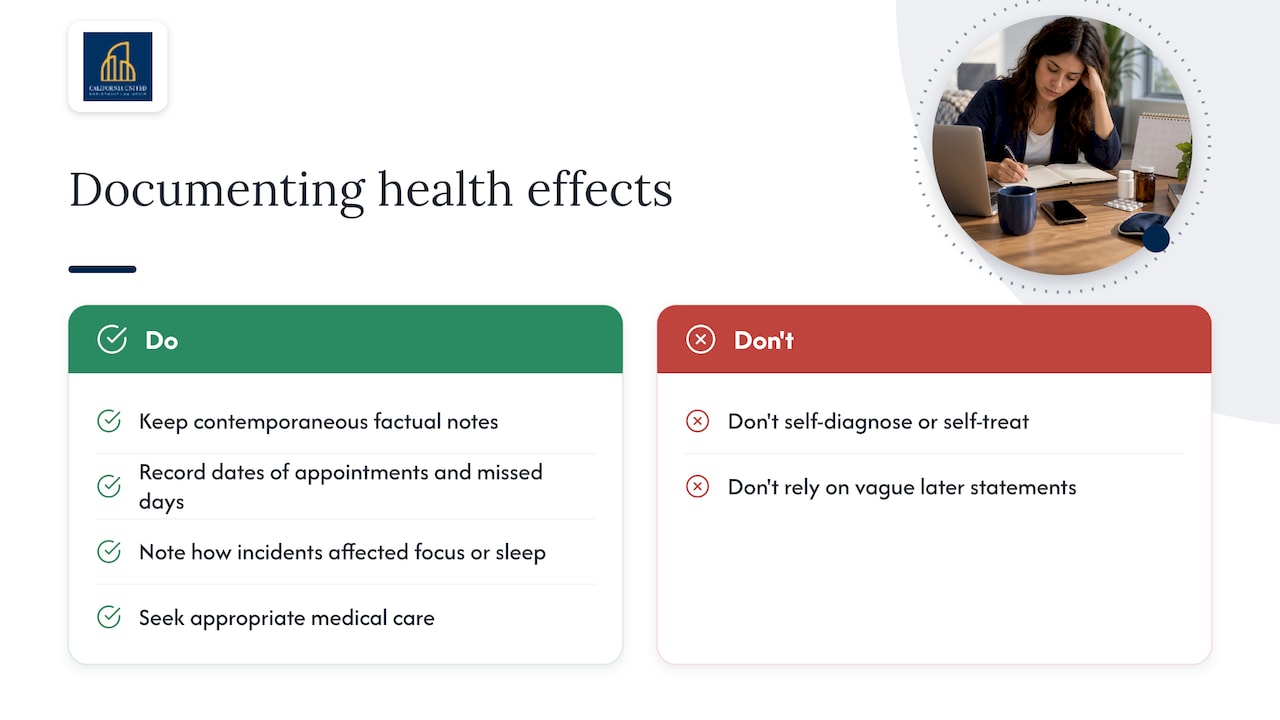
A hostile work environment can affect more than someone’s day at the office. Ongoing exposure to intimidating or demeaning conduct is often associated with stress, anxiety, sleep disruption, and difficulty concentrating, and some employees report physical symptoms such as headaches or fatigue tied to the strain of the situation. These effects are not just personal hardships. They can also become part of the evidentiary record.
Contemporaneous notes about missed workdays, medical appointments, or changes in job performance can help demonstrate the real-world impact of the conduct at issue. Employees experiencing these effects should not attempt to self-diagnose or manage symptoms without appropriate medical care, since this article does not offer medical guidance. What matters from a documentation standpoint is keeping a factual record, such as dates of any related appointments or a brief note about how a specific incident affected your ability to focus or sleep that night. That kind of detail, recorded close in time to the event, tends to carry more weight than a general statement made much later.
What do hostile work environment claims often look like in West Hollywood workplaces?
West Hollywood’s mix of hospitality, entertainment, retail, and creative industry employers means hostile work environment claims can surface in a range of settings, from restaurant and nightlife venues to production offices and retail storefronts. Common scenarios include a manager repeatedly making derogatory comments about an employee’s sexual orientation or gender identity, a supervisor in a fast-paced hospitality setting allowing coworkers to make unwelcome comments about an employee’s appearance or accent, or a pattern of exclusion and demeaning treatment directed at an employee because of their religion or national origin.
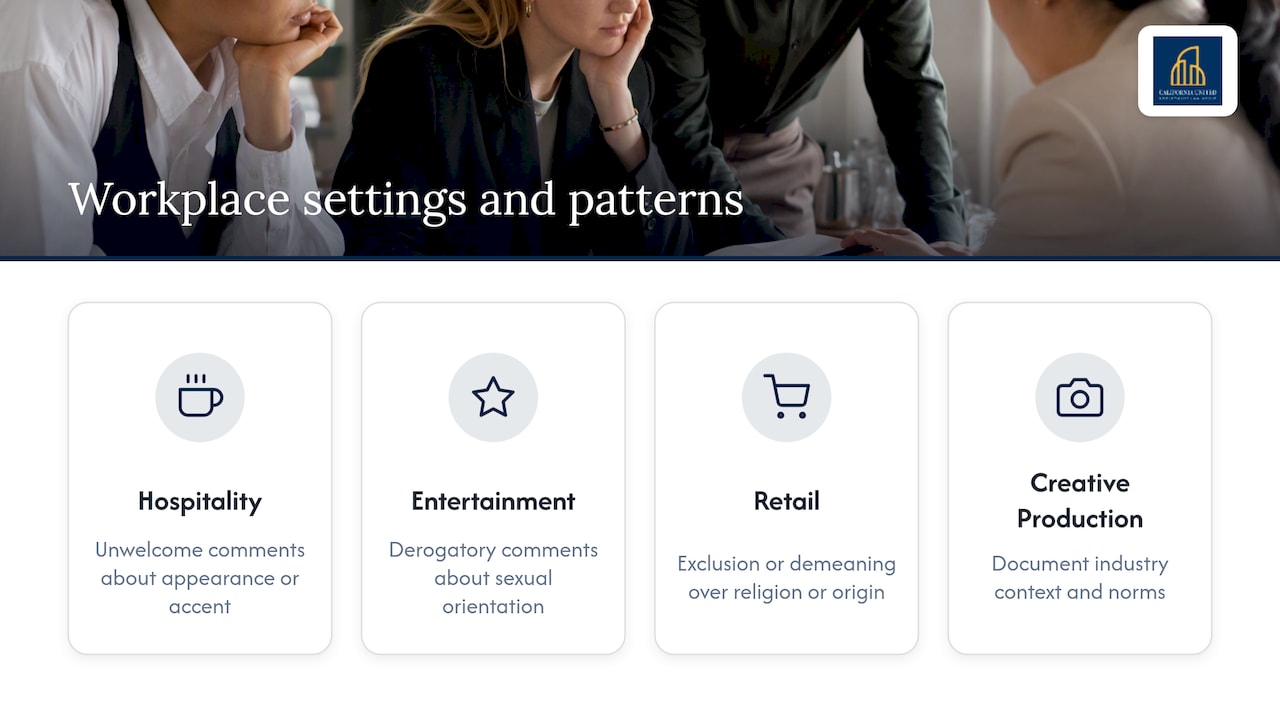
In each case, the legal analysis comes back to context: whether the conduct was severe or pervasive enough that a reasonable person in that specific workplace, whether a busy restaurant floor, nightlife venue, retail storefront, or small production office, would find the environment hostile or abusive. California courts describe this as a totality-of-the-circumstances inquiry rather than a mechanical checklist. Carranza v. City of Los Angeles, 111 Cal.App.5th 388 (Cal. Ct. App. 2025). The setting can shape what counts as ordinary workplace friction versus what crosses into unlawful harassment, which is why documenting specific workplace norms, witnesses, schedules, and reporting channels can matter to an eventual evaluation.
Can one incident create a hostile work environment?
A single incident may be enough in some circumstances, but not every offensive comment or isolated event will qualify. California courts have recognized that one incident can create a triable hostile work environment issue if it unreasonably interferes with the employee’s work performance or creates an intimidating, hostile, or offensive work environment. Beltran v. Hard Rock Hotel Licensing, Inc., 97 Cal.App.5th 865, 878 (Cal. Ct. App. 2023). The practical takeaway is that employees should document even one serious incident carefully, including what happened, who was involved, who witnessed it, whether it affected work duties, and how the employer responded.
A careful note on documentation and timing
This article is for general educational purposes only and is not legal advice. Employment law issues are highly fact-specific, and outcomes vary depending on the details of each situation. If you believe you are experiencing a hostile work environment, documenting events promptly and consistently is one of the more practical steps available to you. Employees who raise good-faith concerns generally have legal protections, and speaking with an attorney can help clarify how those protections apply to your specific circumstances.
— California United Law Group
Get help reviewing your evidence with California United Law Group
If you are a West Hollywood employee sorting through emails, HR notes, and a timeline of incidents, an attorney review can help you understand what you have and where the gaps are. California United Law Group represents employees across harassment and hostile work environment claims, along with related matters like wage and hour disputes and class action cases, and the firm works on a contingency fee basis, meaning clients pay nothing unless the firm wins or settles the case.
Before a consultation, it helps to bring:
- A written chronology of key incidents with dates
- Copies of relevant emails, texts, or messages
- Any HR complaints, performance reviews, or related employer records
👉 Contact Gerardo J. Sosa at California United Law Group to schedule a case evaluation and find out what your documentation shows.
Sources
For further verification, readers can review the EEOC’s harassment guidance, the enforcement guidance on Harris v. Forklift Systems, the CM-602 evidence guidance, and the EEOC’s retaliation guidance. For West Hollywood-specific context, see California United Law Group’s guide on what creates a hostile work environment in West Hollywood and its overview of workplace harassment under California law.
- Harassment | U.S. Equal Employment Opportunity Commission
FAQ
How difficult is it to prove a hostile work environment?
Proving a hostile work environment can be challenging because it requires showing the conduct was both subjectively unwelcome and objectively severe or pervasive, not just a single unpleasant interaction. Cases supported by contemporaneous documentation, credible witnesses, and employer records tend to be stronger than those relying on memory alone.
What are the three criteria for a hostile work environment?
Under the standard reflected in EEOC guidance, the conduct generally must be unwelcome, connected to a protected characteristic, and severe or pervasive enough that a reasonable person would find the workplace intimidating, hostile, or abusive. Both the employee’s actual experience and an objective reasonable-person standard are considered together.
What is evidence of a hostile work environment?
Strong evidence typically includes dated emails and text messages, a contemporaneous written chronology of incidents, witness statements from coworkers who observed the conduct, and HR records such as complaints or performance reviews. The EEOC’s evidence guidance notes that corroborating witness testimony with documentary evidence strengthens a claim.
What qualifies as a hostile work environment in California?
California law generally requires unwelcome conduct tied to a protected characteristic that is severe or pervasive enough to alter the conditions of employment and create a hostile or abusive work environment. Courts evaluate the totality of the circumstances, including frequency, severity, whether the conduct was humiliating or threatening, and whether it interfered with work performance. Lyle v. Warner Brothers Television Productions, 38 Cal. 4th 264, 283 (Cal. 2006). Isolated minor incidents usually are not enough, but a serious single incident or a documented pattern may warrant attorney review.