
If you are a qualified individual with a disability and your Inglewood employer denied a reasonable accommodation, failed to engage in a timely good-faith interactive process, or retaliated after an accommodation request, you may have rights under FEHA and, for covered employers, the ADA. Deadlines apply, so document each request and response in writing and consider speaking with an employment attorney before time limits affect your options.
TL;DR:
- Employers may be required to provide reasonable accommodations unless the accommodation would create an undue hardship, which depends on factors such as the nature and cost of the accommodation and the employer’s operations, size, and resources.
- Common employer failures include refusing schedule adjustments, denying assistive equipment, ignoring remote-work requests, or denying medical leave without proper dialogue.
- The interactive process should be timely, good-faith, and individualized; employers generally should consider the employee’s preference when more than one effective accommodation exists.
- Document every request and communication carefully, as strong records and proof of employer response are key to succeeding in a failure-to-accommodate claim.
- Deadlines for filing claims with the Civil Rights Department or EEOC are strict; acting promptly ensures preservation of legal rights and evidence.
Table of Contents
- What Laws Apply and What They Require (FEHA & ADA)
- Concrete Examples of Failures to Accommodate
- The Interactive Process: Employer Duties and Common Mistakes
- What Relief You Can Seek and Filing Deadlines to Know
- How to Preserve a Claim: What to Document and Next Steps
- How California United Evaluates Failure-to-Accommodate Claims
- The Interactive Process Requirement in Practice
- Practical Note for Inglewood Employees
- How California United Law Group Can Help
- Primary Sources and Further Reading
- Sources
- FAQ
What Laws Apply and What They Require (FEHA & ADA)
Two overlapping laws protect you: California’s Fair Employment and Housing Act (FEHA) and the federal Americans with Disabilities Act (ADA). FEHA covers employers with five or more employees, while ADA Title I applies to employers with 15 or more. In Inglewood, many mid-size and large employers may fall under both laws, but which claims and procedures apply depends on the employer, the facts, and the deadlines involved.
Both laws generally require covered employers to provide reasonable accommodations to qualified employees or applicants who can perform the essential functions of the job with or without reasonable accommodation. A reasonable accommodation can include:
- Modified work schedules for medical treatment
- Job restructuring or reassignment to a vacant position
- Assistive equipment or software
- Extended or intermittent leave
- Remote work when duties allow it
- Medical leave, if it is reasonable and does not impose an undue hardship.
Employers may deny a requested accommodation if it would create an undue hardship, if the employee cannot perform essential job functions even with reasonable accommodation, or if another effective accommodation is available. Under EEOC enforcement guidance, that standard weighs the actual cost and disruption against the employer’s size and resources. Minor inconvenience alone generally is not enough; the analysis depends on the employer’s actual operations, resources, and the accommodation requested.
Concrete Examples of Failures to Accommodate
Certain employer behaviors show up again and again in disability discrimination cases. Recognizing them can help you identify issues to discuss with an employment attorney.
- Refusing a schedule adjustment for medical appointments or treatment without exploring alternatives.
- Denying assistive equipment like screen readers, ergonomic furniture, or communication devices that would let you do the job.
- Ignoring a remote-work request without evaluating whether the essential duties can be performed remotely.
- Improperly denying medical leave tied to a disability, especially when the employer never engaged in dialogue about alternatives.
- Applying a blanket “no exceptions” policy instead of evaluating your specific situation.
Not every denial is unlawful. An employer can lawfully refuse if you couldn’t perform essential job functions even with accommodation, or if granting the request would cause genuine undue hardship. Retaliation for requesting an accommodation may support a separate claim, even if the employer later grants or lawfully denies the accommodation.
The Interactive Process: Employer Duties and Common Mistakes
Once an employer knows of a disability-related need for accommodation, FEHA generally requires a timely, good-faith interactive process. That’s a two-way conversation where employer and employee explore what will actually work. The request generally does not need legal wording, but putting it in writing can help prove what was requested and when.
Frequent failures agencies flag include:
- Delaying the conversation for weeks or months without explanation
- Applying a rigid policy instead of individualized review
- Rejecting every option without proposing a workable alternative
- Demanding excessive medical documentation beyond what’s needed to confirm the need
- Cutting off communication after the first request
Practical tip: If your employer denies a request without asking follow-up questions or proposing alternatives, that may be evidence that the interactive process was not handled properly.
Undue hardship is a fact-specific defense. Minor cost or scheduling friction usually isn’t enough. In general, the employer must show more than mild inconvenience to a supervisor’s routine; the analysis looks at the nature of the accommodation and the employer’s actual operations and resources.
California courts recognize that FEHA creates an affirmative duty to reasonably accommodate known disabilities. In A.M. v. Albertsons, LLC, the court held that even a single failure to accommodate may be actionable where the facts support the claim. Courts have also recognized that FEHA can allow an independent claim for failure to engage in the interactive process, including in Wysinger v. Automobile Club of Southern California.
What Relief You Can Seek and Filing Deadlines to Know
Employees who prove a failure-to-accommodate claim may be able to recover remedies beyond back pay, depending on the facts and claims. Available remedies typically include:
- Reinstatement to your position
- Back pay and, in some cases, front pay
- Emotional distress damages in appropriate cases
- Policy changes at the workplace
- Attorney’s fees and costs
Some remedies may be available through administrative proceedings or a lawsuit after the required right-to-sue process, depending on the claims and procedural posture.
Deadlines matter enormously here. Federal EEOC and California CRD deadlines are strict and fact-specific. California generally provides more time than the federal EEOC process for many FEHA claims, but employees should not delay. Missing an applicable deadline can affect or bar claims, so acting promptly protects evidence and legal options.
How to Preserve a Claim: What to Document and Next Steps
Strong documentation can be important evidence in a failure-to-accommodate claim. Start building your record now, while details are fresh.
- Log every accommodation request with the date, who you told, and how (email, meeting, phone call).
- Save written communication, including texts and emails between you and supervisors or HR.
- Keep relevant medical notes that support the need for accommodation, without sharing more than necessary.
- Follow up oral requests in writing, summarizing what you asked for and how the employer responded.
- Note any adverse treatment that followed your request, including schedule changes or discipline.
Pro Tip: A short email that says “Following up on our conversation about my accommodation request” creates a timestamped record even if your employer never replies.
Internal HR complaints and administrative filings with the CRD or EEOC may be available, depending on the facts and timing. Neither replaces a conversation with an employment attorney about your specific situation.
How California United Evaluates Failure-to-Accommodate Claims
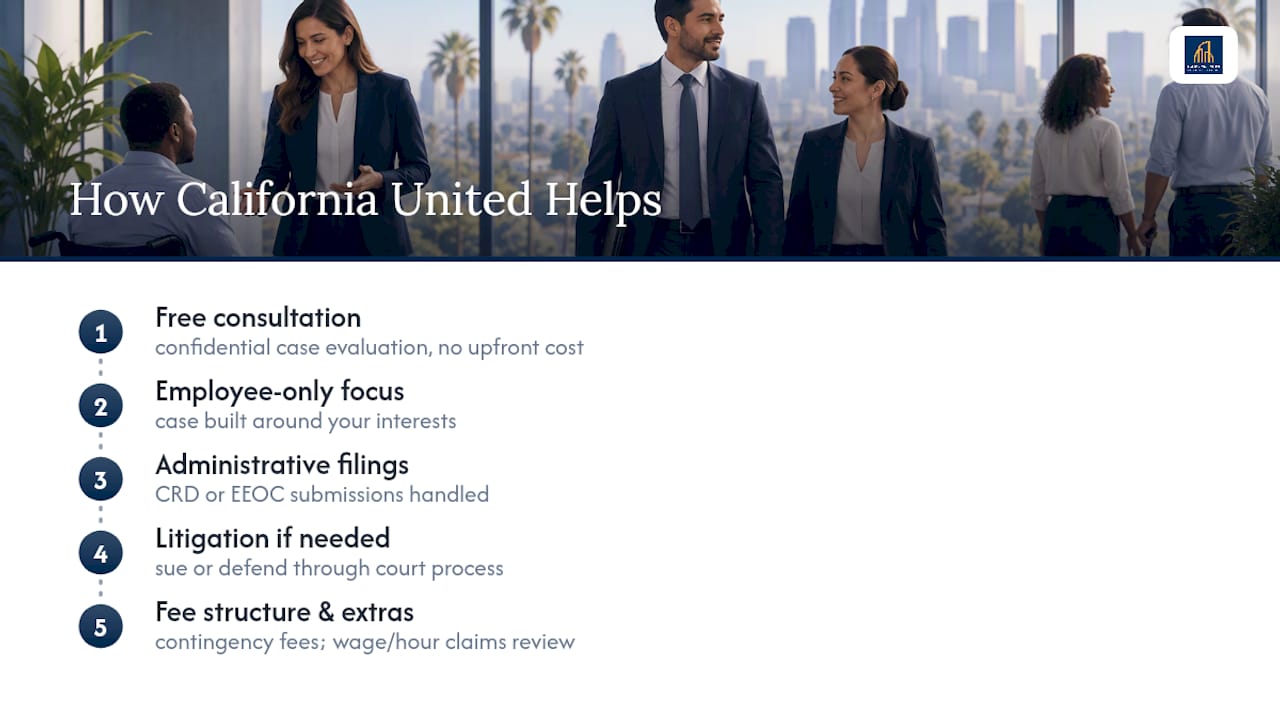
California United Law Group represents employees in FEHA and ADA disputes, including case evaluation, administrative filings, and litigation when appropriate. That employee-side focus shapes how the firm reviews potential claims.
A potential claim may be stronger when evidence shows:
- A clear, identifiable accommodation request, written or verbal
- Employer responses showing delay, denial, or silence
- Documentation connecting an adverse action to the timing of the request
- Records showing the employer never proposed a workable alternative
A key question is whether the employer engaged in a timely, good-faith process or merely appeared to go through the motions.
The Interactive Process Requirement in Practice
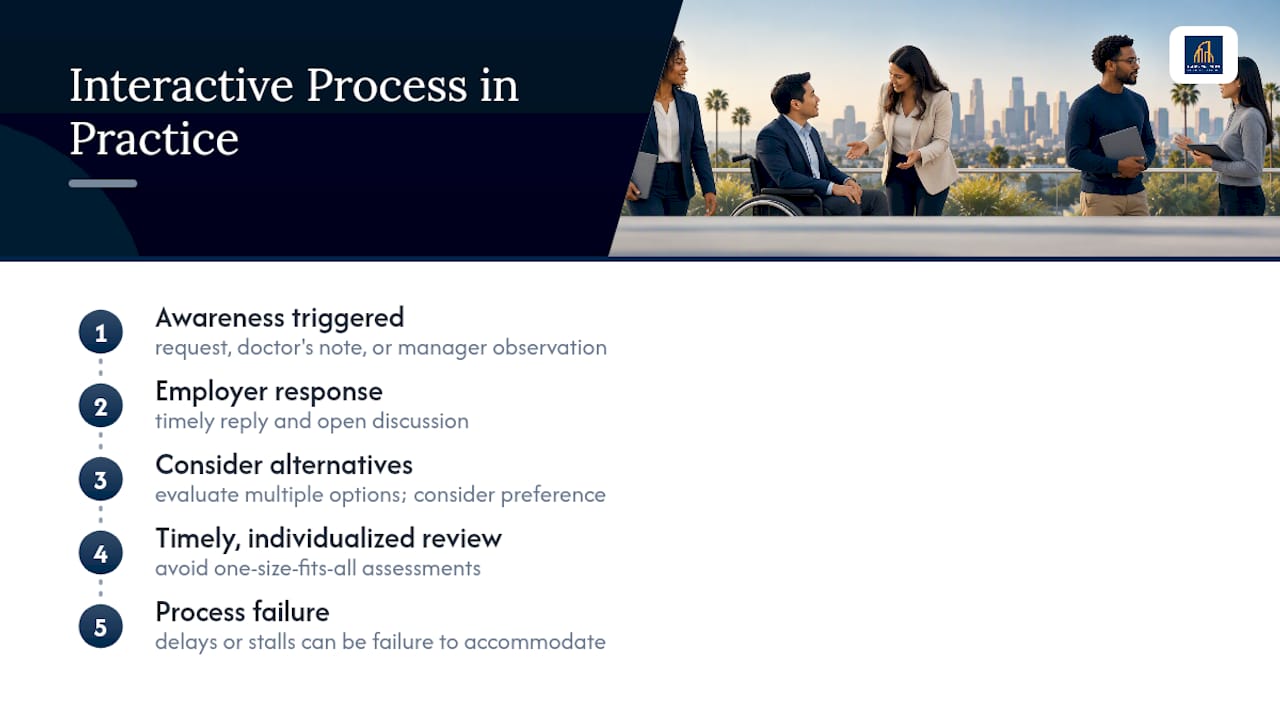
The interactive process is not just paperwork. FEHA treats the interactive process as a legal obligation when an employer becomes aware of a disability-related need for accommodation; ADA obligations may also apply depending on the employer and facts. That awareness can come from a direct request, medical information, a third-party communication, or observations that reveal a possible need for accommodation.
Once triggered, the employer must respond within a reasonable timeframe and actually discuss options, not simply approve or deny the first idea raised. The CRD’s factsheet on workplace accommodations notes that when multiple effective accommodations exist, the employer should consider the employee’s preference, though it isn’t required to grant the exact accommodation requested if another option works equally well.
The CRD’s 2026 guidance puts fresh emphasis on timeliness and individualized assessment, which matters if your employer has dragged out a response or applied a one-size-fits-all policy instead of looking at your specific job and limitations. A process that never starts or stalls without good reason may support a failure-to-engage claim, and in some cases may also support a failure-to-accommodate theory. That distinction can matter when evaluating what went wrong and when.
Practical Note for Inglewood Employees
Every failure-to-accommodate case turns on its own facts and records, so what worked for a coworker won’t necessarily apply to you. If you work in Inglewood and believe your employer ignored a disability-related accommodation request, start documenting now and consider CRD or EEOC resources while you seek a confidential attorney evaluation. This article offers general education, not legal advice, for your specific situation.
How California United Law Group Can Help
You do not have to sort through FEHA and ADA issues alone, and you can request a consultation without paying upfront. California United Law Group represents employees, and case evaluations focus on the employee’s facts, records, deadlines, and legal options. The firm handles disability discrimination and failure-to-accommodate matters from consultation through administrative filings and litigation when appropriate.
If the firm accepts your case on a contingency-fee basis, attorney’s fees are typically paid from a settlement or award; ask during the consultation whether you may be responsible for costs or expenses. If wage issues accompanied your accommodation dispute, the firm’s wage and hour team can review those claims too.
Ready to talk through what happened? Contact California United Law Group for a confidential case evaluation before filing deadlines affect your options.
Primary Sources and Further Reading
- EEOC: Enforcement guidance on reasonable accommodation and undue hardship under the ADA
- California Civil Rights Department: Reasonable Accommodation
- California Government Code section 12940
- Los Angeles disability discrimination guide
- Employer coverage under FEHA vs. ADA
This article is general information, not a substitute for advice from a qualified lawyer. Consult a qualified legal professional about your own circumstances before acting on anything here.
Sources
- EEOC: Enforcement guidance on reasonable accommodation and undue hardship under the ADA
- California Civil Rights Department: Reasonable Accommodation
- California Government Code section 12940
FAQ
Can I sue my employer for not accommodating my disability?
You may be able to sue if you are a qualified individual with a disability and your employer failed to provide a reasonable accommodation or failed to engage in the interactive process required under FEHA. You generally must complete the required administrative process and obtain a right-to-sue notice before proceeding with a FEHA or ADA lawsuit.
What is the consequence of failure to accommodate for the employer?
Employers who fail to accommodate may face remedies such as back pay, reinstatement, emotional distress damages in appropriate cases, attorney’s fees, and policy changes, depending on the facts and claims. Courts may also order policy changes to prevent future violations.
What happens if an employer refuses an ADA accommodation?
A refusal may be lawful if the employer can show undue hardship, if the employee cannot perform essential job functions even with reasonable accommodation, or if the employer offers another effective accommodation. Otherwise, the refusal may support a formal complaint under ADA Title I.
Can I be fired if I have ADA accommodations?
Having an accommodation does not protect you from termination for legitimate, unrelated performance or conduct reasons, but firing you because you requested or received an accommodation may be unlawful retaliation. If adverse action followed closely after your request, that timing may become important evidence.
Does California law give me more protection than the ADA?
FEHA generally applies to smaller employers than the ADA, with FEHA covering many employers with five or more employees and ADA Title I generally applying to employers with 15 or more employees. California’s administrative filing period is often longer than the federal EEOC period, but employees should still act promptly because deadlines are strict and fact-specific.