
Race discrimination claims under California’s Fair Employment and Housing Act (FEHA) succeed on direct evidence, comparator evidence, documents, witness statements, and proof that an employer’s stated reason is pretextual. Race must be a “substantial motivating factor” in the adverse action, not necessarily the only one. Monterey Park employees also have a mandatory procedural step before filing a FEHA lawsuit: they generally must file an administrative complaint with the California Civil Rights Department and obtain a Right-to-Sue notice, including by requesting an immediate Right-to-Sue notice when appropriate.
TL;DR:
- Discrimination claims under FEHA are often proven through a combination of circumstantial evidence like patterns, timing, and comparator treatment, rather than direct bias statements.
- Employers with five or more employees are generally covered for FEHA discrimination claims. Harassment rules can apply differently, including in very small workplaces, and race does not have to be the only reason for an adverse action if it was a substantial motivating reason.
- Filing deadlines are strict: FEHA claims must usually be filed with the CRD within three years of the unlawful act, and any civil lawsuit generally must be filed within one year after the CRD issues a Right-to-Sue notice.
- Valid comparator evidence must be based on similarly situated employees, with the same role, performance history, decision-maker, and timeframe, or it will weaken the case.
- Building a claim relies on contemporaneous records, witness statements, and timing, with a focus on pattern and context over isolated comments or one-off incidents.
Table of Contents
- How Can Monterey Park Employees Prove Race Discrimination? An Evidence Checklist
- What Does FEHA Actually Protect, and Who Is Covered?
- When Do You Have to File With the CRD, and How Long Do You Have?
- What Makes a Comparator Believable in a Discrimination Case?
- Which Documents and Messages Actually Move a Race Discrimination Case?
- Direct Evidence, Circumstantial Evidence, and the Burden-Shifting Framework
- How Do You Show an Employer’s Explanation Is Pretext?
- What Has to Be in a CRD Complaint?
- Keeping Records and Understanding What an Investigation Looks Like
- About California United Law Group and Race Discrimination Claims in Monterey Park
- What Happens If You Face Retaliation After Reporting Race Discrimination?
- What the Evidence Actually Tells Us About These Cases
- Get Help Evaluating a Race Discrimination Claim in Monterey Park
- Sources
How Can Monterey Park Employees Prove Race Discrimination? An Evidence Checklist
Building a race discrimination case starts with knowing what investigators and juries actually look for. FEHA claims rarely hinge on one smoking-gun statement. More often, they rest on a combination of evidence types that, together, paint a coherent picture of bias.
Here is the core inventory Monterey Park employees should compare against their own situation:
- Direct evidence: racial slurs, explicit statements about race in emails, texts, meeting notes, or recorded conversations.
- Comparator evidence: proof that employees outside the protected race were treated more favorably in comparable circumstances.
- Documentary evidence: performance reviews, disciplinary write-ups, hiring and promotion records, payroll data, and internal policies.
- Witness statements: coworkers, former employees, or supervisors who observed discriminatory conduct or can speak to how decisions were actually made.
- Pattern and statistical indicators: repeated actions against employees of one racial group, such as consistently lower raises, exclusion from promotions, or disproportionate discipline.
Direct evidence is powerful but uncommon. Most employers know better than to put bias in writing. That is why circumstantial evidence, particularly comparator data and inconsistent explanations, carries so much weight in California courts.
Pro Tip: A single negative review is rarely persuasive on its own. Look for a pattern across time. One low score can be a coincidence; repeated low scores appearing only after a protected complaint or promotion request may be worth closer review.
Statistical patterns matter more than most employees realize. If a workplace has ten similarly ranked employees and every promotion in three years went to workers of one racial background, that pattern may be circumstantial evidence worth documenting, even absent a single discriminatory remark, especially if the employees had comparable qualifications, decisionmakers, and opportunities.
What Does FEHA Actually Protect, and Who Is Covered?
FEHA prohibits employment discrimination based on race, color, ancestry, national origin, and several other protected characteristics. The California Civil Rights Department enforces these protections, while FEHA statutes and regulations identify the protected categories and coverage rules.
Coverage thresholds matter for some claims. Most FEHA employment discrimination protections apply to employers with five or more employees. Harassment protections, however, work differently. A workplace with even one employee can face harassment liability under FEHA, because the legislature carved harassment out from the general size threshold. That distinction can matter for employees who assume small employers are categorically outside FEHA. Even where discrimination coverage depends on the five-employee threshold, harassment claims may be analyzed under different coverage rules.
Once coverage is established, the next question is causation. California does not require race to be the sole reason for an adverse action. Instead, the standard is whether race was a “substantial motivating factor,” a phrase drawn from CACI No. 2507 and the California Supreme Court’s decision in Harris v. City of Santa Monica. That means an employer can have several reasons for a termination or demotion, some legitimate, and still face FEHA liability if race was more than a remote or trivial reason and substantially contributed to the decision.
California courts use the substantial motivating reason standard in FEHA discrimination cases. In Harris v. City of Santa Monica (2013) 56 Cal.4th 203, the California Supreme Court explained that FEHA liability may arise when discrimination is a substantial factor in an employment decision, even if other factors also influenced the outcome. CACI No. 2507 similarly explains that a substantial motivating reason must actually contribute to the adverse employment action, must be more than remote or trivial, and does not have to be the only reason for the decision.
This standard differs from the “but-for” causation standard used in some federal employment-law contexts. Under FEHA, an employee does not have to prove race was the only factor, just that it mattered enough to influence the outcome. Ancestry and national origin fall under the same umbrella, which is worth knowing if a case touches on immigration status, accent, or surname bias rather than skin color alone.
When Do You Have to File With the CRD, and How Long Do You Have?
Most FEHA employment discrimination claims must be filed with the California Civil Rights Department within three years of the alleged unlawful act, subject to limited exceptions. Missing that window can bar a FEHA administrative complaint and may prevent a later FEHA civil lawsuit, because a CRD filing and Right-to-Sue notice are generally prerequisites to filing a FEHA claim in court.
Employees who want to move straight to civil court can request an immediate Right-to-Sue notice instead of waiting for an investigation. Once that notice issues, the employee must file a civil lawsuit within one year of the notice date. That one-year clock is separate from the three-year CRD filing window and runs from the date the CRD issues the notice, not necessarily the date the employee reads or receives it.
A few timing details deserve attention:
- For discrete acts, the three-year clock generally runs from the date of each alleged unlawful act. For ongoing conduct, a continuing-violation theory may affect the analysis.
- Ongoing or repeated discriminatory conduct may support a continuing-violation theory, but this depends heavily on the facts, and the employee may have to prove why the claim is timely if the employer raises a limitations defense.
- Requesting an immediate Right-to-Sue notice forfeits the CRD’s investigation, so it is a tradeoff worth understanding before choosing that path.
Monterey Park employees weighing these deadlines should treat them as firm unless a qualified attorney identifies a specific exception that applies to their facts.
What Makes a Comparator Believable in a Discrimination Case?
Comparator evidence lives or dies on one word: similarly situated. Courts want to see that the employee they are comparing against had the same job duties, a similar performance record, the same decisionmaker, and roughly the same timeframe. The more those factors differ, the easier it becomes for an employer to argue the comparison is weak.
Here is how the comparator analysis typically breaks down:
- Same role and duties. A cashier cannot meaningfully be compared to a shift supervisor, even if both work in the same store.
- Same or similar performance history. If the comparator had a materially better attendance or disciplinary record, the difference in treatment may reflect that gap rather than bias.
- Same decisionmaker. A comparator disciplined by a different manager weakens the inference, since the alleged bias needs to trace back to the person who made the adverse decision.
- Comparable timeframe. Treatment from five years earlier, under different management or policies, carries less weight than treatment from the same period.
- Comparable conduct or circumstances. A coworker who committed a lesser infraction is not a strong comparator for someone accused of a more serious violation.
A useful comparison might look like this: two warehouse employees, same supervisor, same shift, both clocked in three minutes late twice in a month. One is a Latino employee written up and later terminated; the other, who is white, receives only a verbal reminder. That pairing is the type of comparison investigators and courts may view as stronger because the role, supervisor, timing, and conduct are closely aligned.
A weak comparison would involve two employees in different departments, disciplined by different managers, for conduct that only superficially resembles each other. Employers’ attorneys are quick to pick apart comparator claims on exactly these grounds, so precision matters more than volume.
Pro Tip: Write down the comparator’s job title, supervisor, and the specific incident date as soon as you notice the disparity. Memory fades, and vague recollections rarely hold up months later.
Which Documents and Messages Can Strengthen a Race Discrimination Case?
Contemporaneous records tend to carry more weight than after-the-fact recollections, because they were created before anyone had a reason to spin the narrative. The documents that matter most in a Monterey Park race discrimination claim usually include:
- Emails and text messages referencing performance, scheduling, or disciplinary decisions.
- Written warnings, performance improvement plans, and annual reviews.
- Internal HR policies on discipline, promotion, and complaint handling.
- Job postings and hiring records showing who applied, who was interviewed, and who was selected.
- Payroll and promotion records that reveal pay gaps or advancement patterns across racial lines.
The value of these records often comes from timing and inconsistency. If a performance review from six months before a termination rated an employee as “meets expectations,” but the termination paperwork cites chronic underperformance, that gap between the two documents becomes evidence worth examining. Contemporaneous records created before a dispute arose are generally harder for an employer to explain away than statements made after litigation seems likely.
When describing these documents to investigators or counsel, precision matters. Note who authored each document, the date it was created, and the context surrounding it, such as whether it followed a complaint, a promotion request, or a schedule change. A performance review written the week after an employee reported a racial comment reads very differently than the same review written on a routine annual cycle.
Direct Evidence, Circumstantial Evidence, and the Burden-Shifting Framework
Direct evidence proves discriminatory intent without requiring an inference. A supervisor telling an employee “we don’t promote people like you” is direct evidence. So is a written policy that explicitly excludes a racial group from certain shifts or roles. This kind of proof is rare, because most employers understand the legal exposure it creates.
Circumstantial evidence, by contrast, requires connecting the dots. Comparator treatment, suspicious timing (a termination that follows closely after a complaint), and unexplained deviations from standard procedure all fall into this category. Most FEHA race discrimination claims are built almost entirely on circumstantial proof, according to practice-focused summaries of California discrimination law.
California courts apply a modified version of the McDonnell Douglas burden-shifting framework to evaluate these claims. The employee first establishes a basic case of discrimination. The employer then offers a legitimate, nondiscriminatory reason for the action. The burden shifts back to the employee to show that reason is false or that race was still a substantial motivating factor despite the employer’s stated justification.
This is where California’s causation standard becomes important again. Even if an employer proves it had a legitimate reason, the employee can still prevail by showing race also played a substantial motivating role, since FEHA does not require that discriminatory intent be the sole or even primary cause.
How Do You Show an Employer’s Explanation Is Pretext?
Pretext exists when the reason an employer gives for a decision is not the real reason. Courts look for specific indicators that a stated justification does not hold up:
- Shifting explanations. An employer that offers one reason during an internal review and a different reason during litigation raises red flags.
- Inconsistent documentation. A termination letter citing “poor attendance” when attendance records show no notable issues undermines the employer’s credibility.
- Selective enforcement. A policy applied strictly to one employee but ignored for others in similar situations suggests the rule was not the real driver of the decision.
Timing often reinforces a pretext argument. An adverse action that follows closely on the heels of a complaint, a new supervisor’s arrival, or a shift in company demographics can support an inference that the stated reason was manufactured after the fact. Documentation created after the decision, particularly if it appears to backfill a justification, gets close scrutiny for the same reason.
None of these indicators need to stand alone. Courts weigh them together against the substantial motivating factor standard established in CACI No. 2507. The question is never whether the employer had any legitimate reason. It is whether race also substantially contributed to the outcome, even alongside other factors.
What Has to Be in a CRD Complaint?
The CRD’s procedural regulations spell out specific factual elements a complaint needs before the agency will process it for investigation. Employees should expect to provide:
- The names and roles of the people involved, including the alleged decisionmaker.
- Dates of the specific acts alleged to be discriminatory.
- A description of what happened, in enough detail to identify the conduct at issue.
- The protected basis or bases the complaint relies on, such as race, color, ancestry, or national origin.
These requirements come directly from DFEH/CRD procedural regulations governing intake and complaint content. The CRD generally construes complaints liberally at the intake stage, but jurisdictional checks still apply, including whether the employer meets coverage thresholds and whether the filing falls within the limitations period.
There is a meaningful difference between filing for a full investigation and requesting an immediate Right-to-Sue notice. An investigation keeps the CRD involved as a neutral fact-finder, which can take time but may resolve some claims without litigation. An immediate Right-to-Sue notice skips that process entirely and starts the one-year clock to file a civil lawsuit. Some practice commentary also flags that the specific respondents and legal bases named in a CRD filing can limit what claims are later available in court under a doctrine sometimes called scope of charge, which is one more reason the content of the initial filing carries real consequences.
Keeping Records and Understanding What an Investigation Looks Like
Contemporaneous notes tend to hold up better than reconstructed memories. Jotting down dates, what was said, and who was present, close in time to when it happened, creates a more reliable record than trying to reconstruct events months later.
Witnesses matter too. Coworkers who observed relevant conduct, along with a short summary of what they might say, help investigators and courts evaluate a claim’s strength during intake and review.
Pro Tip: Keep lawful copies of documents you are permitted to access, such as your own pay records, schedules, reviews, written warnings, and communications involving you. Do not take confidential, privileged, trade-secret, private, or restricted company materials without legal advice.
The CRD investigates as a neutral fact-finder rather than an advocate for either side. Outcomes vary and can include a finding of cause, a right-to-sue notice, or case closure. Because the CRD process and a private lawsuit serve different purposes, some employees request an immediate Right-to-Sue notice, while others prefer an agency investigation first. The better path depends on the facts, evidence, deadline posture, and litigation strategy.
About California United Law Group and Race Discrimination Claims in Monterey Park
California United Law Group represents qualifying Monterey Park employees in FEHA matters, including CRD filings, Right-to-Sue requests, litigation, and arbitration.
The firm works on a contingency-fee basis for qualifying employment cases, meaning attorney’s fees are generally paid from a settlement or award rather than upfront. Depending on the fee agreement, clients may still be responsible for litigation costs or case expenses. Outcomes are never guaranteed and depend on the specific facts of each case. Employees considering a race discrimination claim can request a confidential case evaluation to discuss their situation.
What Happens If You Face Retaliation After Reporting Race Discrimination?
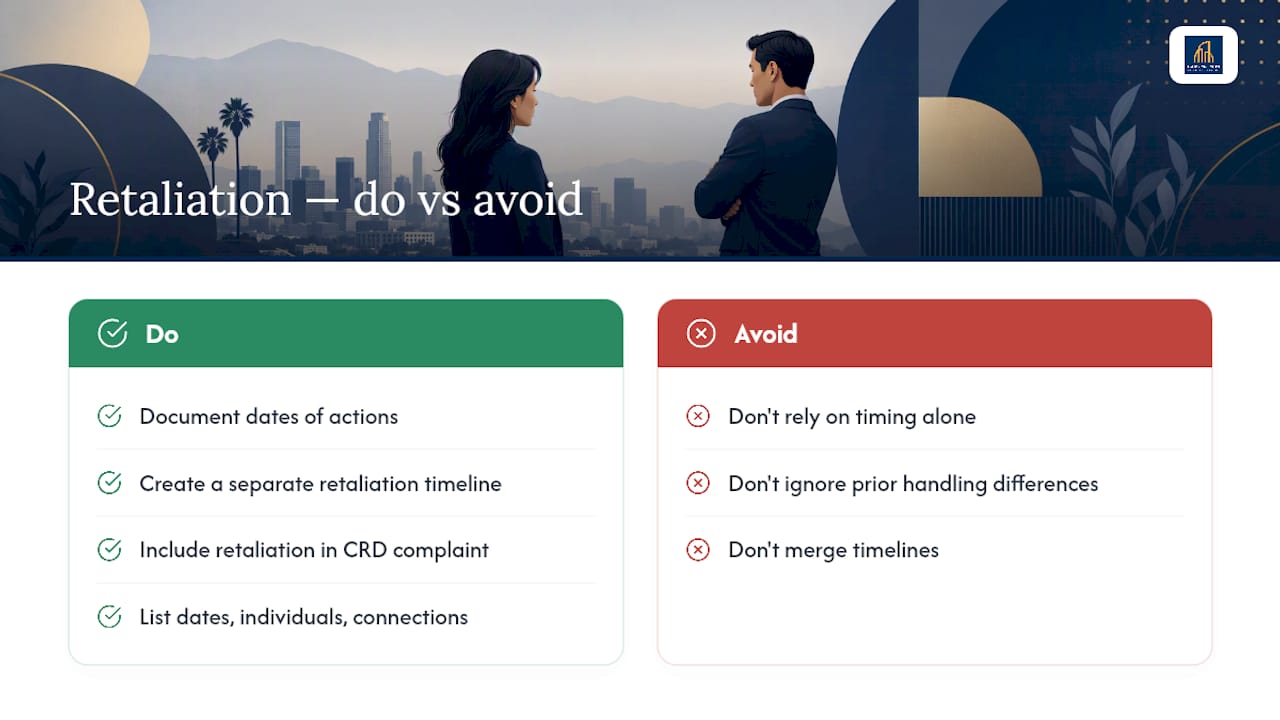
Retaliation claims often travel alongside race discrimination claims, and California law treats them as distinct legal violations with their own evidentiary requirements. An employee who makes a good-faith report of discrimination, participates in an internal investigation, or files a CRD complaint may be protected from retaliation under FEHA, separate from the underlying discrimination claim itself.
Retaliation evidence tends to focus heavily on timing. An adverse action, such as a demotion, schedule cut, or termination, that follows soon after a complaint raises the same kind of suspicion that timing raises in pretext analysis. Close timing between protected activity and an adverse action can support an inference of retaliation, though timing alone rarely settles the question.
Documentation matters here too. Performance concerns that surface for the first time only after a complaint is filed, or discipline that departs from how similar issues were handled before the complaint, both function as circumstantial evidence of retaliatory motive.
Employees facing retaliation should treat it as a separate factual thread worth documenting on its own timeline, distinct from the original discrimination allegations, even though both often get investigated together. A CRD complaint can typically include both the underlying discrimination claim and the retaliation that followed, provided the retaliation is described with the same specificity, including dates, individuals involved, and the connection to the original complaint.
What the Evidence Actually Tells Us About These Cases
The conventional advice on proving race discrimination tends to overemphasize the search for a single damning statement or email. That is not how most FEHA claims actually succeed. Strong race discrimination claims often combine ordinary documents, comparator patterns, and timing into a coherent factual picture, rather than relying on one dramatic piece of proof.
What is genuinely overrated is the idea that a case needs an explicit racial remark to hold up. Under the substantial motivating reason standard, a well-documented pattern of disparate treatment can be powerful circumstantial evidence, sometimes more probative than a single offensive comment that an employer argues was isolated or taken out of context.
What deserves more attention than it usually gets: the CRD filing deadline and the choice between a full investigation and an immediate Right-to-Sue notice. Employees often spend significant energy gathering evidence and comparatively little time understanding these procedural forks, even though missing a deadline can prevent a FEHA claim from being evaluated on the merits.
Prioritize the calendar first. Then build the record.
— California United Law Group
Get Help Evaluating a Race Discrimination Claim in Monterey Park
Some law firms concentrate their practice on California employment claims, including Labor Code and FEHA matters, and can evaluate the evidence, deadlines, and procedural options in those cases. Some firms evaluate qualifying employment cases on a contingency-fee basis, although the fee agreement should explain whether the client may be responsible for litigation costs or case expenses. Consultations can be confidential.
If you believe race played a substantial motivating role in a termination, demotion, or disciplinary action, the details covered here, comparator evidence, documents, witness accounts, and CRD deadlines, are exactly what an evaluation will focus on first. Related California United Law Group resources on ancestry discrimination and national origin discrimination in Monterey Park cover adjacent protected categories that sometimes overlap with race claims.
Contact California United Law Group to schedule a confidential case evaluation and discuss your CRD filing deadline, evidence, and available options.
This article provides general information only and is not legal advice. Reading this article or contacting the firm does not create an attorney-client relationship. Consult a qualified legal professional about your own circumstances before acting on anything here.
Sources
For readers who want to review primary materials directly: the CRD complaint process, CRD procedural regulations, CACI No. 2507 on causation, and the EEOC for federal context all provide authoritative starting points.
- 2 CCR § 10005 — Obtaining a right-to-sue notice (California regulations)
- Employment | California Civil Rights Department (CRD)
- CACI No. 2507 — ‘Substantial motivating reason’ explained