
Yes, many Torrance employees may be able to file pregnancy discrimination claims under California and federal law, depending on employer size, the facts of the claim, and whether the filing deadline has been preserved. The immediate next step matters most: preserve every relevant document and email now, write down names of witnesses while memories are fresh, and contact the California Civil Rights Department or the EEOC promptly, because filing windows can expire before employees expect.
TL;DR:
- Pregnancy discrimination claims can be filed under both California and federal law if the employer has enough employees and filing deadlines are met.
- Pregnancy discrimination claims may be filed under California law, federal law, or both, depending on employer size, the facts, and whether the employee meets the applicable filing deadline.
- Evidence such as emails, performance reviews, or witness contact information is crucial for proving patterns of discrimination, especially when timing suggests retaliation or inconsistent enforcement.
- Filing should be done promptly with CRD or EEOC within specific deadlines, with prepared documentation to support investigations and potential litigation.
- Employers often deny accommodations or retaliate subtly, so thorough record keeping and understanding of legal protections are essential for employees in Torrance.
Table of Contents
- Can Torrance Employees Claim Pregnancy Discrimination Under State and Federal Law?
- Pregnancy Disability Leave, Accommodations, and Lactation Rights
- Building Your Case: What Evidence Actually Proves Discrimination
- Filing With CRD or the EEOC: Deadlines and What to Bring
- What Compensation Might Look Like in a Pregnancy Discrimination Case
- How California United Law Group Supports Torrance Employees
- Local Torrance Policies and Where State Law Fills the Gaps
- Notable Pregnancy Discrimination Enforcement Trends Affecting Torrance Workers
- Harassment Related to Pregnancy: Where the Line Gets Crossed
- You’re Protected From Retaliation for Speaking Up
- When to Talk to a Lawyer, and What to Expect
- Talk to California United Law Group About Your Torrance Case
- Official Resources Worth Bookmarking
- Sources
Can Torrance Employees Claim Pregnancy Discrimination Under State and Federal Law?
Pregnancy discrimination happens when an employer treats you worse because you are pregnant, gave birth recently, or have a related medical condition like postpartum recovery or a pregnancy-related disability. That can look like a demotion right after you announce your pregnancy, a denied promotion you were otherwise qualified for, or termination timed suspiciously close to your leave request.
Several overlapping laws protect you, and knowing which one applies depends largely on your employer’s size:
- FEHA (Fair Employment and Housing Act) generally covers California employers with five or more employees for discrimination claims and also prohibits harassment based on protected characteristics, including pregnancy-related sex discrimination.
- Pregnancy Disability Leave (PDL) applies to the same employers covered by FEHA and provides leave specifically tied to pregnancy-related disability.
- CFRA (California Family Rights Act) generally applies to employers with five or more employees and may provide baby-bonding leave separate from PDL, if the employee meets CFRA eligibility requirements.
- Federal protections may also apply. Title VII, as amended by the Pregnancy Discrimination Act, and the Pregnant Workers Fairness Act generally apply to covered employers with 15 or more employees, and federal guidance recognizes protections for pregnancy, childbirth, and related medical conditions.
Because these laws overlap, many Torrance employees have protection under both state and federal statutes at once.
Pregnancy Disability Leave, Accommodations, and Lactation Rights
California law gives pregnant employees more than just protection from being fired. It gives you specific, enforceable entitlements while you’re still on the job and while you recover.
Pregnancy Disability Leave may provide up to four months of leave per pregnancy when an employee is disabled by pregnancy, childbirth, or a related medical condition, with reinstatement rights subject to the facts and applicable law. Unlike some leave laws, PDL does not require years of tenure, and part-time or newer employees may still be covered if the employer is covered and the employee has a qualifying pregnancy-related disability.
Beyond leave, an employer may have duties to consider reasonable accommodations and engage in an interactive process when an employee requests pregnancy-related workplace changes supported by a health care provider. Common accommodations include:
- Modified duties, such as temporary reassignment away from heavy lifting
- More frequent breaks for rest, hydration, or bathroom access
- A temporary transfer to a less strenuous or hazardous position
- Providing a stool or seating where the job normally requires standing
- Adjusted schedules for prenatal appointments
Lactation accommodations are a separate, ongoing right after you return to work. Your employer must provide reasonable break time and a private space, other than a restroom, to express milk.
Pro Tip: Keep a simple written log of every accommodation request you make and how your employer responds. If a request is delayed, denied, or ignored, that log becomes some of the clearest evidence you can hand to an agency investigator or an attorney.
Building Your Case: What Evidence Actually Proves Discrimination
Discrimination cases rarely hinge on one dramatic moment. They usually come down to a pattern, and patterns require documentation.
Useful evidence includes:
- Emails or texts referencing your pregnancy, due date, or leave plans
- Performance reviews before and after you disclosed your pregnancy
- Memos or write-ups issued shortly after your announcement
- Medical notes describing any requested accommodation
- Names and contact information for coworkers who witnessed relevant conversations or treatment
Timing is often the strongest signal. A sudden performance-improvement plan two weeks after you tell HR you’re expecting, when your reviews were positive for the prior year, raises real questions. Inconsistent enforcement of policy is another pattern worth flagging, such as a company that grants light-duty requests to injured employees but denies the same accommodation to a pregnant one.
Federal enforcement data give a sense of how seriously these claims are treated at the agency level. The EEOC’s PWFA charge data shows active enforcement activity tied specifically to pregnancy accommodation claims, which signals that agencies are actively investigating and resolving these charges rather than letting them sit.
Preserve records carefully and lawfully. Save copies of documents you are authorized to access, take dated screenshots of relevant texts or messages when permitted, keep your own notes, and avoid taking confidential, privileged, trade secret, or proprietary materials without legal advice.
Filing With CRD or the EEOC: Deadlines and What to Bring
Torrance employees may have the option to file with the California Civil Rights Department, the EEOC, or both. In many employment discrimination matters, agency procedures may allow cross-filing or coordination between state and federal agencies, but employees should confirm that the specific filing preserves all intended claims and deadlines.
Here’s how the process typically unfolds:
- Decide where to file first. The right filing path depends on the claims being asserted. CRD may be relevant for California-specific claims such as PDL or FEHA violations, while the EEOC may be relevant for federal claims such as Title VII, the Pregnancy Discrimination Act, or the Pregnant Workers Fairness Act.
- File before the deadline expires. Missing the window can end your claim before an investigator even reviews it, so early action protects options you might otherwise lose.
- Prepare intake documents in advance. CRD’s complaint process guidance recommends bringing items like pay stubs or W-2s, termination or discipline letters, performance reviews, and the names of witnesses.
- Expect an investigation period. Once a complaint is filed, the agency typically reviews your documentation, may interview witnesses, and often facilitates settlement discussions before deciding whether to pursue further action.
- Request a right-to-sue notice if you intend to pursue litigation. This step allows you to move your claim into court rather than waiting on the administrative process alone.
Deadlines vary depending on which agency and which law applies, so verifying your specific timeline early is one of the most consequential things you can do. Waiting even a few weeks to “see how things play out” at work can quietly shrink your options.
What Compensation Might Look Like in a Pregnancy Discrimination Case
Remedies in these cases depend entirely on the facts, the evidence gathered, and how the claim is litigated or settled, so no outcome is guaranteed. That said, California and federal law recognize several categories of relief employees may pursue:
- Back pay for wages lost due to termination, demotion, or reduced hours
- Reinstatement to your former position where appropriate
- Emotional distress damages tied to the discrimination you experienced
- Punitive damages, which may be available only in appropriate cases where the legal standard is met
- Attorney’s fees and costs, when recoverable under the applicable statute or court order
Courts and agencies weigh these remedies case by case. A strong paper trail, documented early and consistently, tends to correlate with stronger settlement leverage, though every case turns on its own specific facts.
How California United Law Group Supports Torrance Employees
California United Law Group evaluates pregnancy discrimination concerns for Torrance employees through a straightforward, no-cost case review. That evaluation typically includes a discussion of your timeline, the accommodation requests you made, and any documentation you’ve already gathered.
From there, the firm can help you understand whether an agency filing with CRD or the EEOC makes sense, assist with preparing that filing where appropriate, and discuss potential representation if the case advances. Expect to be asked for pay records, written communications, and witness names, since an attorney’s first job is often protecting your filing deadline while the fuller picture comes together.
Local Torrance Policies and Where State Law Fills the Gaps
Torrance does not maintain a separate municipal ordinance specifically governing pregnancy discrimination in private employment. Instead, protections for employees working in Torrance come primarily from California’s FEHA, the PDL statute, and CFRA, layered with federal protections under Title VII, the PDA, and the PWFA.
That doesn’t mean local context is irrelevant. Local context can still matter. Torrance includes employers in industries such as retail, aerospace-related work, manufacturing, healthcare, logistics, hospitality, and office services, where pregnancy accommodations may involve very different job duties depending on the role. An employee on a warehouse floor or an assembly line in Torrance may need a very different accommodation than an office worker, and employers in these sectors don’t always have consistent accommodation policies in writing.

The Torrance city government does not regulate private employment discrimination directly, but it can be a useful starting point for locating community resources or verifying business licensing information relevant to a workplace dispute. For the actual legal protections, though, state and federal law do the heavy lifting, and CRD’s pamphlet on rights and obligations as a pregnant employee explains required workplace postings employers must display, which is worth checking if you’re unsure whether your employer is following basic notice requirements.
Notable Pregnancy Discrimination Enforcement Trends Affecting Torrance Workers
Individual case outcomes are fact-specific, and no attorney can promise a particular result, but the broader enforcement trend is worth understanding. Since the Pregnant Workers Fairness Act took effect, EEOC enforcement data show ongoing charge activity specifically tied to pregnancy accommodation disputes nationally, reflecting real administrative attention to these claims rather than a rarely used protection.
For Torrance workers, pregnancy-related disputes may arise in many workplace settings, including aerospace-related work, retail distribution, healthcare, hospitality, logistics, manufacturing, and office environments. Common fact patterns can include denied light-duty requests, disputed leave timing, sudden schedule changes, or discipline after an accommodation request. These aren’t unique to any single employer. In some cases, they may reflect inconsistent application of accommodation policies by different supervisors or departments.
What matters more than any single headline case is the underlying legal principle these disputes reinforce: an employer’s stated policy doesn’t protect it if the policy is applied unevenly depending on who’s asking. If a warehouse supervisor grants a light-duty accommodation to an employee recovering from a sports injury but denies the same accommodation to a pregnant employee with a doctor’s note, that inconsistency itself becomes evidence. Employees don’t need a landmark case name to understand their rights; they need to recognize the pattern in their own workplace.
California courts have addressed pregnancy-related accommodation and retaliation issues in several important decisions. In Sanchez v. Swissport, Inc., the court recognized that a finite leave longer than four months may be a reasonable accommodation for a pregnancy-related disability under FEHA when the facts support it. In Lopez v. La Casa de Las Madres, the court identified the core elements of a pregnancy accommodation claim, including a pregnancy-related condition, a request for accommodation with health care provider advice, refusal of a reasonable accommodation, and the employee’s ability to perform essential job functions with the accommodation. Retaliation cases are also highly fact-specific, and California courts recognize that a series of subtle actions can sometimes matter as much as one obvious termination.
Harassment Related to Pregnancy: Where the Line Gets Crossed
Harassment based on pregnancy is legally distinct from discrimination, though the two often overlap in practice. Harassment involves unwelcome conduct, comments, or treatment based on a protected characteristic that is sufficiently severe or pervasive to alter working conditions or create a hostile work environment, rather than a discrete employment decision like a firing or demotion.
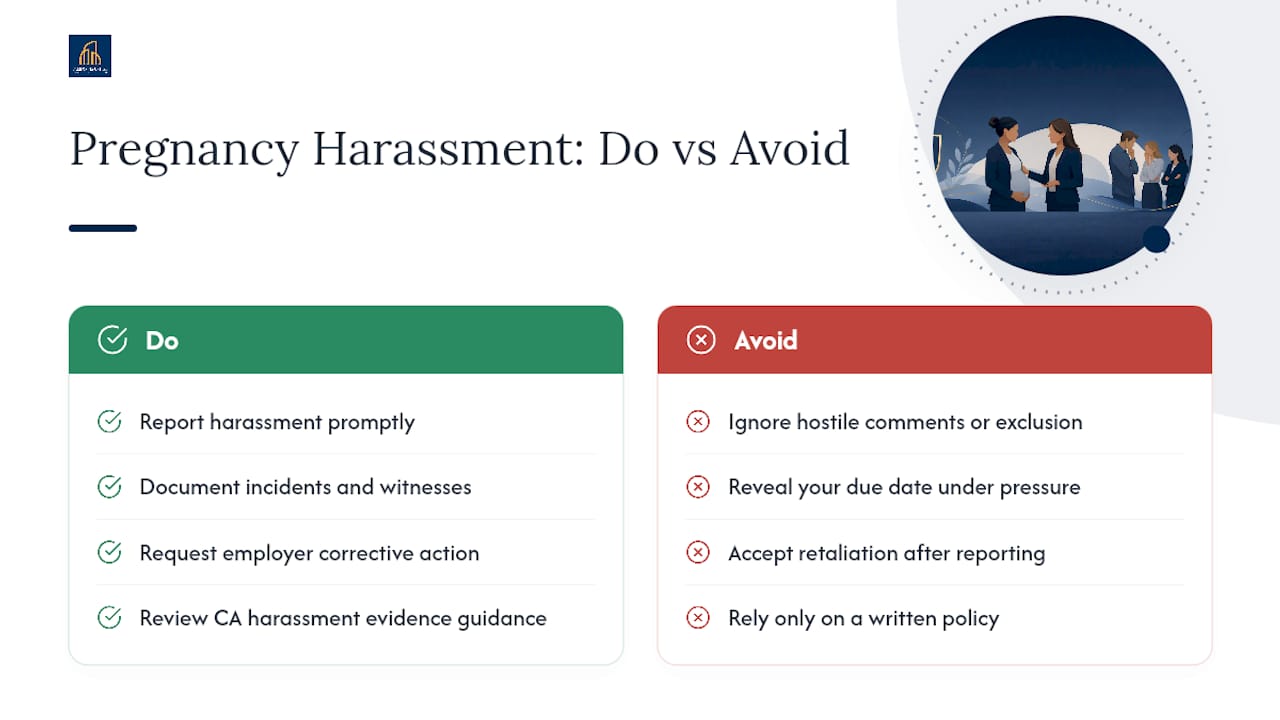
Examples include a supervisor repeatedly making comments about your “condition” affecting the team’s workload, coworkers excluding you from meetings once your pregnancy becomes visible, or a manager pressuring you to disclose your due date so they can “plan around” your absence in ways that feel invasive rather than administrative.
Employers have an affirmative obligation under FEHA to prevent and correct harassment, which means simply having an anti-harassment policy on paper isn’t enough. If you report harassment and nothing changes, or if the reporting itself triggers new mistreatment, that failure to act becomes part of your claim. Employees experiencing this kind of hostility often benefit from reviewing general guidance on how to prove workplace harassment in California, since much of the same evidence-gathering approach applies whether the harassment centers on pregnancy or another protected characteristic.
You’re Protected From Retaliation for Speaking Up
Retaliation protections exist precisely because employees often hesitate to report discrimination out of fear it will make things worse. California law generally prohibits employers from retaliating against employees for protected activity, which can include requesting accommodations, taking protected leave, reporting harassment, or filing an administrative complaint.
Retaliation can be obvious, like an abrupt termination right after you file a complaint, or subtler, such as a sudden schedule change, exclusion from projects you previously led, or a negative performance review that appears out of nowhere. Courts and agencies pay close attention to timing here too. An employee with a clean record for two years who receives a write-up within days of requesting a pregnancy accommodation may have a timeline worth examining closely.
If you believe you’re experiencing retaliation, the same documentation habits apply: save communications, track the timeline, and note who else witnessed the change in treatment. Reviewing workplace retaliation protections in California can help you understand what conduct qualifies and how these claims are typically evaluated alongside a discrimination complaint.
When to Talk to a Lawyer, and What to Expect
If you’ve been terminated, denied an accommodation, or noticed retaliatory treatment after disclosing a pregnancy, that’s generally when a consultation makes sense, not necessarily when you’re ready to sue. A typical intake conversation covers your timeline, what documentation you already have, and whether a filing deadline is approaching. These conversations are generally treated as confidential when they involve seeking legal advice, and many employment firms offer contingency-fee arrangements. If a case is handled on contingency, ask whether you may ever be responsible for litigation costs, case expenses, or other charges. None of this substitutes for individualized legal advice; every situation depends on its own facts.
— California United Law Group
Talk to California United Law Group About Your Torrance Case
California United Law Group offers Torrance employees a free, no-obligation case evaluation. In matters accepted on a contingency-fee basis, attorney fees are typically paid from a successful settlement or award, but clients should review the fee agreement carefully to understand whether they may be responsible for litigation costs or case expenses. That structure can make it easier for employees to have potential claims reviewed before important deadlines pass.
Before your consultation, gather what you can: emails referencing your pregnancy or accommodation requests, performance reviews, pay records, and the names of coworkers who witnessed relevant events. Filing deadlines with CRD and the EEOC can be shorter than employees expect, so reaching out sooner rather than later may help preserve options. You can review the firm’s Torrance employment law services or contact the team directly to schedule your evaluation.
Official Resources Worth Bookmarking
A few government resources are worth reading directly rather than relying solely on secondhand summaries. The CRD’s Pregnancy Disability Leave fact sheet and its complaint process page explain state filing procedures in detail. The EEOC’s pregnancy discrimination fact sheet covers federal protections, and the underlying legislative text behind the Pregnant Workers Fairness Act is available through Congress for readers who want the statutory language itself rather than a summary. Together, these sources give you the primary material regulators and courts actually rely on. Because filing deadlines and right-to-sue procedures can differ depending on the claim, employees should verify the current deadline that applies to their specific facts before waiting to file.
This article provides general information only and does not create an attorney-client relationship. It is not a substitute for advice from a qualified lawyer about your specific facts, deadlines, employer, and available claims.